
If you’re managing crypto assets, offshore companies can help protect your holdings while staying compliant with global regulations. Here’s what you need to know:
- Asset Protection: Jurisdictions like the Cook Islands and Nevis don’t recognize foreign judgments, making it harder for creditors to access your assets. Legal tools like trusts and multi-signature wallets add layers of security.
- Tax Efficiency: Offshore jurisdictions such as the British Virgin Islands (BVI), Cayman Islands, and Panama offer tax benefits like no capital gains tax or corporate tax on foreign income. However, U.S. investors must still report worldwide income to the IRS.
- Compliance: Meeting international standards like FATF‘s AML/KYC protocols and adhering to U.S. tax reporting (Forms 5471, 8938, FBAR) is critical to avoid penalties.
- Popular Structures: Options include International Business Companies (IBCs) for operations, Offshore Foundations for decentralized governance, and Limited Partnerships for investment funds.
- Costs: Setting up an offshore entity can range from $2,000 to $50,000+, depending on the structure and jurisdiction.
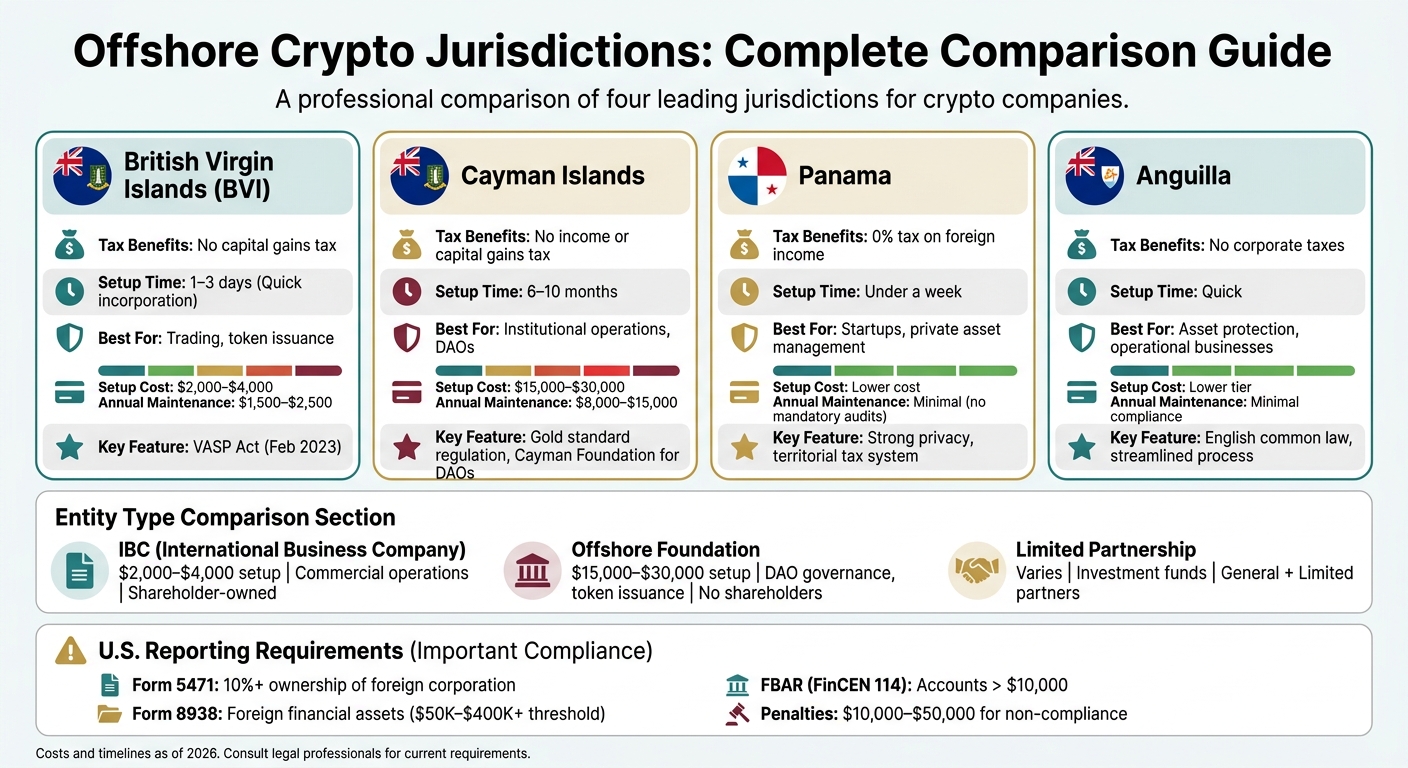
Quick Overview of Key Jurisdictions:
| Jurisdiction | Tax Benefits | Setup Time | Best For |
|---|---|---|---|
| BVI | No capital gains tax | 1–3 days | Trading, token issuance |
| Cayman Islands | No income or capital gains tax | 6–10 months | Institutional operations, DAOs |
| Panama | 0% tax on foreign income | Under a week | Startups, private asset management |
| Anguilla | No corporate taxes | Quick | Asset protection, operational businesses |
By choosing the right jurisdiction and structure, you can safeguard your assets, optimize taxes, and stay compliant with global regulations. Keep in mind that proper reporting and legal compliance are non-negotiable for U.S. investors.
Benefits of Using Offshore Companies for Crypto
Legal Protection Through Offshore Entities
Offshore companies provide a way to shield digital assets from the reach of domestic courts. For instance, jurisdictions like the Cook Islands and Nevis don’t require trustees or corporate managers to comply with U.S. garnishment or asset freeze orders. This becomes especially important when U.S. courts attempt to force individuals to hand over private keys under the threat of contempt charges.
These jurisdictions also don’t recognize foreign judgments, meaning creditors must start legal proceedings from scratch under local laws. In places like Nevis and the Cook Islands, creditors face a much higher burden of proof – "beyond reasonable doubt", the same standard used in criminal cases – compared to the civil "preponderance of evidence" standard in U.S. courts.
Additionally, duress and flight clauses can automatically shift control of assets to a foreign trustee if legal pressure arises. Multi-signature wallet setups further enhance protection; when an offshore trustee holds one of the required keys, domestic courts cannot compel the beneficiary to turn over assets since they lack majority signing authority.
These legal safeguards not only protect assets but also create a solid foundation for tax and operational benefits.
Tax Efficiency for Crypto Investments
Offshore jurisdictions such as Panama, Belize, and the Marshall Islands offer tax systems that are highly favorable for crypto investors. Many operate on a territorial tax basis or impose no corporate tax on foreign-sourced income. For example, the British Virgin Islands eliminate capital gains taxes altogether, making them an attractive option for both holding and active trading activities. This allows DeFi earnings, staking rewards, and token treasuries to grow without immediate tax burdens, enabling reinvestment.
While U.S. investors must still report their worldwide income to the IRS, offshore companies can provide tax deferral opportunities and greater flexibility for international operations. It’s crucial to distinguish between legal tax planning and tax evasion – compliance with reporting requirements like the FBAR and Form 8938 is essential to avoid penalties. These tax advantages, when paired with proper legal compliance, make offshore companies a strategic option for crypto investors.
Common Uses for Crypto Offshore Companies
Beyond tax and legal benefits, offshore structures simplify various operational aspects of managing crypto assets. For example, using an offshore company for wallet custody keeps assets off domestic exchanges, reducing exposure to subpoenas or freezes. Some jurisdictions, like the Marshall Islands, have even implemented specific legislation for Decentralized Autonomous Organizations (DAOs), combining tax benefits with modern governance frameworks.
Offshore companies are also popular for managing token treasuries, such as overseeing funds raised through ICOs in jurisdictions with clear regulatory guidelines. They streamline global payment processing, helping businesses avoid the high fees and tax complications often tied to domestic processors. Many also use auto-conversion tools to quickly convert crypto into fiat, minimizing volatility risks. These operational efficiencies align with the broader objective of reducing regulatory risks while optimizing legal and financial strategies.
sbb-itb-39d39a6
Best Offshore Jurisdictions for Crypto Companies
Picking the right offshore jurisdiction is a key step in managing and protecting your digital assets. Below, we explore four jurisdictions that stand out for their legal frameworks and tax-friendly environments for crypto companies.
British Virgin Islands (BVI)
The British Virgin Islands (BVI) has established itself as a crypto-friendly jurisdiction with the introduction of the Virtual Asset Service Providers (VASP) Act, effective February 1, 2023. This act requires digital asset service providers to register while offering tax neutrality and no corporate taxes on international income.
Setting up a company in the BVI is quick, taking just 1–3 days, though VASP registration may take 3–6 months. Government fees range from $5,000 for standard services to $10,000 for exchanges or custodial operations. Companies need at least two directors, and most standard entities are exempt from mandatory audits, reducing administrative workload.
The BVI Commercial Court has made strides in crypto asset protection. For instance, in the Torque Group Holdings Limited case, the court recognized crypto-assets as "assets or property", with ownership tied to private key control. Similarly, the ChainSwap v Persons Unknown case marked the court’s first freezing order against unidentified wallet owners, showcasing its evolving approach to tackling crypto-related fraud.
Cayman Islands
The Cayman Islands is a preferred choice for institutional crypto operations, offering a strong reputation and access to top-tier banking relationships. Governed by the Virtual Asset (Service Providers) Act and regulated by the Cayman Islands Monetary Authority (CIMA), the jurisdiction requires full licensing for trading platforms and custodians under its Phase 2 regulations, effective April 2025.
With no taxes on income, capital gains, or profits, the Cayman Islands provides complete tax neutrality for offshore businesses. Licensing can take 6–10 months, with fees for trading platform licenses starting at around $60,000 (CI$50,000). Companies must have at least three directors, including one independent director, and undergo local audits.
"The Cayman Islands has meticulously crafted a regulatory environment that is widely considered the gold standard for offshore financial services."
- Anastasia Marchenko, Legal Researcher, LegalBison
The Cayman Foundation Company is a standout option for DAOs, as it can function without members or owners, limiting liability for developers while ensuring protocol governance. Many advanced Web3 projects use a dual-entity setup, combining a Cayman Foundation Company for DAO treasury management with a BVI Business Company for operations and token issuance.
Panama
Panama appeals to crypto companies with its territorial tax system, which imposes 0% tax on foreign-sourced income, and its strong privacy protections with minimal disclosures. Unlike the BVI and Cayman Islands, Panama lacks a dedicated crypto licensing framework. Instead, crypto activities are governed by general commercial and anti–money laundering laws. This makes Panama an attractive option for projects that don’t deal with fiat currency conversions.
Remote company registration in Panama is fast, often completed in under a week. There are no mandatory audits, extensive reporting requirements, or minimum capital obligations, making it an affordable choice for startups and private asset managers.
Panama is ideal for traders and developers who value speed, privacy, and low costs over institutional banking access. However, the absence of crypto-specific licensing may be less appealing to companies seeking clear regulatory support to attract institutional investors.
Anguilla
Anguilla offers a tax-friendly setup with no corporate income tax, capital gains tax, or withholding tax on foreign-sourced income. It’s a practical option for crypto entrepreneurs looking for asset protection without the higher costs associated with more regulated jurisdictions. The legal framework allows for quick company formation while maintaining strong privacy protections for beneficial owners.
Comprehensive service packages in Anguilla cover filings, certifications, and banking introductions. Its streamlined incorporation process, low regulatory requirements, and absence of mandatory audits make it attractive for both holding structures and operational crypto businesses. Grounded in English common law, Anguilla provides reliable protections for asset custody and contracts, with minimal ongoing compliance.
These jurisdictions each offer distinct advantages, allowing crypto companies to find a legal structure that aligns with their specific business goals and operational needs.
Legal Structures for Offshore Crypto Companies
Choosing the right legal structure is a key step in protecting crypto assets, meeting regulatory requirements, and ensuring smooth operations. The main options include International Business Companies (IBCs), Offshore Foundations, and Limited Partnerships (LPs) – each tailored to different needs within the crypto world.
International Business Companies (IBCs)
IBCs are ideal for active crypto trading and everyday business operations. These shareholder-owned entities are designed for commercial purposes, making them a good fit for tasks like hiring developers, managing payroll, and signing contracts with vendors. Setting up an IBC typically costs between $2,000 and $4,000, with annual maintenance fees ranging from $1,500 to $2,500.
The BVI IBC is especially popular due to its quick setup (3–10 business days) and minimal ongoing administrative requirements. However, because IBCs are seen as profit-driven entities, they may not align well with projects aiming for decentralization, particularly when issuing tokens.
"A BVI Company is a shareholder-owned commercial entity, which means assets held inside it are technically owned by shareholders… This conflicts with how DAOs present themselves as neutral, decentralized systems."
- Spindipper Guides
For straightforward crypto trading or service-oriented businesses, an IBC offers a cost-effective and efficient solution. However, decentralized protocols may require a structure that better aligns with non-commercial governance.
Offshore Foundations
Offshore foundations are designed to support decentralized governance and non-commercial protocol management. These non-shareholder entities act as stewards for protocols or DAOs, rather than as commercial operators. As of early 2026, more than 1,700 Cayman Foundations have been registered, making them a leading choice for DAO governance.
Setting up a foundation is more expensive, with costs ranging from $15,000 to $30,000 and annual upkeep between $8,000 and $15,000. However, foundations signal to regulators and exchanges that the protocol is decentralized and not focused on profit-making.
Major crypto projects like Ethereum Name Service (ENS), dYdX, ssv.network, and Indigo Protocol have adopted Cayman Foundations for DAO governance and token issuance. Foundations are particularly useful for holding intellectual property, as they demonstrate that the protocol isn’t controlled by a commercial entity.
"A Cayman Foundation is usually the correct choice if your project intends to issue a utility or governance token and wants to minimize regulatory ambiguity."
- Spindipper Guides
While foundations are effective, they come with a heavier administrative workload. Economic substance requirements, such as appointing local directors and establishing a physical presence, add to the complexity. Legal structuring costs can range from $20,000 to $50,000, and fixing mistakes after token issuance might cost upwards of $200,000.
Limited Partnerships (LPs)
Limited partnerships are best suited for projects that require a clear distinction between management and investors. LPs are commonly used for investment funds and staking ventures, where the general partner handles operations, while limited partners contribute capital without direct involvement.
Many crypto projects combine multiple structures for flexibility. For example, a Cayman Foundation might oversee protocol governance and token issuance, while a BVI IBC handles commercial operations and staffing. This hybrid model is often considered the "gold standard" and costs between $20,000 and $35,000 to establish.
| Feature | International Business Company (IBC) | Offshore Foundation | Limited Partnership (LP) |
|---|---|---|---|
| Primary Use | Commercial operations, payroll, trading | Token issuance, DAO governance, IP holding | Investment funds, staking ventures |
| Ownership | Shareholders / Beneficial Owners | None (Purpose-driven) | General & Limited Partners |
| Setup Cost | $2,000–$4,000 | $15,000–$30,000 | Varies significantly |
| Maintenance | Simple | Complex administration | Complex (Fund accounting) |
| Exchange View | Often viewed as "equity-linked" | Preferred for decentralized tokens | Viewed as investment vehicle |
"Exchanges, regulators, and investors now expect to see a clear separation between protocol stewardship and commercial operations. Cayman Foundations exist largely to satisfy that expectation."
- Spindipper Guides
A common strategy is to start with a lower-cost BVI IBC to develop the product and later transition to a Cayman Foundation when token design and governance are finalized. This approach keeps initial costs manageable while allowing for proper governance structures before token issuance.
How to Set Up an Offshore Company for Crypto
Setting up an offshore crypto company involves careful planning, navigating regulations, and creating an infrastructure tailored to your crypto operations.
Selecting Your Jurisdiction
The first step is identifying your primary activity – whether it’s holding digital assets, running an exchange, issuing tokens, or managing a DAO. Each activity comes with its own regulatory requirements. Jurisdictions generally fall into four categories: Positive (clear regulations and licensing options), Restrictive (with limitations), Prohibitive (crypto is banned), or Unregulated (subject to sudden legal shifts). Additionally, local director requirements and reporting obligations often depend on the founders’ citizenship and tax residency.
"The right choice is a balance between strategic project goals and adherence to regulatory requirements."
- Digital & Analogue Partners
Banking compatibility is another critical factor. Some jurisdictions offer "bank recognizability" for crypto businesses, while others may experience frequent account closures. To avoid delays, it’s smart to start the bank account application process alongside company incorporation – especially in more cautious jurisdictions like the Cayman Islands.
Budget and timeline are also key considerations. Setting up a company can take anywhere from 4 to 12 weeks, with costs ranging from $2,000 to $10,000 for basic setups. In established hubs like the British Virgin Islands (BVI) or Cayman Islands, costs can rise to $50,000–$100,000. Meanwhile, onshore or EU licensing can take 6–12 months.
Once you’ve chosen your jurisdiction, the next step is forming your entity and ensuring compliance with local laws.
Company Formation and Compliance
After selecting a jurisdiction, the incorporation process begins. This typically involves creating a legal entity, such as an International Business Company (IBC) or an LLC, appointing directors, and disclosing beneficial ownership to regulators.
Compliance is a crucial part of the process. Appoint a Compliance Officer (or Money Laundering Reporting Officer, MLRO) and implement internal controls to meet FATF standards. These include Anti-Money Laundering (AML) and Know Your Customer (KYC) protocols.
Some jurisdictions require economic substance, meaning you may need a physical office and local employees. For instance, the BVI’s VASP Act, effective February 1, 2023, and the Cayman Islands’ strict enforcement of substance rules make these requirements non-negotiable for crypto businesses. Government fees also vary widely, from around $1,000 in the Cayman Islands to $5,000–$10,000 in the BVI.
Licensing and Infrastructure Setup
After incorporation and initial compliance, your focus shifts to obtaining the necessary licenses and setting up a secure operational framework.
Licensing requirements depend on your planned activities. Different authorizations cover services like exchange operations, custody, and payment processing. Offshore jurisdictions often process licenses in 4–12 weeks, significantly faster than the 6–12 months required for EU or onshore licenses.
Building a solid operational infrastructure is equally important. This includes implementing cybersecurity measures, transaction monitoring systems, and secure storage solutions. Some jurisdictions, like the Cayman Islands, even offer "sandbox" licenses, allowing companies to test new technologies under regulatory oversight. Additionally, most licensed VASPs are required to prepare annual audited financial statements.
"A regulated offshore crypto license can improve banking and payment service prospects, but account approval depends on bank risk policies."
- Gofaizen & Sherle
Share capital requirements for licensing can range from $50,000 to $800,000. While obtaining a license may boost your chances of securing banking services, final approval largely depends on your compliance measures and the risk tolerance of individual banks.
Compliance and Tax Optimization Strategies
Offshore crypto companies need to strike a balance between optimizing tax efficiency and adhering to regulatory requirements. These strategies go hand-in-hand with the asset protection measures discussed earlier. However, the distinction between lawful tax planning and illegal tax evasion is crucial – crossing that line can lead to severe penalties.
US Investor Reporting Obligations
For U.S. citizens and residents, crypto gains are subject to global taxation, even when held through offshore entities. If you own at least 10% of a foreign corporation, you’re required to file Form 5471. When U.S. shareholders collectively own more than 50% of the entity, it qualifies as a Controlled Foreign Corporation (CFC), triggering Subpart F and GILTI tax rules.
"Form 5471 is an information return, not just a tax return. The IRS requires you to report the existence and financial status of the corporation even if it had zero income, operated at a loss, or was entirely dormant." – Josh Katz, CPA
Other forms may also apply:
- Form 8621: For offshore crypto funds.
- Form 8938: For foreign financial assets.
- FinCEN Form 114 (FBAR): For hybrid accounts holding both crypto and fiat, if thresholds are met.
Penalties for non-compliance are steep. Failure to file Form 5471 starts at $10,000 per form, per year, escalating to $50,000 for continued violations. Civil FBAR penalties can reach 50% of the highest account balance annually.
A high-profile case involved Roger Ver, nicknamed "Bitcoin Jesus", who entered a deferred prosecution agreement with the U.S. Department of Justice and IRS in October 2025. Ver admitted to failing to report and pay taxes on approximately $240 million in Bitcoin held via foreign entities. He resolved the charges by paying $50 million in back taxes, penalties, and interest.
These stringent reporting rules pave the way for broader compliance frameworks, such as those enforced by FATF.
Meeting FATF Standards
The Financial Action Task Force (FATF) mandates offshore Virtual Asset Service Providers to adopt strong Anti-Money Laundering (AML) and Know Your Customer (KYC) protocols, along with effective transaction monitoring systems.
A survey by FATF revealed that 83% of jurisdictions already require crypto service providers to be licensed or registered. Special attention is directed at peer-to-peer stablecoin transfers and unhosted wallets, which regulators view as significant AML gaps. Ensuring complete transparency on beneficial ownership is critical to avoiding sanctions violations.
"Some offshore firms exploit gaps and differences in regulatory and supervisory coverage, making it harder for authorities to monitor activity and enforce Anti-Money Laundering (AML) and Counter-Terrorist Financing rules." – Financial Action Task Force (FATF)
Additionally, the U.S. and over 70 other countries are aligning with the OECD‘s Crypto-Asset Reporting Framework (CARF). By 2029, the U.S. plans to incorporate CARF into domestic law, enabling automatic data sharing between foreign crypto exchanges and the IRS.
"Once CARF data begins flowing, mismatches will be detected automatically, potentially resulting in very expensive problems." – Virginia Jeker, US International Tax Specialist
While AML and KYC protocols address compliance, tax strategies are equally important to stay on the right side of the law.
Legal Tax Planning vs. Tax Evasion
Effective tax planning involves selecting jurisdictions with territorial taxation systems, such as the British Virgin Islands or Cayman Islands, where foreign-sourced income isn’t taxed locally. However, U.S. reporting obligations must still be met. Foreign tax credits can also help offset U.S. tax liabilities on income already taxed abroad.
Tax evasion, on the other hand, involves concealing assets or failing to report income. If past reporting years were missed, the IRS offers amnesty programs:
- Streamlined Filing Compliance Procedures: For non-willful errors.
- Voluntary Disclosure Program: For willful non-compliance.
It’s essential not to skip addressing prior non-compliance before filing current reports, as doing so could draw IRS scrutiny.
| Reporting Requirement | Trigger/Threshold | Form Used |
|---|---|---|
| Foreign Corporation Reporting | 10% or more ownership/control | Form 5471 |
| Passive Foreign Investment Co. | Investment in foreign crypto funds/ETFs | Form 8621 |
| Foreign Financial Assets (FATCA) | $50,000–$400,000+ depending on residency | Form 8938 |
| Foreign Bank/Hybrid Accounts | Aggregate value > $10,000 at any time | FinCEN Form 114 (FBAR) |
When transferring crypto into an offshore structure, ensure you document the transaction properly – whether as a gift or a capital contribution – to establish a clear legal trail. Also, keep in mind that while pure crypto accounts may not currently require FBAR reporting, hybrid accounts holding both crypto and fiat must be reported if they exceed $10,000.
Conclusion
Setting up offshore companies to manage digital assets involves balancing three key factors: asset protection, tax efficiency, and regulatory compliance. Jurisdictions like the British Virgin Islands, Cayman Islands, Panama, and Anguilla provide crypto-friendly policies and territorial tax systems. However, the best choice depends entirely on your specific investment goals and risk tolerance.
One effective approach is using hybrid structures, such as an offshore trust owning an LLC. These arrangements offer added security by making it legally impossible to comply with certain demands – foreign trustees outside U.S. jurisdiction cannot be compelled to hand over private keys. Additionally, multi-signature wallets add another layer of protection by ensuring no single party has full control over your assets.
It’s important to note that offshore structures are intended to protect assets and optimize taxes – not to avoid tax obligations. U.S. investors are required to meet all IRS reporting standards to stay within the law.
These strategies not only safeguard your holdings but also simplify their management. Global Wealth Protection helps clients navigate these complexities with tailored solutions, including selecting the right jurisdiction, structuring trust-owned LLCs with flight clauses, and setting up multi-signature governance systems. By acting proactively and maintaining thorough documentation, you can protect your offshore crypto assets while ensuring full compliance with regulations.
FAQs
Which offshore structure fits my crypto use case?
The ideal offshore structure largely depends on what you’re aiming to achieve – whether it’s asset protection, regulatory compliance, or something else. One popular choice is combining an offshore trust with an LLC. This setup provides solid legal protection, professional management, and allows you to maintain control over your assets.
Another option? Setting up an offshore company in a jurisdiction that’s friendly to cryptocurrency. This can be particularly useful for trading, investing, or running a crypto-related business.
To ensure the structure aligns with your specific goals, it’s essential to consult a legal expert who can guide you through the process.
Will an offshore company reduce my U.S. crypto taxes?
No, setting up an offshore company typically won’t lower your U.S. crypto taxes. The U.S. tax system requires individuals to report and pay taxes on their worldwide income, which includes any earnings from cryptocurrency, even if those holdings are kept offshore. In other words, your crypto profits are still taxable no matter where they’re located.
Do I need a VASP license for what I’m doing?
Whether you need a Virtual Asset Service Provider (VASP) license depends entirely on the nature of your activities involving digital assets. Typically, this license is required if you engage in services such as exchanging, transferring, or managing virtual assets on behalf of others. However, if you’re simply holding or investing in digital assets for personal purposes without offering services to third parties, you might not need one. It’s always a good idea to consult legal professionals to make sure you’re following local regulations.
