
Asia offers several residency programs tailored for entrepreneurs and investors looking to establish a presence in the region. These programs provide access to thriving economies, tax advantages, and simplified visa processes. Here’s a quick breakdown of five key options:
- Singapore Global Investor Program (GIP): Permanent residency with a minimum investment of $7.8M. Ideal for high-net-worth individuals.
- Singapore EntrePass: For startup founders with innovative business ideas. Requires a smaller financial commitment and offers a pathway to residency.
- Malaysia Tech Entrepreneur Programme (MTEP): Flexible options for tech entrepreneurs and investors, with residency durations of 1–5 years.
- Hong Kong Investment as Entrepreneurs: Focuses on businesses contributing to Hong Kong’s economy. Permanent residency available after 7 years.
- Thailand Investor Visa: Requires a $300,000 investment in approved assets. Offers annual residency renewals but no path to permanent residency.
These options vary in investment requirements, residency duration, and long-term benefits. Choose the program that aligns with your business goals, financial resources, and lifestyle preferences.
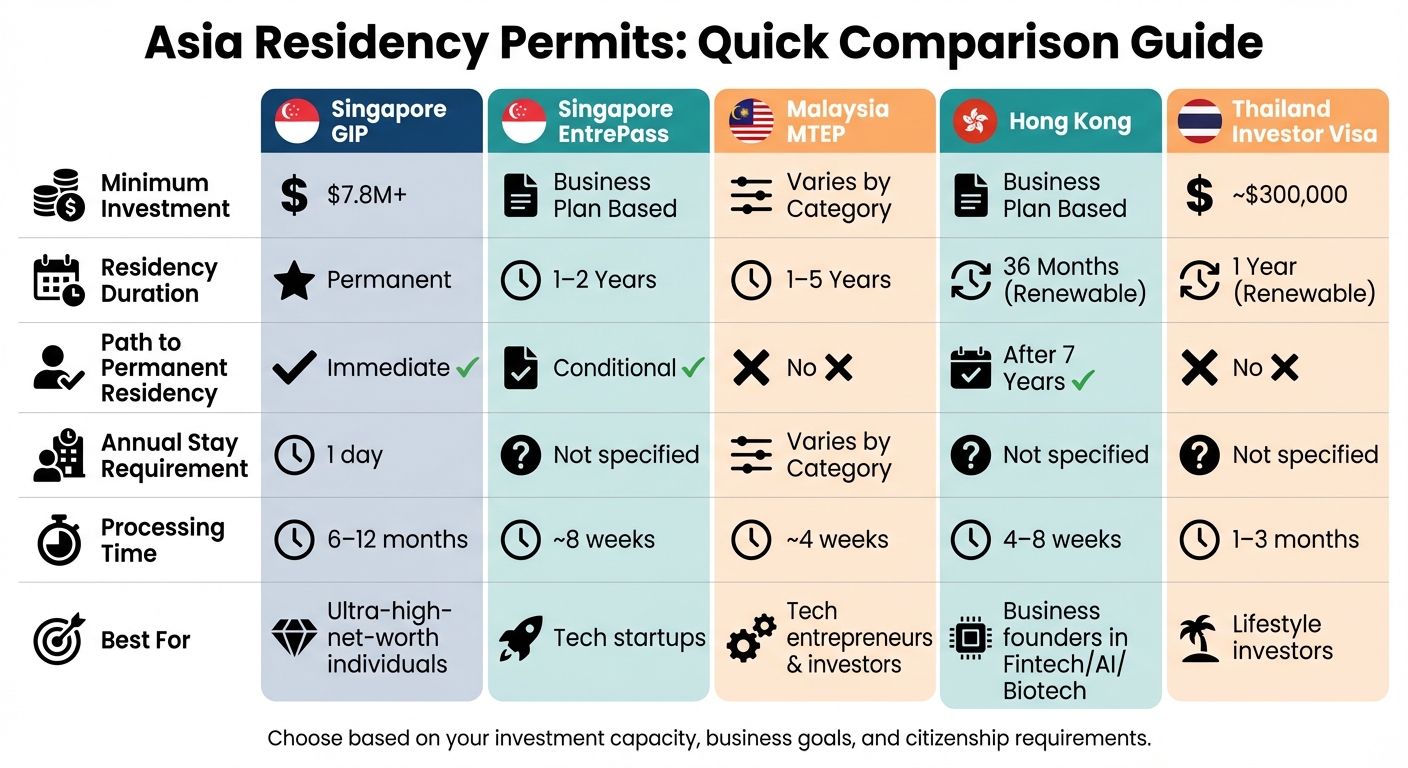
Quick Comparison
| Program | Min. Investment (USD) | Duration | Path to PR | Annual Stay Requirement |
|---|---|---|---|---|
| Singapore GIP | $7.8M+ | Permanent | Immediate | 1 day |
| Singapore EntrePass | Business Plan Based | 1–2 Years | Conditional | Not specified |
| Malaysia Tech Entrepreneur | Varies by Category | 1–5 Years | No | Varies by Category |
| Hong Kong Entrepreneurs | Business Plan Based | 36 Months (Renew) | After 7 Years | Not specified |
| Thailand Investor Visa | ~$300,000 | 1 Year (Renewable) | No | Not specified |
Each program caters to different needs, from high-capital investments to startup-friendly options. Evaluate your priorities – whether it’s immediate residency, tax benefits, or long-term growth – to find the best fit for your objectives.
1. Singapore Global Investor Program
The Global Investor Programme (GIP) is Singapore’s premier residency option tailored for ultra-high-net-worth individuals. This program provides a direct pathway to permanent residency for those who meet stringent financial and business criteria.
Eligibility Requirements
To qualify, applicants must demonstrate a solid entrepreneurial track record spanning at least three years. Additionally, their company should report an annual turnover of at least $38.3 million (SGD 50 million) on average over three years, with a minimum 30% ownership for privately held businesses.
Investment or Business Setup Costs
The GIP offers three distinct investment pathways:
- Option A: Invest $7.7 million (SGD 10 million) in a Singapore-based business, with the commitment to create 30 jobs by year five (15 of which must be for Singaporeans).
- Option B: Allocate $19.2 million (SGD 25 million) into a GIP-approved fund that focuses on Singapore-based companies.
- Option C: For family offices, maintain $153.4 million (SGD 200 million) in assets under management, with at least $38.3 million (SGD 50 million) deployed into approved local investments, such as MAS-licensed exchanges or private equity in Singaporean businesses.
In addition to these investment requirements, applicants must pay a processing fee of $4,330 (SGD 5,650), a government fee of $54 (SGD 70), and a certificate issuance fee of $115 (SGD 150).
Application Process and Timeline
The GIP application involves six key steps:
- Submit audited financial statements, a detailed business plan, and pay the processing fee.
- Attend an interview to present and discuss your investment strategy.
- Receive Approval-in-Principle (AIP) status, valid for six months, during which the required investment must be made.
- Provide proof of your investment to secure final permanent residence approval.
- Formalize your permits within 12 months of receiving final approval.
- Overall, the process takes about 6 to 12 months, with the initial application review typically completed within eight weeks.
This structured and efficient process ensures a smooth journey toward securing permanent residency.
Key Benefits for Entrepreneurs and Investors
The GIP offers immediate permanent residency, with the opportunity to apply for citizenship after two years. Singapore’s tax system is highly attractive, featuring a 24% income tax cap and no taxes on capital gains, inheritance, or wealth. Additionally, the Singapore passport grants visa-free access to 194 countries. Residency extends to your spouse and minor children, with Long-Term Visit Pass options available for parents and adult children. These benefits not only protect your wealth but also provide a strategic base to grow your business presence in Asia.
sbb-itb-39d39a6
2. Singapore EntrePass
The EntrePass offers a way for entrepreneurs to step into Singapore’s business landscape without needing the large financial commitments typical of investor programs. It’s designed for those aiming to establish or who have recently started a startup in Singapore.
Eligibility Requirements
To qualify, applicants must be at least 18 years old and hold a 30% equity stake in a private limited company registered with ACRA. The company should be under six months old at the time of application – or you can apply before registering it. However, the business must be innovative or venture-backed. Traditional ventures like coffee shops, bars, or massage parlors are not eligible.
Applicants also need to meet at least one of these conditions:
- Entrepreneurs: Must have raised at least $76,650 (SGD 100,000) from a government-approved venture capital firm or be part of a recognized startup accelerator.
- Innovators: Should own intellectual property registered with a recognized authority or have an active research partnership with a Singaporean university.
- Investors: Must show a proven track record of investing in and scaling successful businesses.
This streamlined approach ensures applicants are well-prepared to dive into Singapore’s startup ecosystem.
Investment or Business Setup Costs
The total official fees for the EntrePass come to about $276, covering:
- Application fee: $80 (SGD 105)
- Pass issuance fee: $172 (SGD 225)
- Visa fee (if needed): $23 (SGD 30)
Additionally, entrepreneurs should budget for company registration costs and meet the $76,650 (SGD 100,000) startup funding requirement if applying under the entrepreneur track.
Application Process and Timeline
Applications are submitted via the Employment Pass eService. Processing typically takes around eight weeks. Once approved, you’ll receive an In-Principle Approval (IPA) letter, which serves as a six-month single-entry visa. To finalize your EntrePass, you can complete the process online through Singpass or in person at the Employment Pass Services Centre. The physical EntrePass card will be delivered to your Singapore address within five working days.
Key Benefits for Entrepreneurs and Investors
The EntrePass is initially valid for one year and can be renewed for up to two years based on business performance. It also provides a pathway to apply for Singapore Permanent Residency. EntrePass holders can bring their spouse and children to Singapore once certain business spending and local hiring criteria are met. Open to all nationalities, the program connects entrepreneurs to Singapore’s dynamic tech startup scene, offering opportunities for networking, fundraising, and collaboration. It’s a strong gateway to tapping into regional business opportunities while safeguarding assets.
3. Malaysia Tech Entrepreneur Programme
The Malaysia Tech Entrepreneur Programme (MTEP), managed by MDEC, provides tech entrepreneurs and investors with a straightforward way to enter Malaysia’s booming digital economy. The program is divided into four distinct tracks, each designed with specific requirements and residency options to suit different types of applicants.
Eligibility Requirements
Applicants can choose from one of four categories:
- New Tech Entrepreneurs: Open to those with just a tech business idea and up to two co-founders.
- Experienced Tech Entrepreneurs: Requires over two years of business operations.
- Tech Investors: Applicants must have a minimum of $2,422,000 (RM 10 million) in funds and be registered with the VCMC.
- Senior Management Professionals: Requires at least seven years of leadership experience and an annual base salary of $43,596 (RM 180,000).
All applicants must align their business focus with Malaysia’s priority sectors, such as AgriTech, HealthTech, FinTech, Artificial Intelligence, Blockchain, Cyber Security, and Big Data Analytics. These categories ensure that applicants contribute to Malaysia’s targeted economic growth areas.
Investment or Business Setup Costs
For New and Experienced Tech Entrepreneurs, the focus is on the business’s viability rather than a fixed investment amount. However, Tech Investors and Senior Management professionals must meet specific financial criteria to qualify.
Application Process and Timeline
Applications can be submitted through MDEC’s online portal. The process typically takes about four weeks for approval. Once approved, applicants need to visit the eXpats Service Centre in Cyberjaya for passport endorsement. The final pass is issued by the Malaysian Immigration office approximately one week after the applicant’s arrival in the country.
Key Benefits for Entrepreneurs and Investors
The program offers tailored benefits depending on the applicant’s category:
- New Tech Entrepreneurs: Receive a renewable one-year Professional Visit Pass, contingent on first-year performance.
- Experienced Entrepreneurs, Investors, and Senior Management: Qualify for a five-year Resident Pass, which includes dependent privileges, allowing applicants to bring their spouse and children.
The five-year Resident Pass provides a stable foundation for those looking to establish significant business operations or manage investments in Malaysia’s growing tech ecosystem. This program stands as a streamlined residency option, offering a strategic base for entrepreneurs and investors in Asia.
4. Hong Kong Investment as Entrepreneurs
Hong Kong offers an appealing residency pathway for entrepreneurs through its Investment as Entrepreneurs program. This visa is tailored for business founders aiming to establish their ventures in Hong Kong’s pro-business environment. Unlike other programs that require a fixed investment amount, this option focuses on the overall economic impact of your business, making it accessible to entrepreneurs with varying levels of capital and across different industries.
Eligibility Requirements
To qualify, applicants need to demonstrate that their business will significantly contribute to Hong Kong’s economy. This involves submitting a detailed, two-year business plan that includes market analysis, sales projections, and financial forecasts. The Hong Kong Immigration Department currently prioritizes businesses in high-growth fields such as Fintech, AI, Biotech, and ESG (Green Tech).
Some key requirements include:
- Hiring 1–2 local employees in the first year, with plans to expand to 3–5 employees in the second year.
- Securing a physical office space; co-working spaces are acceptable, but residential addresses are not.
- Nominating a local sponsor, which can be either a company or an individual resident aged 18 or older.
- Holding a university degree (though exceptions may be made for founders with outstanding credentials).
Startups accepted into government-backed programs like Cyberport or the Hong Kong Science and Technology Parks (HKSTP) can benefit from a streamlined "Green Channel", which tends to have higher approval rates.
Investment or Business Setup Costs
While there’s no official minimum investment requirement, applicants must show sufficient personal funds and inject capital into their Hong Kong company’s bank account. Typical capital injections range from $64,000 to $128,000 (HK$500,000 to HK$1,000,000). The visa application fee is around $24 (HK$190) per person, and incorporating a company via electronic filing costs approximately $198 (HK$1,545).
Application Process and Timeline
The application process typically takes four to eight weeks. Successful applicants are granted an initial stay of 36 months. After seven years of continuous residence, candidates may apply for permanent residency. It’s essential to ensure that all capital injections have clear audit trails, as authorities are increasingly scrutinizing the source of funds.
Key Benefits for Entrepreneurs and Investors
Hong Kong’s tax system is straightforward, with a corporate tax rate of 16.5% and a reduced rate of 8.25% on the first $256,000 (HK$2 million) of profit. There’s no capital gains tax, allowing founders to retain all their exit proceeds. Additionally, entrepreneurs can sponsor their spouse and unmarried children under 18. Spouses are also permitted to work without needing a separate employment visa. These advantages, combined with Hong Kong’s prime location for accessing Asian markets, make it an ideal hub for entrepreneurs looking to grow their regional operations.
5. Thailand Investor Visa
Thailand provides various residency options tailored to different types of investors. Remote workers can also explore the Thailand Digital Nomad Visa for a different path. The Standard Investment Visa requires a minimum investment of 10 million THB (around $300,000) in approved assets like newly built condominiums purchased directly from developers, Thai government bonds, or fixed deposits in Thai banks. You can also combine these investment categories to meet the threshold. For those looking for a lower investment requirement, Thailand introduced the Property Pathway in October 2025, reducing the minimum investment to 3 million THB for specific real estate options. These include completed freehold condominiums registered after October 1, 2020, or high-value residential rentals with monthly rents of at least 85,000 THB. This pathway provides a more accessible option for investors while still offering strong asset protection opportunities in Asia.
Eligibility Requirements
The Standard Investment Visa is available to anyone with the required financial resources. If you’re considering the Long-Term Resident (LTR) Visa under the Wealthy Global Citizen category, you’ll need to meet these criteria: $1 million in assets, an annual income of $80,000 over the past two years, and a $500,000 investment in Thai property, government bonds, or direct foreign investment. Most long-term visas also require health insurance with at least $50,000 in coverage or a bank deposit of $100,000. Notably, the LTR visa allows same-sex spouses as eligible dependents, reflecting Thailand’s recognition of same-sex marriage starting in 2026. Both the LTR and standard investment visas permit dependents, including spouses and children under 20 years old.
Investment or Business Setup Costs
Investing 10 million THB can secure you about 807 square feet of property in Bangkok or a similar-sized condo with ocean views in Phuket. The Property Pathway involves a one-time fee of 4,000 THB, an annual service fee of 27,000 THB, and legal assistance starting at 12,000 THB. For the LTR Visa, the cost is 50,000 THB (approximately $1,600) for a 10-year multiple-entry visa, plus an additional 3,000 THB annually for a digital work permit. Unlike the Thailand Elite Visa, where membership fees are non-recoverable, the Investor Visa allows you to put your funds into tangible assets like real estate or bonds, which can appreciate in value or be liquidated.
Application Process and Timeline
The application process requires strict adherence to fund transfer guidelines. Funds must be transferred directly from your foreign account to the seller’s Thai account to obtain the necessary FET form. Using intermediaries can disqualify your application, so direct transfers are crucial. Approved applicants initially receive a 90-day visa. Before its expiration, you must visit immigration with the required documents to extend it to a one-year visa. Annual renewals must be completed within two weeks of the visa’s expiration date at a Thai immigration office.
Key Benefits for Entrepreneurs and Investors
Thailand’s investor visa offers several perks that make it attractive for entrepreneurs and investors. The LTR visa features a flat 17% personal income tax rate for highly skilled professionals, a significant reduction from the usual progressive rates of up to 35%. Additionally, LTR holders are exempt from the standard requirement of hiring four Thai employees per foreign worker. Reporting requirements are also simplified, with only one report needed per year instead of every 90 days. For those holding Business or Property Investment Visas, permanent residency may become an option after three to five years of compliance. However, Thailand imposes an annual cap of 100 PR grants per country. With its goal of attracting one million affluent or skilled foreign residents over five years, Thailand is positioning itself as a key destination for investors and entrepreneurs in Southeast Asia.
Comparison of Asia Residency Permits
When choosing a residency program, it’s essential to weigh factors like investment requirements, business objectives, and long-term plans. Singapore’s Global Investor Program (GIP) stands out for its high capital threshold, offering immediate permanent residency upon approval. In contrast, the Singapore EntrePass focuses on the viability and scalability of your business idea, making it a suitable choice for tech entrepreneurs who may lack significant initial capital.
Malaysia’s Tech Entrepreneur Programme provides a flexible, tiered structure catering to both new entrepreneurs and high-net-worth investors with funds of $2,422,000 (RM 10 million). This program offers residency durations ranging from one to five years but does not lead to citizenship. Meanwhile, Hong Kong’s Investment as Entrepreneurs program emphasizes economic contributions rather than fixed investment amounts. It offers a pathway to permanent residency after seven years of continuous residence. Thailand’s Investor Visa requires an investment of 10 million Baht (around $300,000) and grants renewable one-year residency without a route to permanent residency.
Physical presence requirements vary widely. For instance, Singapore’s GIP requires just one day per year to maintain residency, while Malaysia’s program has category-specific mandates. Processing times also differ: Singapore’s EntrePass and Thailand’s Investor Visa are typically processed within 1 to 3 months, while the GIP takes about 6 months. Below is a table summarizing the key criteria for these residency options:
| Program | Min. Investment (USD) | Duration | Path to PR | Annual Stay Requirement |
|---|---|---|---|---|
| Singapore GIP | $7.8M+ | Permanent | Immediate | 1 day |
| Singapore EntrePass | Business Plan Based | 1–2 Years | Conditional | Not specified |
| Malaysia Tech Entrepreneur Programme | Varies by Category | 1–5 Years | No | Varies by Category |
| Hong Kong Investment as Entrepreneurs | Business Plan Based | 36 Months (Renewable) | After 7 Years | Not specified |
| Thailand Investor | ~$300,000 | 1 Year (Renewable) | No | Not specified |
Family inclusion policies are another aspect to consider. Most programs allow spouses and children as dependents. Malaysia’s Tech Entrepreneur Programme, however, extends dependent benefits primarily to applicants under specific categories, particularly those with the five-year Resident Pass.
Conclusion
Selecting the right residency program depends on your financial resources, business goals, and long-term vision. For instance, Singapore’s Global Investor Program offers immediate permanent residency and a route to citizenship, while the EntrePass is tailored for startups with strong potential. Malaysia’s Tech Entrepreneur Programme provides a more accessible entry point with lower thresholds and longer residency options. If your focus is on accessing Chinese markets, Hong Kong’s Investment as Entrepreneurs program could be the right fit, offering permanent residency after seven years. Meanwhile, Thailand’s Investor Visa is an attractive choice for those prioritizing lifestyle, though it doesn’t lead to permanent residency or citizenship.
Each program has its own advantages, whether you’re aiming for quick residency, tax benefits, or flexible business conditions. Factors like processing times, physical presence requirements, and family inclusion policies vary, so be sure to consult the comparison table in the earlier section for detailed information.
Ultimately, your choice will depend on whether your priority is immediate residency, building an active business, or securing a long-term stay. Think about your tax planning, the need for work rights, and whether a citizenship pathway is essential for you. Use the comparison table to identify the program that aligns best with your objectives in Asia.
FAQs
Which program is fastest to get approved?
The Thailand residence by investment program stands out for its speed, typically taking around 6 to 12 months to process. Its reputation for a straightforward application process and quick approval makes it a favored option among entrepreneurs and investors looking for a fast path to residency in Asia.
Do I need to live there to keep the permit?
In many cases, maintaining a residency permit doesn’t require you to live in the country full-time, but the specifics depend on the program. For instance, Thailand’s temporary visa needs renewal every 24 months, provided there’s active business activity. Similarly, Hong Kong’s investment visa mandates ongoing business operations. Some programs even pave the way to permanent residency if certain conditions – like continuous residency or meeting tax obligations – are fulfilled.
Can my spouse and kids be included?
Residency permits in many Asian countries, such as Thailand and Singapore, typically allow applicants to include their spouse and children in the application process. These programs are structured to support family relocation, ensuring that families can move together more seamlessly.
