
Form 3520 is a mandatory IRS document for U.S. persons (citizens, residents, and certain entities) to report:
- Distributions from foreign trusts (even small amounts like $500).
- Foreign gifts exceeding $100,000 in a tax year.
It’s not a tax form but a disclosure to ensure transparency in foreign financial activities. Non-compliance can result in steep penalties, starting at $10,000 or up to 35% of the unreported amount.
Key Points:
- Who Must File: U.S. persons receiving foreign trust distributions or large gifts.
- What to Report: Trust distributions, indirect benefits, and foreign gifts above thresholds.
- Penalties: Up to 35% of unreported amounts or 25% of unreported gifts.
- Common Mistakes: Misclassifying transactions, missing deadlines, or incomplete details.
- Best Practices: Maintain detailed records, use accurate exchange rates, and seek professional advice for complex cases.
Compliance is critical to avoid fines and IRS scrutiny. Always file Form 3520 on time and with accurate information.
Key Sections of Form 3520 for Beneficiaries
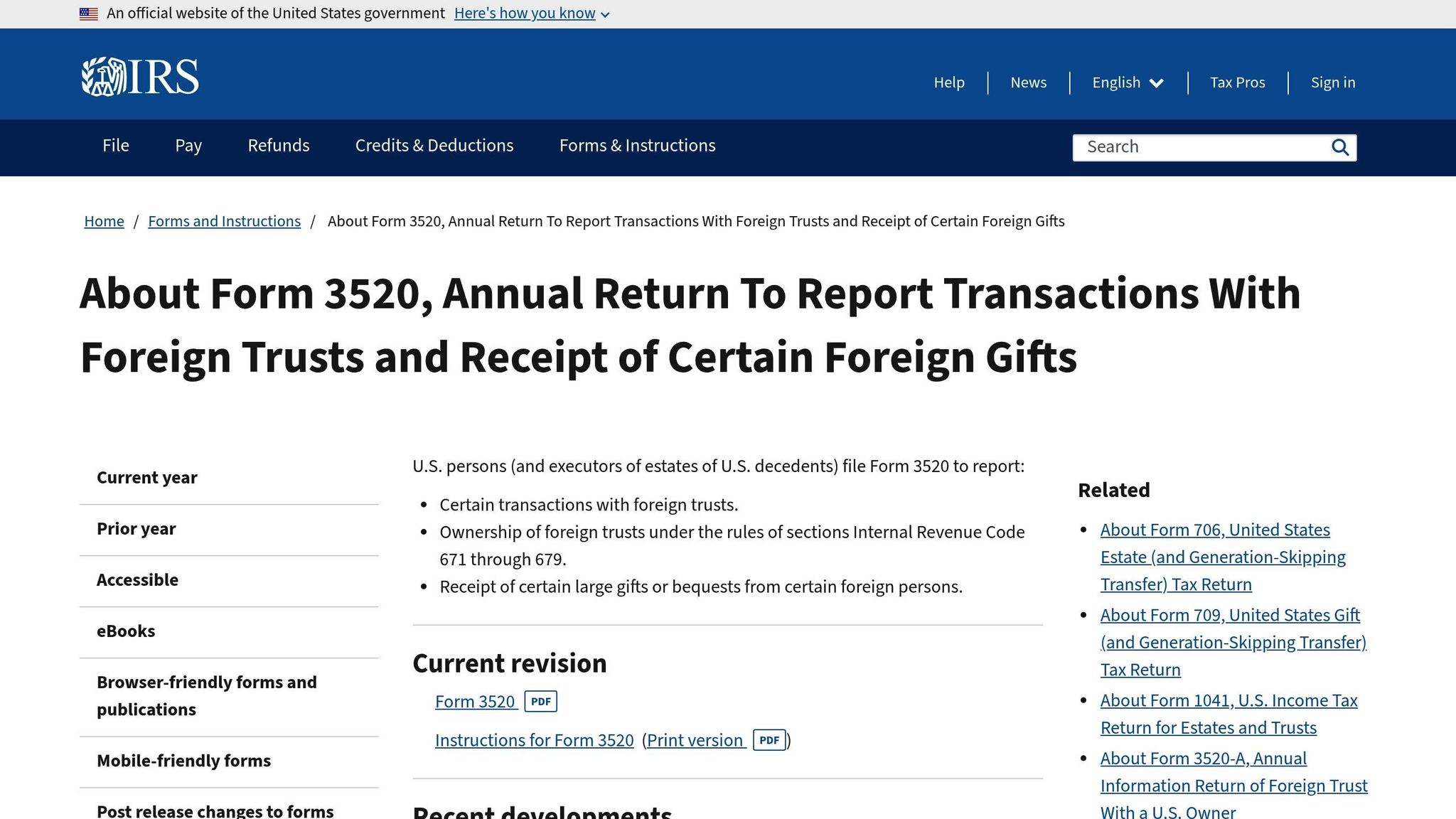
Form 3520 has several parts, but beneficiaries primarily focus on two sections that directly influence their reporting duties. Understanding these sections is crucial for accurate reporting and avoiding potential IRS penalties. Here’s what you need to know about reporting trust distributions and large foreign gifts.
Part 3: Reporting Distributions from Foreign Trusts
Part 3 is where you report any distributions received from foreign trusts during the tax year. This section requires detailed information about each distribution, no matter the amount or type.
- Include the trust’s name, country, trustee’s contact information, exact distribution dates, and the fair market value in U.S. dollars at the time of receipt.
- Separate current distributions (income earned this year) from accumulation distributions (income from prior years, which may be subject to throwback rules).
- Maintain all supporting documents, such as trust statements, trustee correspondence, and records that clarify whether the distribution is income or principal. Organize these by tax year and distribution date for easy access in case of an IRS audit.
- Convert distributions made in foreign currency to U.S. dollars using the exchange rate from the receipt date. Be sure to document the rate and your calculations.
- Report any indirect benefits provided by the trust, such as educational expenses, medical costs, or property, at their fair market value.
Once you’ve addressed trust distributions, the next step is reporting large foreign gifts.
Part 4: Reporting Large Foreign Gifts
Part 4 focuses on reporting foreign gifts when the total value of gifts received during the tax year exceeds $100,000. This section requires thorough details about both the gift and the donor.
- Record the fair market value of each gift in U.S. dollars at the time of receipt. For non-cash gifts, like real estate, artwork, or securities, you may need a professional appraisal. A gift is considered "received" when you gain control of the asset.
- Provide complete donor information: for individuals, include their name, address, and relationship to you; for entities, list their name, country, and principal address. If there are multiple donors, report each one separately.
- Combine the value of all foreign gifts received during the year. If the total exceeds $100,000, you must report them.
- Distinguish inheritances from lifetime gifts, as they follow similar reporting rules but require additional clarification. Include supporting documents like probate records or estate paperwork.
- Avoid double-reporting. Distributions from a foreign trust (covered in Part 3) are not considered gifts unless the initial trust funding qualifies as a reportable gift.
- Keep detailed records for each gift, including its source, value, and your relationship to the donor. Documentation such as gift letters, transfer records, appraisals, and – for inheritances – wills, death certificates, and estate records may be required.
These sections are essential for complying with IRS requirements and ensuring accurate reporting of foreign trust distributions and gifts. Proper documentation and attention to detail are key to avoiding any issues.
Common Errors and Filing Best Practices
Filing Form 3520 correctly can feel like navigating a maze of IRS rules. Even small mistakes can lead to hefty penalties or trigger audits. By understanding common pitfalls and sticking to smart filing habits, you can save yourself from unnecessary headaches.
Frequent Mistakes to Avoid
One of the biggest missteps is misclassifying distributions versus gifts. Always report trust distributions in Part 3 and gifts in Part 4. Gifts should only appear in Part 4 if they come from an individual or entity outside a trust and exceed the $100,000 annual threshold.
Another frequent issue is using incorrect exchange rates. The IRS requires you to use the exchange rate from the transaction date, and you need to document the source, such as the Federal Reserve. Stick to the Federal Reserve‘s daily exchange rates or another reliable source, and keep a record of the rates you apply to each transaction.
Incomplete beneficiary and donor information is a common red flag. Leaving out trustee contact details, providing partial addresses for foreign donors, or failing to specify your relationship to the gift giver can delay processing or even result in penalties. The IRS relies on complete information to verify your filings.
Missing deadlines is another avoidable error. Failing to file by April 15th is more common than you’d think. Form 3520 follows the same deadline as your individual tax return, and there’s no automatic extension. If you need more time, you must explicitly request an extension.
Beneficiaries also often fail to report indirect benefits, such as payments made on their behalf, which should be reported at their fair market value. Additionally, double-counting transactions – reporting the same transaction in multiple sections of the form – is another error that can complicate your filing. Each transaction should appear only once in its correct section.
Avoiding these mistakes is key to staying compliant.
Best Practices for Compliance
To file Form 3520 accurately, follow these practical tips:
- Keep detailed records for at least six years. Don’t wait until tax season to gather information. Create a dedicated file for all trust-related documents, including correspondence, receipts, and supporting evidence for distributions or gifts. For non-cash gifts like artwork or real estate, obtain professional appraisals and document their value.
- Communicate with trustees early. Ask trustees to provide detailed annual statements, including all distributions, the trust’s tax identification number, and confirmation of its foreign status. This ensures you have everything you need to match Form 3520’s requirements.
- Convert foreign currency amounts immediately when you receive them. Use a spreadsheet to log the original amount, the exchange rate, the source of the rate, and the U.S. dollar equivalent. This transparency can save you trouble if the IRS questions your calculations.
- Review trust documents annually. Your status as a beneficiary can change, and so can your reporting obligations. For example, moving from a discretionary beneficiary to a mandatory income beneficiary may alter how you complete Form 3520. Staying informed ensures accuracy.
- File whenever distributions or gifts exceed reporting thresholds. Filing unnecessarily is far less risky than failing to file when required, as the penalties for noncompliance are steep.
- Seek professional advice for complex situations. If you’re dealing with multiple trusts, large distributions, or unclear beneficiary status, consulting an expert can save you from costly errors. Experienced professionals can help identify requirements you might overlook.
Penalties and Exemptions
The IRS enforces strict rules when it comes to Form 3520, and the penalties for non-compliance can be severe. Knowing both the potential consequences of errors and the specific situations where filing might not be required can help you steer clear of costly mistakes.
Non-Compliance Penalties
Failing to file Form 3520, filing it late, or submitting incorrect information can lead to hefty fines. At a minimum, the penalty starts at $10,000 or a percentage of the unreported distribution – whichever is larger. These penalties can escalate quickly, especially if multiple reporting failures occur in the same year, such as with distributions from several foreign trusts.
In certain cases, penalties can be waived if you can prove "reasonable cause" and demonstrate that the failure wasn’t due to willful neglect. However, proving reasonable cause is no easy task. Simply not knowing about the filing requirement usually won’t be enough to avoid penalties.
Exemptions for Beneficiaries
Not all foreign trust transactions require filing Form 3520. For instance, foreign gifts totaling less than $100,000 don’t need to be reported. Additionally, qualified tuition payments or direct medical payments made by a foreign person are excluded from the $100,000 threshold.
Other exemptions include:
- Transfers between spouses under specific conditions.
- Certain trust distributions that fall below reporting thresholds.
- Property received as an inheritance, rather than as a gift.
- Transactions conducted in a corporate or business setting.
Since these exemptions are narrowly defined, it’s often safer to file Form 3520 if you’re uncertain. The cost of filing is far less than the penalties for non-compliance. A clear understanding of these exemptions underscores the importance of accurate and timely reporting to avoid financial consequences.
sbb-itb-39d39a6
How Global Wealth Protection Can Help

Navigating Form 3520 and offshore trust compliance can be daunting, especially for beneficiaries dealing with the complexities of international tax laws. The risks associated with non-compliance make professional guidance essential. That’s where Global Wealth Protection steps in. They specialize in helping international entrepreneurs and investors with services aimed at tax efficiency, asset security, and international financial strategies. Their expertise ensures clients have the tools they need to manage these challenges effectively.
Offshore Trust Setup and Compliance
Global Wealth Protection offers tailored services for creating and managing offshore trusts. Their solutions include everything from trust formation to ongoing administration and asset management, all while ensuring compliance with U.S. tax laws.
For high-net-worth individuals, they also provide private interest foundations as an alternative structure. These foundations not only offer strong asset protection but also align seamlessly with broader financial planning objectives. In addition to trust formation, their advisory services are customized to enhance compliance and strategic financial planning.
Private Consultations and Membership Programs
The GWP Insiders membership program is designed to provide continuous support for those pursuing international strategies. Members gain access to tools and insights such as tax reduction techniques, advice on choosing the right jurisdictions, and updates on changing regulations, helping them stay ahead of reporting requirements.
For those needing more personalized guidance, private consultations offer step-by-step assistance. Whether managing foreign trust interests or exploring new offshore opportunities, these sessions provide actionable advice tailored to individual needs.
Global Wealth Protection also offers Global Escape Hatch action plans, which are designed to help clients develop effective relocation strategies to optimize their tax situations.
Bobby Casey, the firm’s founder, brings years of hands-on experience in international business and U.S. tax compliance. His expertise is invaluable in helping clients integrate their trust interests into a cohesive financial plan.
For anyone dealing with current Form 3520 filing requirements, Global Wealth Protection’s consultation services provide the technical know-how to tackle filing challenges and plan for more efficient financial structures moving forward.
Key Takeaways for Beneficiaries
Filing Form 3520 isn’t optional – it’s required. Missing this step can trigger penalties starting at $10,000 or 35% of the unreported distributions, whichever is higher.
Distributions to report include both cash and non-cash benefits. For example, if you enjoy a rent-free stay at a vacation home owned by a foreign trust, that benefit must be reported, even though no money changes hands. This highlights the importance of keeping thorough documentation.
Detailed records are your safety net. If the IRS has questions about your filings, these records can help justify the values you’ve reported and protect you during reviews.
Understand the thresholds for foreign gifts. In 2025, gifts under $100,000 from individuals and under $20,116 from corporations or partnerships are exempt. Similarly, direct tuition or medical payments made by foreign donors are also excluded. Knowing these limits underscores the value of professional advice in navigating complex cases.
When it comes to international tax matters, professional guidance is invaluable. Differentiating between trust types, categorizing distributions versus gifts, and assigning values to non-cash benefits requires expertise.
Timely filing is non-negotiable. Submit Form 3520 with your annual tax return to avoid automatic penalties. Establishing a system to track distributions and maintaining communication with trustees throughout the year can help you stay on top of deadlines and avoid last-minute chaos.
The intricacies of reporting on international trusts make proactive compliance essential. Instead of scrambling during tax season, work with professionals who understand the technicalities of Form 3520 and how it fits into your broader financial strategy. This not only shields you from costly mistakes but also supports your long-term wealth management goals.
FAQs
What happens if I don’t file Form 3520 on time or provide incomplete information?
Failing to file Form 3520 on time or providing incomplete details can result in hefty penalties. The IRS may charge a penalty equal to 35% of the gross reportable amount for each instance of non-compliance. On top of that, additional fines of $10,000 or more could apply for continued failure to comply.
To steer clear of these steep penalties, make sure your filings are accurate and submitted on time. The IRS places a high priority on enforcing foreign trust reporting rules.
How do I know if a distribution from a foreign trust is taxable income or a gift?
Distributions from a foreign trust are generally treated as taxable income if they stem from trust earnings that haven’t been taxed previously. These amounts are typically taxed in the year they are received. This is especially true for non-grantor trusts, where income is taxed at the trust level before being distributed.
However, if the distribution is classified as a return of principal or a gift from a foreign person, it might fall under the category of a gift. While gifts are not usually taxed as income, they still need to be reported for gift tax purposes. To determine how the distribution should be classified, it’s essential to review the trust’s structure, identify the source of the funds, and confirm whether the distribution is categorized as income or principal.
What records should I keep to comply with IRS rules when filing Form 3520?
When filing Form 3520, it’s essential to meet IRS requirements by keeping well-organized and detailed records related to the foreign trust. This means holding onto copies of trust agreements, documentation of any transfers in or out of the trust, and any related correspondence. These records not only help ensure your filing is accurate but also serve as critical support if the IRS conducts an audit or raises questions.
Make sure to keep these documents for several years, as the IRS may need them to verify your filing. Staying ahead with proper recordkeeping can make tax season smoother and less stressful.
