
Navigating financial regulations is challenging, especially when managing both OFAC sanctions and AML compliance. These frameworks, while different, share a common goal: reducing financial crime risks. OFAC enforces sanctions by screening transactions against prohibited parties, while AML focuses on identifying and mitigating risks like money laundering and terrorist financing across customer bases and transactions.
The key takeaway? Treating these frameworks separately can lead to missed risks, regulatory penalties, and reputational damage. Aligning them ensures better compliance and simplifies operations, particularly for businesses with international exposure.
Key Points:
- OFAC: Focuses on sanctions compliance through list screening (e.g., SDN list). Updates are unpredictable, requiring constant vigilance.
- AML: Broad risk-based approach targeting customer, geographic, product, and channel risks. Annual updates are mandatory, with frequent adjustments based on changes in risks or regulations.
- Integration: Combining these frameworks reduces redundancies, strengthens compliance, and helps organizations keep pace with evolving threats.
Aligning these systems isn’t just about avoiding fines – it’s a smarter way to manage risks and support global operations.
1. OFAC Risk Framework
Regulatory Scope and Focus
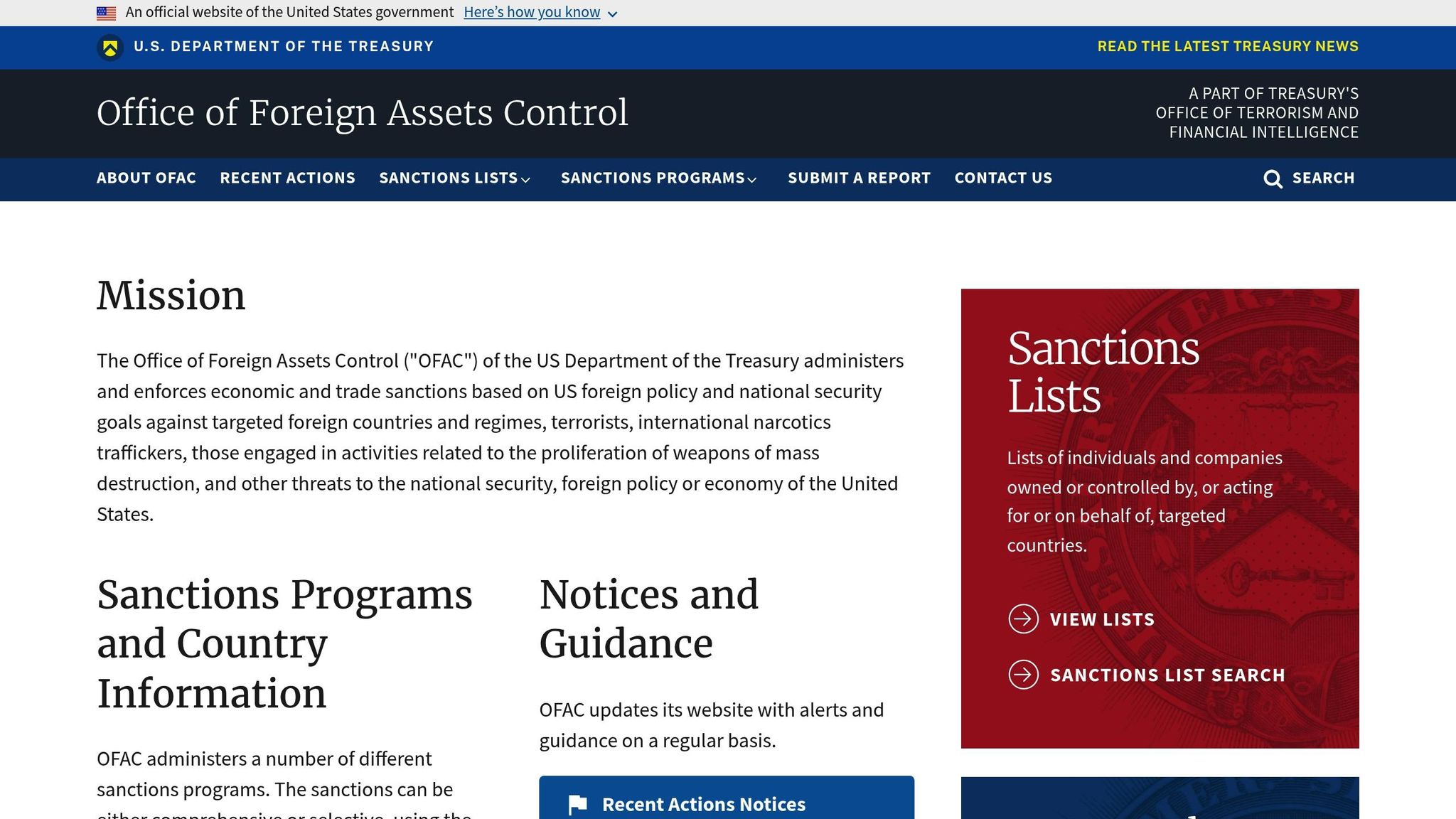
The OFAC risk framework is built around enforcing economic sanctions to support U.S. national security and foreign policy goals. Under these regulations, organizations are required to screen every party involved in a transaction against OFAC’s sanctions lists. The Specially Designated Nationals (SDN) list is the primary tool for this process. OFAC’s jurisdiction is extensive – it applies to any transaction that involves the U.S. financial system or U.S. persons. Even transactions conducted overseas must comply if they involve U.S. dollars. This broad reach demands that organizations adopt flexible and responsive review processes to stay compliant.
Update Triggers and Frequency
OFAC does not operate on a fixed schedule for updating the SDN list.
"The SDN list is frequently updated. There is no predetermined timetable, but rather names are added or removed as necessary and appropriate."
Updates can happen multiple times a week during periods of high activity or as rarely as twice a year. Because of this unpredictability, organizations cannot depend on rigid review schedules and must remain vigilant.
Compliance Requirements
To meet compliance standards, organizations are required to screen the SDN list on a daily basis using automated monitoring systems. This ensures they can quickly adapt to any updates or changes to the list.
2. AML Risk Framework
Regulatory Scope and Focus
AML regulations are designed to combat money laundering and terrorist financing across all financial activities. Unlike OFAC’s sanctions-based approach, which targets specific prohibited parties and transactions, AML compliance requires financial institutions to take a broader approach. This includes identifying, assessing, and mitigating risks associated with money laundering and terrorist financing across their entire customer base and transaction portfolio. Key elements of this framework include customer due diligence, ongoing monitoring, and suspicious activity reporting, all of which apply to every financial institution operating within the United States.
While OFAC focuses on pinpointing specific risks, AML regulations demand a more comprehensive evaluation of customer relationships and transaction patterns. Financial institutions must assess factors such as geographic exposure, customer types, the products and services they offer, and the delivery channels they use.
Key Risk Drivers
AML risk assessments revolve around four main risk categories:
- Customer Risk: This examines the likelihood that certain types of clients could engage in money laundering. High-risk customers often include politically exposed persons (PEPs), cash-intensive businesses, and entities operating in high-risk regions.
- Geographic Risk: This involves evaluating the threats of money laundering and terrorist financing associated with specific countries or regions. Factors include the strength of a jurisdiction’s AML framework, corruption levels, and any known criminal activity.
- Product and Service Risk: Different financial products carry varying levels of risk. For example, private banking services, correspondent banking, and electronic fund transfers are generally more vulnerable to exploitation than standard checking accounts.
- Delivery Channel Risk: This focuses on how customers access financial services. Online banking, ATMs located in high-risk areas, and third-party payment processors can introduce additional vulnerabilities that institutions must address.
Update Triggers and Frequency
AML frameworks must be updated regularly to stay aligned with evolving risks and regulatory expectations. Federal regulations mandate that financial institutions conduct a thorough risk assessment at least annually, but many choose to update their frameworks more frequently in response to changing conditions.
Key triggers for updates include regulatory changes, the emergence of new money laundering methods, market expansion, or shifts in customer demographics. The Bank Secrecy Act underscores the importance of keeping AML programs current, requiring institutions to adapt their frameworks continuously rather than relying solely on scheduled reviews.
Compliance Requirements
A strong AML compliance program is essential for financial institutions. This includes maintaining robust customer identification programs to verify identities and assess risk profiles, both at the time of account opening and throughout the customer relationship.
Ongoing monitoring is another critical component. Institutions must analyze transaction patterns to detect unusual or suspicious activity, tailoring their efforts to each customer’s risk profile. When suspicious activity is identified, institutions are required to file Suspicious Activity Reports (SARs) with the Financial Crimes Enforcement Network (FinCEN) within specified timeframes, providing detailed analysis and documentation of the behavior.
Additionally, the independent testing requirement ensures that AML programs undergo regular audits. These audits, conducted by internal teams or external consultants, assess the effectiveness of risk assessment methodologies and identify areas for improvement. Together, these measures form the foundation of a dynamic and effective AML compliance framework.
sbb-itb-39d39a6
Framework Advantages and Disadvantages
Building on the earlier analysis of separate risk frameworks, this section examines the operational trade-offs between OFAC and AML frameworks, highlighting the challenges of integrating these systems.
Both OFAC and AML frameworks serve distinct purposes in combating financial crime, each with its own balance of clarity and flexibility. Understanding these trade-offs is crucial for allocating resources effectively and managing regulatory risks.
| Factor | OFAC Framework | AML Framework |
|---|---|---|
| Flexibility | Fixed – relies on specific sanctions lists | High – risk-based, adaptable to institutional profiles |
| Implementation Complexity | Moderate – clear guidelines for prohibited parties and transactions | High – requires detailed risk assessments and analysis |
| Resource Requirements | Lower – focused on screening and monitoring | Higher – involves extensive monitoring and documentation |
| Enforcement Risks | Severe – strict liability with significant penalties | Moderate – considers overall compliance efforts |
| Update Frequency | Variable – influenced by geopolitical events | Predictable – includes annual updates and adjustments |
| Scope Coverage | Narrow – targets sanctioned entities and countries | Broad – covers all customers and transaction types |
The OFAC framework stands out for its clarity and specificity. Financial institutions are provided with straightforward guidelines, making it easier to identify prohibited entities and transactions. This precision simplifies compliance processes and reduces uncertainty. However, the rigidity of OFAC can become a drawback when dealing with complex international transactions or rapidly changing geopolitical scenarios. Additionally, OFAC’s strict liability standard means even unintentional violations can lead to substantial penalties.
On the other hand, the AML framework offers a more adaptable, risk-based approach. Institutions can design their compliance programs to align with their unique risk profiles, customer demographics, and business models. This flexibility allows for better resource allocation, focusing efforts on higher-risk areas. However, this broad scope introduces challenges. AML compliance requires advanced monitoring systems capable of analyzing transaction patterns across diverse customer bases. Institutions must also conduct regular risk assessments, maintain extensive documentation, and adapt to ongoing updates – factors that drive up compliance costs.
Enforcement practices differ significantly between the two frameworks. OFAC violations typically result in immediate and severe penalties, regardless of intent or the quality of an institution’s compliance program. In contrast, AML enforcement tends to consider an institution’s overall commitment to compliance and its efforts to improve over time.
From a resource perspective, OFAC compliance relies on focused screening technologies and trained personnel, while AML demands robust monitoring systems and continuous due diligence efforts.
Geographic factors further highlight the differences. OFAC’s sanctions, often country-specific, can pose challenges for institutions operating internationally, as they may face conflicting jurisdictional requirements. Meanwhile, AML frameworks, though generally domestic in focus, also address cross-border money laundering schemes and correspondent banking relationships, adding another layer of complexity.
Both frameworks must also contend with technological challenges. OFAC screening systems need to adapt to increasingly sophisticated evasion techniques, while AML monitoring systems are tasked with detecting intricate layering schemes across various jurisdictions and payment systems. These technological demands emphasize the importance of a coordinated compliance approach.
Integrating OFAC and AML frameworks within a unified risk management system presents its own hurdles. Differences in update cycles, risk methodologies, and regulatory expectations can create operational friction, requiring careful coordination and significant investment in technology to achieve effective harmonization.
Conclusion
OFAC and AML frameworks work hand in hand to combat financial crime. OFAC focuses on a list-based system for sanctions screening, while AML frameworks take a more adaptable, risk-based approach tailored to each institution’s needs. The real challenge – and opportunity – lies in syncing these frameworks through unified technology solutions, ensuring seamless compliance and operational efficiency.
Technology plays a pivotal role in this integration. Today, 75% of banks leverage AI, with 33% specifically utilizing it for fraud detection. These advancements help bridge the gap between sanctions screening and AML processes, breaking down operational silos and enabling a more cohesive approach.
As compliance demands grow, global banks are allocating 5–10% of their operating budgets to compliance efforts. This underscores the urgency of adopting unified systems that minimize redundancies and streamline processes. To achieve this, institutions need to focus on a few key areas: improving data quality, using explainable AI to maintain transparency with regulators, and ensuring systems can adapt to evolving regulatory landscapes.
Evidence from leading European banks showcases the tangible benefits of advanced screening technologies. These solutions not only reduce compliance workloads but also improve detection capabilities, making regulatory adherence less burdensome.
For financial institutions aiming to enhance their risk management practices, adopting integrated compliance platforms is a strategic move. Such platforms simplify operations, strengthen regulatory relationships, and improve overall risk management. By breaking down traditional silos, these unified frameworks not only protect assets but also support international business expansion.
FAQs
How can financial institutions align OFAC and AML frameworks to improve compliance and eliminate inefficiencies?
Financial institutions can bring their OFAC (Office of Foreign Assets Control) and AML (Anti-Money Laundering) systems together by embedding sanctions screening into their broader anti-money laundering processes. This approach involves developing unified risk assessment models and using shared internal controls to simplify workflows and cut down on redundant tasks.
Adopting tools like AI-powered analytics and automation can make a big difference in transaction monitoring. These technologies boost accuracy and encourage smoother collaboration between teams responsible for AML and sanctions compliance. By taking these steps, institutions can not only eliminate inefficiencies but also build a stronger compliance framework that stays aligned with regulatory standards.
What are the main challenges in aligning OFAC and AML risk frameworks, and how can they be addressed?
Aligning OFAC and AML risk frameworks is no easy task. The growing complexity of sanctions, ever-changing money laundering tactics, and varying regulatory requirements across different regions make it a tough landscape to navigate. On top of that, handling massive amounts of data while ensuring accurate reporting only adds to the pressure.
To tackle these obstacles, organizations can adopt strong risk assessment practices, leverage cutting-edge data analytics tools, and establish integrated internal controls that seamlessly connect sanctions compliance with AML efforts. Regular training for staff and staying informed about regulatory updates are also crucial steps to keep the framework effective and up-to-date.
Why is it essential for organizations to stay compliant with OFAC and AML regulations, and what risks do they face if they don’t?
Staying on the right side of OFAC and AML regulations isn’t just about ticking boxes – it’s about protecting your organization from serious legal, financial, and reputational risks. Non-compliance can lead to hefty fines, criminal or civil penalties, and even jail time. But the fallout doesn’t stop there. It can tarnish your organization’s reputation, shake client confidence, and cost you valuable business opportunities.
On top of that, ignoring these regulations can throw a wrench in your operations, drive up expenses, and weaken your overall risk management efforts. In the financial world, where trust and compliance are everything, keeping your practices up to date helps your organization stay strong, trustworthy, and ahead of the competition.
