
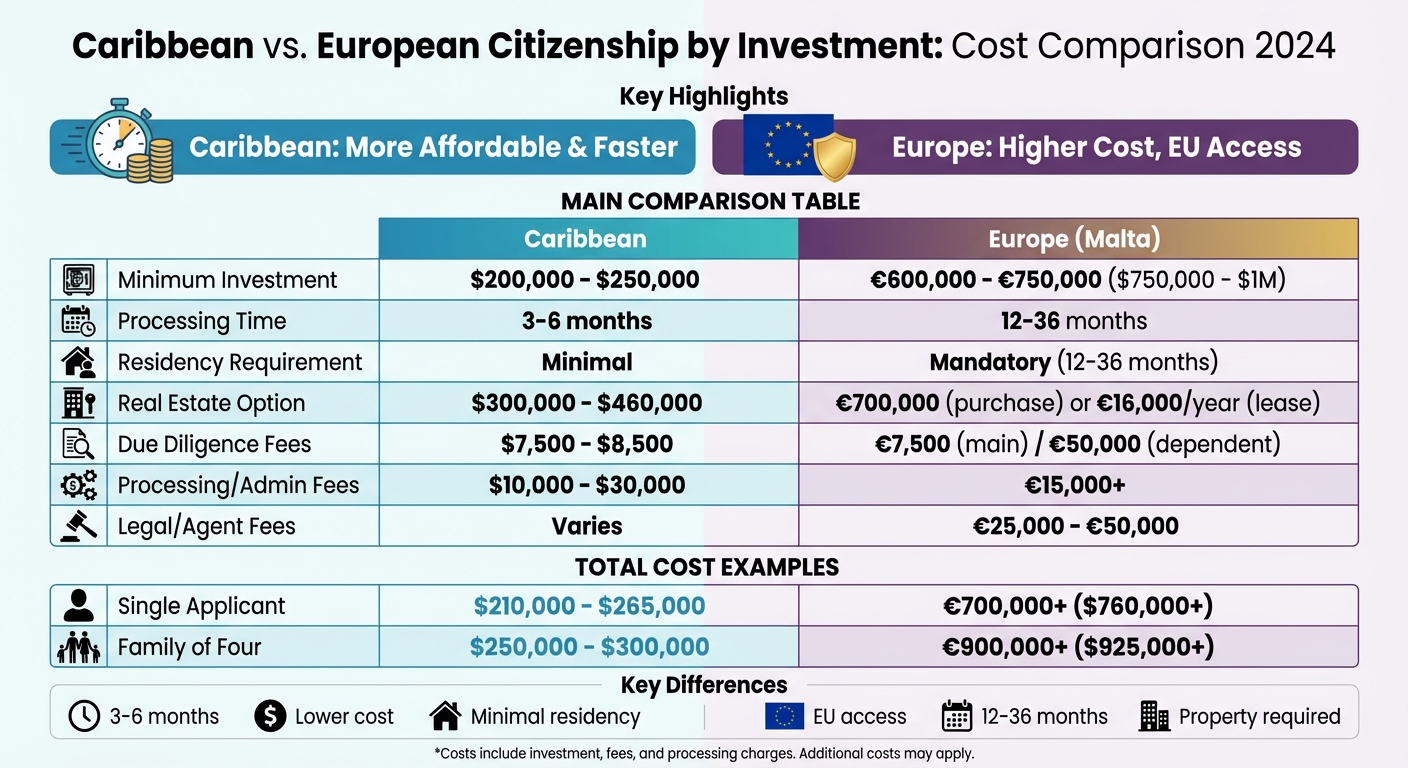
If you’re considering a second citizenship, here’s the key takeaway: Caribbean citizenship programs are more affordable and faster, while European options are pricier but offer access to the EU.
- Caribbean Programs: Start at $200,000 (e.g., Dominica) and go up to $250,000 (e.g., St. Kitts and Nevis) with processing times of 3–6 months. Additional fees (due diligence, processing, and passports) can add $10,000–$30,000 for a single applicant. Families of four may pay around $250,000–$300,000.
- European Programs: Malta, the most prominent option, requires €600,000–€750,000 ($750,000–$1M) plus property investment or rental. Total costs for a single applicant exceed €700,000 ($760,000), with family costs surpassing €900,000 ($925,000). Processing takes 12–36 months and often includes residency conditions.
Key Differences:
- Caribbean: Lower costs, quicker processing, minimal residency requirements.
- Europe: Higher costs, longer timelines, access to EU benefits, and stricter residency obligations.
| Region | Minimum Investment | Processing Time | Residency Requirement |
|---|---|---|---|
| Caribbean | $200,000–$250,000 | 3–6 months | Minimal |
| Europe (Malta) | €600,000–€750,000 | 12–36 months | Mandatory |
Whether you’re prioritizing cost, speed, or EU access, understanding these differences helps align your choice with your goals. For personalized guidance, you can book private consultations to discuss your specific needs.
Caribbean Citizenship by Investment Costs
Minimum Investment Requirements for Caribbean Programs
Starting August 1, 2024, five Caribbean nations – Antigua and Barbuda, Dominica, Grenada, St. Kitts and Nevis, and St. Lucia – aligned their minimum investment thresholds through a Memorandum of Agreement. This agreement put an end to the earlier trend of competitive price reductions among these programs.
Dominica offers the lowest entry point, requiring a US$200,000 contribution to its Economic Diversification Fund (EDF) for a single applicant. On the higher end, St. Kitts and Nevis sets its minimum donation at US$250,000 for a single applicant. The other countries fall in between: Antigua and Barbuda at US$230,000, Grenada at US$235,000, and St. Lucia at US$240,000. For real estate investments, the required amounts typically range from US$200,000 to US$600,000. Grenada also provides a joint ownership real estate option for US$270,000, while St. Lucia stands out with a US$300,000 refundable government bond option. These base investments are just the start, as additional fees significantly shape the final costs.
Processing Fees and Additional Costs in the Caribbean
Beyond the initial investment, applicants face mandatory fees that can add between US$10,000 and US$30,000 to the overall expense for a single applicant. A key component of these fees is due diligence, which costs between US$7,500 in Dominica and US$10,000 in St. Kitts and Nevis for the primary applicant. Fees for spouses range from US$4,000 to US$7,500, and dependents aged 16 or older typically add another US$4,000–US$5,000 each.
Government processing fees vary widely across the region. For example, Antigua and Barbuda charges US$10,000 for a single applicant, while St. Kitts and Nevis requires just US$250. Dominica, Grenada, and St. Lucia generally charge between US$1,000 and US$3,000. Additionally, most programs mandate interviews, costing US$1,000–US$1,500 per person, and passport issuance adds another US$300–US$500 per applicant.
Total Costs for Single Applicants vs. Families
For single applicants opting for donation-based programs, total costs range from around US$209,500 in Dominica to approximately US$260,600 in St. Kitts and Nevis. These figures include the donation, processing fees, due diligence, interview fees, and passport issuance.
The pricing for families depends on the program. Antigua and Barbuda offers a particularly appealing option for families of up to four, maintaining the same US$230,000 donation as for single applicants. For a family of four (two adults and two children), total costs range from roughly US$265,000 in St. Lucia to US$277,400 in St. Kitts and Nevis. Larger families may find Antigua’s University of the West Indies Fund option attractive. At US$260,000, this program includes one year of tuition for one family member. These varied costs highlight the complexity of Caribbean CBI programs and set the stage for comparing them to European alternatives in later sections.
sbb-itb-39d39a6
European Citizenship by Investment Costs
Minimum Investment Requirements for European Programs
When it comes to European citizenship by investment, there are two main paths: direct citizenship programs and residency-based Golden Visas. Currently, only three countries in Europe offer direct citizenship options: Malta, North Macedonia, and Turkey.
- North Macedonia: This is the most affordable option in Europe, requiring a €200,000 donation to a government fund. However, the program is capped at 1,000 applicants and is targeted at successful entrepreneurs.
- Turkey: With a minimum $400,000 real estate investment, Turkey offers a transcontinental option. Processing times range from 3 to 6 months.
- Malta: Malta’s program involves either a €600,000 non-refundable contribution with a 36-month residency requirement or €750,000 with a 12-month residency. Additionally, applicants must purchase property worth at least €700,000 (or lease for €16,000 annually) and make a €10,000 philanthropic donation.
Golden Visa programs, on the other hand, provide a route to citizenship through residency, typically after 5 to 10 years. Here’s a quick look at some of the key programs:
- Greece: Investments range from €250,000 to €800,000, depending on the location.
- Portugal: Requires €500,000 in venture capital or €250,000 in national heritage donations.
- Italy: Accepts startup investments starting at €250,000.
- Spain: Discontinued its real estate-based route as of April 3, 2025.
Each program has its own investment structures, timelines, and additional costs, which are detailed in the sections below.
Processing Fees and Additional Costs in Europe
On top of the investment requirements, applicants need to account for various fees and administrative charges. Here’s a breakdown of some of the notable costs:
- Malta: Due diligence fees are €7,500 for the main applicant, €5,000 for spouses and adult dependents, and €3,000 for children aged 13–17. Agency fees range from €27,000 to €36,000.
- North Macedonia: Includes a €50,000 administrative fee on top of the €200,000 donation.
Golden Visa programs also come with their own processing fees:
- Portugal: Initial application costs about €6,179 per person, with renewal fees of approximately €3,090 every two years.
- Greece: Charges €2,000 for the main applicant and €150 to €500 for dependents.
- Italy: Application fees are approximately €176 per person, plus €126 for the residence card.
Applicants should also factor in the cost of private health insurance, which is mandatory and can add several thousand dollars annually, depending on age and coverage. Additionally, professional legal fees for European applications typically range from €30,000 to €40,000 for a family. These fees are higher than Caribbean programs due to the complexities of EU residency and naturalization laws. Travel for biometric data collection is also required, as this step cannot be completed remotely.
Real Estate and Fund Investment Costs in Europe
Real estate investments often come with added expenses like VAT and holding periods. For example:
- Cyprus: Charges 5% VAT on the first 2,153 square feet of residential property and 19% VAT on commercial property.
- Most programs require investments to be held for at least 5 years to maintain residency or qualify for permanent status.
Greece’s pricing structure is a good example of how investment requirements vary by location:
- €250,000: For renovation properties in any location.
- €400,000: For standard regions.
- €800,000: For prime zones like Athens, Thessaloniki, Mykonos, and Santorini.
This program offers a 5-year residency permit with no minimum stay requirement. However, naturalization typically requires 183 days of residency per year for 7 years.
Fund investments are also a popular option in several countries:
- Portugal: Focuses on €500,000 investments in venture capital or private equity funds. Citizenship eligibility kicks in after 5 years, with an average stay requirement of just 7 days per year.
- Hungary: Offers investment fund units starting at €250,000.
- Latvia: Provides the most affordable residency option at €50,000 through business equity investment, compared to €250,000 for real estate or bond routes.
Unlike non-refundable donations, real estate and fund investments offer the potential for returns after the mandatory holding period. However, the actual returns depend heavily on market conditions and the ease of resale in the chosen location.
Caribbean vs. European Citizenship Costs: Side-by-Side Comparison
Investment Threshold Comparison
When it comes to initial investment, Caribbean citizenship programs are far more budget-friendly than their European counterparts, making them some of the simplest citizenship programs in the world. Thanks to a 2024 Memorandum of Understanding, Caribbean nations have aligned their donation-based entry costs, setting a minimum range of $200,000 to $250,000. Dominica offers the most affordable option at $200,000, while St. Kitts and Nevis tops the range at $250,000.
In Europe, citizenship programs demand significantly higher investments. Malta’s Exceptional Investor Naturalisation (MEIN) Programme requires €600,000 for a 36-month residency option or €750,000 for a 12-month route. On top of this, applicants must either purchase property worth €700,000 or lease one for at least €16,000 annually, along with a €10,000 philanthropic donation. North Macedonia offers a more accessible option at €200,000, but its program is limited in availability.
| Region | Minimum Donation | Real Estate Minimum | Processing Time |
|---|---|---|---|
| Caribbean | $200,000 – $250,000 | $300,000 – $460,000 | 3 – 6 months |
| Europe (Malta) | €600,000 – €750,000 | €700,000 (purchase) | 12 – 36 months |
| Europe (North Macedonia) | €200,000 | N/A | 3 – 6 months |
These figures highlight the stark contrast in upfront costs between regions, which becomes even more apparent when factoring in fees and additional expenses.
Fees and Processing Costs Breakdown
Beyond the initial investment, the processing and administrative costs also vary widely between the Caribbean and Europe. In the Caribbean, due diligence fees for the main applicant typically range from $7,500 to $8,500, with government processing fees adding another $10,000 to $30,000, depending on the size of the applicant’s family. Passport issuance is relatively inexpensive at about $300 per person.
Malta, on the other hand, has a more intricate fee structure. Due diligence costs €7,500 for the main applicant and €50,000 for each dependent. Administrative fees start at €15,000, while legal representation for a family can range between €25,000 and €50,000. Additionally, applicants must secure health insurance with a minimum coverage of €50,000, which can add a few thousand euros annually.
| Fee Type | Caribbean (Average) | Europe (Malta) |
|---|---|---|
| Due Diligence | $7,500 – $8,500 | €7,500 (main) / €50,000 (dependent) |
| Processing/Admin Fees | $10,000 – $30,000 | €15,000+ |
| Legal/Agent Fees | Varies by firm | €25,000 – €50,000 |
| Passport Issuance | $300 | €500 |
| Per Dependent Fee | $10,000 – $50,000 | €50,000 |
Total Cost Estimates for Single Applicants and Families
When all costs are tallied, the gap between Caribbean and European citizenship expenses becomes even clearer. A single applicant opting for Caribbean citizenship through a donation route can expect total costs to fall between $210,000 and $265,000. For a family of four, this typically rises to $250,000 to $300,000.
For European citizenship, Malta requires a much heftier financial commitment. A single applicant’s total costs exceed €700,000 (around $760,000), factoring in contributions, property investments, and associated fees. For a family of four, the total surpasses €900,000 (approximately $925,000), excluding ongoing property and insurance expenses.
Families may find the Antigua and Barbuda program particularly appealing. Its $230,000 National Development Fund contribution covers a family of up to four, with relatively low additional fees for extra dependents. This is far more economical compared to Malta’s €50,000 per dependent fee structure. These comparisons set the stage for exploring hidden and long-term financial considerations.
Hidden Costs and Long-Term Financial Considerations
Bank Fees, Government Forms, and Passport Issuance
The advertised investment amounts for citizenship-by-investment (CBI) programs often leave out a range of extra costs that can add up quickly. For instance, bank transfer commissions alone can tack on an additional $200 to $400 per transaction. On top of that, government processing fees typically run around $250 per applicant in countries like Dominica. Then there’s the cost of issuing passports, which generally falls between $250 and $500.
Other fees, while seemingly small, can still make an impact. For example, naturalization certificate fees range from about $50 in St. Kitts and Nevis to $250 in Dominica. Courier and document delivery fees, often overlooked, can add another $250 in places like St. Lucia. While none of these fees are overwhelming on their own, together they can significantly influence the overall cost of your CBI plan.
Holding Periods and Resale Potential
The financial considerations don’t stop with upfront costs. Long-term factors like holding periods and the resale potential of investments play a big role in determining the true value of a CBI program. Real estate investments, for example, often come with mandatory holding periods that tie up your capital for years. In St. Kitts and Nevis, the required holding period is 7 years, while most other Caribbean programs require you to hold the property for 3 to 5 years.
During these holding periods, properties in the Caribbean can yield annual rental returns of around 2% to 5%, which can help cover ongoing expenses like maintenance. Additionally, many programs are designed with resale in mind. Take Dominica as an example: after 5 years, you can resell your property to another CBI participant, or even after just 3 years if selling to someone outside the program.
There are also residency requirements to consider. Antigua and Barbuda, for instance, mandates that citizens spend at least 5 days in the country within the first five years to keep their passports valid. This is relatively lenient compared to Malta, where maintaining citizenship often requires 12 to 36 months of legal residency. For those not purchasing property in Malta, this residency comes with an added expense – a mandatory annual property lease of at least €16,000.
All these factors highlight the importance of carefully evaluating both the upfront and ongoing costs when considering a CBI program.
Conclusion
Key Takeaways
When considering citizenship by investment (CBI), weighing both initial costs and future expenses is crucial to making the right decision. Caribbean programs, following the 2024 Memorandum of Understanding, start at $200,000, while European options like Malta require €600,000–€750,000, plus additional real estate or donation expenses.
The decision largely hinges on your priorities. Caribbean programs offer faster processing times, typically between 3 to 6 months, whereas European programs often take 12 to 36 months and may include residency requirements.
"Caribbean citizenship through investment tends to be more risky and less reliable in the long run" compared to European programs, though it offers lower costs and quicker processing. – Endevio
For families mindful of their budgets, Caribbean programs can be appealing due to their relatively low inclusion costs. On the other hand, business-oriented investors aiming for access to the EU market might prefer European residency-by-investment options, such as Portugal’s Golden Visa, which starts at €250,000 but involves a longer path to citizenship. These financial and logistical factors highlight the importance of seeking expert guidance when evaluating CBI options.
Expert Support for CBI Planning
Selecting the right CBI program involves analyzing upfront costs, long-term commitments, and additional fees such as due diligence, bank transfers, mandatory interviews, and possible residency obligations – all of which shape the total investment.
Global Wealth Protection offers specialized consultations tailored to location-independent entrepreneurs and investors exploring CBI opportunities. Their services include tax planning, asset protection strategies, and customized internationalization solutions to help you navigate this complex process effectively.
FAQs
What are the key benefits of choosing Caribbean citizenship by investment over European programs?
Caribbean citizenship-by-investment programs are known for being more affordable and tax-friendly compared to many European options. Take Dominica, for instance – its minimum investment starts at $200,000, while European programs like those in Malta or Austria often require contributions in the range of several hundred thousand euros. This affordability, along with quicker processing times, makes Caribbean programs more accessible for many investors.
Beyond cost, Caribbean passports come with some major perks. They provide visa-free travel to over 140 countries, allow holders to maintain multiple citizenships, and come with no taxes on foreign income, capital gains, wealth, or inheritance. Pair that with the region’s low cost of living, warm climate, and relatively low crime rates, and it’s easy to see why U.S. investors find the Caribbean an attractive option for increasing mobility and optimizing finances.
What are the differences in processing times and residency requirements between Caribbean and European citizenship-by-investment programs?
Caribbean citizenship-by-investment programs are known for being fast and straightforward. In most cases, applicants can secure a passport in just 3 to 6 months, though some jurisdictions may take up to 12 months. A major perk? There are no residency requirements – you don’t need to live in the country to qualify.
On the other hand, European residency-by-investment programs, often called "golden visas", focus on granting a residence permit within 2 to 8 months. For instance, Greece typically processes applications in 3 to 4 months, while Portugal takes around 4 to 6 months. However, transitioning from residency to full citizenship in Europe is a longer process. It usually demands 5 or more years of actual residency, along with meeting minimum annual stay requirements and completing integration steps like proving language skills or understanding local customs.
In essence, Caribbean programs are ideal for those seeking quick citizenship with little to no residency commitment, while European options are better suited for those aiming for long-term residency and eventual citizenship through a more gradual process.
What other costs should I plan for when considering a citizenship by investment program?
When looking into Caribbean and European citizenship-by-investment (CBI) programs, it’s crucial to consider the additional costs that go beyond the initial investment. These include several mandatory fees, such as:
- Government fees: Non-refundable charges that apply to each applicant or family member listed in your application.
- Due diligence fees: Costs for background checks on adults (and sometimes older dependents) to ensure the legitimacy of your funds.
- Passport issuance fees: Fees for issuing passports once your application is approved.
- Processing fees: Administrative expenses managed by authorized agents, which can start at $10,000 for individuals and increase for families.
- Dependent fees: Additional charges for including extra family members in your application.
These extra costs can range from $7,500 to over $30,000, depending on the program and the number of applicants. Make sure to factor these into your overall budget to choose the CBI program that aligns with your financial plans.
