
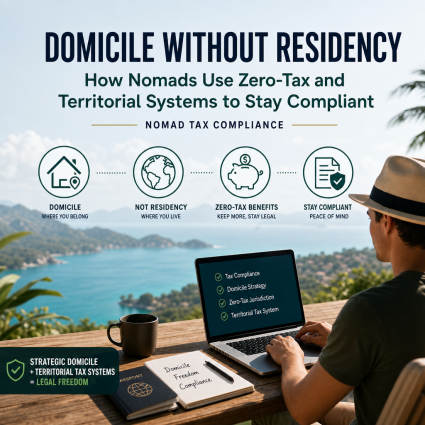
Digital nomads are rewriting the rules of global mobility. As more entrepreneurs live and work across borders, one question keeps surfacing: How do you maintain a legal domicile without meeting residency day‑counts? The answer lies in choosing jurisdictions with flexible domicile rules, zero‑tax regimes, or territorial systems that only tax income earned locally. For nomads who want stability without physical presence, this approach offers a powerful blend of compliance, simplicity, and tax efficiency.
This guide explains how domicile works, why it matters, and how nomads strategically use zero‑tax and territorial systems to stay compliant—without needing to live in one place.
What “Domicile Without Residency” Actually Means
Most people assume domicile and residency are the same. For digital nomads, they’re not.
Domicile is your permanent legal home—the place you intend to return to, even if you never actually do. It determines your legal identity, where you vote, where your estate is handled, and often where you maintain banking relationships.
Tax residency, on the other hand, is determined by physical presence, economic ties, or center‑of‑life tests. You can be a tax resident in a country without intending to live there permanently, and you can maintain domicile in a place where you spend zero days.
Nomads use this separation strategically. By choosing a domicile jurisdiction with flexible rules and pairing it with international tax systems that don’t require physical presence, they maintain legal stability while avoiding accidental tax residency.
Why Digital Nomads Seek Domicile Without Residency
Avoiding Accidental Tax Residency
Nomads often cross borders frequently, making them vulnerable to:
- Rolling 183‑day rules
- Tie‑breaker tests in tax treaties
- Center‑of‑life evaluations (family, property, business)
A stable domicile helps anchor their legal identity even when they’re constantly moving.
Maintaining a Stable Legal Home
Banks, payment processors, and corporate registries require a consistent address. A domicile provides:
- A place to register businesses
- A location for estate planning
- A home for banking and KYC compliance
Without domicile, nomads risk account closures or compliance flags.
Reducing Global Tax Exposure
Zero‑tax and territorial systems allow nomads to legally minimize tax obligations by ensuring foreign‑source income isn’t taxed. When combined with a domicile that doesn’t require physical presence, this creates a compliant, low‑friction lifestyle.
The Three Systems Nomads Use to Stay Compliant
1. Zero‑Tax Jurisdictions
Zero‑tax jurisdictions impose no personal income tax, regardless of where income is earned. Popular examples include:
- United Arab Emirates (UAE)
- Cayman Islands
- Bahamas
These jurisdictions often offer residency pathways that don’t require strict day‑counts. For entrepreneurs earning globally, zero‑tax systems provide clarity and simplicity.
Pros
- No tax on foreign or local income
- Strong banking ecosystems
- Attractive for high‑earning entrepreneurs
Cons
- Residency may require investment or sponsorship
- Cost of living can be high
- Some countries scrutinize zero‑tax residencies
2. Territorial Tax Systems
Territorial systems tax only local‑source income, meaning income earned outside the country is exempt. Key examples:
- Panama
- Georgia
- Paraguay
- Malaysia
For remote entrepreneurs, territorial systems are ideal because their income is typically foreign‑sourced.
Pros
- Foreign income untaxed
- Low physical presence requirements
- Affordable residency options
Cons
- Must avoid creating local‑source income
- Some systems require minimal annual visits
3. No‑Minimum‑Stay U.S. Domicile States
Certain U.S. states allow domicile with minimal or zero physical presence, making them popular among nomads:
- South Dakota
- Florida
- Texas
These states offer:
- No state income tax
- Straightforward domicile establishment
- Strong legal frameworks
South Dakota is especially popular among RVers and perpetual travelers because domicile can be established with a single overnight stay and maintained through mail forwarding.
Best Jurisdictions for Domicile Without Residency
South Dakota (U.S.)
South Dakota is one of the easiest states for nomads to establish domicile:
- No state income tax
- No minimum stay requirement
- Simple driver’s license process
- Mail forwarding services widely available
It’s ideal for U.S. citizens who want a stable legal home without residency obligations.
Florida (U.S.)
Florida offers:
- No state income tax
- Strong legal domicile protections
- International banking friendliness
- Easy access to global travel hubs
It’s especially attractive for entrepreneurs who need a reputable U.S. address.
UAE
The UAE’s zero‑tax regime makes it one of the most attractive jurisdictions globally:
- No personal income tax
- Residency available through employment, business setup, or investment
- No minimum stay requirement for maintaining residency
- World‑class banking and infrastructure
Entrepreneurs often pair UAE residency with a U.S. domicile for maximum flexibility.
Panama
Panama’s territorial tax system and Friendly Nations Visa make it a favorite among nomads:
- Foreign income untaxed
- Residency can be maintained with minimal presence
- Affordable cost of living
- Strong banking sector
Panama is ideal for remote workers earning globally.
Georgia
Georgia offers:
- Territorial tax system
- Simple residency pathways
- Low cost of living
- Attractive for freelancers and startup founders
It’s one of the easiest countries for nomads to establish residency without strict day‑counts.
How Nomads Prove Domicile Without Residency
To maintain domicile, nomads establish legal and administrative anchors:
Legal Ties
- Driver’s license
- Voter registration
- State or national ID
- Business registration
Administrative Ties
- Mail forwarding address
- Bank accounts
- Insurance policies
- Vehicle registration (in some cases)
Documentation to Maintain
Nomads should keep:
- Mail service agreements
- Utility or service bills
- Affidavits of domicile
- Copies of voter registration
- Bank statements showing address consistency
These documents help prove domicile during tax audits, banking reviews, or immigration checks.
Compliance Risks and How to Avoid Them
Accidental Tax Residency
Nomads must monitor:
- Day‑counts in each country
- Economic ties (property, employment)
- Family ties
- Local business activities
Even short stays can trigger residency in countries with aggressive tax rules.
Permanent Establishment (PE) Risk
Entrepreneurs must avoid creating a taxable presence by:
- Not hiring local employees
- Not serving local clients
- Not maintaining local offices
PE risk is one of the most misunderstood compliance issues among nomads.
Banking and KYC Red Flags
Banks may flag accounts when:
- Residency and domicile don’t match
- Addresses change frequently
- Income sources appear inconsistent
Maintaining a stable domicile helps reduce compliance friction.
Case Studies: How Nomads Use Domicile Without Residency
South Dakota Domicile + Global Travel
A U.S. freelancer establishes South Dakota domicile using a mail forwarding service, obtains a driver’s license, and spends the year traveling through Asia and Europe. Their domicile remains intact, and they avoid state income tax.
UAE Residency + International Business
A startup founder sets up a company in Dubai, obtains residency, and earns all income from clients abroad. With zero personal income tax and no minimum stay requirement, they maintain residency while traveling full‑time.
Panama Territorial Tax + Remote Work
A remote entrepreneur obtains Panama residency through the Friendly Nations Visa. Since their income is foreign‑sourced, they owe no tax in Panama and only visit once a year to maintain residency.
Step‑by‑Step: How to Choose Your Domicile as a Nomad
- Assess your tax exposure Identify where you risk becoming a tax resident.
- Choose a domicile jurisdiction Consider tax rules, banking friendliness, and legal stability.
- Establish legal ties Obtain a driver’s license, register to vote, and set up mail forwarding.
- Document your status Keep proof of domicile and maintain consistent records.
- Review annually Ensure your travel patterns don’t trigger unwanted tax residency.
Comparison: Zero‑Tax vs Territorial vs No‑Stay Domicile States
| System | Tax on Foreign Income | Physical Presence | Ease of Setup | Best For |
|---|---|---|---|---|
| Zero‑Tax | None | Low | Moderate | High‑earning entrepreneurs |
| Territorial | None | Low–Moderate | Easy | Remote workers |
| No‑Stay U.S. States | None (state level) | Minimal | Very easy | U.S. citizens, RVers, nomads |
Key Takeaways for Nomads
- Domicile and residency are separate legal concepts.
- Zero‑tax and territorial systems allow nomads to minimize tax exposure.
- U.S. no‑stay states offer stable domicile options without residency requirements.
- Compliance depends on documentation, day‑count management, and avoiding local economic ties.
Conclusion
For digital nomads and international entrepreneurs, domicile without residency is not only possible—it’s often the most strategic way to stay compliant. By choosing jurisdictions with flexible rules and pairing them with zero‑tax or territorial systems, nomads gain stability, clarity, and tax efficiency while enjoying the freedom to live anywhere.
