
Looking to protect your assets and optimize taxes? Forming an International LLC in Anguilla might be the solution. Here’s why:
- Privacy: Member details and agreements stay confidential.
- Tax Benefits: 0% taxes on corporate income, capital gains, and estate transfers.
- Flexibility: Operates as a pass-through entity, avoiding double taxation.
- Ease of Formation: Incorporation is fast (1 business day) and affordable (starting at $2,800).
- Asset Protection: Shields personal assets from business liabilities.
Anguilla’s LLC structure, modeled after Wyoming’s, offers simplicity and global appeal. With no minimum capital requirements or mandatory local management, it’s tailored for international investors. However, compliance with Know Your Customer (KYC) and U.S. tax reporting (FATCA & FBAR) is essential.
Whether you’re an entrepreneur or investor, Anguilla provides a secure, efficient framework for managing global operations. Keep reading for a step-by-step guide on forming your LLC, compliance needs, and more.
What International LLCs Are and Why They Matter
What Is an International LLC?
An International LLC is a hybrid business structure that blends the limited liability of a corporation with the flexibility and tax transparency of a partnership. In Anguilla, this structure is based on the U.S. LLC model but tailored specifically for international investors.
One key feature of an International LLC is that it operates under a private LLC Agreement rather than relying solely on statutory rules. This agreement gives members the freedom to define voting rights, profit sharing, and management roles. Ownership is represented through membership interests instead of traditional shares, offering more options for managing capital contributions and distributions.
Unlike domestic LLCs in many jurisdictions, International LLCs in Anguilla don’t require directors, company secretaries, or annual meetings. Members can manage the LLC themselves or appoint third-party managers. The LLC is a separate legal entity, meaning your liability is limited to the amount of your investment. Anguilla law also distinguishes between a "LLC interest" (which includes full membership rights) and an "economic interest" (limited to profits and distributions). These interests can be transferred independently, adding even more flexibility.
This structure is particularly appealing for those seeking asset protection, privacy, and operational ease.
Main Benefits of International LLCs
One standout feature of an International LLC in Anguilla is its tax neutrality. The jurisdiction imposes a 0% tax rate on corporate income, personal income, capital gains, inheritance, and withholding taxes for both residents and non-residents. This setup ensures that profits flow directly to members without the LLC itself being taxed.
Privacy is another major advantage. In Anguilla, member details and the LLC Agreement are kept confidential, stored only at the company’s registered office. This contrasts with jurisdictions where such information is often part of public records.
The LLC’s status as a separate legal entity provides a crucial layer of protection. Your personal assets are shielded from business liabilities and legal disputes, which is especially useful for international investors dealing with cross-border claims. This simplifies dispute resolution and enhances overall security.
Operational flexibility is another draw. Meetings can be held in person, electronically, or through written resolutions, no matter where members are located. Anguilla law also allows redomiciliation, meaning the LLC can move to another jurisdiction if necessary. Additionally, the LLC can exist perpetually (if specified in the bylaws) and can be formed with just one member, who may be an individual or a corporate entity.
These features make the International LLC a practical choice for protecting assets and managing global operations efficiently.
Why Anguilla Is the Best Jurisdiction for Your International LLC
Anguilla’s legal framework not only incorporates the advantages of the LLC structure but also enhances them to cater to international investors. The jurisdiction follows English Common Law, and its Limited Liability Company Act is modeled after Wyoming’s well-regarded LLC Ordinance. This familiar and modern legal system is particularly appealing to global investors.
The Anguilla Financial Services Commission (FSC) provides regulatory oversight, ensuring stability and credibility. Anguilla’s reputation is further bolstered by its status as the fifth-largest jurisdiction globally for captive insurance, showcasing its expertise in handling complex financial structures.
Setting up an International LLC in Anguilla typically costs around $2,800. The tax environment is highly favorable, with 0% rates across key categories and no minimum capital requirements. For instance, property tax is levied at a flat 0.75% on annual land value, and stamp duty on contracts ranges from 0.01% to 5%.
To enhance privacy, nominee director services are available, ensuring personal names remain off internal records. Additionally, the absence of a public registration system for security interests keeps debt financing arrangements private.
These features make Anguilla a standout choice for establishing an International LLC, offering a blend of legal stability, tax advantages, and confidentiality.
sbb-itb-39d39a6
What You Need to Form an International LLC
Personal and Business Documents
To set up an international LLC, you’ll need to gather specific personal and business documents. Each member and beneficial owner must provide a valid passport and a police record issued within the last six months. Make sure the police records are current to avoid delays in the process.
Additionally, you’ll need proof of address, which can be recent utility bills or bank statements dated within the past three months. At least three character references or testimonials from non-family members are required to establish credibility during due diligence. A bank reference letter or a statement of financial ability is also necessary to show you have the resources to operate the LLC.
Prepare a detailed business plan that outlines your intended activities, and include documentation of any relevant professional qualifications. While forming the LLC can be completed in just one business day, opening a corporate bank account may take 2–4 weeks due to the bank’s Know Your Customer (KYC) procedures. If you already have an existing business, include your current formation documents.
Company Requirements
Your LLC must have a unique company name ending with "Limited Liability Company" or "LLC". Certain terms, like "Bank", "Trust", or "Royal", are restricted and require special permission. The name reservation and approval process is the first official step in forming your company.
An Anguilla LLC must appoint a licensed registered agent and maintain a registered office in Anguilla. Ensure your registered agent holds a valid license from the Anguilla government to avoid legal issues. There’s no minimum capital requirement, and contributions can come in the form of cash, property, or services. The LLC can even be formed with just one member, whether an individual or a corporate entity. No local directors or managers are required.
Draft an LLC Operating Agreement to define member roles, responsibilities, and profit-sharing arrangements. This document isn’t publicly filed but must be kept at your registered office in Anguilla, along with a register of members, managers, and accounting records. These straightforward requirements make Anguilla a popular choice for offshore companies.
Compliance and Due Diligence
Compliance revolves around Know Your Customer (KYC) and Anti-Money Laundering (AML) standards. Your registered agent will handle much of this process, but you’ll need to provide key documents like passport copies, proof of residential address, and a professional resume for all directors and beneficial owners. In high-risk industries, you may also need to submit a declaration of income source and commercial history. Meeting these KYC, AML, and economic substance standards is essential for keeping your LLC in good standing in Anguilla.
If your LLC plans to engage in "relevant activities" such as banking, insurance, or holding company operations, you’ll need to comply with Economic Substance (ES) rules. These include maintaining a local physical presence and filing annual substance reports. Pure equity holding companies face fewer requirements compared to businesses in high-risk sectors like intellectual property.
For US-based applicants, remember to account for FATCA and FBAR reporting requirements for offshore financial activities. The government fee for forming an LLC in Anguilla is approximately $450 for the first year. Full incorporation packages, which include document preparation and registered office services, typically cost between $1,000 and $2,500. Annual renewal fees are around $300, with total compliance and maintenance costs ranging from $800 to $1,500 per year.
Once you’ve gathered the necessary documents and met compliance standards, you’ll be ready to proceed with the formation process step by step.
How to Form an International LLC: Step-by-Step Process
Step 1: Reserve and Approve Your Company Name
Start by reserving a compliant name for your company using Anguilla’s streamlined incorporation system. Your company name must include "Limited Liability Company", "LLC", or "L.L.C." in any language to meet international branding and legal standards.
Work with a local registered agent who can access ACORN (Anguilla’s Commercial On-line Registration Network) to check that your chosen name isn’t identical or too similar to existing businesses. Be mindful of restricted terms like "Bank", "Insurance", "Royal", "University", or "Foundation" – these require specific licenses or permissions from the appropriate authorities. Once your name is approved, it can be reserved for up to 120 days.
Step 2: Choose Your LLC Structure and Seek Professional Guidance
Decide whether your LLC will be member-managed – where all members are involved in operations – or manager-managed, where designated managers handle daily tasks while members retain ownership.
Your LLC can have just one member, who may be an individual or a corporate entity, with no restrictions on nationality. There’s also no requirement for local directors or managers, giving you flexibility in structuring profit-sharing and voting rights. For U.S.-based applicants, it’s particularly important to consult experts familiar with Anguilla’s laws and U.S. tax obligations, such as FATCA and FBAR, to ensure compliance.
Once you’ve chosen your structure, gather the necessary documents to proceed.
Step 3: Prepare and Submit Your Documents
The next step is to finalize and submit your formation documents. Your registered agent will prepare and electronically file the Articles of Formation through ACORN. These documents must include your company name, details of your Anguilla office, and your registered agent’s information.
Additionally, you’ll need a private Operating Agreement, which outlines roles, management responsibilities, and how profits will be distributed. While this document isn’t publicly filed, it must be kept at your registered office and serves as the operational blueprint for your LLC. Thanks to the ACORN system, the incorporation process can be completed in as little as one business day.
Step 4: Receive Your Certificate and Handle Post-Formation Details
Once your Certificate of Formation is issued by the Registry, hold an initial meeting to formally adopt the Operating Agreement, appoint managers (if applicable), and issue membership certificates.
You’ll also need to update your Register of Members and Managers, which is maintained at your Anguilla office. If your LLC is involved in activities like banking, insurance, or holding company functions, you’ll need to prepare for Economic Substance filings and comply with any local presence requirements. Completing these steps ensures your LLC is fully operational and legally protected.
Tax Rules and Compliance for Anguilla International LLCs
Tax Exemptions and Treatment
Anguilla offers a tax-neutral environment, meaning neither individuals nor corporations face direct taxes. For your LLC, this translates to 0% tax rates on corporate income, personal income, capital gains, dividends, inheritance, estate transfers, and gifts. Essentially, profits and losses are passed directly to members, based on their ownership shares.
However, if you’re a U.S. citizen, you must still comply with FATCA and FBAR reporting requirements. These tax benefits make Anguilla a standout destination for offshore LLCs.
To remain in good standing, your company must pay an annual $250 license fee. Anguilla also has no exchange controls, and while the official currency is the Eastern Caribbean Dollar, the U.S. Dollar is widely accepted for transactions.
In addition to tax neutrality, Anguilla LLCs must meet specific economic substance standards.
Economic Substance Requirements
All Anguilla LLCs must file an annual Economic Substance (ES) return, especially if they engage in "relevant activities." These activities include areas like banking, insurance, fund management, financing and leasing, headquarters operations, shipping, intellectual property-related business, distribution and service centers, and pure equity holding functions.
If your LLC engages in any of these, you’ll need to prove a physical presence in Anguilla. This involves having local office space, hiring qualified personnel who are physically present in Anguilla, and incurring local operating expenses. Additionally, your LLC must demonstrate that it is directed and managed from Anguilla, which includes holding board meetings locally with reasonable frequency. For pure equity holding companies, the requirements are less stringent, while intellectual property businesses face stricter standards, including detailed business plans.
You may qualify for an exemption from ES requirements if your LLC can establish tax residency in a jurisdiction with a corporate tax rate of at least 10%. The ES return must be filed by the end of the calendar quarter that corresponds to your incorporation anniversary.
Aside from these substance rules, Anguilla LLCs must also meet basic annual compliance obligations.
Annual Compliance Requirements
Anguilla makes compliance relatively straightforward. Your LLC must always have a licensed registered agent and a registered office address in Anguilla. These are legal requirements. Additionally, you need to maintain an Operating Agreement, along with records of members and managers, at your registered office.
While you don’t need to file annual financial statements or undergo audits, your LLC must keep accounting records that accurately reflect its financial position. These records must be available for inspection if necessary, but they remain private and are not filed with the government.
LLC vs. Other Business Structures: Which Is Right for You?
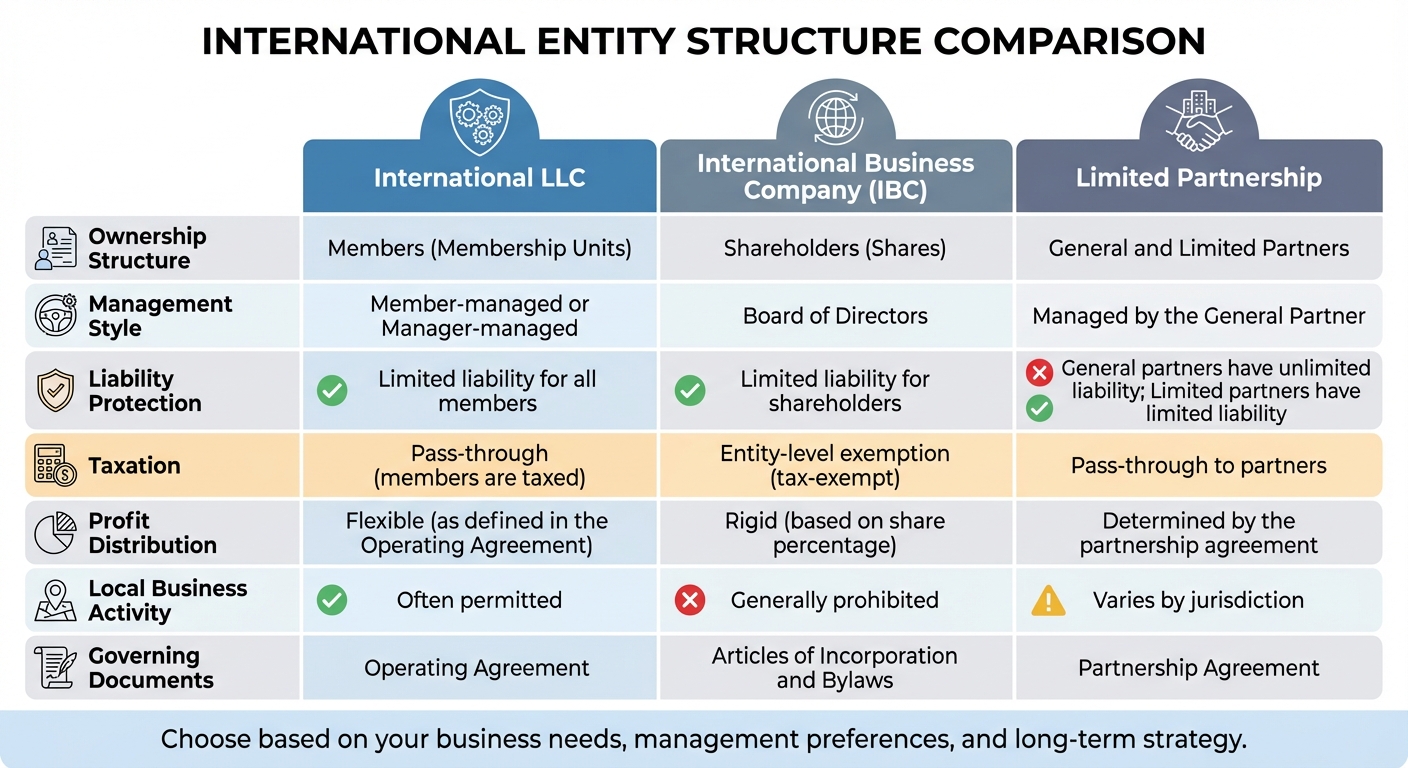
International LLC vs IBC vs Limited Partnership Comparison Chart
Building on the benefits and requirements discussed earlier, let’s compare LLCs with other offshore structures to help you decide which one aligns best with your goals.
Structure Comparison: LLCs, IBCs, and Limited Partnerships
Choosing the right offshore structure depends on your business needs, management preferences, and long-term strategy. Each entity type has its own strengths and limitations.
| Feature | International LLC | International Business Company (IBC) | Limited Partnership |
|---|---|---|---|
| Ownership Structure | Members (Membership Units) | Shareholders (Shares) | General and Limited Partners |
| Management Style | Member-managed or Manager-managed | Board of Directors | Managed by the General Partner |
| Liability Protection | Limited liability for all members | Limited liability for shareholders | General partners have unlimited liability |
| Taxation | Pass-through (members are taxed) | Entity-level exemption (tax-exempt) | Pass-through to partners |
| Profit Distribution | Flexible (as defined in the Operating Agreement) | Rigid (based on share percentage) | Determined by the partnership agreement |
| Local Business Activity | Often permitted | Generally prohibited | Varies by jurisdiction |
| Governing Documents | Operating Agreement | Articles of Incorporation and Bylaws | Partnership Agreement |
This table highlights the key differences to help you weigh your options.
"LLC allows highly customizable internal governance." – Astra Trust
When an LLC Is Your Best Option
For many investors, especially those focused on asset protection and tax neutrality, an International LLC is often the most practical choice. This is particularly true in jurisdictions like Anguilla, where LLCs offer unique advantages.
LLCs are ideal for small, owner-managed businesses where direct control matters and formalities like a board of directors aren’t necessary. For U.S. taxpayers, an LLC simplifies IRS reporting because it’s treated as a pass-through entity – profits flow directly to owners and are reported on their personal tax returns. Additionally, the flexibility of an Operating Agreement allows members to decide how profits are distributed, regardless of capital contributions. This makes LLCs especially appealing for U.S. clients and partners. Unlike IBCs, LLCs in some jurisdictions, such as Anguilla, may also be allowed to conduct local business activities.
When to Use IBCs or Limited Partnerships Instead
In certain scenarios, an International Business Company (IBC) or a Limited Partnership might be the better fit.
An IBC works well for larger operations or when raising capital from multiple investors. Its share-based structure and governance by a board of directors are features that often appeal to institutional investors. IBCs also allow profits to stay within the company for reinvestment, unlike LLCs, which distribute profits directly to members.
"The main difference between an LLC and IBC is that an IBC cannot do business within the borders of the jurisdiction where it is incorporated, whereas an LLC can." – Offshore Circle
Limited Partnerships, on the other hand, are commonly used for investment funds where partners have distinct roles. However, the unlimited liability for general partners makes this structure inherently riskier than LLCs or IBCs. Cost-wise, IBCs typically range from $900 to $1,600 to set up, compared to $650–$750 for U.S. LLCs. Annual maintenance fees vary depending on the jurisdiction.
Some businesses even combine structures, such as using a U.S.-based LLC as the public-facing entity while an IBC holds offshore profits. This hybrid approach can balance operational flexibility with tax efficiency, though it often requires professional expertise to implement effectively.
Conclusion
Setting up an International LLC in Anguilla offers a combination of tax neutrality, asset protection, and operational flexibility. With its 0% tax regime and strict confidentiality measures, Anguilla is an attractive choice for businesses seeking a secure and efficient structure. Its foundation in English common law provides the stability and predictability that investors value.
The Anguilla LLC structure, inspired by the Wyoming LLC model, allows for customized management and profit-sharing arrangements. Unlike traditional corporations, Anguilla LLCs eliminate the need for statutory directors, mandatory annual meetings, or public ownership disclosures. This simplifies operations while maintaining a high level of privacy.
To make the most of an Anguilla LLC, it’s crucial to start with a well-drafted LLC Agreement, engage a licensed registered agent, and ensure compliance with economic substance rules when necessary. Expert advice is essential, especially from professionals knowledgeable about both Anguilla’s regulations and the legal landscape in the United States.
Incorporating an LLC in Anguilla is straightforward, with incorporation fees typically around $2,800 and user-friendly electronic filing systems. However, creating the ideal structure requires a clear understanding of Anguilla’s requirements alongside any tax obligations in your home country. Professional guidance can help you navigate these complexities and fully leverage the benefits of an Anguilla LLC while staying compliant with all regulations.
FAQs
Will a U.S. owner still owe U.S. taxes on an Anguilla LLC?
Yes, U.S. citizens and residents are required to pay taxes on income earned through an Anguilla LLC. U.S. tax laws mandate reporting and taxation on worldwide income, no matter where the company is established. It’s crucial to consult a tax professional to ensure proper compliance with these regulations.
Do Economic Substance rules apply to my Anguilla LLC?
Yes, Economic Substance rules apply to Anguilla LLCs engaged in certain activities. These businesses are required to show a meaningful presence in Anguilla. This includes maintaining qualified employees, incurring operating expenses, and having physical assets located within the territory.
Can I open a U.S. bank account for an Anguilla LLC?
Yes, it’s possible to open a U.S. bank account for an Anguilla LLC, but you’ll need to follow U.S. regulations. Generally, this involves having a U.S.-based registered agent and preparing essential documents like your LLC approval, identification, proof of address, and either an EIN or ITIN. Be sure to check the specific requirements of the bank you’re working with to ensure a smooth process.
