
The digital nomad economy is thriving, with over 40 million remote professionals worldwide. But here’s the challenge: marketing to this group requires more than a one-size-fits-all approach. Tailoring your services to specific regions is essential to connect with their unique needs.
Here’s what you need to know:
- Localized marketing means customizing your messaging, visuals, and offers to match regional norms, currencies, and expectations.
- Digital nomads prioritize different factors based on location – like visa pathways in Europe, cost savings in Southeast Asia, or tax and residency solutions in the Americas.
- Services that resonate include financial and legal support, insurance, co-working spaces, and relocation assistance.
- Top nomad destinations include Lisbon, Bali, and Mexico City, each with distinct challenges and opportunities.
This article dives into how businesses can align their branding, pricing, and campaigns to build trust and deliver value to digital nomads across the globe.
Finding Key Digital Nomad Locations and Customer Groups
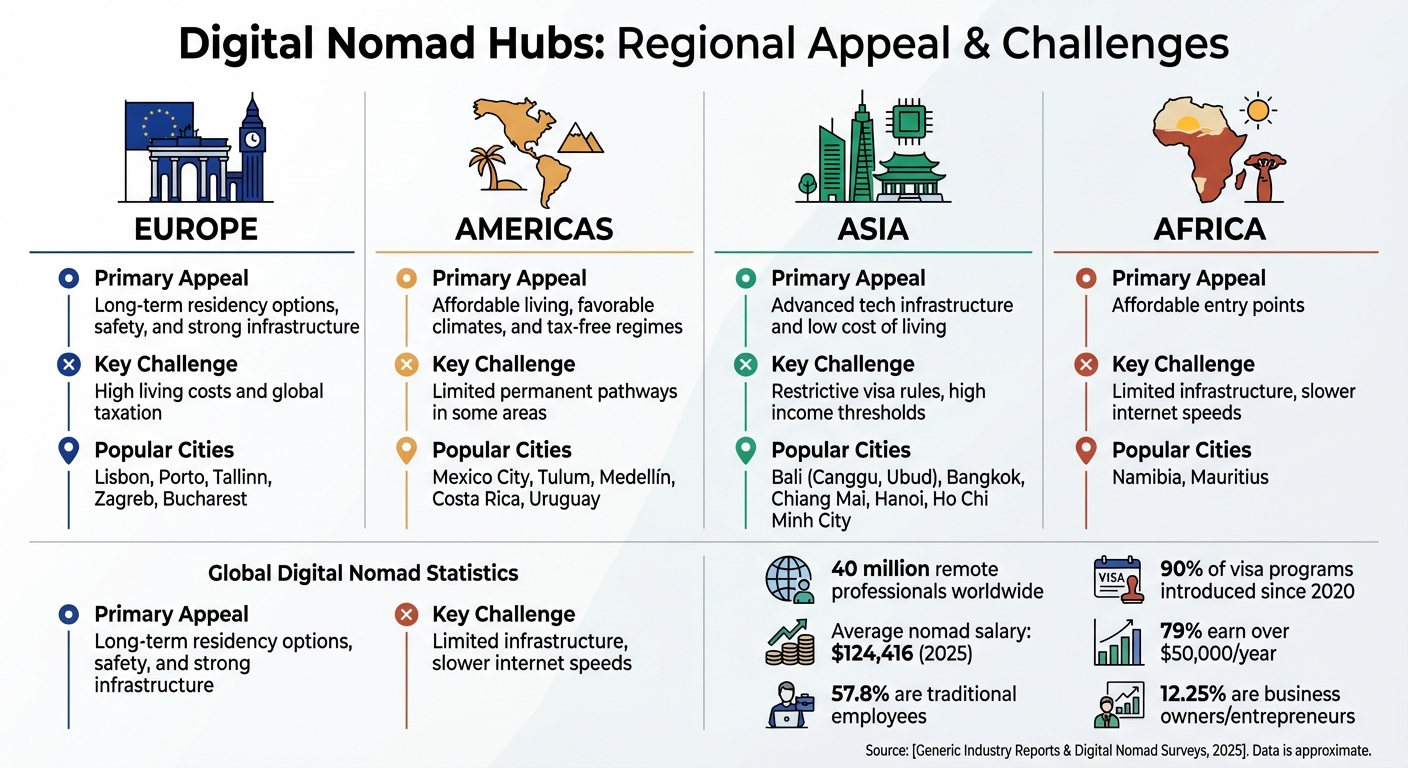
Understanding where digital nomads thrive and what drives them is crucial – especially since 90% of visa programs have been introduced since 2020. This section dives into the top destinations, how to categorize digital nomads, and the data sources that can guide your targeting strategy. It lays the groundwork for effectively reaching this diverse and dynamic group.
Popular Digital Nomad Cities
Europe is a top choice, offering structured visa programs and a high standard of living. Portugal (with hotspots like Lisbon and Porto), Spain, Czechia, and Romania are standout destinations. Eastern European cities, including Tallinn, Zagreb, and Bucharest, are also gaining traction due to fast internet and moderate living costs. These cities are especially appealing to nomads seeking long-term residency options.
Southeast Asia continues to be a favorite for digital nomads. Destinations like Bali (notably Canggu and Ubud), Thailand (Bangkok and Chiang Mai), and Vietnam (Hanoi and Ho Chi Minh City) remain popular. The region’s low living costs, strong expat communities, and reliable high-speed internet make it a magnet for remote workers. However, new visa programs here often come with strict eligibility criteria and high income requirements.
The Americas strike a balance between affordability and lifestyle. Cities such as Mexico City, Tulum, and Medellín attract U.S.-based nomads due to their proximity and similar time zones. Costa Rica and Uruguay have also introduced nomad-specific visas; for instance, Costa Rica requires a monthly income of $3,000 for individuals or $5,000 for families. In the Caribbean, countries like Barbados, the Bahamas, and Bermuda cater to high-earners with "lifestyle" visas, offering tax-free living and tropical backdrops.
"Digital nomads are not simply travelers with laptops; they are active participants in a globalized knowledge economy."
– Global Digital Nomad Report 2025
Here’s a quick comparison of regional appeal and challenges:
| Region | Primary Appeal | Key Challenge |
|---|---|---|
| Europe | Long-term residency options, safety, and strong infrastructure | High living costs and global taxation |
| Americas | Affordable living, favorable climates, and tax-free regimes | Limited permanent pathways in some areas |
| Asia | Advanced tech infrastructure and low cost of living | Restrictive visa rules, high income thresholds |
| Africa | Affordable entry points (e.g., Namibia, Mauritius) | Limited infrastructure, slower internet speeds |
How to Group Digital Nomads
The digital nomad community isn’t one-size-fits-all – it’s made up of diverse groups. Traditional employees now dominate, making up 57.8% of the community, surpassing freelancers. Meanwhile, business owners and entrepreneurs account for 12.25%.
Stay patterns also vary. Some nomads, often called "Slomads", prefer longer stays of several months to a year, using this time to work toward permanent residency or second citizenship. On the other hand, "tourist visa hoppers" move every 90 days, prioritizing flexibility.
Passport strength is another key factor. U.S. nationals lead the pack due to their extensive visa-free travel options. For individuals from less powerful passport countries, digital nomadism can be a stepping stone toward second citizenship. Financially, most nomads are well-off, with an average annual salary of $124,416 in 2025 and 79% earning over $50,000 per year. This purchasing power makes them a prime audience for premium services, provided the value is clear.
Regional preferences also differ. Europe attracts those looking for structured migration pathways and safety. The Americas and Caribbean lure nomads focused on tax benefits and lifestyle perks. Asia appeals to tech-savvy professionals seeking top-tier infrastructure, while Africa draws budget-conscious nomads despite some infrastructure gaps.
Using Data to Choose Target Regions
Data is your best ally when narrowing down target regions. The Global Digital Nomad Report (GDNR) 2025 evaluates 64 countries across factors like visa processes, mobility, tax benefits, quality of life, and tech advancements. It’s a great starting point for identifying nomad-friendly regions and their unique offerings.
Other useful tools include:
- Nomad List: A community-driven platform with real-time data on demographics, salaries, and gender distribution.
- EY Global Immigration Index: An interactive database on remote worker visas, detailing income requirements and other criteria.
- Stack Overflow‘s Annual Developer Survey: Tracks migration trends among tech professionals, highlighting shifts from high- to low-cost areas.
Before targeting a specific city, assess local infrastructure – reliable internet and coworking spaces are major decision factors. Speedtest Global Index and coworking density searches can provide valuable insights. Additionally, active Facebook groups (e.g., "Expats in [City]") and subreddit communities can offer real-time updates on local conditions and sentiment.
Focus on regions where remote workers can enjoy lower costs while earning high urban salaries. These emerging "mobile micro-economies" present significant opportunities. Between 2019 and 2022, the UK saw a 147% increase in digital nomads, with notable shifts: a 42% rise in urban-to-suburban moves, a 31% increase in city-to-rural transitions, and a 67% surge in relocations from high-cost to low-cost areas.
Income thresholds for visas can help you further segment your audience by purchasing power. Many nomad programs – 66% – use a one-year renewable visa model, signaling a trend toward stability in these regions. By aligning your strategy with these data-driven insights, you can better connect with digital nomad trends and preferences.
sbb-itb-39d39a6
Adjusting Your Brand and Messages for Local Markets
Once you’ve pinpointed key digital nomad hubs, the next step is fine-tuning your brand voice to resonate with local audiences. This doesn’t mean reinventing your brand entirely – it’s about staying true to your identity while addressing specific regional needs. For instance, a digital nomad in Lisbon eyeing long-term residency will have very different priorities compared to someone in Bali, where affordable living and a tropical lifestyle take center stage. This localized approach naturally feeds into refining your value proposition to align with what matters most in each market.
Tailoring Your Value Proposition by Location
Your core offering stays intact, but the emphasis shifts based on local preferences. In European cities like Lisbon or Tallinn, digital nomads often prioritize clear visa pathways and long-term stability. In these markets, showcasing your expertise in regulatory compliance and long-term planning can strike a chord. On the other hand, in Southeast Asia, where affordability and lifestyle flexibility dominate, focusing on cost savings and simplified short-term solutions is more effective.
In the Americas – think hubs like Mexico City, Medellín, or Costa Rica – tax optimization and proximity to the U.S. are key selling points. Many nomads in these areas maintain U.S. business ties while enjoying lower living expenses. Meanwhile, Caribbean destinations like Barbados or the Bahamas attract high-earners who value wealth preservation and privacy. Understanding these regional priorities is essential to crafting a message that resonates.
Once your value proposition reflects these local priorities, weave these insights into your overall branding strategy.
Location-Based Branding Methods
Localization goes beyond translation – it’s about adapting visuals, tone, and layout to reflect local nuances. This process, known as transcreation, ensures your brand’s emotional appeal aligns with cultural expectations. For example, the color red might symbolize luck in one culture but caution in another.
Practical localization strategies include creating city-specific landing pages that highlight local landmarks, display region-specific currencies, and feature testimonials from nomads in that area. Use location-targeting tools to automatically show local phone numbers, business hours, and promotions. Geo-targeted social media posts have been shown to perform six times better than generic global ones, while localizing currency displays on product pages can boost conversion rates by 40%. Many global brands succeed by tailoring visuals and messaging to local audiences.
"Localizing is not only translation to different languages but also semantics like spelling, idioms, date formatting, currency symbols – plus design that considers the cultural context. These may sound like little details, but this is what makes someone feel the experience was made for them."
– Derek Gleason, Senior Lead, Content, Shopify
How Global Wealth Protection Can Customize Services for Different Nomad Hubs
Using regional insights, tailor your services to address the unique challenges of each market. Global Wealth Protection provides a great example of this. In European hubs, the company emphasizes how private U.S. LLC formation can strengthen business ties while preserving U.S. benefits – an attractive option for nomads planning long-term stays. In Southeast Asia, where mobility is a priority, they focus on offshore company setups that simplify compliance across multiple countries. For nomads in the Americas, highlighting tax optimization strategies tailored to work across time zones reinforces both convenience and effectiveness. Meanwhile, in high-earning Caribbean markets, their premium services – offshore trusts and privacy-focused solutions – address the wealth-preservation needs of this audience. By aligning services with the challenges of each region, you not only build trust but also show that your offerings are designed with local needs in mind.
Marketing Channels and Campaign Tactics by Location
Once you’ve tailored your messaging, the next step is choosing the right channels and tactics to connect with your audience locally. For digital nomads, who are always on the move, this means combining precise geographic targeting with platforms they frequently use while traveling. Your strategy should seamlessly blend digital and local outreach to meet them wherever they are.
Location-Targeted Digital Ads
Platforms like Google Ads allow for detailed location targeting, letting you focus on specific cities, postal codes, or even a set radius around a particular area. For example, if you’re marketing tax consultation services and the Portugal digital nomad visa, you can use radius targeting to focus on popular areas like Príncipe Real or Cais do Sodré. Adjusting bids for these zones helps your ads gain visibility locally.
Google Maps is another effective tool for reaching nomads who are actively searching for services in new cities. In fact, 54% of smartphone users can be reached through localized campaigns on Maps. Adding location extensions to your ads ensures that nomads can easily find your contact details and reach out without hassle.
Social platforms like Facebook, Instagram, and LinkedIn also offer options to target users by location and interests. For instance, you could target English-speaking nomads in Bangkok by setting the language filter to English and using "Presence or Interest" targeting. This approach has proven effective, with advertisers in the travel sector seeing a 5% boost in conversions. You can also adjust bids to prioritize high-value markets while using negative location targeting to avoid spending in areas where your services aren’t available. These strategies create opportunities to deliver content that connects on a local level.
Creating Location-Specific Content
Local content needs to go beyond translation – it should resonate deeply with the audience. Start by building city-specific landing pages that address the unique needs of nomads in each location. For instance, a page for Mexico City might emphasize tax optimization for U.S.-based businesses, while a Bali-focused page could highlight compliance solutions for multi-country operations. Include visuals, testimonials from local nomads, and references to well-known landmarks to make the content relatable.
Local SEO is also critical. With Google commanding 84.69% of the search market and 96% of consumers reading local business reviews before making decisions, optimizing for location-specific keywords is a must. Search terms that nomads use in one city may differ significantly in another, so research is key. Use subdirectories (e.g., yoursite.com/lisbon) and implement hreflang tags to ensure search engines understand which regions your pages target. Avoid relying on machine translation – human-vetted localization maintains professionalism and credibility. Instead of auto-redirecting users based on location, offer alternate versions of your content when it makes sense.
To establish trust, your content should demonstrate E-E-A-T (Experience, Expertise, Authoritativeness, Trustworthiness). Include practical advice, first-hand insights, and references to credible sources.
"Local businesses should focus on branding, customer experience, and developing their expertise. With generative AI coming into play, having lots of content about your topic isn’t enough. Your content across all platforms needs to paint a clear picture of who you are and why you’re important."
– Amanda Jordan, RicketyRoo
Consider creating detailed city guides that address the practical concerns of digital nomads, like visa requirements, banking options, tax regulations, or business registration processes. This type of content not only helps your audience but also positions you as a trusted resource.
Building Local Partnerships and Communities
Community recommendations are vital for digital nomads, making local partnerships a powerful way to build trust and visibility. Co-working spaces, for example, are natural allies – 88% of mobile searches for local businesses result in a call or visit within 24 hours. Partnering with these spaces to offer exclusive packages, like a free initial consultation or sponsorship of networking events, can help you connect with your audience.
Sponsoring local events is another way to boost visibility. Hosting a "Digital Nomad Meetup" in Chiang Mai or sponsoring a tech talk in Lisbon connects you directly with potential clients. This approach aligns with the fact that 38% of consumers shop locally to feel more connected to their community. If your audience includes nomad parents, consider family-focused events instead of nightlife gatherings.
Collaborating with influencers who know the local scene can also amplify your efforts. Partner with city guide bloggers or community leaders, offering them your services in exchange for authentic reviews or user-generated content that resonates with your audience.
Cross-promotions with complementary businesses can further extend your reach. For example, team up with local cafes, gyms, or language schools to create joint packages like "Business Setup + 3 Months Co-working" or "Tax Consultation + Local Banking Introduction." Each partner can promote the offer to their customer base, creating a win-win scenario. Consistent Name, Address, and Phone (NAP) details across these partnerships also strengthen your local SEO.
Finally, joining local business networks or chambers of commerce can further boost your visibility. With 97% of people learning about local businesses online, being part of these networks ensures you’re seen where it matters most.
Building Location-Specific Offers and Pricing
Crafting the right pricing and packages for different locations starts with understanding what digital nomads need and what they’re willing to pay. With an average annual salary of $124,034 USD, this market has considerable spending power. But not all nomads are alike, so your offerings need to address a variety of preferences. By tailoring your services, you can meet the diverse demands of nomads across regions.
Creating City-Specific Service Packages
Think about how travel patterns shape your audience. For instance, "slowmads" tend to stay in one place for 2–3 months, making them ideal candidates for monthly discounts and community-driven perks. Part-time nomads prioritize reliable Wi-Fi and flexible booking, while full-time travelers often seek high-speed internet and ergonomic work setups.
Your packages should also address location-specific hurdles. Consider bundling services that help nomads navigate local financial and regulatory systems. For example, you could collaborate with local businesses to offer exclusive rates for coworking spaces or gyms. Upselling extras like airport transfers, local SIM cards, or guides covering visa rules and transportation options can add value to your offerings.
Another idea? Develop "Welcome Packages" that tackle common local challenges, such as regulatory and financial obstacles. These packages can help position your services as a go-to solution for digital nomads.
Setting Prices for Different Markets
Price your services in USD, but also display local currency equivalents to make things easier for clients. Tiered pricing based on engagement length can also be effective. For instance, a one-time consultation might stick to your standard rate, while a three-month retainer could come with a discounted price to attract slowmads. With 36% of digital nomads earning between $100,000 and $250,000 annually, there’s room to offer premium services, though affordability remains key.
Diverse payment options like Apple Pay, Google Pay, and cryptocurrency can help reduce foreign exchange fees. If you’re using booking platforms, consider offering a lower "direct-only" rate on your website to avoid commission fees. Don’t forget to factor in local purchasing power and competition when setting your prices.
Once your packages are ready, fine-tune pricing to match the economic realities of each market.
Time Zones and Local Compliance
Competitive offers go beyond pricing – they also need to align with local time zones and regulatory requirements. Use tools like WhatsApp or Slack to match your clients’ schedules. For consultations, consider offering specific availability blocks tailored to key nomad hubs, such as early mornings for European clients or evenings for those in Asia.
Compliance is another critical piece of the puzzle. Digital nomads must track their time in each country down to 24-hour increments to qualify for tax benefits like the Foreign Earned Income Exclusion. Your service packages could include guidance on tracking these requirements and navigating local tax obligations. As of April 2023, 51 countries offer digital nomad visas, with 36 of them outlining specific taxation policies that nomads must adhere to.
If your services involve regular meetings or local staffing, keep "permanent establishment" rules in mind. Even small activities, like frequent customer meetings, can trigger a taxable presence, potentially requiring adjustments to cover corporate income taxes. For U.S.-based nomads, some states mandate tax withholding even for a single day of work. Building flexibility into your services to handle these compliance complexities ensures your pricing accounts for the administrative overhead of multi-jurisdiction regulations.
Tracking Results and Avoiding Common Mistakes
Once you’ve crafted tailored campaigns and localized content, the next step is to monitor their performance and steer clear of common pitfalls. To measure the success of localized campaigns, focus on metrics like conversion rates, cost per local lead (CPL), customer lifetime value (CLV), and local search visibility. Considering that 76% of people who search for a local business on their smartphone visit within 24 hours, keeping a close eye on your visibility in Google’s Local Pack is essential.
Key Metrics for Location-Based Campaigns
Go beyond simple traffic numbers and dive into metrics that reveal regional behavior. For example:
- Repeat purchase rate by location: This shows which cities have the most loyal customers, helping you decide where to focus retention efforts.
- Engagement signals: Metrics like click-to-call actions and appointment bookings highlight genuine interest in specific areas.
- Sentiment analysis: Tools that analyze local reviews and social media comments can reveal customer satisfaction trends. A one-star improvement in ratings has been shown to increase revenue by 5–9%.
It’s worth noting that while over 40% of Google searches have local intent, only 27% of marketers track sales revenue tied directly to location marketing. That’s a missed opportunity to connect your efforts to real-world results.
Setting Up Analytics and Tracking
To make sense of your data, you’ll need to set up analytics tools thoughtfully:
- Google Analytics: Segment your data by city or ZIP code instead of lumping all traffic into one national category.
- UTM Parameters: Use these on your Google My Business links (e.g.,
utm_campaign=gmb-lisbon) to differentiate map-based traffic from organic search. - Google Tag Manager: This tool helps you manage tracking snippets for different locations without constantly tweaking your website code.
- Dynamic Number Insertion: Assign unique tracking numbers to each visitor for phone inquiries while maintaining consistent business information for SEO.
One smart move is assigning conversion values based on your typical sale and closing rate. For instance, if 10% of leads close at $1,000, each conversion is worth $100. This approach ties abstract metrics to actual revenue, giving you a clearer picture of your campaign’s financial impact.
Avoiding Localization Risks
Localization isn’t just about translating text – it’s about adapting to local contexts, currencies, and regulations. A classic example of poor localization is a product name that unintentionally offended Spanish-speaking markets. To avoid these blunders, hire native-language copywriters who understand the nuances of the region. Studies show that 40% of consumers won’t buy if a site isn’t properly localized.
"Localization goes beyond merely having to translate website content, and it connects with consumers on a personal level, builds your brand image in a way that is both accessible and unique. In short, localization is about building trust."
- Danyelle C. Overbo, Contributor, Smartling
Here are a few technical tips to avoid common mistakes:
- Don’t hard-code URLs or strings into your codebase – this makes updates a nightmare as you scale.
- Skip IP-based redirects. Instead, offer a manual location selector to let users choose their preferred site version.
- Keep your NAP (name, address, phone number) details consistent across directories to prevent confusion for search engines.
Finally, think strategically about how you allocate resources. Should you focus on one or two key hubs or spread your efforts across multiple regions? Here’s a quick comparison:
| Strategy Type | Focus | Pros | Risks |
|---|---|---|---|
| Focused Location Strategy | Invest heavily in 1–2 top hubs (e.g., Medellín, Chiang Mai). | Builds strong local presence and authority; streamlined operations. | Vulnerable to local economic or regulatory changes. This is particularly relevant when managing location independence and asset protection across different jurisdictions. |
| Diversified Location Strategy | Expand across multiple hubs globally. | Reduces risk; captures diverse market trends; less dependent on one location. | More complex to manage; higher costs; potential for diluted messaging. |
Deciding between these approaches depends on your risk tolerance and resources. One final note: speed matters. If you wait 30 minutes to respond to a lead instead of 5 minutes, your odds of qualifying that lead drop 21 times. By tracking the right metrics and avoiding these common mistakes, you can optimize your localized campaigns for better performance while minimizing costly errors.
Conclusion and Key Takeaways
Localized marketing isn’t just about translating words – it’s about tailoring your approach to fit the cultural, legal, and practical nuances of each nomad hub. For instance, a study found that 72.4% of consumers are more likely to buy from a brand that communicates in their language. On top of that, geo-targeted social media posts perform significantly better, being six times more effective than generic global content.
Main Strategies Recap
To succeed, start by identifying key nomad hubs like Lisbon, Chiang Mai, and Medellín. Then, adapt your messaging to meet the unique needs of each location. Use transcreation – a blend of translation and creative writing – to maintain the emotional tone of your content while respecting local idioms and traditions.
Your choice of marketing platforms should align with the audience you’re targeting. For example:
- In China, prioritize Baidu and WeChat over Google and Facebook.
- In Russia, focus on Yandex and VK to engage effectively.
Optimize your content for these platforms, and track localized metrics such as conversion rates, search visibility, and engagement. As Danyelle C. Overbo from Smartling explains:
"Localization goes beyond merely having to translate website content, and it connects with consumers on a personal level, builds your brand image in a way that is both accessible and unique. In short, localization is about building trust"
By following these strategies, you’ll be better equipped to avoid common missteps and create campaigns that truly resonate.
Final Recommendations
To refine your localized marketing efforts:
- Hire local experts instead of relying on automated tools. Machines often miss the subtle cultural nuances that make a message resonate.
- Test your messaging with native speakers to catch any translation errors before launch.
- Ensure consistency in your NAP (name, address, phone number) details across all directories to maintain strong search engine rankings and customer confidence.
Lastly, keep evolving. The digital nomad world changes constantly – visa rules shift, new hubs emerge, and preferences evolve. Use performance data to fine-tune your approach. Start small by focusing on one or two key hubs, perfect your strategy, and then expand thoughtfully as you learn what works in each market. By blending cultural awareness with data-driven insights, you can craft campaigns that connect locally and scale globally.
FAQs
How can businesses attract digital nomads by tailoring their marketing to different locations?
To draw in digital nomads, businesses need to tailor their marketing to reflect what makes each destination appealing. Start by leveraging geo-targeted ads and localized content that emphasize essentials for remote workers, such as visa-friendly policies, affordable living costs, and dependable internet access. Highlight local perks like ergonomic workspaces, high-speed internet, and quiet zones – whether it’s a beachfront co-working hub or a cozy café with a stunning view.
Connecting with the local community can make a big difference, too. Partner with co-working spaces, organize events that mix work with leisure, and team up with regional influencers who can genuinely showcase the destination. Social media is a great tool for sharing engaging stories about the area’s lifestyle, attractions, and unique vibe, transforming the location into more than just a place to work.
Don’t overlook practical details either. For U.S.-based audiences, display prices in U.S. dollars ($), use the MM/DD/YYYY format for dates, and provide measurements in imperial units. By aligning your messaging with both the practical needs and cultural nuances of each location, you can create a personalized experience that resonates with digital nomads and builds lasting loyalty.
What factors do digital nomads consider when choosing a place to work and live?
Digital nomads weigh several factors when choosing their next destination. At the top of the list is the cost of living – finding a place where their earnings stretch further is essential. Equally important is having access to a reliable, high-speed internet connection, which is non-negotiable for staying productive while working remotely.
Other key considerations include safety and healthcare access. Feeling secure and having medical support readily available are crucial for peace of mind. Many also seek destinations with flexible visa options, such as digital nomad visas, which make it easier to settle in and stay for an extended period.
Factors like climate and lifestyle also play a big role. Destinations with coworking spaces, engaging activities, and a friendly, welcoming community can significantly enhance the overall experience, offering a balance between work and leisure.
By carefully assessing these elements, digital nomads can find places that align with their work needs and personal happiness.
How does localized marketing help brands connect with digital nomads and build trust?
Localized marketing helps brands connect with digital nomads by crafting a more tailored and personal experience. By aligning messaging with local languages, traditions, and preferences, companies show they understand and respect the unique context of their audience. This connection can be as simple as using regional payment options, referencing area-specific events, or customizing landing pages based on the visitor’s location – all of which make interactions feel relevant and meaningful.
Brands can also take it a step further with strategies like region-specific social media content, localized SEO efforts, and targeted email campaigns. Offering perks tied to a nomad’s location, like discounts at coworking spaces or partnerships with local businesses, shows genuine support for their lifestyle. These personalized touches not only build trust but also encourage loyalty and spark recommendations within this ever-mobile community.
