
Structuring offshore trusts is a legal tool for protecting your wealth from lawsuits and creditors. By transferring assets to a trust in a foreign jurisdiction like Anguilla, Cook Islands, or Nevis, you can enjoy strong legal protections unavailable in the U.S. Here’s what you need to know:
- How It Works: You transfer ownership of your assets to a foreign trustee who manages them for your benefit. U.S. courts can’t force foreign trustees to comply with judgments.
- Who Uses Them: Popular among doctors, lawyers, business owners, and families with $250,000+ in assets.
- Benefits:
- Protection from lawsuits and creditors.
- Privacy – foreign jurisdictions often keep trust details confidential.
- Simplified estate planning – avoids probate and forced heirship laws.
- Tax neutrality for U.S. citizens (income reported on personal tax returns).
Anguilla stands out as a top jurisdiction due to its zero-tax policies, strong legal protections, and quick setup process (under 24 hours, $250 registration fee). Offshore trusts are especially useful for shielding liquid assets, investments, and intellectual property, while also offering a layer of privacy and control.
If you’re looking to safeguard your wealth, an offshore trust might be the solution. Just ensure compliance with U.S. tax laws and work with experts for proper setup and management.
Benefits of Offshore Trusts
Offshore trusts offer three main benefits: protection from lawsuits, privacy, and simplified estate planning. These perks stem from the legal separation that occurs when assets are transferred to a foreign trustee under foreign laws. Jurisdictions like Anguilla are known for maximizing these protections.
Protection from Creditors and Lawsuits
One of the biggest advantages of offshore trusts is the jurisdictional separation they provide. When you transfer assets to an offshore trust, those assets are no longer legally yours – they belong to the trust. This makes it difficult for personal creditors to access them. As asset protection attorney Jon Alper explains:
"The fundamental principle is jurisdictional separation: assets are owned by foreign entities, administered by independent foreign trustees, and governed by foreign law."
Because foreign trustees operate outside U.S. jurisdiction, U.S. courts cannot force them to comply with domestic orders. For example, Anguilla doesn’t recognize foreign judgments, meaning creditors must start legal proceedings from scratch in the local courts. This process can be both costly and complex, requiring creditors to hire local attorneys, post bonds (often $25,000 to $50,000), and prove their case under local laws. In some places, like the Cook Islands, creditors face an even higher hurdle: they must prove their claims "beyond a reasonable doubt", the same standard used in criminal trials.
Additionally, offshore jurisdictions often impose a short statute of limitations – usually just one or two years – for challenging fraudulent transfers. Once this window closes, the transfer is nearly impossible to contest. Even if creditors manage to pursue a claim, their options are limited. Typically, they can only obtain a charging order, which allows them to collect distributions made by the trustee but doesn’t let them force the sale of assets or seize the trust’s principal.
Tax Efficiency and Privacy
For U.S. citizens, offshore trusts are tax-neutral. The IRS treats these trusts as grantor trusts, meaning all income is reported on your personal tax return without creating additional tax obligations.
Privacy is another key advantage. In Anguilla, for example, the government-filed Trust Charter does not include the names of the settlor or beneficiaries. Additionally, the trust’s terms and asset details remain confidential. This level of anonymity can discourage "deep pocket" lawsuits. On top of that, jurisdictional barriers prevent creditors from using U.S. subpoenas to access trust information.
Estate Planning and Probate Avoidance
Offshore trusts also simplify estate planning. Since the trust owns the assets, they are kept out of your estate, allowing your heirs to bypass the lengthy, expensive, and public probate process. Unlike a will, which becomes a public document, an offshore trust keeps your family’s financial matters private.
Another advantage is protection against forced heirship laws. In some countries, these laws require assets to be distributed in a specific way among relatives, regardless of your wishes. Jurisdictions like Anguilla do not recognize these rules, giving you full control over how your wealth is distributed. Furthermore, with the abolition of the Rule Against Perpetuities in certain regions, trusts can continue indefinitely, allowing wealth to grow and benefit multiple generations. For families with businesses, the trust can own family corporations, ensuring smooth operations and uninterrupted profit distribution to heirs.
When combined with Anguilla’s favorable legal and tax framework, these benefits make it an attractive option for forming offshore trusts.
sbb-itb-39d39a6
Why Anguilla Is the Top Jurisdiction for Offshore Trusts
Anguilla stands out as a leading destination for offshore trusts, thanks to its zero-tax policies, strong privacy laws, and stable political environment. As a British Overseas Territory governed by English Common Law, Anguilla has also introduced modern legislation to bolster asset protection.
Anguilla’s Tax-Free Policies
One of Anguilla’s biggest draws is its lack of taxes on offshore trusts. There are no income, corporate, capital gains, or inheritance taxes, allowing trust assets to grow without tax-related interruptions. Setting up a trust is straightforward, with just a one-time registration fee of $250 and no annual renewal fees. Plus, the process is quick – registration is typically done within 24 hours.
These tax benefits are paired with robust privacy and legal protections, making Anguilla a standout choice.
Privacy and Legal Safeguards
Anguilla’s legal framework is designed to protect the privacy of trust participants. For instance, the Trust Charter filed with the government does not disclose the names of the settlor or beneficiaries – something not all jurisdictions offer. According to First Anguilla Trust Company Limited:
"Unless you commit an extreme criminal offense, it is almost impossible for anyone to get through the veil of confidentiality that an offshore trust offers."
Anguilla also provides strong legal barriers against foreign claims. Its courts do not enforce foreign court orders related to divorce, inheritance, bankruptcy, or taxes. Creditors must file new legal cases locally, where they face a strict three-year statute of limitations from the date assets were transferred. The Anguilla Trust Act of 2014 further strengthens protections by eliminating the Rule Against Perpetuities, allowing trusts to exist indefinitely.
Political Stability and Global Standing
Anguilla’s political stability adds another layer of security for offshore trusts. As a British Overseas Territory since 1980, it operates under a well-established constitutional framework, similar to Bermuda and the Cayman Islands. Its legal system is grounded in English Common Law and overseen by the Eastern Caribbean Supreme Court, with final appeals handled by the UK Privy Council.
The Anguilla Financial Services Commission (AFSC) ensures compliance with international standards for due diligence and anti-money laundering, aligning with organizations like the OECD and FATF. For U.S. clients, the use of English as the official language simplifies legal processes. As Geneva Trust highlights:
"Its reputation for excellence is its greatest strength, making it a major role player in international finance."
Anguilla’s combination of tax advantages, privacy protections, and political stability creates an ideal environment for safeguarding assets against lawsuits and creditor claims. These factors work seamlessly together to make it a top choice for offshore trusts.
How Offshore Trusts Shield Assets from Lawsuits
Offshore trusts protect assets by combining legal ownership transfers, jurisdictional hurdles, and strict time limits for lawsuits. Together, these factors create a robust barrier around your wealth.
Legal Separation of Ownership
When you set up an Anguilla trust, you transfer legal ownership of your assets to a trustee. Since these assets are no longer part of your personal estate, creditors typically can’t access them to satisfy judgments against you.
A common setup involves the trust owning an offshore Limited Liability Company (LLC). You can act as the manager of this LLC, allowing you to oversee investments and business decisions. This way, you retain operational control without the risks tied to personal ownership.
This transfer of ownership serves as the foundation for the additional protections offered by Anguilla’s legal system.
Jurisdictional Protections in Anguilla
Anguilla’s laws ensure that foreign judgments, such as those from U.S. courts, carry no authority. Creditors would need to start fresh by filing a lawsuit in Anguilla, facing significant local legal challenges. As Global Wealth Protection notes:
"In Anguilla, however, US court rulings hold no bearing whatsoever."
Beyond this, creditors must adhere to a three-year statute of limitations from the date assets are transferred into the trust. Even within this period, they must prove either that you were insolvent at the time of transfer or became insolvent as a result – a difficult standard to meet.
Example: How an Offshore Trust Protects Assets During a Lawsuit
Imagine a U.S. business owner who, three years ago, created an Anguilla trust and transferred $2 million in investment accounts and real estate into it. The trust owns a Wyoming LLC for asset protection, which holds the property titles, while the business owner acts as the LLC manager.
Now, a lawsuit in California results in a $1.5 million judgment. The creditor learns about the offshore trust and tries to enforce the California ruling against the trust’s assets. Here’s what happens:
The California judgment is unenforceable in Anguilla. To pursue the assets, the creditor must hire local lawyers and file a new lawsuit in Anguilla. However, because more than three years have passed since the asset transfer, the creditor is barred by the statute of limitations from making a fraudulent transfer claim.
As a result, the trust’s assets remain secure. The creditor is left with the choice of dropping the case or spending substantial time and money on offshore litigation with slim chances of success. This often leads creditors to settle for a fraction – typically 10% to 20% – of the original judgment amount.
Setting Up an Offshore Trust in Anguilla with Global Wealth Protection

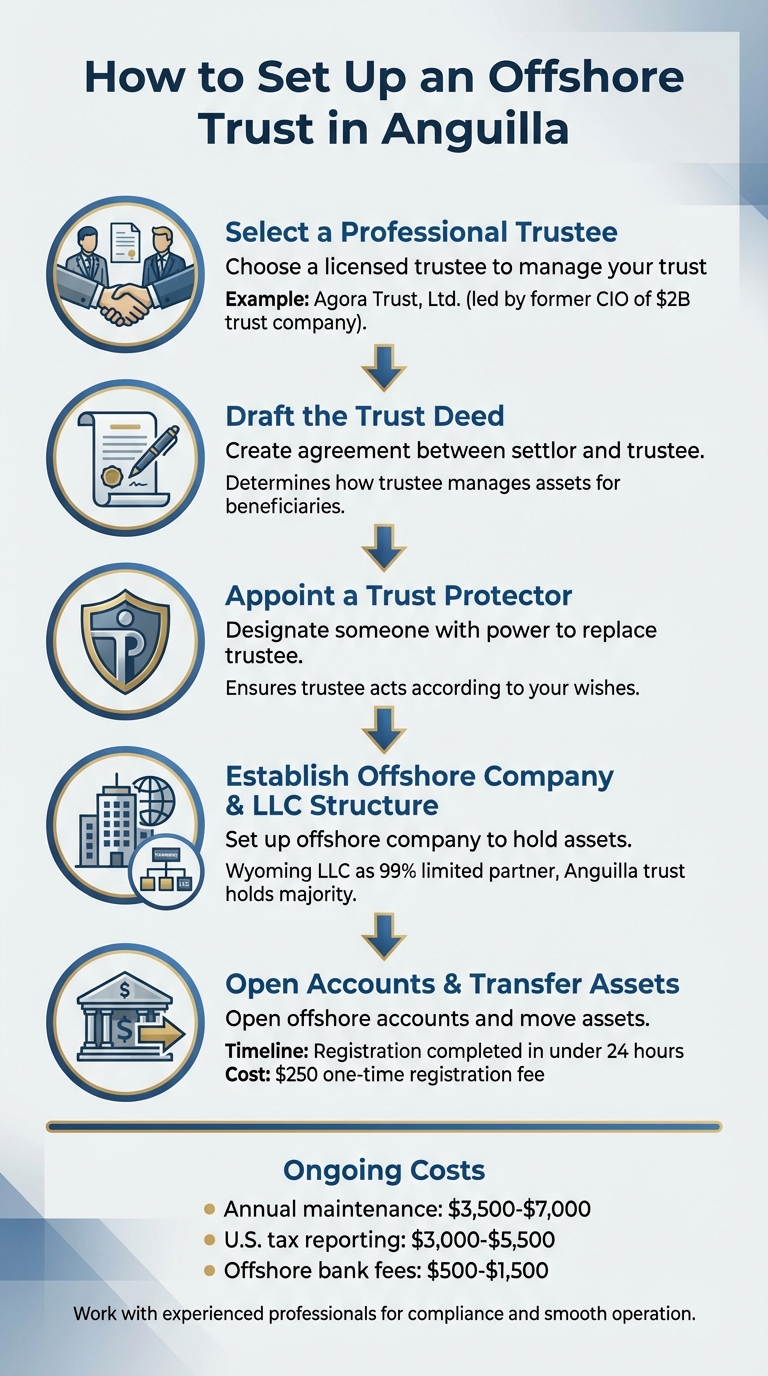
5 Steps to Establish an Offshore Trust in Anguilla
Steps to Establish an Offshore Trust in Anguilla
Creating an Anguilla trust involves several key steps designed to safeguard your assets legally.
The first step is selecting a professional trustee. Global Wealth Protection collaborates with Agora Trust, Ltd., a licensed trustee led by a former Chief Investment Officer of a $2 billion trust company, to ensure expert management of your trust.
Next, you’ll draft the trust deed, which acts as the agreement between you (the settlor) and the trustee. As Global Wealth Protection explains:
"A trust is simply a contract between you as settlor (or grantor) and trustee that determines how the trustee will manage your assets for your beneficiaries."
To further protect your interests, appoint a trust protector. This individual has the authority to replace the trustee if needed. According to Global Wealth Protection:
"Should Agora Trust, Ltd. begin to do anything against your wishes, the protector has the power to immediately fire Agora as Trustee and replace us with something else."
The trust will then establish an offshore company to hold your assets, allowing you to maintain control over asset management while ensuring a legal separation. For U.S.-based assets, such as real estate, an anonymous Wyoming LLC can act as the 99% limited partner, with the Anguilla trust holding the majority interest.
You’ll also need to open offshore accounts and transfer your assets to keep them beyond the reach of U.S. courts. Registration for these accounts can be completed in under 24 hours.
Once these steps are complete, working with experienced professionals ensures your trust remains compliant and operates smoothly.
Why Work with Global Wealth Protection
Global Wealth Protection specializes in helping U.S. clients navigate tax compliance and reporting. They ensure your accountant receives all the necessary details for annual filings, including Forms 3520, 3520-A, and 8938.
They also offer personalized 60-minute consultations to address your financial goals and asset protection needs. For ongoing support, their GWP Insiders membership provides access to a library of strategies for international asset protection and discounts on trust administration services.
A key advantage of their approach is the multi-jurisdictional structure that places the trustee outside U.S. court jurisdiction. As they highlight:
"In Anguilla, however, US court rulings hold no bearing whatsoever. Moreover, there is literally no standing whatsoever for a creditor to challenge your Anguilla unless a creditor can prove that the assets were fraudulently conveyed."
With a trust in place and professional guidance, maintaining effective management is essential to preserve its protective benefits.
Trust Management and Compliance
Proper trust management is critical for ensuring your asset protection plan remains effective. Global Wealth Protection works alongside Agora Trust to handle annual government filings, produce accurate financial statements, and provide regular updates to beneficiaries.
The trustee maintains a registered office and agent in Anguilla to manage legal and regulatory documents. They also conduct thorough KYC (Know Your Customer) and AML (Anti-Money Laundering) checks, verifying identity, address, and sources of funds.
Annual maintenance costs typically range from $3,500 to $7,000. U.S. tax reporting fees add another $3,000 to $5,500, while offshore bank account fees range from $500 to $1,500.
Litigation readiness is another vital aspect of trust management. Asset protection attorney Gideon Alper emphasizes:
"The trustee’s ability to respond to creditor attacks is central to the trust’s ability to withstand challenges."
Periodic reviews of the trust deed are also recommended to address changes in personal circumstances, like marriage, divorce, or the addition of new heirs. These updates help ensure the trust remains legally relevant and aligned with your goals.
Conclusion
Offshore trusts offer a strong layer of legal separation between you and your assets, effectively blocking creditors from accessing your wealth during lawsuits. They provide a combination of privacy, tax neutrality, and long-term wealth preservation that domestic options simply cannot match.
When it comes to asset protection trusts, Anguilla emerges as a top choice. Its robust legal framework, including strict creditor requirements, refusal to recognize foreign judgments, and tax-free status – no income, capital gains, or inheritance taxes – makes it an ideal jurisdiction. Plus, with trusts that can last indefinitely, Anguilla ensures your family’s financial security for generations.
Global Wealth Protection offers expert guidance in offshore legal strategies while delivering customer service tailored to American clients. They specialize in U.S. tax compliance, providing all necessary documentation to ensure you meet IRS requirements. Their collaboration with Agora Trust, Ltd. – led by a former Chief Investment Officer of a $2 billion trust company – adds a level of institutional expertise to your asset protection plan.
Additionally, built-in protector roles give you the authority to replace the trustee if needed. This feature, combined with professional trust management and compliance support, lets you safeguard your assets while maintaining practical oversight.
In a world where lawsuits are increasingly common, an Anguilla offshore trust acts as a shield against judicial overreach and baseless claims. With the right planning and expert assistance, you can protect your wealth, ensure compliance with U.S. tax laws, and secure your financial legacy for years to come.
FAQs
Can I still control my money after it’s in an Anguilla trust?
Yes, you can still manage your money, but the way you do so shifts. When assets are placed in a trust, legal ownership is transferred to the trust itself, which is overseen by a professional trustee. While you lose direct control, you can maintain certain powers that allow you to guide how the assets are managed and distributed, as outlined in the trust’s terms. This setup provides solid protection against creditors while ensuring you stay compliant with legal requirements and maintain some level of influence.
When is it too late to move assets into an offshore trust?
It’s often too late to transfer assets into an offshore trust once legal claims or liabilities are on the horizon or already in progress. Courts might see these transfers as fraudulent and decide to nullify them. To avoid this, it’s best to set up your trust well in advance, during calm periods. This ensures the transfer appears legitimate and isn’t viewed as an effort to dodge creditors or legal responsibilities.
What IRS forms do I have to file for an offshore trust?
If you’re dealing with a foreign trust that has a U.S. owner, you’ll need to file IRS Form 3520-A to report it. On top of that, depending on your circumstances, you might also need to file Form 3520 to disclose any transactions with the trust or to report foreign gifts. For clarity on your specific obligations, it’s a good idea to check the IRS guidelines or consult a tax professional.
