
Navigating global wealth protection can be challenging, especially for U.S. investors who face taxation, inflation, and government debt concerns. Many are turning to international jurisdictions that offer tax advantages, political stability, and strong asset protection laws. Key options include:
- Cayman Islands: Zero taxes on income, corporate earnings, and capital gains. Strong asset protection laws and stable governance under UK oversight.
- British Virgin Islands (BVI): No taxes on income or capital gains, with a simple regulatory framework for offshore companies.
- Singapore: Territorial tax system, 0% capital gains tax, and robust legal protections. High political stability and financial infrastructure.
- Switzerland: Flexible tax rates, lump-sum taxation for foreigners, and unparalleled financial privacy. Strong legal and political systems.
- Anguilla: Straightforward 0% tax system, secure asset protection laws, and efficient company registration.
Each jurisdiction offers unique benefits, from tax-free environments to advanced legal frameworks. However, the right choice depends on your financial goals, residency preferences, and compliance needs.
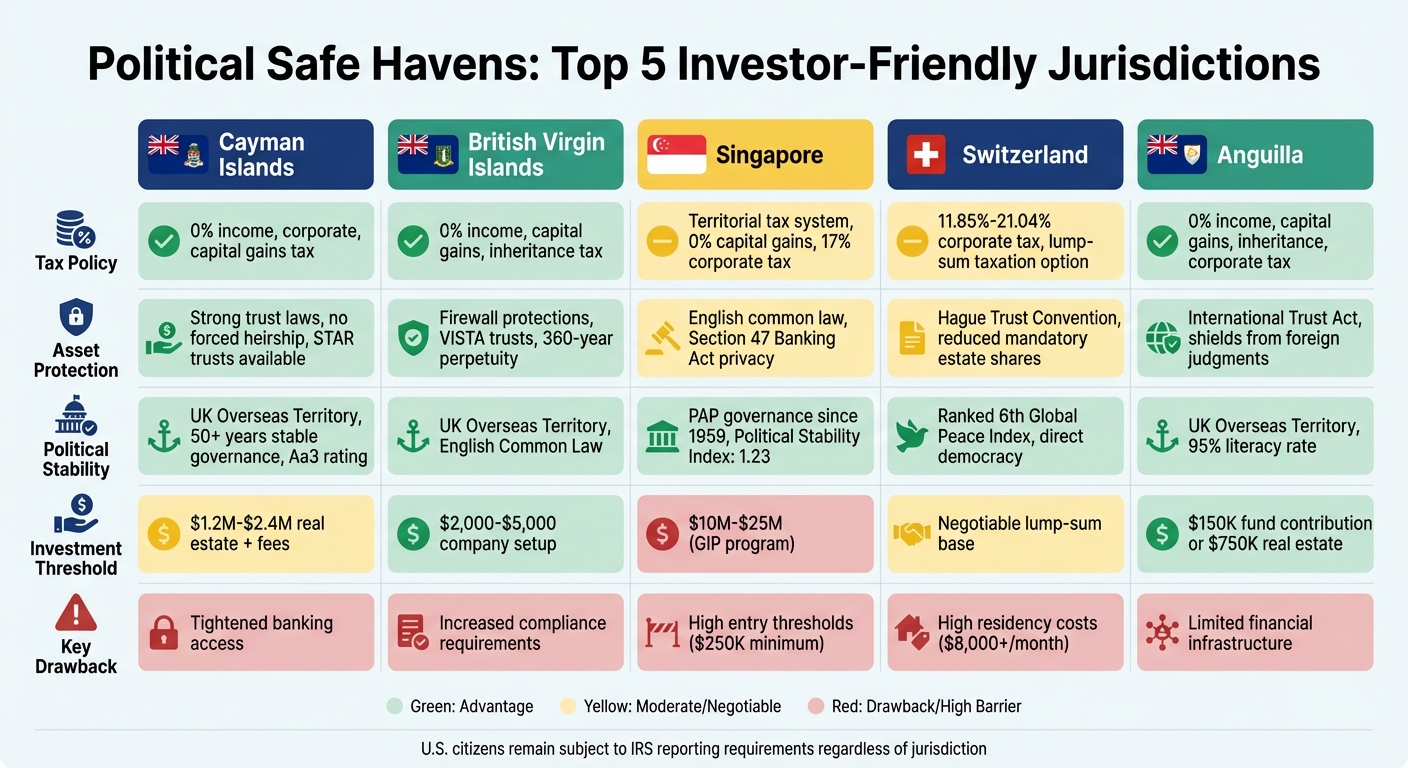
Quick Comparison:
| Jurisdiction | Tax Policy | Asset Protection | Political Stability | Key Drawback |
|---|---|---|---|---|
| Cayman Islands | No income, corporate, or capital gains tax | Strong trust laws, no forced heirship | Stable under UK oversight | Tightened banking access |
| British Virgin Islands | Zero tax on income or capital gains | Reliable trust protections | UK-linked stability | Increased compliance requirements |
| Singapore | Territorial tax, 0% capital gains | Strong legal system | High political stability | High entry thresholds for investors |
| Switzerland | Flexible tax rates, lump-sum option | Strong privacy, robust legal system | Neutral and stable | High residency costs |
| Anguilla | 0% tax on income and corporate earnings | Confidential trust laws | UK-backed stability | Limited financial infrastructure |
Whether you’re prioritizing tax savings, asset protection, or long-term stability, these options provide tailored solutions for safeguarding wealth abroad.
1. Cayman Islands
The Cayman Islands is known for its tax-neutral status, meaning it does not impose direct corporate, income, capital gains, property, payroll, or withholding taxes. Instead, the government relies on revenue from import duties (typically 22%), stamp duties on real estate transactions, work permit fees, and financial service licensing fees. This setup provides investors with predictable costs and eliminates concerns about fluctuating tax laws.
Tax Policies
Exempted entities in the Cayman Islands enjoy guaranteed tax-free status for a specific period – usually 20 years for companies and up to 50 years for partnerships and trusts. By early 2024, the Cayman Islands Monetary Authority oversaw more than 12,800 open-ended mutual funds and over 16,700 closed-ended private funds. The jurisdiction also hosts 121,400 active registered companies and holds an Aa3 sovereign risk rating. These tax policies are reinforced by a stable political and legal environment, ensuring a reliable framework for investors.
Political Stability
As a British Overseas Territory, the Cayman Islands benefits from UK oversight on defense and foreign affairs while maintaining its own stable government for over five decades. Its legal system is rooted in English common law, with the Privy Council in London serving as the final appellate court. The Grand Court includes a specialized Financial Services Division to handle complex commercial disputes. Recently, the jurisdiction was removed from the FATF Grey List in October 2023 and the EU Anti-Money Laundering blacklist in February 2024, showcasing its commitment to international compliance. These strong institutions also enhance the Cayman Islands’ reputation for asset protection.
Asset Protection Laws
The Cayman Islands builds on its governance with strong offshore asset protection measures. The Trusts Act (2021 Revision) ensures that foreign judgments conflicting with Cayman law, particularly on forced heirship, are not enforceable. STAR Trusts (Special Trusts Alternative Regime) allow for purpose-driven structures without traditional beneficiaries, offering flexibility in asset management. Segregated Portfolio Companies (SPCs) provide a way to separate assets and liabilities among different sub-portfolios within a single company. Furthermore, the absence of forced heirship rules allows investors complete control over how their estates are distributed.
Investor Incentives
The Cayman Islands offers appealing incentives for investors. Permanent residency is available with a minimum real estate investment of US$2.4 million, plus a grant fee of approximately US$121,955. For a lower-tier residency certificate, the minimum investment is US$1.2 million (with at least 50% allocated to residential real estate) and a grant fee of about US$24,400. Additionally, the jurisdiction has no exchange controls, allowing unrestricted movement of funds. The Cayman Islands dollar is pegged to the U.S. dollar for added stability. With 79 licensed banks as of June 2025 and a stock exchange boasting a market capitalization exceeding US$800 billion, the Cayman Islands provides a robust financial infrastructure for wealth management and investment strategies.
sbb-itb-39d39a6
2. British Virgin Islands
The British Virgin Islands (BVI) stands out as a leading offshore financial hub, offering a mix of tax benefits and regulatory reliability. Ranked at the top of the Corporate Tax Haven Index (December 2025), the BVI is home to nearly 40% of the world’s offshore companies. With a zero-tax policy on income, capital gains, inheritance, and wealth, it has become an attractive destination for global investors. The use of the US Dollar as its official currency and the absence of foreign exchange controls make it especially convenient for American investors to manage cross-border transactions.
Tax Policies
The BVI does not levy withholding taxes on dividends, interest, or royalties. While certain multinationals are subject to a 15% minimum tax under OECD guidelines, most investors benefit from the prevailing zero-tax framework. Instead of direct taxation, the government generates revenue through indirect means like a payroll tax (ranging from 10% to 14%, with the first $10,000 exempt) and real estate stamp duty (12% for foreign buyers and 4% for locals). Setting up a company in the BVI typically costs between $2,000 and $5,000, with annual fees ranging from $450 to $1,350, depending on the number of authorized shares.
Political Stability
As a British Overseas Territory, the BVI enjoys a stable political system modeled after the United Kingdom. Operating under English Common Law, the territory ensures legal consistency, with the Judicial Committee of the Privy Council in the UK serving as the ultimate court of appeal. This legal framework supports dependable enforcement of commercial laws. The BVI also adheres to international transparency standards, having established over 100 Tax Information Exchange Agreements and processed more than 1,000 information requests. Nicholas Kuria, Corporate Counsel at Conyers, highlights this commitment:
"Transparency in tax matters is part of the British Virgin Islands’ international financial centre model".
Asset Protection Laws
The BVI Trustee Act offers strong "firewall" protections, shielding BVI trusts from foreign legal claims, including forced heirship and matrimonial orders. Additionally, the Virgin Islands Special Trusts Act (VISTA) allows trusts to hold company shares while granting settlors or their appointed directors complete control over business operations without interference from trustees. With a perpetuity period of up to 360 years, Structuring BVI trusts enables long-term wealth preservation across generations. Registering a new trust is efficient, often completed within 24–48 hours.
Investor Incentives
Foreign investors in real estate must obtain a Non-Belonger Land Holding License (NBLHL), a process that takes 3 to 9 months. To attract innovation, the BVI introduced a Fintech Sandbox in 2020, allowing companies to test new financial products under the supervision of the Financial Services Commission. The Virtual Assets Service Providers (VASP) Act, effective February 1, 2023, regulates digital assets while maintaining a 0% tax rate on cryptocurrency gains. In 2024, the BVI facilitated approximately 2.5% of global cross-border financial transactions by multinationals, with foreign direct investment inflows reaching $1.1 billion and outflows at $1.5 billion. These measures reflect the BVI’s focus on creating a secure and appealing environment for investors.
3. Singapore
Singapore stands out as a global financial hub, known for its efficient tax system and political consistency. The country operates under a territorial tax system, meaning only income earned within Singapore is taxable. Foreign-sourced income received by residents is generally exempt from taxation[42,45]. Additionally, there are no taxes on capital gains, inheritance, or gifts, making it an attractive destination for investors looking to grow and transfer wealth without the heavy tax burdens often seen in Western countries. While the corporate tax rate is a flat 17%, new startups can enjoy an exemption of up to S$125,000 on their first S$200,000 of income during their first three years of operation.
Tax Policies
Singapore’s tax policies are designed to encourage investment and simplify compliance. The one-tier dividend system ensures that dividends from resident companies are tax-free for shareholders. Personal income taxes follow a progressive scale, with rates reaching a maximum of 24% for incomes exceeding S$1 million (around $740,000) starting in 2024[42,43]. Non-residents are taxed at a flat 24% on most income, while employment income is taxed at either 15% or according to the progressive scale, whichever results in a higher amount[43,45].
The country has established over 100 tax treaties to prevent double taxation and applies standard withholding rates of 15% on interest and 10% on royalties[44,45]. For trading companies, the Global Trader Programme offers reduced tax rates ranging from 5% to 15% for a period of five years.
Political Stability
Singapore’s political stability is another key factor in its appeal to investors. The People’s Action Party (PAP) has governed the nation since 1959, ensuring a consistent and predictable administrative environment. In 2025, the PAP won its 16th consecutive term, securing 87 out of 97 parliamentary seats with 65.57% of the popular vote.
The country’s Political Stability Index was recorded at 1.23 in 2024, significantly higher than the global average of -0.07, while its Government Effectiveness rating stood at 2.28. Anton Ruddenklau, Financial Services Advisory Lead at KPMG, summed it up well:
"Investors do not want surprises. They want predictable, and Singapore gives them that".
In 2020, U.S. foreign direct investment in Singapore reached $270 billion, more than double the investment in any other Asian country.
Asset Protection Laws
Singapore’s robust legal framework provides strong protections for investors. Rooted in English common law, the judicial system is known for upholding contracts and safeguarding intellectual property rights[48,50]. Financial privacy is protected under Section 47 of the Banking Act, with exceptions only for criminal investigations and international tax compliance[42,44].
Singapore also adheres to the Common Reporting Standard, facilitating information exchange with over 100 jurisdictions. Strong economic policies have bolstered the Singapore dollar, which peaked against the U.S. dollar in January 2026.
Investor Incentives
Singapore offers attractive incentives for high-net-worth individuals through its Global Investor Programme (GIP). Investors can qualify for permanent residency by investing S$10 million in a business, S$25 million in a GIP-approved fund, or setting up a Single Family Office with at least S$200 million in assets (with a minimum of S$50 million transferred to Singapore)[53,54]. The application fee is S$20,000 (around $14,800), and processing typically takes 9 to 12 months[52,53,54].
U.S. nationals also benefit from the U.S.-Singapore Free Trade Agreement, which exempts them from the 60% Additional Buyer’s Stamp Duty on residential property – a tax that applies to other foreign buyers[48,50]. GIP participants are eligible to apply for citizenship after two years of residency.
In a move to support sustainable growth, British International Investment pledged $60 million in October 2025 to a Green Investment Partnership led by the Monetary Authority of Singapore. This initiative focuses on bio-energy and solar projects across Southeast Asia.
4. Switzerland
Switzerland has long been a top destination for those seeking financial security and stability. Known for its neutrality and well-established financial systems, the country ranks as the number one offshore financial center worldwide. By 2022, Switzerland had attracted over $1 trillion in cumulative foreign direct investment, with 41% of that coming from the United States alone. Its appeal lies in a combination of stability, investor-friendly policies, and favorable tax structures.
Tax Policies
Switzerland’s tax system operates on three levels: federal, cantonal, and municipal. Corporate tax rates generally range from 11.85% to 21.04%, making them lower than those in most European countries. With 26 cantons setting their own rates, investors have flexibility. For example, Zug offers rates as low as 12.3%, while Jura’s can reach 32.3%.
A standout feature is the lump-sum tax system for non-working foreign residents. Instead of taxing worldwide income, Switzerland calculates taxes based on annual living expenses – typically seven times the annual rent, with a minimum threshold of CHF 434,700 (roughly $482,000). This system enjoys strong public support, as evidenced by a 2014 vote where nearly 60% rejected its abolition.
Other tax highlights include a standard Value Added Tax of 8.1%, exemptions on capital gains from movable assets like shares, and a 35% withholding tax on dividends and bank interest, which can often be refunded through Switzerland’s extensive network of over 100 bilateral tax treaties. Starting in January 2024, Switzerland adopted the OECD’s 15% minimum corporate tax rate for large multinational companies with annual revenues exceeding €750 million.
Political Stability
Switzerland’s political system is rooted in direct democracy, where citizens vote on major policy changes, including tax reforms. This approach ensures broad consensus and protects against sudden policy shifts, which is a key factor for wealth preservation. Ranked 6th on the 2024 Global Peace Index and 6th on the 2023 Corruption Perceptions Index, Switzerland offers a highly stable environment.
The country’s neutrality and balanced governance provide an ideal setting for long-term planning. UBS Global highlights this in its analysis:
"Switzerland’s political stability plays a significant role in contributing to its economic stability and growth".
Switzerland also leads in innovation, holding the top spot on the Global Innovation Index for 14 consecutive years, underscoring its focus on research and technological advancements.
Asset Protection Laws
Switzerland’s legal framework offers robust protections for investors while adhering to international transparency standards. As a participant in the Hague Trust Convention, Switzerland recognizes trusts established abroad and allows Swiss-based trustees to manage them. The judicial system consistently upholds contracts and property rights, providing a secure foundation for multi-generational wealth planning.
Recent reforms have also increased flexibility for estate planning. In January 2023, the mandatory share of estates reserved for descendants and spouses was reduced, giving individuals more control over their assets. Wealth taxes at the cantonal level are relatively low, typically ranging from 0.3% to 0.5% of net worth.
While banking secrecy has been adjusted to comply with international agreements like FATCA and the Automatic Exchange of Information, Switzerland still maintains high standards of financial privacy. Niki Thomet, Managing Partner at Engel & Völkers Lake Zurich, notes:
"Global high-net-worth individuals value Switzerland’s stable legal, political, and economic frameworks".
Investor Incentives
Switzerland provides several attractive options for foreign investors. The lump-sum tax system remains a key draw for ultra-high-net-worth individuals relocating without employment. Negotiating tax bases with cantonal authorities is an essential step for those seeking to benefit from this system.
The 2020 Federal Act on Tax Reform (TRAF) eliminated preferential tax treatment for foreign-only companies, requiring cantons to apply the same rates to domestic and foreign firms. This change increased transparency while preserving Switzerland’s competitive edge through cantonal flexibility. Companies holding at least 20% of another corporation’s shares also enjoy participation exemptions that significantly reduce taxes on dividends and capital gains.
Foreign real estate investors face restrictions under Lex Koller, which requires non-residents to obtain permits or establish Swiss residency to purchase primary residences in non-tourist areas. Additionally, starting in 2024, large public companies and financial institutions must disclose climate-related risks to align with European standards.
These policies highlight Switzerland’s ability to balance rigorous fiscal oversight with investor-friendly measures, ensuring its continued appeal as a financial hub.
5. Anguilla
Anguilla stands out as an attractive jurisdiction for investors, combining political stability, straightforward tax policies, and strong asset protection laws. As a British Overseas Territory, it benefits from the stability of the United Kingdom while offering regulations tailored to international investors under English Common Law.
Tax Policies
Anguilla is known for its exceptionally simple tax system, featuring 0% tax rates on income, capital gains, inheritance, and corporate earnings. Neither individuals nor companies are subject to direct taxation, and property taxes are minimal. Instead, the government relies on revenue from customs duties to fund its operations.
According to Select Anguilla:
"Anguilla has no direct taxation, with no income tax, capital gains tax, inheritance tax or corporate taxation."
This tax structure is automatically available to investors who gain residency through real estate purchases or contributions to the Capital Development Fund, similar to some of the simplest citizenship programs. Residency options include a $150,000 contribution for individuals or a $750,000 investment in approved real estate projects.
Political Stability
Anguilla’s political stability is closely tied to its constitutional relationship with the United Kingdom, which oversees foreign affairs, defense, and security. This connection provides a reliable safeguard against sudden legal or political changes. The island operates under a parliamentary democracy, with a history of peaceful power transitions.
For example, during the height of the COVID-19 pandemic in June 2020, the Anguilla Progressive Movement secured 7 out of 11 parliamentary seats, resulting in a smooth change in leadership. Judicial independence is further reinforced by the Judicial Committee of the Privy Council in London, serving as Anguilla’s final court of appeal. Additionally, the island boasts a literacy rate of approximately 95%, supporting a skilled workforce.
Asset Protection Laws
Anguilla’s legal framework is designed to preserve and protect wealth. The International Trust Act ensures that trusts established in the jurisdiction are shielded from foreign judgments and forced heirship claims, safeguarding the settlor’s intentions for asset succession. These protections extend to creditor claims, offering a secure environment for financial planning.
As noted by Offshore Protection:
"Anguilla’s legal framework emphasizes the confidentiality of business and trust activities… ensuring a high degree of secrecy for trust arrangements while maintaining compliance with global standards."
Trust documents are not publicly accessible, and shareholder registers remain closed to protect beneficiaries’ privacy. Investors can also integrate International Business Companies (IBCs) and Limited Liability Companies (LLCs) with trust structures for additional asset segregation. Annual IBC maintenance fees typically range from $200 to $600, making it a cost-effective option for many.
Investor Incentives
Anguilla complements its legal and tax advantages with modern infrastructure to support business operations. The island offers high-speed internet via fiber optic connections and has streamlined company incorporation through its digital Commercial Registry (ACORN). This system allows for secure, instant company registration, making it particularly convenient for remote investors.
Select Anguilla highlights the jurisdiction’s focus on regulated services:
"Anguilla, British Caribbean, is a regulated offshore jurisdiction for company management, trusts and estate planning, foundations, captive insurance and mutual funds."
The Anguilla Financial Services Commission ensures compliance with international standards like the Common Reporting Standard (CRS) and FATCA. Trust companies must appoint qualified trustees and work with licensed registered agents, ensuring a high level of oversight. Additionally, advisory firms on the island assist investors in creating effective strategies for wealth preservation.
Anguilla exemplifies how a stable legal system, combined with investor-friendly policies, can create a secure and efficient environment for asset protection and financial growth.
Advantages and Disadvantages
Every jurisdiction offers its own mix of benefits and challenges when it comes to protecting wealth. Knowing these details can help guide decisions about residency, banking, or setting up corporate structures.
Here’s a quick breakdown of how some key jurisdictions compare:
| Jurisdiction | Tax Advantages | Asset Protection Strengths | Accessibility & Ease of Use | Key Disadvantages |
|---|---|---|---|---|
| Cayman Islands | No income, corporate, or capital gains tax; no direct personal or corporate taxation | Courts require local legal review before enforcing foreign judgments; statutory limits on fraudulent-transfer claims for offshore trusts and private interest foundations | Focused on corporate and trust structures; no citizenship-by-investment option | Banking access has tightened; compliance demands are increasingly complex |
| British Virgin Islands | No tax on income, capital gains, or inheritance | Offers strong confidentiality and a reliable legal framework for trusts and corporations | Simple company setup process with a solid global reputation | Faces increased international scrutiny and new substance requirements |
| Singapore | Territorial tax system with no capital gains tax; foreign-sourced income often untaxed | MAS-regulated banks ensure strong data privacy and financial stability | Top-tier banking services; seen as a global benchmark for investors | High entry threshold for private banking (minimum deposit of $250,000); strict compliance standards |
| Switzerland | Lump-sum taxation available for qualifying foreigners; assets held separately from bank balance sheets | Swiss courts conduct full legal reviews before enforcing external claims, offering strong asset protection | Long-standing financial stability and infrastructure | Residency costs often exceed $8,000/month; entry requirements can be complex |
| Anguilla | No taxes on income, capital gains, inheritance, or corporate earnings | Emphasizes privacy in asset protection | Streamlined company incorporation process | Limited financial services infrastructure and less global recognition than larger hubs |
This comparison highlights the strengths and drawbacks investors face when considering these jurisdictions as safe havens for their assets.
For example, stricter substance rules now make it harder to rely on passive shell companies, while banking privacy has evolved into regulated confidentiality, still offering strong protections under national law. For those earning over $200,000 annually, the benefits often outweigh the setup and compliance costs. However, smaller investors may find these options less practical.
Singapore and Switzerland are known for their robust banking systems and regulatory stability, while Caribbean jurisdictions like the Cayman Islands, British Virgin Islands, and Anguilla shine with their simple tax systems and strong asset protection features.
Conclusion
Choosing the right jurisdiction depends on aligning with your financial objectives. If your goal is to eliminate taxes entirely, the Cayman Islands is a standout option. It offers zero taxes across all categories, making it an attractive choice for U.S. investors looking to minimize foreign tax exposure. On the other hand, Singapore combines a strong banking infrastructure with tax efficiency, featuring a 0% capital gains tax and a territorial tax system.
"The Cayman Islands still stand out as a tax haven for US citizens in 2026 owing to its complete absence of direct taxes."
– Josh Katz, CPA, Universal Tax Professionals
For corporate structuring, the British Virgin Islands provides a tax-free environment with straightforward compliance processes. Meanwhile, Switzerland appeals to ultra-high-net-worth individuals with its lump-sum taxation and unparalleled privacy. However, this comes at a premium, with residency costs exceeding $8,000 per month. Whether it’s Singapore’s banking advantages or Switzerland’s robust asset protection, each jurisdiction offers unique benefits tailored to different investor priorities.
It’s important to remember that U.S. citizenship-based taxation requires continued IRS reporting, even for those living offshore. To avoid double taxation, take advantage of exclusions and credits while staying compliant with FBAR and FATCA reporting requirements.
As global economic substance requirements evolve, investors must actively engage with these jurisdictions rather than rely on passive structures. With around $32 trillion held in major wealth hubs and an anticipated 142,000 high-net-worth individuals relocating in 2025, competition among jurisdictions for investor-friendly policies is only growing fiercer.
FAQs
Do I still owe U.S. taxes if I use one of these jurisdictions?
Yes, if you’re a U.S. citizen or resident, you’re required to report your worldwide income to the IRS and follow U.S. tax laws, no matter where your investments or assets are held. This rule applies regardless of whether those assets are in the U.S. or abroad.
Which country is best for banking access and stability?
Switzerland has earned a reputation as a global leader in banking, thanks to its solid financial system, strict regulatory standards, and a history of prioritizing privacy and security in banking services.
What’s the easiest residency option for U.S. investors?
The EB-5 Immigrant Investor Program provides one of the most straightforward ways for investors to gain residency in the U.S. By making a qualifying investment that generates jobs, participants can secure lawful permanent residence (Green Card). This program appeals to individuals looking for a clear and direct route to residency through investment.
