
Renouncing U.S. citizenship is a major decision, and choosing the right country for your new residency is key. Factors like safety, legal stability, healthcare, and financial considerations play a big role in this choice. Here’s a quick guide to some of the best countries for former U.S. citizens:
- Portugal: Known for safety, affordable living, and accessible residency options like the D7 Visa for retirees. Tax benefits include no wealth tax and reduced U.S. Social Security withholding rates.
- Malta: Offers easy integration with English as an official language, attractive tax policies, and multiple residency programs, including the Global Residence Programme.
- Mexico: Affordable living and proximity to the U.S. with straightforward income-based residency options.
- Argentina: Fast citizenship route (2 years of residency) and low living costs, though bureaucracy can be challenging.
- Thailand: Popular for retirees and remote workers with affordable healthcare and the Long-Term Resident Visa.
- Paraguay: Simple residency process, low taxes, and a low cost of living.
- Colombia: Affordable living, improving safety, and multiple visa options tied to income or investment.
- Cayman Islands: Tax-neutral jurisdiction with high investment requirements but excellent safety and infrastructure.
- UAE: No income tax, modern infrastructure, and long-term residency options like the Golden Visa.
Quick Comparison
| Country | Key Benefits | Residency Options | Taxes |
|---|---|---|---|
| Portugal | Safety, low cost of living, EU access | D7 Visa, Golden Visa | No wealth tax, U.S. treaty |
| Malta | English-speaking, EU member | GRP, MPRP, Nomad Visa | 15% tax on foreign income remitted |
| Mexico | Affordable, close to U.S. | Temporary/Permanent Residency | No wealth or inheritance tax |
| Argentina | Quick citizenship, low cost | Rentista, Pensionado, Inversionista Visas | Worldwide income taxed |
| Thailand | Affordable healthcare, expat-friendly | LTR Visa, Retirement Visa | Limited tax on foreign income |
| Paraguay | Simple process, low taxes | Temporary to Permanent Residency | Territorial tax system |
| Colombia | Affordable, improving safety | Pensionado, Rentista, Investment Visas | Worldwide income taxed |
| Cayman Islands | Tax-neutral, high safety | Investment-based Residency | No direct taxes |
| UAE | No income tax, modern infrastructure | Golden Visa, Retirement Visa | No income or wealth tax |
Each country offers unique advantages depending on your priorities – be it tax savings, safety, or lifestyle. Plan carefully, considering visa requirements, tax implications, and healthcare access.
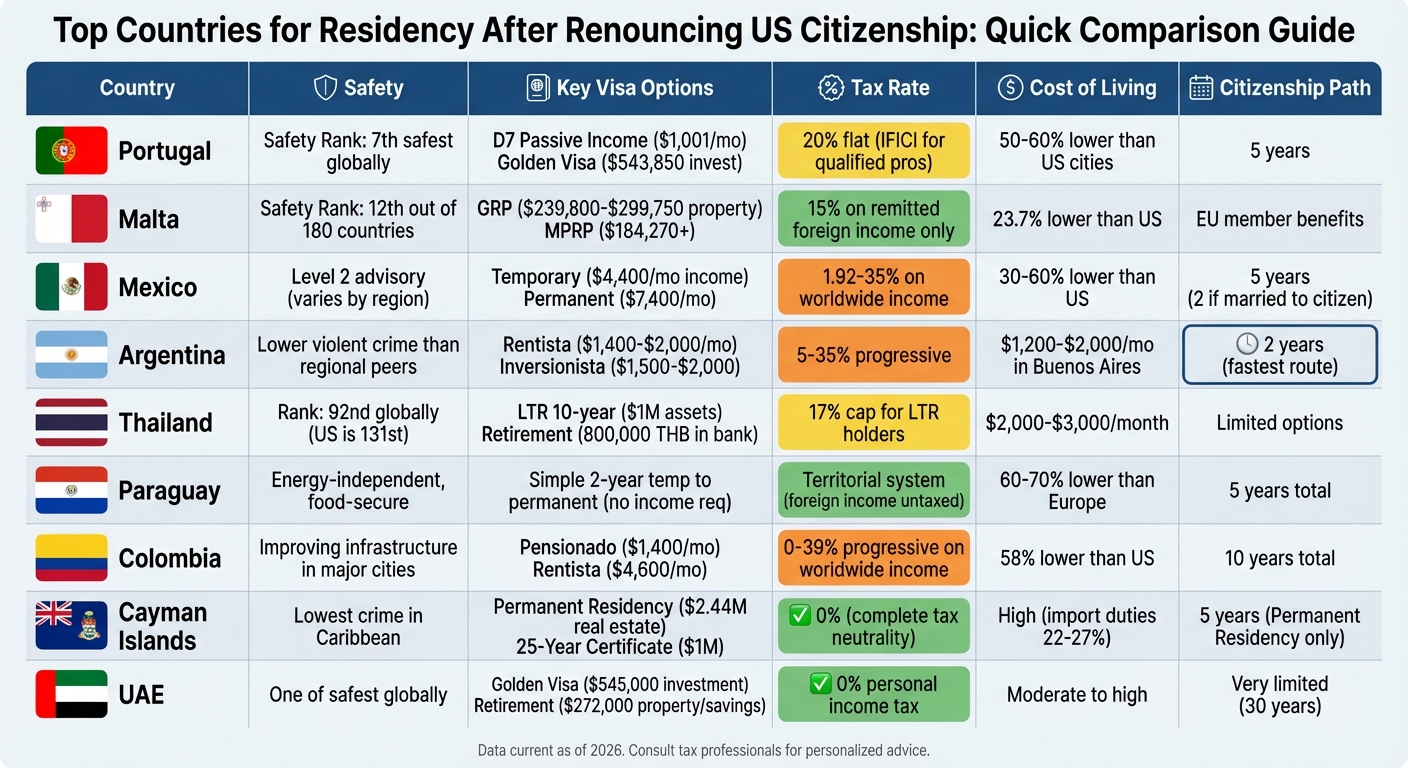
Top 9 Countries for Residency After Renouncing US Citizenship: Quick Comparison
1. Portugal
Portugal has become a favorite destination for former U.S. citizens. In 2023, Americans surpassed Chinese nationals as the top group of Golden Visa applicants, with 567 approvals. The country’s mix of safety, accessible residency options, and appealing tax policies makes it an attractive choice for those leaving the U.S.
Safety and Political Stability
Portugal consistently ranks as the 7th safest country in the world, according to the Global Peace Index. This places it far ahead of Spain (#32), Italy (#34), and Greece (#48). Low crime rates and effective community policing contribute to a strong sense of security, with 73% of expats describing the locals as friendly. Life expectancy in Portugal is an impressive 82.9 years, reflecting the country’s overall stability and quality of life. These safety benefits are further enhanced by flexible visa options.
Residency and Visa Options
Portugal offers 13 legal pathways to residency, catering to a variety of financial situations. The D7 Passive Income Visa is popular with retirees, requiring a minimum monthly income of $1,001 (€920). Remote workers can apply for the D8 Digital Nomad Visa, which has a higher income requirement of $4,003 (€3,680) per month. The Golden Visa remains a good option for those seeking minimal stay requirements, as it only necessitates a seven-day annual presence and allows for citizenship after five years .
Since October 2023, real estate investments no longer qualify for the Golden Visa. Instead, applicants can invest $543,850 (€500,000) in venture capital funds or make a cultural donation of $271,925 (€250,000). Processing times for visas range from 12 to 24 months, so obtaining a Portuguese tax number (NIF) remotely before arriving can help avoid delays.
Tax Advantages and Financial Incentives
Portugal’s tax policies are another major draw. The NHR regime was replaced in 2025 by IFICI (NHR 2.0), which offers a 20% flat tax rate for 10 years on qualifying employment income in science, technology, and R&D fields. However, retirees generally don’t qualify for IFICI, as it targets professionals with advanced degrees. Portugal does not impose a wealth tax and abolished its formal inheritance tax in 2004. Transfers to spouses, children, and parents are exempt from the 10% Stamp Duty. For individuals receiving U.S.-source Social Security income, the U.S.–Portugal tax treaty can lower withholding rates. Former U.S. citizens should consult cross-border tax professionals to manage FATCA reporting requirements.
Portugal also offers a cost of living that is 50–60% lower than in major U.S. cities, with rent being approximately 63% cheaper. These financial perks make it easier for expats to protect and grow their assets while enjoying a more affordable lifestyle.
Quality of Life and Integration
Portugal’s appeal extends beyond finances and paperwork. With over 300 days of sunshine annually and 404 Blue Flag beaches known for their cleanliness and safety, the country provides an exceptional quality of life. Living costs are manageable, with a couple’s monthly expenses in Lisbon ranging from $2,371 to $3,513. Cities like Porto and the Algarve offer even lower costs, with one-bedroom apartments renting for around $1,176 and $993, respectively.
The path to EU citizenship is relatively quick, requiring just five years of residency and passing an A2-level Portuguese language test . This timeline is much shorter than the 10-year residency requirements in Spain or Italy. However, legislative discussions about extending the residency requirement make it wise for residents to apply for citizenship as soon as they qualify.
Additionally, private health insurance costs between $43 and $163 per month, offering faster access to care compared to the public system while maintaining high standards. These factors make Portugal an appealing choice for those looking to relocate abroad.
sbb-itb-39d39a6
2. Malta
If you’re looking for a place that combines safety, stability, and ease of integration after renouncing U.S. citizenship, Malta checks all the boxes. As an EU member state where English is an official language, Malta offers a welcoming environment alongside tax policies designed with international residents in mind. According to the Philtr Country Risk Index 2023, Malta ranks 12th out of 180 countries for safety. It also leads Europe in LGBT rights, scoring an impressive 89% on the ILGA-Europe Rainbow Map. With 22% of its population being non-Maltese, integration into local life is well-established.
Residency and Visa Options
Malta provides three main residency options, each catering to different needs and circumstances:
- Global Residence Programme (GRP): Requires property purchase valued between $239,800–$299,750 (€220,000–€275,000) or annual rent of $9,538–$10,464 (€8,750–€9,600). There’s also a flat annual tax of $16,350 (€15,000). Processing takes about 3–4 months.
- Malta Permanent Residence Programme (MPRP): Offers lifetime residency, with costs starting at $184,270 (€169,000) for renters or $516,780 (€474,000) for property buyers. This includes a $65,400 (€60,000) administrative fee and a $40,330 (€37,000) government contribution. Processing takes 6–8 months.
- Nomad Residence Permit (similar to the Italy Digital Nomad Visa): Designed for remote workers, this permit requires a minimum monthly income of $3,815 (€3,500) from sources outside Malta. The application fee is $327 (€300) per person.
These options are tailored to suit diverse financial and lifestyle preferences, making Malta an attractive choice for those seeking both residency and financial advantages.
Tax Benefits and Financial Incentives
Malta’s tax system is another major draw. Residents pay a flat 15% tax rate only on foreign income brought into Malta, while income kept abroad is untaxed. Additionally, foreign-source capital gains remain tax-free, even when remitted. Unlike the U.S., Malta has no wealth, inheritance, gift, or annual property taxes, which is a stark contrast to the U.S. estate tax that can reach up to 40%.
Living in Malta is also more affordable. The cost of living is approximately 23.7% lower than in the United States, with rental prices averaging 41.5% less. Healthcare is much more affordable too – private specialist appointments cost $55–$110 (€50–€100), compared to $200–$500 in the U.S.. On top of that, public transportation is free for residents.
Quality of Life and Integration
English is widely used in government, business, and healthcare, making day-to-day life convenient for English speakers. The Mediterranean climate, with 300 sunny days a year, encourages an active lifestyle centered around outdoor activities and fresh, local food. Residency permits also come with the perk of visa-free travel across the 29 Schengen countries for up to 90 days within any 180-day period.
Real estate in Malta is not only a residency requirement for some programs but also a solid investment. Property values have consistently appreciated at an annual rate of about 10%. In 2024 alone, Malta issued 4,073 residence permits, demonstrating its well-developed infrastructure for welcoming international residents.
3. Mexico
Mexico stands out as a combination of convenience and affordability for those leaving the U.S. With over 2 million U.S. expats calling it home, it’s a popular destination. Internations.org ranked Mexico #1 for "Ease of Settling In", and it’s also the second-happiest country in Latin America, according to the 2024 World Happiness Report.
Safety and Political Stability
Safety in Mexico can vary widely depending on the region. While the U.S. Department of State gives Mexico an overall "Level 2: Exercise Increased Caution" advisory, many expat-friendly areas like Chapala, Ajijic, and Puerto Vallarta have no travel restrictions for government employees. However, states like Colima, Guerrero, Michoacan, Sinaloa, Tamaulipas, and Zacatecas are under "Level 4: Do Not Travel" advisories. For safer travel, stick to toll roads during daylight hours.
Mexico’s political landscape is stable, operating as a federal republic and boasting the world’s 12th-largest economy. Its legal system, guided by the Ley de Migración (Immigration Law), offers clear paths from temporary residency to permanent residency and even citizenship.
Ease of Obtaining Residency or Visas
Mexico’s residency process is based on financial self-sufficiency. To qualify:
- Temporary residency: Requires a monthly income of about $4,400 or savings of $74,000 held over 12 months.
- Permanent residency: Requires a monthly income of roughly $7,400 or savings of $298,000.
- Alternatively, owning property worth around $598,000 in Mexico can also qualify you for residency.
| Residency Type | Monthly Income Requirement | Savings Requirement |
|---|---|---|
| Temporary Residency | ~$4,400 | ~$74,000 (12 months) |
| Permanent Residency | ~$7,400 | ~$298,000 (12 months) |
| Dependent (Spouse/Child) | +~$1,434 | +~$1,434 |
Applications must be initiated at a Mexican consulate abroad. Once approved, you have 180 days to enter Mexico and 30 days to complete the Canje process. Costs for the first-year temporary resident card are around 11,141 MXN (about $620) as of 2026, which is double the 2024 rate. Requirements can vary slightly between consulates, so it’s best to confirm details like bank statement durations and exchange rates beforehand.
There’s no strict minimum stay requirement to maintain residency, though extended absences might be reviewed during renewals. Citizenship is available after five years of legal residency, or just two years if married to a Mexican citizen.
These straightforward residency options also open the door to appealing tax advantages.
Tax Benefits and Financial Incentives
Mexico taxes residents on their worldwide income, with rates ranging from 1.92% to 35%. However, the top rate only applies to annual earnings above $250,000. You’re considered a tax resident if you spend over 183 days in Mexico in a calendar year.
One major perk: Mexico doesn’t impose wealth, inheritance, estate, or gift taxes. Additionally, tax treaties with the U.S. and Canada prevent double taxation by allowing foreign tax credits. Residents aged 18 and older must obtain an RFC (tax ID) to open bank accounts or purchase vehicles. Neglecting to activate the electronic mailbox (Buzón Tributario) can lead to fines ranging from 3,850 MXN to 11,540 MXN.
If you’re planning to buy property near the coast, you’ll need a fideicomiso (bank trust), as foreigners cannot directly own property within 50km of the coastline or 100km of international borders. Setting up a fideicomiso costs between $2,000 and $3,000, with annual fees of $550 to $1,000.
Quality of Life and Cultural Integration
Living in Mexico can be surprisingly affordable. A couple can comfortably live on $2,500 per month, which includes housing and domestic help. Overall living expenses are 30%–60% lower than in the U.S., with medical services also being much cheaper – specialist visits cost about $20, and dental cleanings around $40. If you’d rather not handle residency paperwork yourself, hiring a professional costs between $300 and $700.
Vehicle compliance rules are strict: Temporary residents can keep foreign-plated cars, but permanent residents must either export or permanently import their vehicles to avoid confiscation. Enforcement of these rules has become more rigorous.
4. Argentina
Argentina, often called the "Paris of Latin America", offers one of the quickest routes to citizenship – naturalization after just two years of continuous legal residency. The country also embraces immigrants with a rich mix of backgrounds and traditions. Since April 2025, residents have been allowed unrestricted use of U.S. dollars, thanks to new currency liberalization policies.
Safety and Political Stability
Compared to many other Latin American capitals, Buenos Aires has a lower rate of violent crime, though petty theft remains an issue. As a federal republic, Argentina maintains political stability, and its legal system has streamlined the process from temporary residency to citizenship. This is all managed digitally through the RaDEX platform, making the process more accessible.
Ease of Obtaining Residency or Visas
Argentina’s residency programs are simple and relatively affordable. Here are some key options:
- Rentista Visa: Requires proof of passive income (like dividends, rent, or investments) of $1,400–$2,000 per month.
- Pensionado Visa: Similar requirements, but the income must come from a foreign pension.
- Inversionista Visa: Requires an investment of about $1,500–$2,000 (ARS 1,500,000) in a locally registered business.
Applications are submitted via the RaDEX platform, and applicants receive a temporary residencia precaria, which allows them to live and work while their application is processed (typically 2–6 months). The government filing fee is around $100.
A newer Citizenship by Investment program, introduced under Decree 524/2025, offers direct citizenship for a $500,000 investment. However, as of early 2026, this program has not yet been implemented.
"Argentina offers one of the fastest and most accessible paths to citizenship in the world. Foreigners can apply for naturalization after just two years of continuous legal residency."
- Pascal Klein, Residency Consultant
One crucial rule under the 2025 reforms (Decree 366/2025) is that applicants for the two-year citizenship path cannot leave Argentina during this period – even a short trip resets the timeline. In contrast, permanent residents are allowed up to 12 consecutive months of absence without losing their status. These clear residency pathways also come with appealing tax conditions.
Tax Benefits and Financial Incentives
Argentina taxes worldwide income on a progressive scale ranging from 5% to 35%. Tax residency is established after 12 months of continuous presence or upon obtaining permanent residency. While there is no federal inheritance or gift tax, the Province of Buenos Aires may impose its own transfer taxes.
The wealth tax, known as Impuesto sobre los Bienes Personales, currently ranges from 0.5% to 1.25%, though plans are in place to lower it to a flat 0.25% by 2027. For 2023, the exemption threshold was ARS 11 million, with residential properties exempt up to ARS 56 million. However, Argentina lacks a tax treaty with the United States, which means residents are not protected from double taxation.
Public universities, such as the prestigious Universidad de Buenos Aires (UBA), remain tuition-free for all residents, regardless of nationality. Temporary residents, however, must maintain private health insurance ($100–$250 per month) as they are no longer eligible for free public healthcare under policies enacted in May 2025.
Quality of Life and Cultural Integration
Living expenses in Buenos Aires for a single person range between $1,200 and $2,000 per month, while cities like Córdoba and Mendoza are 20%–30% cheaper. Renting a one-bedroom apartment in trendy neighborhoods like Palermo or Recoleta costs $500–$900 per month. The standard VAT rate is 21%, and social security contributions for employees are about 17% of gross income.
Argentina is known for its complex bureaucracy, so hiring a gestoria (an administrative fixer) can be invaluable for tasks like obtaining a National ID (DNI) or setting up a bank account. Due to the peso’s historical instability, experts recommend keeping savings in U.S. dollars or euros and converting only what’s needed for daily expenses. The DNI is essential for everyday activities, often more so than a passport, including signing contracts and opening bank accounts.
An Argentine passport offers visa-free travel to over 170 countries, including the Schengen Area, the United Kingdom, and Japan. Argentina allows dual citizenship, so applicants can retain their original nationality when they naturalize.
5. Thailand
Thailand stands out as a welcoming destination for those seeking a fresh start abroad. With a Level 1 travel advisory from the U.S. State Department, it’s considered one of the safer options globally. Ranked 92nd on the 2023 Global Peace Index – well ahead of the United States at 131st – Thailand offers a stable environment. Cities like Chiang Mai boast a Safety Index of 77.89, while Bangkok’s Safety Index is around 60.24, and the national Crime Index is a low 37.77.
Safety and Political Stability
Thailand’s strong safety record is complemented by a variety of residency visas designed for foreign nationals. Governed by a parliamentary system, the country enforces strict laws to maintain order. With a migrant population of 3.6 to 4 million – about 5.2% of the total population – Thailand has created a supportive framework for long-term foreign residents. Additionally, the 2025 Marriage Equality Act now recognizes same-sex couples, allowing them to qualify for dependent visas under the "O" and "LTR" programs.
Ease of Obtaining Residency or Visas
Thailand offers several residency options for former U.S. citizens, each catering to different needs:
- Long-Term Resident (LTR) Visa: A premium 10-year visa (split into two 5-year terms) that includes benefits like a work permit, expedited airport services, and annual reporting instead of the typical 90-day check-ins. The application fee, now reduced to 50,000 THB (about $1,400), makes it more accessible. Applicants must meet financial criteria, including $1 million in assets and a $500,000 investment in Thailand. Processing takes 6 to 12 months.
- Retirement Visa (Non-Immigrant O or OA): Designed for retirees aged 50 and older, this visa requires either 800,000 THB in a Thai bank account or a monthly income of 65,000 THB. The visa fee is approximately 2,000 THB. Many retirees opt for a Non-Immigrant O visa to avoid the OA visa’s health insurance requirements.
- Thai Elite Visa: This residency-by-investment option offers stays of 5 to 20 years for a non-refundable fee ranging from 500,000 to 2,000,000 THB. However, it does not permit employment.
- Investment Visa: For those investing at least 10 million THB in Thai condos or government bonds, this visa provides an indefinite stay.
"The LTR visa represents Thailand’s most comprehensive attempt to attract global talent and investment."
- TheBahtExpert
These visa options provide flexibility and open the door to further financial and lifestyle benefits.
Tax Benefits and Financial Incentives
Thailand considers individuals tax residents after they spend 180 days in the country within a calendar year. Starting in 2026, all foreign-sourced income remitted into Thailand will be taxable unless earned before January 1, 2024. LTR visa holders enjoy a capped personal income tax rate of 17%. Financial experts recommend keeping separate bank accounts for pre-2024 savings and new income to manage tax liabilities effectively.
An additional perk for LTR visa holders is the ability to own up to 1 rai (approximately 0.4 acres) of land for residential use – a rare privilege for foreign residents. LTR holders can also include their spouse and dependents (children under 20 and parents) on their visa.
Quality of Life and Cultural Integration
Thailand is known for its excellent and affordable healthcare system. Private hospitals provide care comparable to Western standards at significantly lower costs. A specialist visit typically costs between 1,000 and 2,000 THB ($26–$52), while procedures that might cost $20,000 in the U.S. are often under $5,000 in Thailand.
Living comfortably in Thailand generally requires a monthly budget of $2,000 to $3,000. Rent for a furnished apartment ranges from 15,000 to 35,000 THB ($400–$1,000), and street food meals cost just 40 to 80 THB ($1.10–$2.20). Whether you prefer the affordable lifestyle of Chiang Mai, the urban amenities of Bangkok, or the coastal charm of Hua Hin, Thailand offers options for everyone.
"Thailand’s healthcare system is modern, well-equipped, and far more affordable than what most retirees are used to in the U.S. or Canada."
- Katelynn Minott, CPA & CEO, Bright!Tax
While English is widely spoken in expat-friendly areas, learning basic Thai phrases can greatly enhance daily interactions and help with deeper integration. Opening a Thai bank account typically requires a Non-Immigrant visa and a Certificate of Residence from an embassy or immigration office.
6. Paraguay
Paraguay offers one of the easiest paths to residency in South America, making it an appealing choice for former U.S. citizens looking for stability. Thanks to Law No. 6984/2022, the process is straightforward, with no need for an upfront investment or proof of income during the initial temporary residency phase. This approach simplifies the process while providing long-term financial advantages.
Safety and Political Stability
Paraguay has a history of neutrality and stays removed from global conflicts. The country is self-sufficient, generating 100% clean energy through the Itaipú dam and maintaining strong food security as a major exporter. While the Economist Intelligence Unit classifies Paraguay as a "hybrid regime", the nation has enjoyed steady governance. Most expatriates choose safe neighborhoods in Asunción, like Villa Morra, Carmelitas, and Santa Teresa, which offer infrastructure and safety comparable to Western cities. Crime rates, especially for street robberies, are lower than in neighboring countries like Brazil or Argentina.
"Paraguay is historically neutral and removed from major geopolitical conflict zones. It is energy-independent and food-secure – critical factors for a long-term safety net."
Ease of Obtaining Residency or Visas
The residency process in Paraguay is simple: applicants start with two years of temporary residency before qualifying for permanent status. U.S. citizens enjoy visa-on-arrival privileges. To begin, applicants need apostilled documents such as birth certificates, FBI background checks (from the past three years), and marriage certificates. These are submitted in Asunción during a 3–5 business day process, which includes Spanish translations, notarizations, and biometric data collection. Government filing fees range from $350 to $400, while professional assistance costs between $1,480 and $2,180. After a 2–4 month approval period, residents receive the Cédula de Identidad (national ID card), essential for banking and contracts. Temporary residents must visit Paraguay at least once a year, while permanent residents are only required to return once every three years.
Tax Benefits and Financial Incentives
Paraguay uses a territorial tax system, meaning income earned abroad – whether from dividends, interest, rental income, or business profits – is not taxed. The country has no Controlled Foreign Corporation (CFC) rules, wealth taxes, gift taxes, or exit taxes. For income earned within Paraguay, personal income tax rates are between 8% and 10%, and a 10% VAT applies. To maintain tax residency without spending 120 days in the country, residents must keep an "Active RUC" (Tax ID) by filing monthly VAT returns, even if there are no transactions. Paraguayan passport holders also gain visa-free or visa-on-arrival access to over 140 countries, including the EU and the UK.
"Paraguay stands out as a rare anomaly. It is not just a ‘tax haven’; it is a sanctuary for personal sovereignty."
- Paraguay Simply
Quality of Life and Cultural Integration
Paraguay’s low cost of living is another major draw. Expenses are 60% to 70% lower than in Spain or other European countries, with modern apartments in Asunción renting for about $300 per month. Overall, the cost of living is roughly one-third that of cities like London or Miami, while still offering high-quality private healthcare and diverse dining options. Private health insurance costs between $30 and $100 per month. After five years of residency (two years temporary, three years permanent), residents can apply for citizenship by passing a Spanish or Guaraní language test. The guarani currency has also shown stability, depreciating only 13% against the U.S. dollar from 2005 to 2023, with an average annual inflation rate of 6% over the last 20 years.
7. Colombia
Safety and Political Stability
Over the years, Colombia has evolved significantly, shifting from a history of conflict to a more stable and inviting destination. Cities like Medellín showcase this transformation with efficient metro systems, dependable internet, and thriving expat communities. Bogotá, the capital, continues to improve its urban infrastructure as well. However, petty theft remains a concern in urban areas, especially after dark or on public transportation. Many former U.S. citizens opt for safer neighborhoods, particularly in Medellín, which boasts a pleasant, spring-like climate, or in coastal cities like Cartagena and Santa Marta. These improvements in safety and stability are complemented by straightforward pathways for long-term residency.
Ease of Obtaining Residency or Visas
Colombia provides several Migrant (M) visa options, making it relatively accessible for those seeking long-term residency. These visas are tied to the national minimum wage (SMMLV), which, as of 2026, is COP 1,750,905 following a 23% increase earlier that year. Key visa options include:
- Pensionado Visa (M-11): Requires a lifetime pension of at least 3 SMMLV (approximately $1,400/month).
- Rentista Visa: Requires passive income of 10 SMMLV (about $4,600/month).
- Real Estate Investment Visa (M-10): Requires an investment of 350 SMMLV (around $163,000).
- Business Investment Visa (M-6): Requires an investment of 100 SMMLV (approximately $47,000).
Application fees range from $55 to $270. Once a visa is approved, it must be registered with Migración Colombia within 15 days to obtain a Cédula de Extranjería (foreigner ID card), which is crucial for tasks like opening a bank account or handling legal matters. The pathway to citizenship typically involves holding an M visa for 5 years, followed by another 5 years of permanent residency, totaling approximately 10 years.
Tax Benefits and Financial Incentives
Colombia’s tax system applies to worldwide income for residents, with progressive rates ranging from 0% to 39%. Non-residents are taxed at a flat 35% on Colombian-source income. Spending 183 days or more within a rolling 365-day period establishes tax residency. Additionally, a wealth tax applies to individuals with net assets exceeding COP 3.77 billion as of 2026. There is no double taxation treaty with the U.S., which can affect individuals receiving income from U.S. sources.
Residents are also required to enroll in Colombia’s public health system (EPS), contributing roughly COP 87,500 per month, even if they have private international insurance. Because visa financial thresholds are tied to the SMMLV and adjusted annually, maintaining income or investments above the minimum requirements is essential for long-term stability.
Quality of Life and Cultural Integration
Living in Colombia is highly affordable compared to the U.S., with overall expenses about 58% lower and rent approximately 71% cheaper. A single person can live comfortably on around $576 per month (excluding rent), while a one-bedroom apartment in a city center typically costs between $366 and $459 per month. Healthcare is another attractive aspect, with public health insurance (EPS) premiums averaging $70–$85 per month for a couple.
Colombia’s varied climate adds to its appeal. Medellín offers year-round spring-like weather, while the Caribbean coast features tropical conditions. Though English is commonly spoken in expat hubs, learning Spanish can be helpful for daily activities like banking or accessing healthcare services.
Colombia also allows dual citizenship, enabling expatriates to obtain a Colombian passport without giving up their original nationality. These factors make Colombia an appealing option for former U.S. citizens seeking affordable living, a comfortable lifestyle, and secure residency opportunities.
8. Cayman Islands
Safety and Political Stability
The Cayman Islands, as a British Overseas Territory, enjoy a politically stable environment under the oversight of the United Kingdom. This includes defense, external affairs, and internal security matters. The legal system is rooted in English common law, with final appeals handled by the Judicial Committee of the Privy Council in London. The islands boast one of the Caribbean’s lowest crime rates, making it a safe place to live. A high GDP per capita – between $70,000 and $80,000 – ensures well-developed infrastructure and modern, hurricane-resistant building codes. Additionally, the Cayman Islands dollar (CI$) is pegged to the U.S. dollar at a rate of CI$1 = US$1.2195.
Ease of Obtaining Residency or Visas
The Cayman Islands offer straightforward residency options designed to suit a variety of investor profiles. There are four main residency pathways, each catering to different investment levels and goals. Processing times generally range from 1 to 3 months, though they may extend to 6 months depending on due diligence.
| Residency Option | Minimum Investment | Application Fee | Path to Citizenship |
|---|---|---|---|
| Permanent Residency (Independent Means) | CI$2,000,000 (US$2.44M) in real estate | CI$100,000 (US$121,955) | Yes, after 5 years |
| 25-Year Certificate (Independent Means) | CI$1,000,000 (with at least CI$500,000 in real estate) | CI$20,000 (US$24,400) | No |
| Certificate of Direct Investment | CI$1,000,000 in an employment-generating business | CI$20,000 (US$24,400) | Possible |
| Substantial Business Presence | 10% ownership or senior management role | CI$5,000 (US$6,098) | No |
The Permanent Residency Certificate for Persons of Independent Means is the sole option that leads to naturalization as a British Overseas Territories Citizen after five years of residency. For those seeking lower investment thresholds, the "Sister Islands" (Cayman Brac or Little Cayman) offer a more affordable route, with the real estate requirement for a 25-year certificate reduced to CI$250,000. Applicants must also secure comprehensive health insurance and work with Cayman-based immigration attorneys, whose professional fees typically range from CI$5,000 to CI$10,000.
Tax Benefits and Financial Incentives
The Cayman Islands’ tax system is a major draw for investors and residents alike. The territory offers complete tax neutrality, meaning no personal income, corporate, capital gains, inheritance, gift, or annual property taxes. Additionally, there are no IRS reporting requirements for worldwide income.
"With no direct taxation, the Cayman Islands are a thriving offshore financial center. More than 99,000 active companies were registered in the Cayman Islands as of 2016, including almost 300 banks, 750 insurers, and 10,500 mutual funds."
- PricewaterhouseCoopers
Currently, the Cayman Islands host around 75% of the world’s offshore hedge funds and had 118,443 active companies registered by the end of 2023. While there are no direct taxes, residents should account for import duties (typically between 22% and 27%) and a one-time stamp duty on property purchases. Starting January 1, 2026, properties valued at CI$2 million or more will face a 10% stamp duty, while the standard rate remains at 7.5%.
Quality of Life and Cultural Integration
The Cayman Islands combine Caribbean charm with modern conveniences, offering a high standard of living. Healthcare facilities like Health City Cayman Islands and Doctors Hospital provide care that meets U.S. standards, while private schools offer British, American, and International Baccalaureate curricula, with annual tuition ranging from $10,000 to $20,000. A Cayman Islands (BOTC) passport grants visa-free travel to over 120 countries, and residents can register as full British citizens to expand that access to approximately 185 countries.
With a literacy rate of 98% and English as the official language, settling into the community is straightforward. Residency requirements are also flexible: holders of the 25-year certificate need only spend 30 days per year in the Cayman Islands, while Permanent Residency requires just one day annually (though additional time is needed for those seeking citizenship).
9. United Arab Emirates (UAE)
Safety and Political Stability
The UAE stands out as one of the safest and most stable countries globally. Known for its wealth and modern infrastructure, the nation offers world-class healthcare and international education options that align with Western standards. Adding to its appeal, the UAE has no personal income tax and a regulatory framework that supports businesses, making it a magnet for professionals and investors from around the globe.
Ease of Obtaining Residency or Visas
The UAE has simplified residency processes, offering multiple pathways without the need for a corporate or individual sponsor. The Golden Visa program is particularly attractive, granting 5 to 10-year renewable residency with automatic renewal. This visa allows holders to live, work, study, and invest without relying on a sponsor. To qualify for a 10-year Golden Visa, applicants need to invest at least AED 2 million ($545,000) in public funds or real estate. Entrepreneurs can qualify with a project worth AED 500,000 ($136,000).
For retirees aged 55 and older, the Retirement Visa offers a 5-year renewable residency. Applicants must meet one of the following criteria: own AED 1 million ($272,000) in UAE property or savings, or have a monthly income ranging from AED 15,000 to AED 20,000 ($4,080 to $5,440), depending on the emirate. Processing times for this visa range from 1–2 months, with fees between AED 3,000 and AED 7,000 ($816–$1,905). Both visa options allow holders to sponsor their spouse and dependent children. However, citizenship is not easily attainable; naturalization typically requires 30 years of continuous residence and is granted only by a sovereign decree.
Tax Benefits and Financial Incentives
The UAE’s tax policies are a major draw for expatriates. There is no personal income tax on pensions, retirement savings, investment income, or rental income. Additionally, the country imposes no wealth, capital gains, inheritance, gift, or property taxes. Residents can also open multi-currency bank accounts in USD, EUR, and AED, which simplifies international transfers and savings.
Although the UAE introduced a 9% corporate tax in June 2023 for business profits exceeding AED 375,000 ($102,000), this rate remains far below global averages. Golden Visa holders enjoy extra perks, such as the Esaad Privilege Card, which provides discounts of up to 70% at various retailers, clinics, and services – a bonus for those looking to maximize their financial efficiency.
Quality of Life and Cultural Integration
Beyond financial benefits, the UAE offers a vibrant, multicultural lifestyle. Its international community makes integration smooth, with English being widely spoken in business and education. The Golden Visa also enables 100% ownership of mainland businesses without requiring a local sponsor, giving professionals greater independence.
The UAE’s healthcare system meets global standards, and the country has become a hub for medical tourism. Real estate investments are flexible, and as of February 2026, Golden Visa eligibility will be based on a total property value of AED 2 million, with no mandatory 50% down payment. However, dual citizenship is rarely granted, and naturalization remains uncommon. For those considering renouncing U.S. citizenship, securing an alternative nationality first is crucial to avoid becoming stateless.
10. Global Wealth Protection Residency Planning Services
Personalized Consultation Services
Global Wealth Protection (GWP) simplifies the often-complicated process of choosing the right residency path. Their consultation services are designed to align your legal, tax, and compliance strategies with your specific goals. Whether you’re a pre-IPO executive, managing a family office, or an entrepreneur with a location-independent lifestyle, GWP ensures you’re matched with the most suitable jurisdiction based on your wealth profile and timeline. This expert guidance minimizes risks like costly errors and missed opportunities, giving you peace of mind as you navigate your options.
Global Escape Hatch Action Plans
The Global Escape Hatch plan introduces a 4-Tier Framework for residency selection. Programs are sorted into four categories: simplest citizenship programs, EU Golden Visas, Caribbean Efficiency, and Global Business Hubs. This structured approach simplifies decision-making, helping you select a residency program that complements your financial goals and mobility needs.
GWP Insiders Membership Benefits
The GWP Insiders membership provides exclusive, tailored advice on reducing taxes, selecting jurisdictions, and creating a diversified residency portfolio. This portfolio acts as a safeguard against political or economic instability. Members enjoy one-on-one consultations to develop strategies that promote resilience and ensure mobility for future generations, all while maintaining access to global markets.
Support for International Relocation
Relocating internationally can be overwhelming, but GWP offers comprehensive support to make the transition smoother. They coordinate residency planning, tax strategies, and asset protection to help you achieve long-term financial stability in your new country. By combining strategic planning with professional execution, GWP ensures you’re well-prepared for life in your new jurisdiction. This integrated approach helps you establish security and stability as you settle into your new home.
Conclusion
Deciding where to establish residency after renouncing U.S. citizenship depends on aligning your personal needs with the right program. Start by identifying which category best describes your situation: Remote Worker (requires reliable internet and suitable time zones), Retiree/FIRE (values stability and healthcare), Entrepreneur/Investor (seeks opportunities to deploy capital), or Test-Driver (prefers flexible entry and exit options). This approach narrows down your options, helping you focus on countries that truly fit your lifestyle and financial priorities.
Your must-haves are just as important as visa requirements. Europe offers walkable cities, excellent public infrastructure, and clear paths to a second passport, though it comes with higher taxes and more bureaucracy. Latin America provides proximity to the U.S. and affordable living costs, typically ranging from $1,500 to $2,000 per month, but safety and infrastructure vary widely by location. Southeast Asia stands out for affordability and access to modern private healthcare, though most countries in the region have limited routes to permanent residency or citizenship.
Plan for a realistic relocation timeline of 6–12 months. Visa approvals alone often take 3–6 months, and you’ll need additional time to handle tasks like gathering apostilled documents, translations, and FBI background checks. Test-driving your chosen destination can be a smart move – programs like Mexico’s Temporary Resident visa or Georgia’s visa-free stay allow you to experience life there before committing to permanent residency. Also, ensure your U.S. passport is valid for at least six months beyond your intended arrival date.
Don’t overlook tax planning – it’s a critical part of the process. Consult a qualified tax professional to understand how the Foreign Earned Income Exclusion (FEIE) and tax treaties might impact your situation, especially during the transition. While the U.S. renunciation fee has dropped from $2,350 to $450 as of April 13, 2026, the financial and legal implications extend far beyond this fee. Careful planning can even help those with a net worth under $17 million avoid the U.S. exit tax entirely.
For personalized guidance, Global Wealth Protection’s residency planning services offer a structured approach to avoid costly errors. Their 4-Tier Framework – covering Fast-Track Citizenship, EU Golden Visas, Caribbean Efficiency, and Global Business Hubs – focuses on matching you with programs that meet your real needs rather than relying on marketing hype. With the right strategy, you can secure a residency plan that ensures long-term stability, tax advantages, and global mobility.
FAQs
Should I secure a second passport before I renounce U.S. citizenship?
Obtaining a second passport before giving up U.S. citizenship can be a smart decision. It opens up advantages like visa-free travel, better tax options, and added political stability, making it easier to settle and adapt to life in another country.
Which countries are easiest for former U.S. citizens to get permanent residency in?
Countries such as Portugal, Canada, Australia, and Malta are popular choices for former U.S. citizens seeking permanent residency. These countries stand out for their straightforward application processes, relatively quick processing times, and accessible visa programs, making them appealing destinations for those looking to relocate.
How do I avoid being taxed in both my new country and the U.S. during the transition?
To steer clear of double taxation during the transition, make sure to file IRS Form 8854. This form notifies the IRS and ensures you meet expatriation tax requirements. It’s important to understand that giving up U.S. citizenship doesn’t erase your tax responsibilities. In fact, you might face an expatriation tax if your financial situation exceeds specific thresholds.
Planning is key. Work with a tax professional to stay compliant, reduce tax burdens, and make the process as smooth as possible.
