
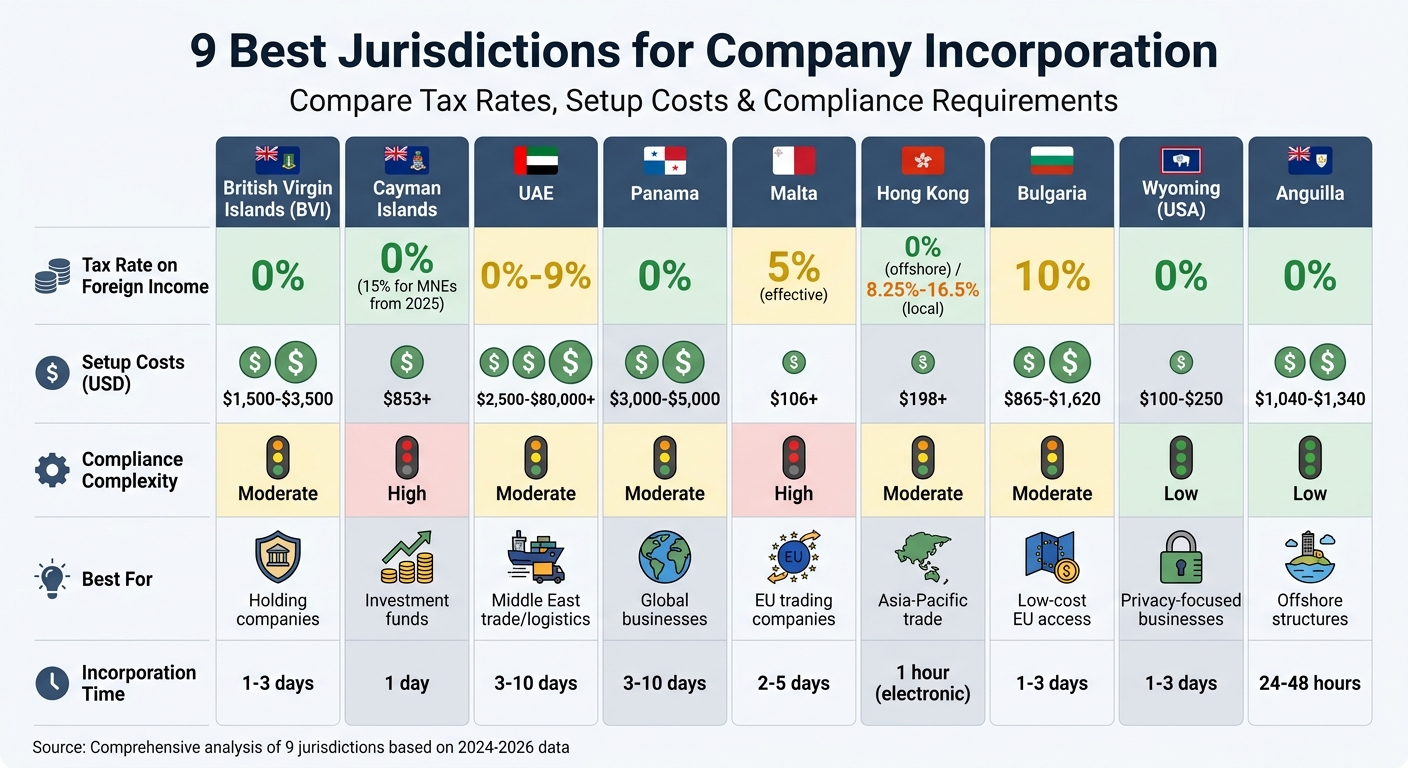
Choosing the right jurisdiction for incorporating your business can save you money and simplify compliance. This article compares nine popular jurisdictions based on costs, tax rates, and compliance requirements: British Virgin Islands (BVI), Cayman Islands, United Arab Emirates (UAE), Panama, Malta, Hong Kong, Bulgaria, Wyoming (USA), and Anguilla.
Here’s a quick breakdown:
- BVI: Zero tax on foreign income, setup costs from $1,500, but strict compliance rules.
- Cayman Islands: No taxes, high setup costs ($853+), and new 15% tax for large multinationals from 2025.
- UAE: 0% tax in free zones, but 9% federal tax on local income, setup from $2,500.
- Panama: Territorial tax system (0% on foreign income), setup from $3,000.
- Malta: Effective 5% tax on trading income, setup starts at $106.
- Hong Kong: 0% tax on offshore income, 8.25%-16.5% on local profits, setup from $198.
- Bulgaria: 10% flat tax, low costs, EU access, setup from $865.
- Wyoming (USA): No state taxes, low setup costs ($100+), strong privacy.
- Anguilla: 0% tax, setup costs from $1,040, minimal compliance.
Quick Comparison Table
| Jurisdiction | Tax Rate (Foreign Income) | Setup Costs (USD) | Compliance Complexity | Best For |
|---|---|---|---|---|
| BVI | 0% | $1,500-$3,500 | Moderate | Holding companies |
| Cayman Islands | 0% (15% for MNEs) | $853+ | High | Investment funds |
| UAE | 0%-9% | $2,500-$80,000+ | Moderate | Middle East trade/logistics |
| Panama | 0% | $3,000-$5,000 | Moderate | Global businesses |
| Malta | 5% (effective) | $106+ | High | EU trading companies |
| Hong Kong | 0% (offshore), 8.25%-16.5% | $198+ | Moderate | Asia-Pacific trade |
| Bulgaria | 10% | $865-$1,620 | Moderate | Low-cost EU market access |
| Wyoming (USA) | 0% | $100-$250 | Low | Privacy-focused businesses |
| Anguilla | 0% | $1,040-$1,340 | Low | Offshore structures |
Each jurisdiction has unique strengths and limitations, so choose based on your business goals, client base, and banking needs.
1. British Virgin Islands (BVI)
The British Virgin Islands (BVI) is a prominent offshore jurisdiction, hosting over 400,000 active companies despite having a population of just 36,000. This small territory manages an impressive $1.5 trillion in assets, with its economy holding foreign investments that are more than 5,000 times its own GDP. In 2024, the BVI achieved a perfect Tax Haven CTHI Score of 100.0, highlighting its maximum potential for corporate tax benefits.
Setup Costs (USD)
Setting up a company in the BVI involves initial incorporation costs ranging between $1,500 and $3,500. The government incorporation fee depends on the number of authorized shares:
- $550 for companies with up to 50,000 authorized shares
- $1,350 for companies exceeding that threshold
To save $800 annually, many opt to keep their authorized share capital at or below 50,000 shares.
Annual maintenance costs typically fall between $1,950 and $2,450, covering:
- Registered agent services: $700–$800
- Financial return maintenance: $350–$500
- Economic substance reporting: $350–$600
For those needing extra privacy, optional nominee services cost $500 to $2,000 per role annually.
Corporate Tax Rates
The BVI offers a zero-tax environment for international earnings. This means no corporate income tax, capital gains tax, sales tax, VAT, gift tax, or inheritance tax. Additionally, BVI Business Companies benefit from no withholding taxes on dividends. The absence of foreign exchange controls further enhances the appeal, allowing unrestricted movement of capital.
While the tax benefits are clear, the BVI has implemented strict compliance measures to maintain its global reputation.
Compliance Requirements
Compliance in the BVI is designed to ensure transparency and accountability. Each company must:
- Maintain a registered office in the BVI
- Appoint a licensed registered agent to handle filings and incorporation
- Submit an annual financial return within six months of the fiscal year-end (this remains private unless requested)
- File economic substance notifications annually, with enhanced requirements for "relevant activities" such as banking, fund management, or intellectual property
Additionally, companies must keep accurate accounting records for at least five years and report their physical location to the registered agent. Failure to comply with economic substance reporting can result in penalties starting at $20,000 for first-time violations and escalating to $400,000 for repeat offenders. Under the BOSS Act, beneficial ownership information must also be submitted to a centralized but non-public database.
Incorporation Time
Incorporating a company in the BVI is relatively quick, typically taking one to three business days once Know Your Customer (KYC) requirements are met. However, opening a bank account can be more time-consuming. Many BVI companies choose banking hubs like Hong Kong, Singapore, or Switzerland, so it’s wise to begin the account setup process alongside incorporation to avoid delays.
sbb-itb-39d39a6
2. Cayman Islands
The Cayman Islands is a key player in the world of offshore finance, hosting around 121,400 active registered companies as of 2023. Known for its low-tax framework, it’s particularly attractive for large-scale financial operations. The jurisdiction holds banking assets equivalent to 1/15th of the world’s total $30 trillion in banking assets and manages nearly half of the global hedge fund industry’s assets. With a GDP per capita of $97,749, it ranks among the top 10 globally.
Setup Costs (USD)
Starting January 1, 2025, registration fees in the Cayman Islands depend on a company’s authorized share capital. For an Exempt Company:
- Up to $42,000: Registration fee of $853.66
- $42,001 to $820,000: Registration fee of $1,219.51
- $820,001 to $1,640,000: Registration fee of $2,419.51
- Above $1,640,000: Registration fee of $3,131.71
Annual fees also vary. An Exempt Company with capital at or below $42,000 pays about $1,128 (CI$925) yearly, while a Limited Liability Company (LLC) incurs approximately $1,341 (CI$1,100) annually. Additionally, all companies must maintain a local registered office through a licensed service provider.
Corporate Tax Rates
The Cayman Islands is known for its zero-tax policy. There is no corporate income tax, capital gains tax, withholding tax, or payroll tax. Companies can also secure a Tax Concession Undertaking, which protects them from future taxes for 20 to 30 years – or up to 50 years for exempted limited partnerships.
However, starting in 2025, the jurisdiction will align with the OECD’s Pillar Two framework. Multinational enterprises with annual revenues above EUR 750 million will be subject to a 15% corporate income tax. The Cayman Islands dollar (KYD) is pegged to the US dollar at a fixed rate of KYD 1 = USD 1.20.
Compliance Requirements
Companies in the Cayman Islands must file annual returns and retain financial records for at least five years. Under the Beneficial Ownership Transparency Act 2023, all entities are required to maintain a confidential beneficial ownership register accessible to Cayman authorities. This information is not made public.
Economic Substance regulations apply to companies conducting "relevant activities", such as banking, insurance, or fund management. These entities must demonstrate a local presence and proper management. Failure to submit an Economic Substance Return on time results in a CI$5,000 fine, with an additional CI$500 per day for continued delays. The Cayman LLC law is modeled after the Delaware LLC framework, making it especially appealing to U.S. investors due to its flexibility and familiarity.
Incorporation Time
The Cayman Islands offers expedited incorporation, often completing the process in just one day. Standard timelines may vary by service provider but remain competitive with other major financial hubs. Up next, we’ll dive into the opportunities offered by the United Arab Emirates.
3. United Arab Emirates (UAE)
The UAE has established itself as a global business hub, with DMCC – its largest free zone – serving as home to over 24,000 companies. Businesses can choose between two main structures: mainland companies that directly access the local market, and free zone entities offering 100% foreign ownership and potential tax exemptions. This decision, along with selecting the right free zone, has a big impact on costs and compliance requirements. Let’s break down the UAE’s incorporation costs, tax policies, and compliance obligations.
Setup Costs (USD)
Incorporation costs in the UAE can vary widely depending on the free zone chosen. Here’s a quick breakdown:
- RAKEZ: Startup costs range from $2,500–$4,100, with annual fees between $1,900–$3,270.
- DMCC: A mid-tier option with setup costs ranging from $5,000 to $13,600, and yearly fees of $5,000 to $8,200.
- DIFC (Dubai International Financial Centre): A premium choice with setup costs starting at $30,000 to $80,000+, and annual fees of $15,000 to $40,000. DIFC stands out for using a common-law court system.
Additionally, incorporation in the UAE includes access to 2-year renewable residency visas for shareholders, which cost approximately $820 to $1,360 per visa.
Corporate Tax Rates
The UAE’s tax framework offers tailored benefits for businesses. As of June 1, 2023, a federal corporate tax of 9% applies to taxable income exceeding AED 375,000 (around $102,000). Income below this threshold is taxed at 0%, which supports smaller enterprises.
Free zone companies qualifying as a "Qualifying Free Zone Person" (QFZP) enjoy a 0% tax rate until June 2027, provided they generate "Qualifying Income" from approved activities like logistics, manufacturing, or fund management. However, "Excluded Activities" such as banking and insurance are taxed at 9%, even within free zones. To maintain the exemption, non-qualifying income must stay under 5% of total revenue.
Other tax highlights include:
- 0% withholding tax on dividends, interest, and royalties.
- No personal income tax on salaries or dividends.
- A standard 5% VAT applies to most taxable supplies, with mandatory registration for businesses with turnover exceeding AED 375,000.
Compliance Requirements
While the UAE offers appealing tax incentives, these come with strict compliance obligations. Here’s what businesses need to know:
- Corporate Tax Filing: All taxable entities must register with the Federal Tax Authority and submit tax returns within nine months of their tax year-end.
- Free Zone Compliance: To qualify for the 0% tax rate, free zone companies must demonstrate "adequate substance." This includes maintaining real assets, hiring qualified personnel, incurring operational expenses, and having a physical office – whether a flexi-desk or a dedicated space – within the UAE.
- Financial Reporting: Financial statements must adhere to International Financial Reporting Standards (IFRS).
- AML and Data Protection: Businesses must comply with Anti-Money Laundering (AML) regulations, including customer due diligence and transaction monitoring, as well as the Personal Data Protection Law (PDPL), which aligns with GDPR standards. Non-compliance can lead to hefty penalties.
For US citizens, additional reporting is required. UAE bank accounts exceeding $10,000 must be reported annually via FBAR (FinCEN Report 114), and UAE banks report US account holders to the IRS under FATCA. Engaging a US international tax CPA for Form 5471 and FBAR compliance is highly recommended for American entrepreneurs.
These compliance measures, combined with the UAE’s tax benefits and strategic location, make it a standout choice for international businesses.
4. Panama
Panama is well-known for its territorial tax system, which allows companies to pay 0% tax on income earned outside the country. This setup makes it an attractive choice for global businesses aiming to reduce tax burdens while benefiting from economic stability. The country uses the US Dollar (pegged 1:1 with the Balboa), eliminating currency exchange risks and providing a predictable financial environment.
Setup Costs (USD)
The initial cost to incorporate a business in Panama ranges from $3,000 to $5,000, covering legal fees, government registration, and the mandatory resident agent. While this is higher than incorporation fees in the US, the territorial tax advantages often offset the upfront expense for companies with foreign income. There’s no minimum capital requirement for setting up a corporation (S.A.) or LLC (S.R.L.), though businesses commonly set an authorized capital of $10,000. Annual maintenance costs include the Tasa Única (a government franchise tax) and ongoing fees for the resident agent. These expenses lay the groundwork for a tax-friendly business environment, as explained below.
Corporate Tax Rates
Panama’s tax system is straightforward but requires careful navigation. The standard corporate tax rate is 25% on income earned within the country. For companies with gross taxable income exceeding $1.5 million, the CAIR method applies, requiring payment of the higher amount between 25% of net taxable income or 4.67% of gross taxable income. Dividends from domestic income are taxed at 10%, while dividends from foreign or tax-exempt income are taxed at 5%. Businesses operating in special economic zones, such as the Colon Free Zone or Panama Pacifico, may enjoy 100% tax holidays or exemptions from import duties.
Compliance Requirements
Panama mandates that every company appoint a local lawyer or law firm as a resident agent to maintain a registered office and ensure compliance with local laws. Corporations must have at least three directors (President, Secretary, and Treasurer), a requirement that differs from the single-member structures permitted in many US states. Annual income tax returns (Form 110) are due by March 31 or within three months of the fiscal year-end. Even companies with only foreign-sourced income must file nil returns and maintain proper records. Starting in 2026, industries like finance and intellectual property management will face stricter economic substance requirements, possibly necessitating a local office or workforce to uphold tax benefits. Despite these obligations, Panama offers a relatively smooth incorporation experience.
Incorporation Time
The incorporation process in Panama is quick, typically taking 3 to 10 business days once KYC documents are approved. To streamline the process, notarized or apostilled copies of passports and address confirmations for all directors and shareholders should be prepared in advance. Setting up a corporate bank account may take an additional 1 to 3 weeks. Panama’s removal from the EU’s high-risk list for money laundering in 2026 has further boosted investor confidence and simplified compliance procedures. Up next, we’ll examine Malta’s regulatory and tax framework.
5. Malta
Malta is a member of the EU that offers an attractive corporate tax structure, effectively reducing the tax rate on trading income to just 5% after applying a shareholder refund mechanism. While the standard corporate tax rate is 35%, Malta’s full imputation system allows shareholders to claim a 6/7ths refund on taxes paid, significantly lowering the tax burden. Additionally, English is an official language for business and legal matters, removing any language-related hurdles.
Setup Costs (USD)
The cost of registering a company in Malta depends on the authorized share capital. Filing electronically through the BAROS portal costs €100 (around $106), while paper-based registration starts at €245 (approximately $260) for companies with share capital up to €1,500. A Private Limited Company requires a minimum share capital of €1,165 (roughly $1,240), with at least 20% (€233 or about $248) paid at the time of incorporation. Filing annual returns begins at €100. Additionally, all companies in Malta must undergo an annual audit, which adds to compliance costs. This structure becomes particularly cost-effective for businesses generating annual profits exceeding €150,000.
Corporate Tax Rates
Although Malta’s corporate tax rate is officially 35%, the refund mechanism reduces the effective rate to 5% for trading income. The country also has over 80 double taxation treaties, which enhance opportunities for international tax planning. While tax refunds are generally processed within 14 working days, errors in paperwork can extend this timeframe to six months.
"Many people delay their tax refund application or submit incomplete paperwork, turning a two‐month process into a six‐month ordeal. If you file the claim immediately after the tax return and ensure the shareholder’s bank details are correct, the system works reliably."
– Dr. Jörg Werner, Founder, Dr. Werner & Partners
Compliance Requirements
Malta’s regulatory framework is structured to promote transparency and efficiency. Companies must file annual returns with the Malta Business Registry (MBR) within 42 days of their "made-up" date. Financial statements need board approval within 10 months of the financial year-end and should be filed within 42 days of that approval. Businesses looking to access tax refunds or treaty benefits must demonstrate economic substance in Malta. This typically involves maintaining a registered office and ensuring that key management decisions are made locally. Trading companies are also required to submit quarterly VAT returns, while inactive companies must file nil returns to remain compliant. Additionally, maintaining a Register of Beneficial Owners is mandatory to meet AML/KYC standards.
Incorporation Time
Once all necessary documents are submitted, the MBR usually completes the registration process within 2 to 5 working days. However, achieving full operational status – including opening a bank account and completing tax registration – typically takes 6 to 8 weeks. Remote identity verification is possible using certified or apostilled documents. For those opting for electronic filing via the digital portal, registration can sometimes be completed in as little as 24 hours, with lower associated fees.
Next, we’ll take a closer look at Hong Kong’s business environment and regulatory framework.
6. Hong Kong
Hong Kong stands out as a global financial hub, offering a territorial tax system that only taxes profits generated within its borders. With over 70 of the world’s 100 largest banks operating there, Hong Kong is often celebrated as one of the world’s most open economies. It allows unrestricted capital flows, imposes no tariffs, and treats foreign and local companies equally. These features make it an attractive option for businesses seeking a balance between cost efficiency and regulatory compliance.
Setup Costs (USD)
Incorporating a company in Hong Kong involves the following costs:
- Government fees: HK$1,545 ($198 USD) for electronic submissions via the e-Services Portal or HK$1,720 ($220 USD) for hard copy filings.
- Business registration fee: Approximately HK$2,150 ($275 USD).
- Annual return filing fee: HK$105 (around $13 USD) if submitted on time. Late submissions (beyond 42 days after the incorporation anniversary) incur a fee of HK$3,480 (approximately $445 USD).
Using electronic filing not only reduces costs but also speeds up the processing time.
Corporate Tax Rates
Hong Kong employs a two-tiered profits tax system:
- 8.25% on the first HKD 2 million of assessable profits.
- 16.5% on profits exceeding that amount.
For unincorporated businesses, the rates are slightly lower: 7.5% for the first HKD 2 million and 15% thereafter. Additionally, Hong Kong does not impose capital gains tax, dividend tax, VAT, or withholding tax on interest income [55, 58]. For businesses earning revenue exclusively outside Hong Kong, a 0% tax rate may apply through an offshore profits claim, provided sufficient documentation proves all revenue-generating activities occurred abroad.
Compliance Requirements
Hong Kong’s straightforward compliance process adds to its appeal. Key requirements include:
- Annual audits: All companies must have their accounts audited by a Hong Kong-registered CPA. Audit fees typically range from HK$5,000 to HK$10,000 (approximately $640 to $1,280 USD).
- Company secretary: Businesses must appoint a company secretary – either a Hong Kong resident or a Hong Kong-registered company – within three months of incorporation.
- Registered office: A physical office address in Hong Kong is mandatory.
- Annual filings: Companies must submit annual returns within 42 days of their incorporation anniversary. Audited financial statements must accompany the Profits Tax Return. Late submission of audited accounts can result in fines up to HK$50,000 and a daily penalty of HK$1,000.
Incorporation Time
Hong Kong’s incorporation process is known for its speed:
- Electronic applications: Typically processed within one hour.
- Hard copy submissions: Completed in about four working days.
The jurisdiction permits 100% foreign ownership without requiring a local director. However, opening a traditional bank account can be challenging due to lengthy KYC procedures. Many businesses are now turning to virtual banks for faster account setup.
With its efficient processes and business-friendly policies, Hong Kong remains a strong choice for companies exploring offshore jurisdictions. Up next, we delve into Bulgaria’s regulatory environment.
7. Bulgaria
Bulgaria officially adopted the euro on January 1, 2026, eliminating currency risks for businesses operating in euros. This monetary stability, paired with low incorporation expenses, makes Bulgaria an appealing choice for startups. It’s one of the most cost-effective places to set up a business in the European Union, with incorporation costs ranging from $865 to $1,620 (€800–€1,500). Additionally, the country has maintained a flat 10% corporate income tax rate for nearly two decades, offering consistency for businesses.
Setup Costs (USD)
Starting a business in Bulgaria typically costs between $1,840 and $4,540 (€1,700–€4,200) in the first year. The minimum share capital required is just $1.08. One-time setup costs include:
- Trade Registry fee: $30 for electronic filings or $65 for paper submissions
- Notary fees for specimen signatures: $11 to $32
- Professional legal fees: $756 to $1,080 plus VAT
- Non-refundable bank KYC review fee: $108 to $540
- Virtual office services (first year): $194 to $324
Corporate Tax Rates
Bulgaria applies a flat 10% corporate income tax and a 5% dividend tax on distributed profits, resulting in an effective tax rate of 15%. However, dividends paid to companies based in other EU or EEA countries may qualify for a 0% withholding tax under the EU Parent-Subsidiary Directive, provided the parent company holds at least a 10% stake for 12 months. Companies that file electronically and pay their taxes by March 31 may also receive a 1% tax discount.
Compliance Requirements
Bulgarian companies are required to maintain double-entry bookkeeping and submit annual financial statements by June 30. Corporate tax returns must be filed by March 31. VAT-registered businesses must file monthly returns by the 14th of the following month, while social security declarations are due by the 25th. Even dormant companies must submit annual declarations of inactivity and financial statements. The VAT registration threshold is $55,300 in taxable turnover per calendar year. For small firms, annual bookkeeping and tax compliance services generally cost between $1,296 and $2,592.
Incorporation Time
The Trade Registry processes electronic applications within 1 to 3 business days. Including the time required to open a bank account, the setup process typically takes 5 to 7 business days for in-person applications or 2 to 3 weeks for remote applications via Power of Attorney. Over 90% of company applications are now submitted electronically through the Registry Agency portal. While traditional banks take about a week to complete KYC reviews, many founders prefer using fintech solutions like Wise or Revolut for daily operations after depositing the required initial capital with a licensed Bulgarian bank.
With low startup costs, a flat 10% tax rate, and a straightforward registration process, Bulgaria stands out as a practical choice for EU-based businesses. Next, we’ll take a look at Wyoming’s benefits for U.S. entrepreneurs.
8. Wyoming (USA)
Wyoming introduced the U.S. LLC structure back in 1977 and has since become a go-to state for non-resident entrepreneurs. Each year, more than 200,000 new businesses are established here, and Wyoming consistently ranks #1 on the Tax Foundation‘s State Business Tax Climate Index.
One of Wyoming’s biggest draws is its zero-tax policy. The state does not impose corporate income, personal income, franchise, or gross receipts taxes. Its only state-level tax is a 4% sales tax, making it especially appealing for non-residents running online or location-independent businesses with no U.S.-sourced income.
Setup Costs (USD)
Starting an LLC in Wyoming is affordable. Filing the Articles of Organization costs $100, with an additional $4 fee for online submissions. Registered agent services typically range from $100 to $150 per year, bringing the total first-year cost to around $200–$250. For those needing expedited service, Wyoming offers 24-hour processing for $100 or same-day service for $500. Over five years, state fees for a Wyoming LLC average about $400, significantly lower than Delaware’s $1,590. A Certificate of Good Standing costs just $3.
Corporate Tax Rates
Wyoming has no corporate or personal income taxes and does not levy franchise or gross receipts taxes. However, foreign-owned LLCs are required to file IRS Form 5472 and a pro forma Form 1120 annually. Non-compliance can lead to hefty penalties of $25,000 per form.
"Wyoming is the best state for most LLC owners, especially non-residents. Delaware is better only if you plan to raise venture capital from US investors."
– USLLCGlobal Team
The state’s tax benefits are paired with minimal compliance requirements, making it a practical choice for entrepreneurs.
Compliance Requirements
Wyoming mandates an annual report, due on the first day of the LLC’s formation anniversary month. The minimum fee is $60, calculated as $60 per $250,000 of Wyoming-based assets or $0.0002 per dollar of assets. Additionally, businesses must maintain a registered agent with a physical address in Wyoming to handle legal and government notices.
Privacy is another standout feature. Wyoming does not require LLC members or managers to be listed in public records. It also offers strong charging order protection, even for single-member LLCs, shielding assets from creditors. Starting in 2025, most LLCs will need to file a Beneficial Ownership Information (BOI) report with FinCEN within 30 days of formation under the Corporate Transparency Act. Failing to file the annual report for two consecutive years leads to administrative dissolution, though reinstatement is possible within two years for a $50 fee.
Incorporation Time
Wyoming’s incorporation process is smooth and efficient. Online filings are typically processed within 1 to 3 business days, while mail submissions may take up to two weeks. Over 90% of applications are now filed electronically, speeding up the process.
Wyoming has also embraced digital advancements, passing over 30 blockchain-related laws and creating a legal framework for decentralized autonomous organizations (DAOs). This forward-thinking approach makes the state particularly attractive to tech-focused entrepreneurs.
9. Anguilla
Anguilla, a British Overseas Territory, operates under English Common Law, providing a reliable legal framework for offshore companies. It’s particularly known for its strong privacy protections – disclosing company information is illegal, and the names of directors and shareholders are kept confidential. Additionally, Anguilla allows foreigners to own 100% of an Anguilla Business Company without needing local shareholders.
Setup Costs (USD)
Setting up a company in Anguilla costs between $1,040 and $1,340, depending on the service package you choose. Here’s a breakdown:
- Basic Package ($1,040): Covers government fees for the first year, document preparation, and secretarial services.
- Standard Package ($1,240): Includes everything in the basic package plus one bank account application.
- Premium Package ($1,340): Adds priority support and up to five bank account applications.
Annual renewal fees are around $1,030, which includes service provider charges and the government’s annual fee of approximately $200.
Corporate Tax Rates
Anguilla offers a 0% corporate tax rate for both residents and non-residents. Offshore entities are also exempt from capital gains, withholding, wealth, inheritance, and gift taxes, provided they don’t conduct business with Anguilla residents or own property in the territory. Note that bearer shares were abolished in 2018, so all shares must now be registered.
Compliance Requirements
Compliance in Anguilla is straightforward and minimal. Companies aren’t required to conduct financial audits or submit annual reports to the government. However, they must:
- Maintain a local registered office.
- Appoint a licensed registered agent.
- Keep accounting records for at least six years.
During registration, notarized "Know Your Customer" (KYC) documents are required. These typically include a passport copy and proof of address (like a utility bill or bank statement) dated within the last three months. If a company engages in specific activities like banking, insurance, or intellectual property, Economic Substance (ES) requirements apply, necessitating an annual ES return.
Incorporation Time
Anguilla boasts one of the fastest incorporation processes in the Caribbean. Corporate documents are usually issued within 24 to 48 hours of filing. Thanks to the ACORN (Anguilla’s Commercial On-line Registration Network) system, licensed managers can incorporate companies instantly, around the clock, making it a convenient option for quick offshore structuring.
Advantages and Disadvantages by Jurisdiction
Picking the right jurisdiction for your business involves more than just comparing tax rates. Each location has its own benefits and challenges that can significantly influence your operations. As Bertrand Théaud, Founder of Statrys, explains:
"The tax rate is actually the least important number on this list… Get those answers wrong and your 0% tax jurisdiction quietly becomes your most expensive business decision".
Here’s a quick comparison of key jurisdictions, summarizing their unique strengths and limitations based on our detailed analysis.
Wyoming is an attractive option for small businesses and entrepreneurs who value privacy. It offers low fees, minimal annual costs, and strong confidentiality protections. The only major downside? If your business operates across multiple states, you’ll need to register as a foreign entity in each one, which means hiring registered agents and paying extra fees to stay compliant.
On the other hand, BVI and the Cayman Islands provide zero-tax environments but come with higher setup costs and the requirement to demonstrate economic substance. This means having a physical presence beyond just a paper entity. Banking can also be tricky, especially for businesses that need to invoice clients directly. However, these jurisdictions work well for holding companies and joint ventures.
Bulgaria offers excellent value in the EU, with a registration fee of just EUR 28 and a combined corporate and dividend tax rate of 15% (10% corporate tax plus 5% dividend tax). That said, complying with EU regulations adds some complexity.
Hong Kong operates under a territorial tax system, meaning 0% tax on offshore profits. However, companies must complete mandatory annual audits and handle in-person banking requirements, which can be cumbersome.
Delaware is a popular choice for Fortune 500 companies. Still, for international entrepreneurs, the global average corporate tax rate of 23.58% makes exploring other specialized jurisdictions worth considering.
Here’s a table summarizing the main advantages, drawbacks, and best use cases for each jurisdiction:
| Jurisdiction | Key Advantage | Main Drawback | Best Use Case |
|---|---|---|---|
| Wyoming | Low filing and annual fees, strong privacy | Must register as foreign entity if operating in other states | Privacy-focused consultants, remote businesses |
| BVI | 0% tax on all foreign income | Difficult banking access; higher setup costs | Holding structures, joint ventures |
| UAE | 0% tax in free zones | In-person visits required; high renewal costs | Middle East trade, logistics |
| Hong Kong | 0% on offshore profits | Mandatory audits; in-person banking procedures | Asia-Pacific trading companies |
| Bulgaria | EUR 28 registration, 15% combined tax | EU regulatory compliance | Low-cost EU market access |
| Cayman Islands | Pure zero-tax jurisdiction | Very high costs; challenging banking | Investment funds, private equity |
The Vorx Team highlights the importance of a broader perspective when deciding on a jurisdiction:
"In 2026, choosing where to form your company is no longer a tax-shopping exercise. It’s a strategic decision that sits at the intersection of regulation, banking access, and digital infrastructure".
Before committing, ensure your major clients accept invoices from your chosen jurisdiction. Some companies scrutinize addresses linked to traditional tax havens, which could impact your business relationships. Use these insights to align your jurisdiction choice with both your operational goals and tax planning strategy.
Conclusion
Choosing the right jurisdiction for incorporation isn’t just about chasing the lowest tax rate – it’s about finding a location that aligns with your business’s operational and strategic needs. Each jurisdiction comes with its own set of benefits, tailored to different priorities and goals.
For international founders looking for a mix of tax efficiency and dependable banking access, Hong Kong stands out. With 96% of clients successfully opening accounts within three business days, it offers a 0% offshore tax rate, making it a great fit for remote businesses. Plus, startup exemptions can bring effective tax rates to under 5% during the first three years.
If privacy and affordability are your main concerns, Wyoming is worth considering. Its strong confidentiality protections, combined with a $100 filing fee and a $50 annual report fee, make it a cost-effective option. This reflects the broader appeal of jurisdictions with low compliance costs. Meanwhile, Bulgaria is an excellent gateway to the European market, offering a flat 10% corporate tax rate and moderate operational expenses. It’s an appealing choice for small to medium-sized businesses aiming to establish an EU presence.
For those focused on holding structures or asset management, the British Virgin Islands (BVI) remain a solid option with their 0% tax rate. However, it’s important to note that banking access in the BVI can be more complicated compared to Hong Kong, and invoices from traditional offshore jurisdictions may face extra scrutiny from some enterprise clients.
Before making a decision, ensure you can open a corporate bank account remotely and confirm that your clients will accept invoices from your chosen jurisdiction. As industry experts often point out, selecting the wrong jurisdiction can lead to unexpected and costly challenges. Ultimately, the best choice balances tax benefits, banking convenience, client expectations, and long-term compliance – not just the headline tax rate.
FAQs
Which jurisdiction is easiest for opening a corporate bank account?
The United States stands out as one of the most accessible places for setting up a corporate bank account. Thanks to various banks and fintech platforms, non-residents can often open accounts online with just a few basic requirements. This simplicity makes it an appealing option for international entrepreneurs looking to streamline their banking needs.
Do I need real “economic substance” to keep the tax benefits?
Yes, maintaining economic substance – meaning real business activity and a physical presence – is often necessary to qualify for tax benefits in certain jurisdictions. Authorities and courts scrutinize arrangements that appear to lack a legitimate business purpose. To comply, businesses usually need to show evidence of actual operations, such as having employees, conducting activities, or holding assets in the jurisdiction.
What filings do U.S. owners need for offshore or foreign-owned companies?
U.S. individuals who own offshore companies or have interests in foreign-owned businesses are required to submit specific reports to the IRS and other agencies. These reports include details about beneficial ownership (such as filings like Schedule 13D or 13G) and disclosures of foreign financial assets, accounts, or gifts. Key forms for these purposes include the FBAR (FinCEN Form 114) and FATCA Form 8938, with filing obligations depending on the value of assets held overseas. The exact requirements can vary based on each person’s unique situation.
