
Stripe Atlas promises an easy way to set up a Delaware C Corporation or LLC for global entrepreneurs, but it often creates more problems than it solves. Here’s why:
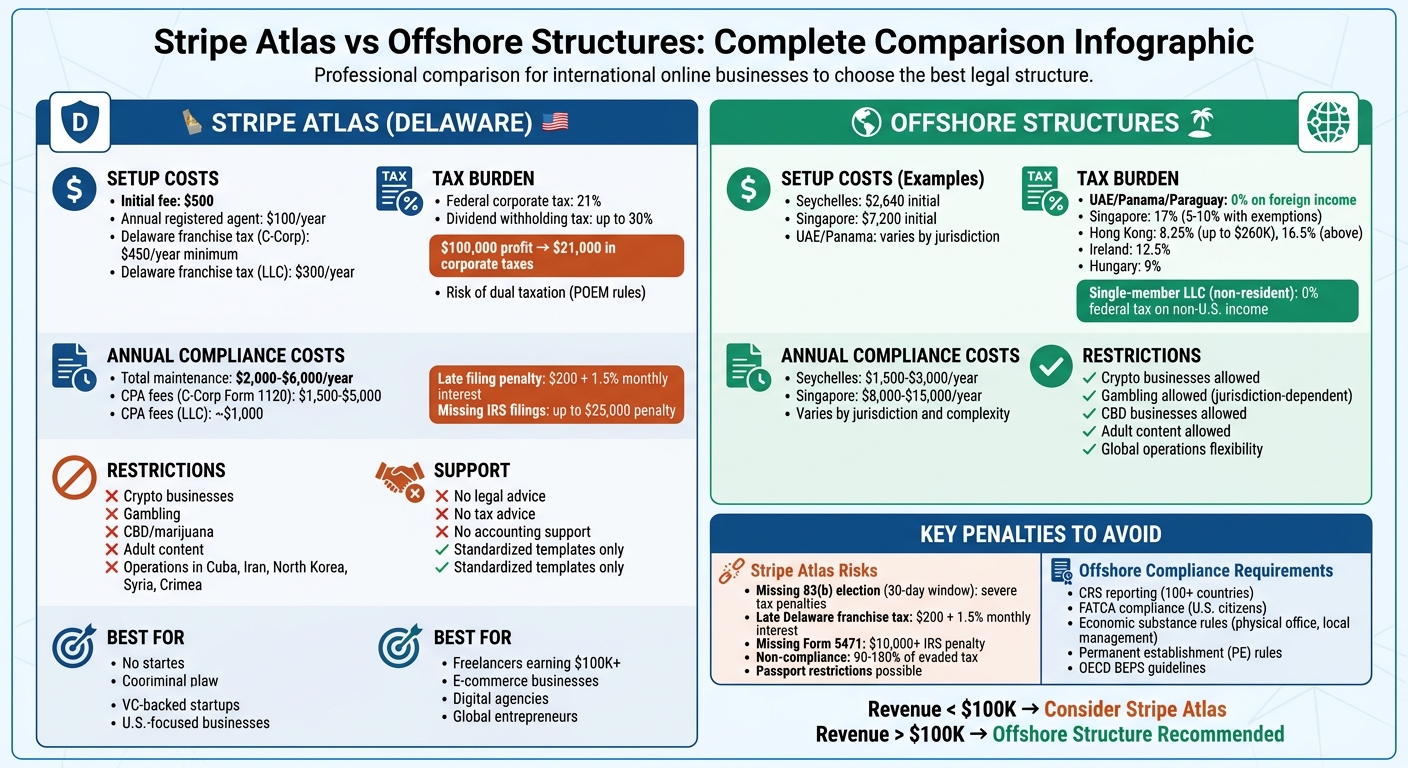
- Tax Issues: U.S. companies face federal taxes (21%), dividend withholding taxes (up to 30%), and compliance costs ($2,000–$6,000 annually). International founders risk dual taxation due to local rules like "Place of Effective Management" (POEM).
- Compliance Challenges: Stripe Atlas doesn’t provide legal, tax, or accounting support. Founders must navigate complex cross-border compliance and reporting requirements, risking penalties like $25,000 for missing IRS filings.
- Limited Flexibility: The platform offers standardized templates that don’t address specific needs like non-compete clauses or asset protection.
- Industry Restrictions: Businesses in crypto, gambling, CBD, and other industries are excluded due to Stripe’s policies.
- Hidden Costs: Even inactive companies incur fees, with Delaware corporations requiring annual franchise taxes and filings.
Offshore Structures: A Better Solution
Offshore setups can solve these issues by offering tailored solutions for tax efficiency, asset protection, and global scalability. Benefits include:
- Lower Taxes: Jurisdictions like the UAE or Panama offer 0% tax on foreign income. Single-member U.S. LLCs can avoid federal taxes on non-U.S. income.
- Stronger Asset Protection: Tools like trusts and holding companies shield personal assets from lawsuits and creditors.
- Global Freedom: Offshore companies face fewer restrictions, enabling operations in diverse industries and regions.
For businesses earning $100,000+ annually, professional advice ensures compliance with international tax laws, economic substance rules, and reporting standards like CRS and FATCA.
Key Takeaway
Stripe Atlas is ideal for U.S.-focused, VC-backed startups but falls short for freelancers, e-commerce businesses, and digital agencies. Offshore structures, while more complex upfront, provide better long-term solutions for global entrepreneurs.
What Stripe Atlas Offers and Where It Falls Short
What Is Stripe Atlas?
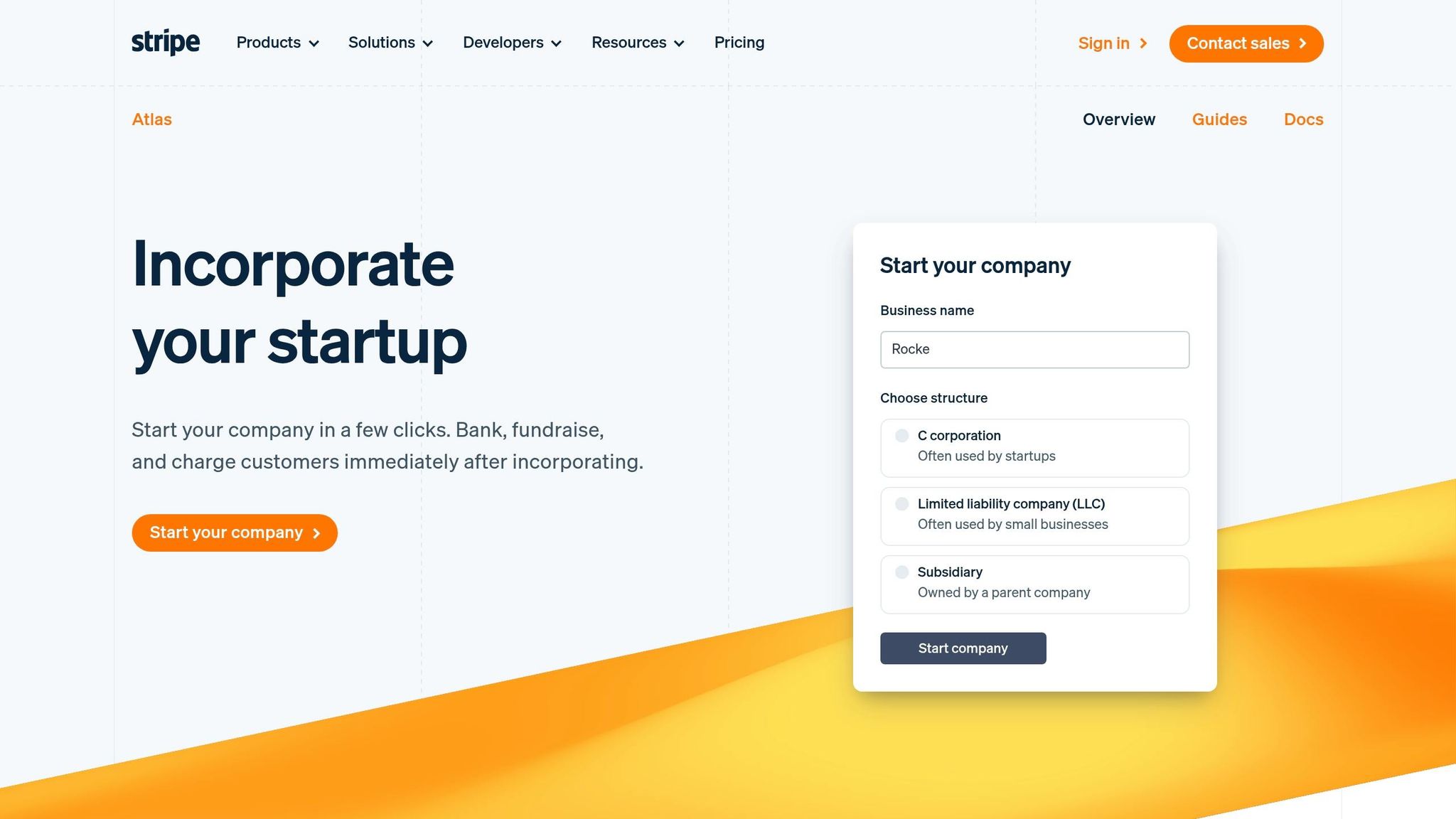
Stripe Atlas is designed to help entrepreneurs worldwide set up a Delaware C Corporation or LLC in just two days. It takes care of the incorporation paperwork, secures an Employer Identification Number (EIN) from the IRS, and arranges for a registered agent.
The platform goes beyond incorporation by offering access to business bank accounts through partners like Mercury and Brex. It also enables businesses to start accepting U.S. card payments via Stripe immediately. Additionally, Atlas provides pre-drafted legal documents, such as bylaws and operating agreements, created with the law firm Cooley. It handles issuing founder stock, setting up equity vesting schedules, and even provides templates for fundraising using SAFEs (Simple Agreements for Future Equity).
The service costs $500 upfront, which covers incorporation, state filing fees, and the first year of registered agent services. After that, there’s an annual fee of $100 for continued registered agent services. New users also get perks like $50,000 worth of partner benefits and $2,500 in Stripe product credits during their first year.
While Stripe Atlas simplifies the early stages of business formation, it also brings some notable challenges.
Main Problems with Stripe Atlas
Although Stripe Atlas makes incorporation straightforward, it can lead to significant long-term issues. For one, it relies heavily on standardized templates, which don’t allow for custom clauses like non-compete agreements. This lack of flexibility leaves founders without the tailored legal advice they may need to navigate complex international regulations.
Tax inefficiencies are another major drawback. Delaware C Corporations face a minimum annual tax of $450, which includes a $400 franchise tax and a $50 filing fee, while LLCs owe $300 annually. Missing the Delaware franchise tax deadline (March 1st) results in a $200 late fee and 1.5% monthly interest on the unpaid amount. For entrepreneurs in countries like India, "Place of Effective Management" (POEM) rules can complicate matters further, potentially classifying the U.S. entity as a local tax resident if operations are primarily managed from their home country.
The annual maintenance costs for a Stripe Atlas business can range from $2,000 to $5,000, even if the company isn’t actively operating. Krish Subramanian, co-founder of Chargebee, shared his experience in 2016, where an administrative error in filing Form 5471 separately from their income statement resulted in a $10,000 IRS penalty. Fixing this required significant time and investor support. He cautioned:
Stripe Atlas, right now, does not seem to include all the regulatory filings, tax advice… It’s your job.
The platform also places restrictions on certain industries. Businesses involved in gambling, marijuana/CBD, adult content, and some financial services – especially crypto-related ventures – are prohibited due to Stripe’s financial partner policies. Additionally, operating in multiple countries brings the same legal, tax, and accounting challenges faced by large multinational corporations, but without the resources to manage them effectively.
These challenges highlight the importance of considering offshore strategies that offer lower tax burdens, better asset protection, and smoother pathways for global growth. Entrepreneurs need to weigh these factors carefully when deciding whether Stripe Atlas aligns with their long-term business goals.
sbb-itb-39d39a6
The Problems with Using Stripe Atlas for International Business
Higher Taxes and Missed Savings
For international founders, using Stripe Atlas can lead to unexpected tax burdens. When a U.S. company is managed from another country – like Canada or India – it often needs to register as "doing business" locally, which can result in being taxed in both countries. To avoid penalties, founders must follow strict transfer pricing rules. This means ensuring that transactions between the U.S. entity and a local company are conducted at market value, a process that requires costly intercompany agreements and professional tax consultations. These expenses can easily match an engineer’s annual salary.
"The moment you’re operating in two countries you are subject to the same legal, tax & accounting rules that multi-national corporations have to conform to." – antoinevg, Founder
On top of this, Delaware companies face mandatory franchise taxes, which apply even if the business isn’t profitable. Some countries also have "Place of Effective Management" (POEM) rules, which can classify a U.S. company as a local tax resident if it’s managed from abroad. This adds another layer of complexity for tax residency and planning. Together, these factors make compliance an uphill battle for non-U.S. founders.
Compliance Issues for Non-US Business Owners
While Stripe Atlas helps set up a Delaware company, it doesn’t provide tailored legal, tax, or accounting advice. Founders are left to handle all reporting requirements on their own, starting immediately after incorporation.
The compliance demands can be overwhelming. Missing key deadlines, like the 30-day window for filing an 83(b) election, can result in severe tax penalties. In some cases, founders even need regulatory approval from their home country to own a U.S. entity. For example, South African entrepreneurs must get clearance from their Reserve Bank. Keeping a U.S. company compliant while living abroad can cost between $2,000 and $5,000 annually.
"If you pay peanuts you get monkeys; hire a shitty accountant, then you are screwed big time. They may not ask all the right questions about your liability in different countries and cross border transactions." – Krish Subramanian, Co-founder, Chargebee
Beyond tax and compliance challenges, international founders also face risks related to asset protection and privacy.
Weak Asset Protection and No Privacy
Delaware incorporation through Stripe Atlas doesn’t automatically protect founders’ assets from lawsuits or creditors. The platform doesn’t address the more complex cross-border legal structures needed to separate liabilities between a U.S. entity and a foreign parent or subsidiary. Without proper intercompany agreements and transfer pricing documentation, founders remain vulnerable to legal and financial risks.
Neglecting compliance obligations can lead to severe consequences. The IRS can impose hefty fines for missed filings, and in extreme cases, even restrict a founder’s passport. Under the terms of Stripe Atlas, both the company and its founders are jointly and severally liable for any legal violations. This means founders could be held personally responsible for the company’s failures.
For those seeking better asset protection and privacy, other jurisdictions might offer more favorable options. However, Stripe Atlas does not provide guidance on these alternatives. These gaps highlight why establishing proper offshore structures is critical for international businesses aiming for long-term security and growth.
Why Offshore Structures Work Better for Online Businesses
Offshore structures offer a flexible alternative to domestic options, addressing common challenges like high taxation, limited asset protection, and restricted global operations. These structures are designed to meet the specific needs of online businesses, making them a practical choice for entrepreneurs.
Lower Tax Burdens
Domestic business structures, like a Delaware C-Corporation, often come with hefty tax obligations. For example, such corporations face double taxation: a 21% federal tax on profits and additional taxes on shareholder dividends. To put it in perspective, a profit of $100,000 could lose around $21,000 to corporate taxes before any personal distributions.
On the other hand, a single-member LLC owned by a non-resident can avoid corporate-level taxes if there’s no U.S.-sourced income. Compliance costs also differ significantly. While filing requirements for a C-Corporation, such as Form 1120, can lead to CPA fees between $1,500 and $5,000 annually, an LLC’s simpler compliance typically costs closer to $1,000 per year. Even annual maintenance fees vary: Delaware’s minimum franchise tax is $300 (sometimes higher), while Wyoming charges around $60, and New Mexico may not charge anything at all.
As one expert put it:
"The LLC saves thousands per year in taxes and CPA fees. This is not tax avoidance – it is choosing the correct entity type for your situation."
These savings not only reduce operational costs but also lay a solid foundation for international growth.
Better Asset Protection
Stripe Atlas, while popular, offers limited asset protection and provides no legal, tax, or accounting advice. A Delaware corporation remains fully subject to U.S. legal systems, and Stripe can suspend or terminate accounts if it detects "heightened risk of legal or regulatory non-compliance." This leaves founders vulnerable to legal and financial risks. In March 2026, the FTC highlighted the risks associated with certain domestic structures, emphasizing the need for stronger protection strategies.
Offshore structures, by contrast, employ tools like trusts, private foundations, and holding companies to separate personal and business assets. Jurisdictions such as Anguilla and the Cayman Islands offer legal frameworks specifically designed to shield personal assets from creditors. This level of protection ensures businesses can operate securely across multiple jurisdictions.
Easier Global Expansion
Domestic solutions like Stripe Atlas come with operational restrictions. For instance, Stripe prohibits business activities in countries like Cuba, Iran, North Korea, Syria, and Crimea. It also blocks entire industries, including CBD/hemp products, certain financial services, and adult content, due to compliance requirements from U.S. financial partners.
Offshore structures eliminate these limitations. They allow businesses to access favorable banking systems, operate in regulated industries without prohibitions, and transact in stable currencies like the U.S. dollar. Jurisdictions such as Ireland and Hungary, with corporate tax rates of 12.5% and 9% respectively, create environments that support global scalability. This freedom enables businesses to grow and adapt to international markets with fewer barriers.
Choosing the right structure isn’t just about cutting costs – it’s about creating a framework that supports sustainable growth and long-term success in the global marketplace.
What to Consider When Setting Up Offshore Structures
When dealing with the limitations of Stripe Atlas, setting up a well-thought-out offshore structure becomes essential. A properly designed structure can help you avoid banking hurdles, compliance missteps, and steep penalties.
Selecting the Right Jurisdiction
Choosing the right jurisdiction is all about finding a balance between tax advantages and reliable banking access. For instance, places like Singapore and Hong Kong are known for their stable banking systems, making it easier to open accounts with traditional banks. On the other hand, privacy-focused jurisdictions such as Seychelles or the British Virgin Islands (BVI) may require you to work with Electronic Money Institutions (EMIs) like Wise or Revolut.
Tax rates vary widely depending on the jurisdiction. Some countries, like the UAE, Panama, and Paraguay, offer 0% tax on foreign income. Others, such as Singapore, have a corporate tax rate of 17%, which can drop to 5–10% through exemptions. Hong Kong uses a tiered system: profits up to $260,000 are taxed at 8.25%, while anything above that is taxed at 16.5%.
To ensure your offshore structure holds up under scrutiny, it must meet economic substance rules. This means having a physical office, local management, and documented operations. Without these, your home country’s tax authorities may disregard the structure entirely and tax you as if it doesn’t exist.
Legal systems also play a role. Jurisdictions that follow English Common Law, such as Antigua, Anguilla, and Hong Kong, tend to offer more predictable contract enforcement. Some countries also provide specific treaty benefits, like the Madrid Protocol for intellectual property protection.
Costs are another key factor. For example, forming a company in Seychelles costs about $2,640, with annual maintenance fees ranging from $1,500 to $3,000. In contrast, Singapore requires around $7,200 upfront and annual costs between $8,000 and $15,000.
"A 0% tax rate means nothing if you can’t open a bank account, can’t get payment processing, or can’t meet substance requirements." – EasyInc
Once you’ve chosen the right jurisdiction, make sure your structure complies with all legal and regulatory requirements.
Meeting Legal and Compliance Requirements
Ignoring international reporting standards like CRS (Common Reporting Standard) and FATCA (Foreign Account Tax Compliance Act) can lead to penalties ranging from 90% to 180% of the evaded tax. Over 100 countries participate in CRS, sharing account information with tax authorities in the account holder’s home country. U.S. citizens must also comply with FATCA.
To avoid reclassification as a domestic resident, ensure your company’s management genuinely operates within the offshore jurisdiction. For example, if you incorporate in Panama but make all key decisions from your home country, tax authorities might treat the company as a domestic entity. This practice, known as "foreign incorporation" or esterovestizione, can result in back taxes and fines.
Permanent establishment (PE) rules add another layer of complexity. If you operate through a fixed location or agents in your home country, your foreign income could become taxable domestically. The OECD‘s BEPS (Base Erosion and Profit Shifting) guidelines ensure that profits are taxed where actual economic activity takes place.
Documenting management decisions is critical. Board meetings and strategic decisions should physically occur – or at least be documented as occurring – within the offshore jurisdiction. This helps establish tax residency and strengthens asset protection.
"Offshore does not mean invisible. Over 100 countries now participate in the Common Reporting Standard (CRS)… Disclose properly and stay compliant." – Bertrand Théaud, Founder, Statrys
Once compliance is addressed, it’s time to bring in professionals to create a tailored solution.
Getting Professional Help for Custom Solutions
Offshore structuring is complex, so working with experts in international tax, corporate law, and banking is essential. International tax accountants help navigate reporting standards like CRS and FATCA, while also addressing controlled foreign corporation (CFC) rules that may apply in your home country. Corporate lawyers handle incorporation documents, intellectual property transfers, and asset protection strategies.
Banking and compliance specialists are equally important. Banks now conduct stricter due diligence than government registries and often reject businesses in high-risk categories, like crypto, to avoid regulatory issues. Specialists can help match your business with the right bank or EMI.
Strategic consultants can design multi-layered structures that combine customer-facing entities, operational companies, and holding organizations. This approach balances credibility, tax efficiency, and asset protection.
The financial tipping point for professional structuring usually starts at $100,000 to $150,000 in annual revenue. While forming a company can take as little as 48 hours, opening a business bank account might take up to three months.
Experts also address personal tax residency alongside corporate structuring – two separate challenges that require careful coordination. They verify economic substance, set up physical addresses, and document management activities to prevent reclassification by home-country tax authorities. This ensures better asset protection and tax planning compared to domestic setups.
Conclusion
Atlas struggles to address the complexities of international tax, compliance, and asset protection. While Stripe Atlas may seem like a fast and easy solution, it often creates serious long-term problems. The platform locks you into a Delaware-based structure regardless of your tax residency, offers no legal or accounting support, and exposes you to potential dual taxation risks – issues that can lead to costly penalties. As Stripe itself clarifies:
We are not a law firm or an accounting firm, and we provide no legal, tax or accounting advice of any kind whatsoever.
These limitations highlight why alternative offshore structures are a better option. Properly designed offshore setups provide what Atlas cannot: flexibility in jurisdiction, stronger asset protection, and tax strategies tailored to your unique circumstances. Instead of being stuck with a C-Corporation that comes with double taxation, you can select a structure that aligns with your residency and business goals. While Atlas may seem cheaper upfront, the long-term compliance risks and restrictions – especially in light of the FTC’s March 2026 warnings on debanking practices – can far outweigh the initial savings.
The choice between a $500 automated setup and a customized offshore solution is ultimately about long-term success, not just upfront cost. Stripe Atlas is best suited for VC-backed startups that can navigate U.S. tax complexities. However, for freelancers, e-commerce businesses, and digital agencies, offshore structures offer lower ongoing expenses, easier reporting, and the freedom to operate in industries that Stripe restricts, such as CBD, gambling, or adult content.
At Global Wealth Protection, we specialize in creating comprehensive offshore frameworks that address both corporate structures and personal tax residency – two key areas that Atlas overlooks. Our team manages everything from selecting the right jurisdiction and meeting economic substance requirements to establishing banking relationships and ensuring compliance from the start.
Don’t settle for a cookie-cutter solution that leaves you vulnerable to unnecessary taxes, compliance headaches, and account closures. Consider professional offshore structuring tailored to your business model, residency, and long-term growth plans.
FAQs
When does an offshore structure make more sense than a Delaware company?
Offshore structures are often the better choice when a business focuses on tax efficiency, safeguarding assets, and expanding globally, particularly for international operations. These entities typically offer advantageous legal systems, lower tax obligations, and stronger protection against legal claims. On the other hand, Delaware companies are well-suited for businesses centered on the U.S. market. For companies involved in international trade or digital services, offshore setups provide a more adaptable legal framework.
How do I avoid being taxed in both the U.S. and my home country?
To steer clear of double taxation, it’s crucial to grasp the concept of tax residency and familiarize yourself with any tax treaties between the U.S. and your home country. These treaties often outline which country has the right to tax specific types of income, such as business profits or royalties.
Setting up the right offshore structure in a jurisdiction with advantageous treaties can make a big difference. Pair this with professional legal or tax advice to reduce the risk of double taxation while staying compliant with all applicable laws.
What does ‘economic substance’ mean for an offshore company?
Economic substance means an offshore company must engage in real business activities, have a physical presence, and conduct genuine operations in the jurisdiction where it is registered. This concept ensures the company isn’t merely a shell entity created for tax advantages or legal loopholes. Many jurisdictions require companies to prove their economic substance to comply with local laws and avoid potential penalties.
