
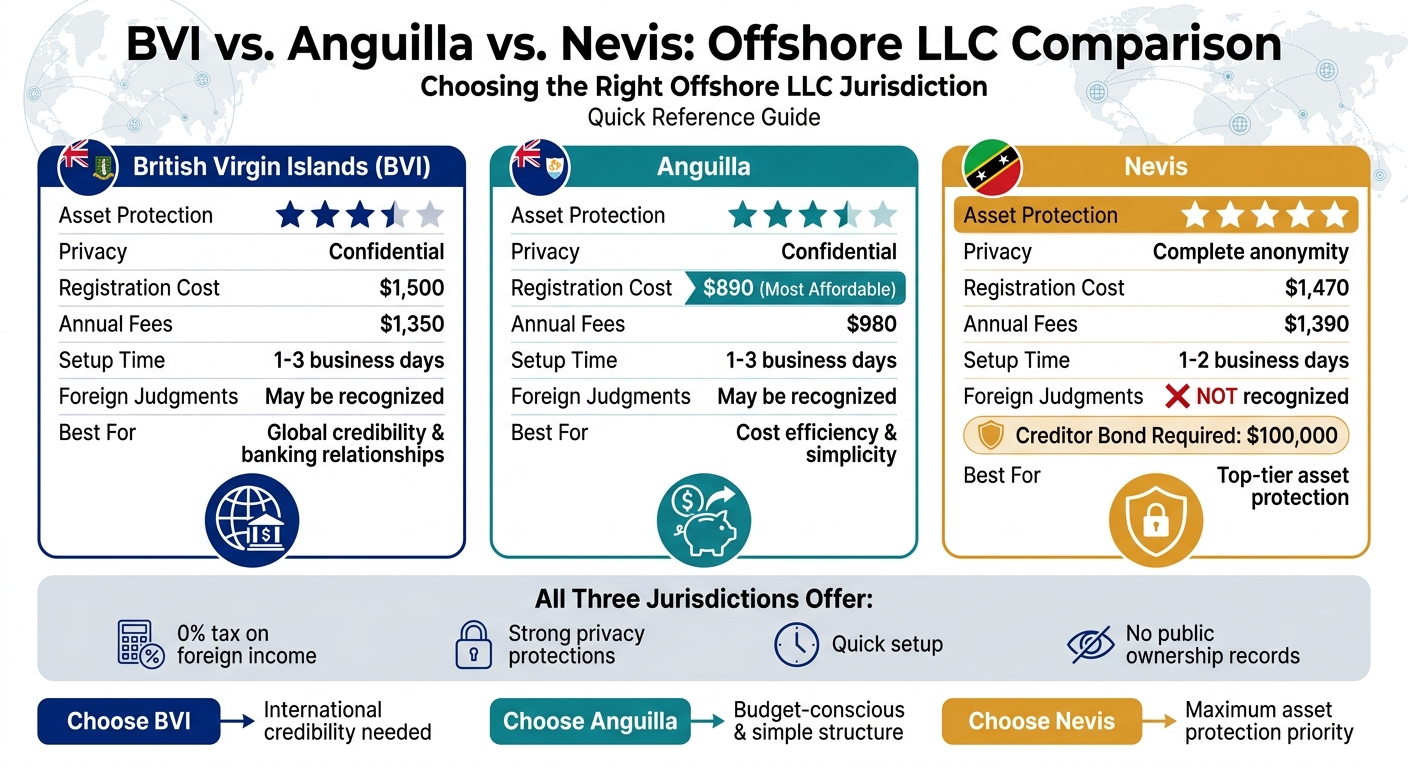
When deciding between BVI, Anguilla, and Nevis for offshore LLC formation, here’s what you need to know:
- BVI is ideal for global recognition and banking relationships but comes with higher costs and stricter compliance.
- Anguilla is the most affordable option, offering simplicity and stability, but lacks advanced asset protection features.
- Nevis excels in asset protection with strong legal safeguards, including a $100,000 creditor bond and non-enforcement of foreign judgments, but it’s costlier upfront.
Quick Comparison
| Feature | BVI | Anguilla | Nevis |
|---|---|---|---|
| Asset Protection Rating | 3/5 | 3/5 | 5/5 |
| Privacy | Confidential | Confidential | Complete anonymity |
| Registration Cost | $1,500 | $890 | $1,470 |
| Annual Fees | $1,350 | $980 | $1,390 |
| Foreign Judgments | May be recognized | May be recognized | Not recognized |
| Setup Time | 1–3 business days | 1–3 business days | 1–2 business days |
| Best For | Global credibility | Cost efficiency | Asset protection |
Key Takeaway:
Choose BVI for international credibility, Anguilla for cost savings, and Nevis for top-tier asset protection. Each jurisdiction offers tax-neutral structures, privacy, and ease of setup, but the right choice depends on your priorities.
British Virgin Islands (BVI) Business Companies
Key Features of BVI Business Companies
The BVI operates under the BVI Business Companies Act 2004, which is rooted in English Common Law. This creates a legal framework that international investors find reliable and predictable.
One of the standout benefits for BVI companies is tax neutrality. Companies that don’t conduct business within the territory are exempt from corporate tax, capital gains tax, gift taxes, inheritance taxes, and VAT. This makes financial planning simpler and boosts banking efficiency for offshore LLCs. Utilizing specific LLC secrets to keep your assets safe can further enhance these protections. Adding to its global appeal, the BVI uses the U.S. dollar as its currency, making cross-border transactions more seamless.
Setting up a company in the BVI is straightforward. Only one director and one shareholder are needed, and the same person can serve in both roles. Companies are not required to conduct annual audits, file financial accounts, or hold Annual General Meetings. Additionally, director details filed with the Registrar remain confidential, while shareholder and beneficial owner information is privately maintained by the Registered Agent.
The BVI’s prominence in the offshore sector is undeniable. About 40% of all offshore companies are based here, and as of 2023, over 350,000 business companies are registered in the BVI. Since 1984, more than one million companies have been incorporated. The jurisdiction also boasts an impressive statistic: roughly 30 registered companies per resident, one of the highest ratios in the world.
These features highlight why offshore asset protection in the BVI remains a top choice for entrepreneurs looking to establish LLCs.
Advantages of BVI for Offshore LLCs
The BVI’s strong reputation means its companies are widely accepted on major stock exchanges like NASDAQ, NYSE, LSE, and HKEX. International banks also generally welcome relationships with BVI entities. Furthermore, the OECD rates the BVI as "largely compliant" in terms of transparency and information exchange – on par with countries like the UK and the US.
Incorporation in the BVI is notably efficient. Same-day processing is possible, and most companies are formed within 3–5 business days. Only licensed BVI registered agents can form companies, ensuring that anti-money laundering checks and Know Your Client procedures are handled professionally.
Drawbacks of BVI
Despite its many advantages, the BVI does come with some challenges.
One of the main drawbacks is cost. Fees for BVI companies are higher compared to jurisdictions like Anguilla or Nevis. Government fees start at $350 for companies issuing up to 50,000 shares, with additional costs for higher share counts. Security registration incurs an extra $100.
Compliance has also become stricter in recent years. The BVI Business Companies (Amendment) Act 2024 introduced more rigorous requirements for beneficial ownership reporting and record-keeping to combat money laundering. Companies involved in activities like banking, insurance, or fund management must also comply with the BVI Economic Substance Act, which mandates physical presence and local expenditure.
Bearer shares, while allowed, are subject to strict conditions. They require a licensed custodian and come with higher fees.
sbb-itb-39d39a6
Anguilla Limited Liability Companies
Key Features of Anguilla LLCs
Anguilla operates under the Limited Liability Company Act 2014, which was inspired by Wyoming’s LLC laws. This makes it a familiar choice for North American investors.
The tax structure is simple and appealing. Anguilla LLCs are flow-through entities, meaning profits and losses are passed directly to members. As long as the LLC does not engage in business within Anguilla, it is exempt from corporate, capital gains, and income taxes.
Privacy is another strong point. By law, revealing information about an Anguilla company is a criminal offense. Additionally, the Articles of Formation filed with the Registrar are not publicly available.
"Under the laws of Anguilla, it is a crime for anyone to reveal any information about an Anguilla company. Records at the government’s Registrar Office are not available to the public." – OffshoreCompany.com
Forming an LLC in Anguilla is straightforward. Only one member and one manager are required, with no residency, minimum capital, or annual meeting requirements. Furthermore, Anguilla LLCs can be set up with perpetual existence.
These features make Anguilla LLCs an appealing and cost-effective option, particularly for U.S. investors. For those seeking even higher levels of security, structuring offshore trusts for asset protection can complement an LLC strategy.
Advantages of Anguilla for Offshore LLCs
Anguilla’s legal framework is straightforward, and company formation is both quick and affordable. The initial incorporation fee is $350, with an annual renewal fee of $250.
Thanks to Anguilla’s online registration system, ACORN (Anguilla Commercial Online Registration Network), incorporations can be completed within 24 hours, provided all forms and payments are submitted. Licensed registered agents can process everything instantly.
The legal framework, modeled after Wyoming law, gives Anguilla a competitive edge. Its similarity to U.S. legal structures makes it especially attractive for North American private equity firms and investment vehicles. This familiarity simplifies the process for U.S.-based attorneys and accountants.
"Anguilla LLCs have been around since 2000 and have found a niche market in the North American private equity field." – Harneys
Anguilla also benefits from political stability as a British Overseas Territory. It operates under English Common Law, with the UK Privy Council serving as the highest court of appeal. All legal documents are in English, eliminating the need for translations.
Drawbacks of Anguilla
Despite its advantages, Anguilla faces some limitations. Its international recognition is not as strong as that of more established offshore hubs like the British Virgin Islands (BVI). This can lead to increased scrutiny when opening bank accounts or forming business relationships in certain regions.
Since 2019, Anguilla has introduced Economic Substance requirements for LLCs involved in "relevant activities" such as banking, insurance, or fund management.
Another drawback is the corporate insolvency framework, which is considered less developed compared to jurisdictions like the BVI.
Lastly, while Anguilla’s privacy laws are robust, the territory is working to align with international transparency standards. Legislative reforms are underway as Anguilla transitions toward a more "onshore" jurisdiction.
Nevis Limited Liability Companies
Key Features of Nevis LLCs
Nevis operates under the Limited Liability Company Ordinance (NLLCO), introduced in 1995 and updated in 2015 to strengthen asset protection measures. Over the years, Nevis has gained a reputation as one of the most secure jurisdictions for safeguarding assets.
From a tax perspective, Nevis LLCs are treated as tax-transparent entities, meaning they don’t pay corporate or personal taxes on income earned outside Nevis. For U.S. owners, these LLCs are often classified as disregarded entities for tax purposes.
Privacy is another standout feature. Nevis does not maintain public records of LLC members, managers, or owners, ensuring that personal information remains confidential. This legal framework adds a layer of security by shielding ownership details from public access.
One of the most distinctive aspects of Nevis LLCs is their strong creditor protection. Creditors must post a litigation bond of at least $100,000 before initiating lawsuits against an LLC in Nevis. Additionally, Nevis courts do not enforce foreign judgments, including those from U.S. courts. This forces creditors to re-litigate claims in Nevis, which can be both costly and time-consuming. Another protective measure is the limited duration of charging orders, which expire after three years and cannot be renewed.
"The charging order is the only remedy available to a creditor against an LLC member. It grants no voting rights, no management control, and expires after three years – non-renewable." – Brian T. Bradley, Esq., Asset Protection Lawyer
Fraudulent transfer claims face significant barriers. Creditors must meet the high standard of proving their case "beyond a reasonable doubt", and claims are limited to a two-year statute of limitations.
Nevis LLCs are highly flexible, requiring just one member and one manager. There are no residency requirements, no minimum capital requirements, and no mandatory annual meetings. Even single-member LLCs enjoy the same level of protection as those with multiple members.
These features make Nevis LLCs a robust option for asset protection, laying the groundwork for the advantages discussed next.
Advantages of Nevis for Offshore LLCs
When compared to other offshore jurisdictions like the British Virgin Islands (BVI) and Anguilla, Nevis offers superior asset protection. Its combination of strict creditor deterrents and refusal to honor foreign judgments creates multiple hurdles for creditors, making legal challenges more expensive and less appealing.
"Nevis is one of the two jurisdictions in the world offering the strongest level of statutory asset protection." – International Legal Network
Another key advantage is Nevis’s status as part of an independent nation. Unlike BVI and Anguilla, which are British Overseas Territories, Nevis is part of the sovereign state of St. Kitts and Nevis, which gained independence in 1983. This independence allows Nevis to maintain its own legal system without external interference.
Setting up a Nevis LLC is both quick and cost-effective. Incorporation can be completed within 24 to 48 hours, with initial costs ranging from $1,500 to $2,500 and annual maintenance fees between $1,500 and $2,000. For more complex asset protection arrangements, setup costs typically range from $10,000 to $35,000, with annual fees between $5,000 and $10,000.
Compliance is straightforward. Nevis LLCs are not required to file annual financial reports, tax returns, or undergo audits. While maintaining financial records is mandatory, these can be stored anywhere and are not subject to public inspection. Additionally, under a March 26, 2025, Interim Final Rule, foreign entities like Nevis LLCs that are not registered to do business in the U.S. are exempt from reporting Beneficial Ownership Information to FinCEN under the Corporate Transparency Act.
Drawbacks of Nevis
Despite its strengths, Nevis LLCs come with some challenges.
Banks and other financial institutions may view offshore entities as higher-risk, which can complicate the process of opening accounts or forming business relationships.
The robust asset protection features require a significant upfront investment, typically ranging from $10,000 to $35,000. Additionally, Nevis LLCs must be established well in advance of any legal disputes. Setting one up after a claim arises may expose it to challenges as a fraudulent transfer, although creditors still face significant legal hurdles.
U.S. owners must carefully adhere to IRS and FinCEN reporting requirements. This includes filing Form 8858 for disregarded entities and reporting foreign account balances exceeding $10,000 via FBAR (FinCEN Form 114). Non-compliance can result in severe penalties.
Finally, Nevis LLCs are not suitable for directly holding U.S. real estate, as such property would fall under U.S. court jurisdiction. Instead, these entities are better suited for holding liquid assets, intellectual property, or offshore investments.
Feature Comparison: BVI, Anguilla, and Nevis
Comparison Table
Here’s a quick look at how the British Virgin Islands (BVI), Anguilla, and Nevis stack up against each other. Each jurisdiction has its own strengths, catering to different business needs like asset protection, cost considerations, or legal credibility.
| Feature | British Virgin Islands (BVI) | Anguilla | Nevis |
|---|---|---|---|
| Legal Framework | BVI Business Companies Act 2004 | International Business Companies Act | Nevis Limited Liability Company Ordinance (NLLCO), 1995 (amended 2015) |
| Taxation (Foreign Income) | 0% | 0% | 0% |
| Privacy Protection | Strict confidentiality maintained | Strict confidentiality maintained | Complete non-public ownership records |
| Asset Protection Rating | 3/5 stars | 3/5 stars | 5/5 stars |
| Foreign Judgments | May be recognized | May be recognized | Not recognized or enforced |
| Required Creditor Bond | Not required | Not required | $100,000 |
| Fraudulent Transfer Lookback | Standard | Standard | 2 years |
| Non-renewable Charging Order Duration | Standard | Standard | 3 years |
| Registration Cost | $1,500 | $890 | $1,470 |
| Annual Maintenance Fee | $1,350 | $980 | $1,390 |
| Incorporation Speed | 1–3 business days | 1–3 business days | 1–2 business days |
| Regulatory Complexity | High/Complex | Straightforward | Reasonable due diligence |
| Single-Member LLC Protection | Standard | Standard | Explicitly protected |
The BVI is well-known for its global reputation and is often the go-to choice for joint ventures or intellectual property holdings. However, it comes with higher costs and more complex regulations. Registration costs $1,500, and annual maintenance fees reach $1,350, making it the most expensive option of the three. Despite this, its credibility and legal framework make it attractive for businesses needing international recognition.
Anguilla stands out as the most affordable option, with a registration cost of $890 and annual fees of $980. It offers a simple and stable legal framework rooted in UK law, making it an appealing choice for those prioritizing cost efficiency.
Nevis, on the other hand, is unmatched in asset protection. With a 5/5-star rating, it offers unique safeguards like requiring creditors to post a $100,000 bond before filing a lawsuit and limiting fraudulent transfer claims to just two years. These measures, along with its refusal to enforce foreign judgments, make it a fortress for asset protection.
All three jurisdictions share common benefits, such as zero tax on foreign-sourced income and strict privacy measures that keep ownership records confidential. However, the differences in regulatory complexity and creditor deterrents are where the real distinctions lie. Nevis, for instance, explicitly protects single-member LLCs and enforces a three-year limit on non-renewable charging orders, making it a standout for those seeking robust legal barriers.
This comparison highlights how each jurisdiction aligns with various priorities, whether it’s cost savings, legal simplicity, or maximum protection for assets.
Pros and Cons of Each Jurisdiction
Advantages and Disadvantages Table
Every jurisdiction has its own set of strengths and weaknesses. Weighing these trade-offs can help you decide which aligns best with your goals – whether you’re prioritizing cost savings, international credibility, or advanced asset protection.
| Jurisdiction | Advantages | Disadvantages |
|---|---|---|
| British Virgin Islands (BVI) | • Strong global reputation and recognition • Legal framework rooted in English common law • Excellent banking relationships and international acceptance • Ideal for international trading and holding companies |
• Complex compliance regulations • Higher registration and annual fees • Asset protection laws are less advanced than Nevis • May recognize certain foreign judgments • Rated 3/5 stars for asset protection |
| Anguilla | • Affordable option with lower registration and annual fees • Stable UK territory with straightforward regulations • Simple legal framework • Predictable government and legal environment |
• Weaker asset protection statutes compared to Nevis • Legislation lacks innovation • May recognize certain foreign judgments • Rated 3/5 stars for asset protection |
| Nevis | • Rated 5/5 stars for asset protection • Creditors must post a $100,000 litigation bond before filing lawsuits • Two-year statute of limitations on fraudulent transfers • Does not enforce foreign judgments • High burden of proof ("beyond a reasonable doubt") for creditors • Charging orders expire after three years with no renewal • Single-member LLCs explicitly protected • Reasonable fees |
• Limited global recognition compared to BVI • Potential banking challenges in some areas • Requires specialized legal expertise • U.S. persons still face IRS and FinCEN reporting obligations |
This table breaks down the core benefits and limitations of each jurisdiction, offering a quick overview before diving into further details.
The BVI stands out for its global credibility, though its regulatory environment is often criticized as overly complex. As one critique puts it, the BVI "has become a sector of the regulators, by the regulators and for the regulators". Anguilla, on the other hand, is appealing for its affordability and simplicity, but it doesn’t offer the robust asset protection measures that high-net-worth individuals often seek. Nevis clearly leads in asset protection, earning a 5-star rating and recognition as the "best offshore company haven for asset protection (LLCs), ease and speed of formation and price".
Experts also highlight these distinctions. Brian T. Bradley, Esq., notes:
"Nevis offers nearly identical statutory advantages [to the Cook Islands] at a lower cost and with easier administrative management".
Ultimately, your choice will depend on whether your priority is international credibility, cost efficiency, or maximum asset protection. Keep in mind that all three jurisdictions must adhere to Economic Substance rules and U.S. reporting requirements.
Costs, Compliance, and Setup Processes
Setup Costs and Timeframes
Let’s break down the costs and timelines involved in setting up an offshore LLC.
For a Nevis LLC, the initial registration typically ranges between $1,500 and $2,500. This fee covers government charges and the first year of service from a registered agent. The process is relatively quick, with most Nevis LLCs being registered within 24–48 hours. It’s important to note that all three jurisdictions – Nevis, Anguilla, and the BVI – require filings to be managed by a licensed local registered agent.
To get started, you’ll need standard KYC (Know Your Customer) documentation and a company name that complies with local regulations. For example, in Anguilla, LLC names must include terms like "Limited Liability Company", "LLC", or "L.L.C." and cannot imply any association with the Royal Family or UK government entities unless explicitly approved.
Once you’ve covered the initial setup, the next step is understanding the compliance responsibilities.
Compliance Requirements
One major advantage of setting up in Nevis, Anguilla, or the BVI is the simplicity of compliance. These jurisdictions don’t require annual financial reports, tax filings, or audits, which keeps ongoing costs low. As Astra Trust explains:
"Nevis jurisdiction doesn’t require business entities to file annual financial reports or tax reports, which reduces the maintenance fees".
For Nevis LLCs, annual maintenance fees typically fall between $1,500 and $2,000. Anguilla LLCs, while also free from extensive reporting obligations, must maintain accurate records at their registered office. Additionally, all three regions protect privacy by not requiring public registers for directors or members.
However, you’ll need to be aware of the Economic Substance (ES) rules introduced in 2019. If your LLC engages in "relevant activities" like banking, insurance, or distribution services, you’ll need to demonstrate actual business operations and physical presence in the jurisdiction. Passive holding companies and investment vehicles are often exempt, but it’s wise to confirm your specific situation with your registered agent. Keep in mind, failure to pay Nevis annual fees could result in deregistration, which would strip your LLC of its legal protections.
How to Choose the Right Jurisdiction
Factors to Consider
When deciding between jurisdictions like BVI, Anguilla, and Nevis, it’s important to weigh factors such as asset protection, regulatory requirements, and costs.
If asset protection is your top priority, Nevis is worth a closer look. For example, it mandates a $100,000 litigation bond and applies stringent standards of proof for fraudulent transfer claims. These measures make it much harder for creditors to succeed in legal actions.
For those working within tighter budgets, Anguilla provides a more cost-effective option compared to Nevis and BVI. While the BVI is globally recognized, its regulatory framework is more complex. On the other hand, Nevis and Anguilla offer simpler compliance processes while maintaining legal reliability.
By focusing on these factors, you can align your choice of jurisdiction with your specific needs.
Recommendations by Use Case
For high-net-worth individuals prioritizing asset protection:
Nevis is an excellent option. Its legal setup includes a two-year statute of limitations on asset transfer challenges, charging orders that expire after three years without renewal, and a high burden of proof for creditors. Combining a Nevis Trust with a Nevis LLC provides even greater protection, allowing you to manage assets while adding an extra legal shield.
For small business owners and entrepreneurs dealing with offshore investments or digital assets:
Nevis also shines here. Its strong asset protection laws, reasonable costs, and favorable pass-through tax treatment simplify U.S. tax compliance, making it an attractive choice.
For international trading companies prioritizing reputation and global recognition:
The BVI remains a go-to jurisdiction. Its well-established regulatory framework is widely respected in international business circles, offering credibility and trustworthiness.
For consulting businesses or holding companies seeking simplicity and stability:
Anguilla is a practical alternative. Its UK-influenced legal framework and straightforward compliance requirements make it particularly appealing for those looking to avoid the more extensive regulatory hurdles associated with the BVI.
Conclusion
Deciding between BVI, Anguilla, and Nevis depends on matching each jurisdiction’s strengths to your specific needs.
Each brings something different to the table. Nevis stands out for asset protection, offering strong legal barriers like a $100,000 litigation bond, a two-year limit on fraudulent transfer claims, and a high burden of proof for creditors. This makes it an excellent choice if safeguarding assets is your top concern. On the other hand, BVI is known for its institutional credibility, making it a go-to for international trading companies that rely on global banking recognition. However, some experts consider its regulatory framework to be more restrictive. Anguilla strikes a balance, offering legal stability backed by the UK at a lower cost. For instance, its registration fees are approximately $890 compared to BVI’s $1,500, and annual maintenance costs are $980 versus $1,350 in BVI and $1,390 in Nevis. This makes Anguilla a practical choice for simpler consulting or holding structures.
All three jurisdictions share key benefits: zero corporate, capital gains, and withholding taxes on foreign income, along with strong privacy protections that don’t require public disclosure of directors or members. While their tax benefits and privacy measures are similar, the differences in cost and legal frameworks can guide your decision.
Ultimately, the choice comes down to what matters most to you. If litigation protection is critical, Nevis’s legal safeguards are worth the higher costs. For those prioritizing global banking relationships and a strong reputation, BVI’s established standing may be the better fit. And if you want a cost-efficient, stable structure without added complexity, Anguilla offers a compelling option.
There’s no one-size-fits-all answer here. The best jurisdiction is the one that aligns with your priorities and balances the trade-offs you’re willing to accept.
FAQs
Which jurisdiction is easiest for U.S. owners to bank with?
Anguilla is a popular choice for U.S. owners looking to open offshore bank accounts. Its straightforward setup process, strong privacy measures, and tax advantages make it appealing. The legal system in Anguilla is rooted in English Common Law, which aligns closely with U.S. banking norms. This compatibility simplifies the process of setting up accounts. While there are other jurisdictions that permit offshore banking, Anguilla is particularly notable for being accessible and easy to navigate for U.S. account holders.
Will I still owe U.S. taxes if my LLC is in BVI, Anguilla, or Nevis?
Registering your LLC in places like the British Virgin Islands (BVI), Anguilla, or Nevis doesn’t automatically mean you’ll owe U.S. taxes. These jurisdictions are considered tax-neutral and don’t impose income taxes. That said, your U.S. tax obligations depend on factors such as your citizenship, residency, and where your income is sourced. It’s always a smart move to consult a tax professional to make sure you’re meeting all U.S. tax requirements.
What makes a Nevis LLC harder for creditors to attack?
A Nevis LLC offers robust legal protections that make it challenging for creditors to pursue claims. If a creditor obtains a charging order, they’re limited to claiming future distributions from the LLC – without gaining access to its assets or any control over the company. On top of that, Nevis law requires creditors to post a $100,000 bond just to file a lawsuit. Adding to its protective nature, charging orders in Nevis automatically expire after three years. These strict measures combine to create a powerful defense against creditor claims.
