
Looking to form an offshore company in 2026? Here’s what you need to know. Offshore jurisdictions vary widely in tax policies, setup costs, privacy protections, and banking access. The right choice depends on your business needs, whether it’s tax savings, asset protection, or global banking connections.
Key Takeaways:
- British Virgin Islands (BVI): 0% tax, strong privacy, but banking access can be challenging. Setup starts at $1,500.
- Hong Kong: 0% tax on offshore income, excellent banking, and strong legal stability. Setup costs from $1,500 to $3,000.
- Seychelles: Affordable (setup from $950), 0% tax, but limited banking options.
- Cayman Islands: Zero-tax hub with high setup costs ($5,000+ annually) and moderate banking access.
- Belize: Low-cost ($990 setup), 0% tax, and strong privacy, but banking access is improving.
- UAE (Free Zones): 0% tax on qualifying income, residency options, and growing banking infrastructure. Setup costs vary by free zone ($2,500+).
- Cyprus: EU-compliant with a 15% corporate tax rate and access to European banks. Setup costs start at $2,000.
- Singapore: Territorial tax system with startup tax incentives (effective rate ~6%). High banking standards and setup costs from $1,500.
Quick Comparison
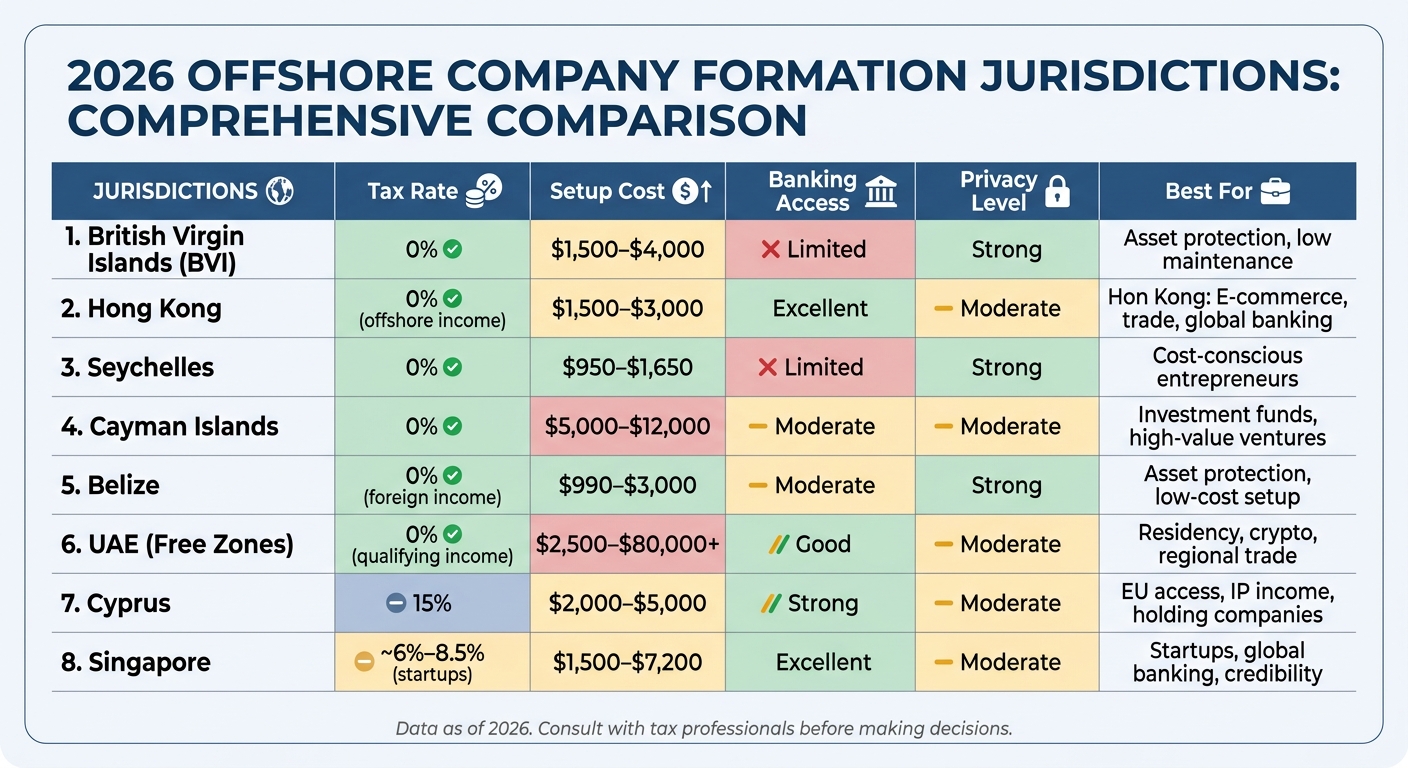
| Jurisdiction | Tax Rate | Setup Cost | Banking Access | Privacy | Best For |
|---|---|---|---|---|---|
| BVI | 0% | $1,500–$4,000 | Limited | Strong | Asset protection, low maintenance |
| Hong Kong | 0% (offshore income) | $1,500–$3,000 | Excellent | Moderate | E-commerce, trade, global banking |
| Seychelles | 0% | $950–$1,650 | Limited | Strong | Cost-conscious entrepreneurs |
| Cayman Islands | 0% | $5,000–$12,000 | Moderate | Moderate | Investment funds, high-value ventures |
| Belize | 0% (foreign income) | $990–$3,000 | Moderate | Strong | Asset protection, low-cost setup |
| UAE (Free Zones) | 0% (qualifying) | $2,500–$80,000+ | Good | Moderate | Residency, crypto, regional trade |
| Cyprus | 15% | $2,000–$5,000 | Strong | Moderate | EU access, IP income, holding companies |
| Singapore | ~6%–8.5% (startups) | $1,500–$7,200 | Excellent | Moderate | Startups, global banking, credibility |
Pro Tip: Choose a jurisdiction that aligns with your business model and offers reliable banking access. Tax savings mean little if you can’t manage your funds effectively. Always consider economic substance rules and compliance requirements to avoid unexpected penalties.
1. British Virgin Islands (BVI)
The British Virgin Islands (BVI) operate under a zero-tax system, making them an attractive option for businesses seeking tax neutrality. With the U.S. Dollar as its currency, the jurisdiction also minimizes the risks associated with foreign exchange fluctuations.
Tax Policies
The BVI imposes 0% tax on key categories, including corporate income, capital gains, and withholding taxes on dividends, interest, and royalties. This structure is a cornerstone of offshore asset protection strategies for international investors. There are also no inheritance, gift, or sales taxes. This allows companies to reinvest their profits without worrying about tax burdens on income sourced from outside the BVI. However, companies involved in certain activities – like holding assets, managing intellectual property, or operating shipping businesses – must adhere to Economic Substance reporting rules introduced in 2019. These rules align with international standards set by the OECD and the EU.
While the tax advantages are clear, the BVI also offers relatively competitive costs for setting up and maintaining a business.
Setup Costs
Starting a business in the BVI typically involves registration fees of around $1,500. Annual maintenance costs range from $1,350 to $4,000, placing the BVI in the mid-tier range for jurisdictions offering similar benefits. Additionally, companies registered in the BVI enjoy reduced administrative burdens, as they are not required to hold annual meetings, file financial statements, or submit tax returns.
Privacy Protections
One of the standout features of the BVI is its strong privacy safeguards. The jurisdiction does not maintain a public registry of shareholders or beneficial owners. Instead, ownership details are only disclosed to the Registrar and a licensed registered agent, ensuring confidentiality. Statutory registers are kept at the company’s registered office and remain inaccessible to the public. Although the UK government has pushed for the adoption of public registries, the BVI continues to uphold its current privacy protections.
However, despite these privacy advantages, businesses face challenges when it comes to banking.
Banking Access
Opening traditional bank accounts has become increasingly difficult for BVI-registered companies. Many businesses rely on banking relationships in major financial centers like Singapore, Hong Kong, or Switzerland to manage payments and transactions. International banks have raised their standards for accepting BVI companies as clients. On the positive side, the BVI’s reliance on an English Common Law system provides a stable and globally recognized legal framework, which adds to its appeal as a business hub.
sbb-itb-39d39a6
2. Hong Kong
Hong Kong taxes only profits earned within its borders, with offshore earnings completely exempt. Bertrand Théaud, Founder of Statrys, sums it up perfectly:
"Hong Kong is probably the clearest answer for most founders on this list. Its territorial tax system means you pay 0% on offshore profits – income sourced outside Hong Kong simply isn’t taxed."
Tax Policies
For locally earned profits, the tax rate is 8.25% on the first HKD 2 million (approximately US$256,000) and 16.5% on amounts exceeding that. There are no VAT, GST, sales taxes, capital gains taxes, estate duties, or withholding taxes. However, to claim the offshore tax exemption, businesses must formally apply to the Inland Revenue Department. This process often involves professional fees ranging from US$2,000 to US$5,000 and requires detailed documentation – such as contracts, emails, and meeting minutes – to prove that operations occurred outside Hong Kong.
Setup Costs
Incorporating a company in Hong Kong is quick, typically taking 3–5 business days. Professional services for incorporation cost between US$1,500 and US$3,000, while government fees are about US$130. Additionally, the annual Business Registration fee is roughly US$300. Other recurring costs include registered address and company secretary services, which range from US$1,150 to US$1,900 annually, and mandatory audits costing between US$800 and US$3,000. These reasonable setup costs are complemented by Hong Kong’s strong banking infrastructure.
Banking Access
Hong Kong hosts 75 of the world’s 100 largest banks, offering unmatched global banking connections for offshore companies. For a deeper dive into global options, see our offshore banking report. While setting up a company is straightforward, opening a traditional bank account can be more complex. Banks like HSBC and Standard Chartered often require in-person visits and lengthy onboarding procedures. On the other hand, digital banking options such as Statrys and Airwallex simplify the process, allowing some companies to open accounts in as little as three business days. Multi-currency accounts are common, making Hong Kong particularly appealing to businesses involved in international trade. Combined with its banking strengths, the jurisdiction’s legal framework provides added security for businesses.
Legal Stability
Hong Kong’s legal system, rooted in English common law, ensures a transparent and stable business environment. Operating under the "One Country, Two Systems" framework, Hong Kong offers reliable contract enforcement and strong intellectual property protections. It complies with OECD and FATF standards, including the Common Reporting Standard (CRS) for automatically exchanging financial information. Ownership details are kept confidential and shared only with tax authorities when required under CRS. The independent judiciary and regulatory clarity further protect business assets from potential legal or regulatory risks in the owner’s home country. This combination of legal and regulatory stability makes Hong Kong a secure and attractive jurisdiction for businesses.
3. Seychelles
Seychelles stands out as the most budget-friendly mainstream offshore jurisdiction for company formation in 2026. Its International Business Companies (IBCs) enjoy a territorial tax system, meaning no taxes are levied on foreign-source income. Additionally, IBCs aren’t required to file annual returns or undergo mandatory audits, significantly reducing administrative expenses. Government fees for IBC licenses range from just $100 to $150, making it far more affordable compared to $450 in the British Virgin Islands (BVI) or over $800 in the Cayman Islands.
Setup Costs
Forming a company in Seychelles is relatively inexpensive. The initial setup costs start at $950, which includes registration, a registered agent, and a local address for the first year. Annual renewals cost $1,650 and cover all compliance and government fees. Over five years, businesses can save between $4,000 and $4,250 by choosing Seychelles over BVI or Cayman. Incorporation is quick, taking just 1 to 2 business days. There’s no minimum share capital requirement, and directors and shareholders don’t need to be residents. This affordability makes Seychelles a compelling option for cost-conscious entrepreneurs.
Privacy Protections
Seychelles offers strong privacy measures with no public register for beneficial owners, directors, or shareholders. Only the Memorandum of Association and Articles of Association are publicly accessible, and these documents don’t disclose the names of shareholders or beneficial owners. Ownership and director information is kept confidential by the licensed Registered Agent. Disclosure is only possible through a Seychelles Supreme Court order, which requires an injunction from the Attorney General. Even then, this is limited to investigations into specific crimes, such as narcotics or arms trafficking and money laundering.
Banking Access
Banking is where Seychelles IBCs encounter challenges. While these companies work well with digital banks and payment processors in places like Hong Kong and Singapore, they often face difficulties accessing major private banks in Switzerland, the UK, or the US. Vivian Au, Founder of Air Corporate, explains:
"The cost advantage comes at a trade-off: BVI and Cayman carry stronger recognition with institutional banks and sophisticated counterparties".
For businesses that depend on relationships with Tier-1 banks, BVI or Cayman may offer better options, despite their higher costs. This highlights the balance between affordability and banking convenience for Seychelles IBCs.
Legal Stability
Seychelles IBCs are regulated by the Financial Services Authority (FSA), and the jurisdiction aligns with FATF standards. With more than 200,000 active IBCs, Seychelles has established itself as a credible offshore center. It adheres to the OECD Common Reporting Standard (CRS), Mandatory Disclosure Requirements, and GDPR. As an independent republic, Seychelles operates outside the EU Savings Tax Directive, which imposes restrictions on many UK overseas territories.
4. Cayman Islands
The Cayman Islands have earned a reputation as one of the premier offshore financial hubs. This British Overseas Territory, recognized as one of the top 10 international financial centers, offers a combination of a zero-tax regime and adherence to international compliance standards. Let’s dive into the key benefits, including tax policies, setup expenses, privacy measures, banking access, and legal stability.
Tax Policies
The Cayman Islands operate under a zero-tax framework. This means no corporate income tax, capital gains tax, or personal income tax. Offshore entities also avoid withholding taxes on dividends, interest, and royalties, and there are no property, payroll, or sales taxes. For exempted companies, there’s a 20-year tax relief guarantee, which can be extended to 30 years, and there are no restrictions on currency exchange. Despite these advantages, the Cayman Islands maintain credibility on the OECD and FATF "white lists" due to their compliance with international tax regulations.
Setup Costs
Setting up an offshore company in the Cayman Islands is more expensive compared to some other jurisdictions. Registration fees start around $2,900, with annual maintenance fees typically at $2,610. Operating costs, which include government fees and registered agent services, usually range between $5,000 and $12,000 annually. For companies with an authorized share capital of up to KYD 42,000, the initial government registration fee is approximately $732 (KYD 600). Service packages for incorporation range from $2,999 to $3,699, and the process typically takes 3 to 7 days – though express services can complete it within 24 to 48 hours. Only one director and one shareholder are required, and these roles can be held by the same person or entity, with no residency requirements.
Privacy Protections
Historically known for strict banking secrecy, the Cayman Islands have adapted to global demands for transparency. Ryan Yeomans, Director of the Private Wealth Team at Titan Wealth International, notes:
"The Cayman Islands once had strict banking secrecy laws… As a result of international pressure for greater transparency… the Cayman Islands have enacted legislation that has relaxed its secrecy rules."
While director and shareholder names must be filed with the Registrar, this information is not publicly accessible. Additionally, starting January 1, 2026, the Cayman Islands will implement CRS 2.0, requiring expanded reporting for digital wallets, crypto-assets, and detailed information on controlling persons. Financial institutions must also share account details with international authorities when necessary.
Banking Access
Cayman entities are viewed as high-governance structures, thanks to oversight from the Cayman Islands Monetary Authority (CIMA). Local banks are well-suited to serve these entities, though international banking often relies on correspondent relationships. Banking access is considered moderate compared to places like Singapore or Hong Kong. Minimum deposits range from $10,000 to $250,000, and compliance requirements can make opening accounts a lengthy process, often taking several weeks.
Legal Stability
The Cayman Islands’ legal system is based on English Common Law, offering a high degree of stability and predictability. For businesses involved in regulated activities – such as banking, fund management, insurance, shipping, or intellectual property – economic substance requirements must be met. This includes maintaining a physical presence, hiring local staff, and incurring local expenses. Penalties for non-compliance with these rules start at CI$10,000 and can climb to CI$100,000. As a result, the Cayman Islands are increasingly chosen for high-value, regulated ventures like insurance vehicles, special purpose vehicles (SPVs), and multinational holdings, rather than for simpler shell companies.
5. Belize
Belize stands out as an affordable and privacy-focused jurisdiction with a modern legal framework. Joining the ranks of top offshore destinations in 2026, this English-speaking Central American country offers low costs, quick setup times, and strong confidentiality measures. Here’s what makes Belize a compelling choice in 2026.
Tax Policies
Belize operates on a full tax exemption model for non-resident entities. Companies registered in Belize enjoy a 0% tax rate on corporate income, capital gains, withholding, and stamp duties for foreign-sourced income – without requiring a local presence. The Belize Companies Act of 2022 revamped the regulatory framework, merging the older International Business Company structure into a unified "Belize Company" status. This change aligns with international standards while retaining the jurisdiction’s tax advantages. Some structures even qualify for a 50-year exemption from company-level taxes.
Setup Costs
Setting up a company in Belize is highly affordable. Registration fees hover around $990, and annual maintenance costs range from $1,500 to $3,000 – significantly lower than jurisdictions like the Cayman Islands or Singapore. The incorporation process is also impressively fast, often taking just 24 to 48 hours.
Privacy Protections
Belize is known for its robust confidentiality standards, which comply with global regulations. Under the 2022 Companies Act, sensitive information like beneficial ownership, director names, and shareholder registers must be filed with the Belize Companies and Corporate Affairs Registry. However, this information is strictly protected and not accessible to the public. Access is limited to formal legal requests, such as those tied to criminal investigations through mutual legal assistance treaties.
As the Privacy Solutions Legal & Compliance Team highlights:
"the 2026 Belize Compliance Advantage: the ability to build a corporate structure that is both deeply private and fully compliant with international standards".
To enhance anonymity, Belize allows the use of nominee directors and shareholders in internal records. These privacy measures are complemented by the country’s evolving banking practices.
Banking Access
Belize’s banking framework has improved significantly, offering unique benefits compared to traditional offshore centers. While Tier-1 banks may still be cautious, the 2022 legal updates have increased acceptance among international banks in hubs like Singapore, Switzerland, and the UAE. For operational needs, many Belize-based entities use electronic money institutions or fintech platforms. Local banks also provide attractive options, including high liquidity ratios, remote account opening, and low deposit requirements.
Legal Stability
Belize’s legal system is another major advantage. As the only English-speaking Central American nation, it operates under English Common Law, with the Privy Council in London serving as the final court of appeal. This system offers predictability and familiarity for international business owners. Belize is particularly well-suited for holding companies, international trading, and digital businesses that prioritize low-cost maintenance over prestige.
For asset protection, Belize has taken significant steps. The repeal of fraudulent conveyance claims in 2007 ensures immediate protection against foreign court orders. Additionally, Belize LLCs offer "charging order protection", which prevents creditors from seizing a member’s interest or forcing distributions. These measures make Belize a standout jurisdiction for those seeking both privacy and legal security.
6. United Arab Emirates (UAE)
The UAE has positioned itself as a hybrid jurisdiction since 2026, blending the prestige and banking access of traditional financial hubs with the tax advantages and privacy features often associated with offshore centers. With more than 45 active free zones spread across its seven emirates, the UAE provides opportunities for company formation and residency visas. Key features include a 0% personal income tax rate, a variety of free zone options, and its strategic location linking Europe, Asia, and Africa. Let’s dive into the UAE’s tax policies, setup costs, privacy measures, banking access, and legal framework.
Tax Policies
The UAE’s tax system offers attractive benefits for eligible businesses. Companies operating in free zones can enjoy a 0% corporate tax rate on qualifying income if they meet the requirements for Qualifying Free Zone Person (QFZP) status. This includes maintaining a real office, employing staff, and generating income from designated activities. This benefit is expected to remain in place until at least June 2027.
For businesses that don’t qualify for QFZP status, a 9% corporate tax applies only to taxable income exceeding AED 375,000 (around $102,000). Additionally, the Small Business Relief program allows companies with annual revenue under AED 3 million to benefit from a 0% corporate tax rate until at least December 2026. Residents and foreign nationals enjoy no personal income tax, meaning dividends, salaries, and capital gains are not taxed at the individual level. A standard 5% VAT applies to most local transactions, though many offshore activities fall outside its scope.
Setup Costs
Costs for setting up a business in UAE free zones vary widely. For example, RAKEZ charges between $2,500 and $4,100 for setup, with annual fees ranging from $1,900 to $3,270. On the other hand, DMCC, which has been ranked the world’s top free zone for nine consecutive years and hosts over 24,000 companies, has setup costs between $5,000 and $13,600 and annual fees from $5,000 to $8,200. Premium zones like DIFC and ADGM require higher investments, with setup costs ranging from $30,000 to over $80,000 and annual renewal fees between $15,000 and $40,000.
| Free Zone | Setup Cost | Annual Renewal |
|---|---|---|
| RAKEZ | $2,500 – $4,100 | $1,900 – $3,270 |
| DMCC | $5,000 – $13,600 | $5,000 – $8,200 |
| JAFZA | $4,100 – $10,900 | $3,300 – $8,200 |
| ADGM | $15,000 – $50,000+ | $10,000 – $30,000 |
| DIFC | $30,000 – $80,000+ | $15,000 – $40,000 |
Setting up a company typically takes 3 to 7 business days. Unlike many offshore jurisdictions, forming a company in the UAE provides a direct pathway to residency visas, including options like the 2-year investor visa, 5-year Green visa, or 10-year Golden visa.
Privacy Protections
The UAE ensures privacy through private beneficial ownership registers, accessible only to regulators and banks for compliance purposes. In certain regions, such as Ras Al Khaimah, there is no public commercial register, which helps keep company information confidential. Some free zones also do not require owners to register their residential addresses, adding another layer of privacy. Additionally, nominee directors and shareholders are permitted in most offshore structures, further enhancing confidentiality.
Free zones like ADGM and DIFC follow English Common Law, providing a stable and predictable legal system for asset protection. While the UAE has tightened its economic substance requirements – ensuring companies demonstrate real business activity through office spaces and local decision-making – these measures are aimed at maintaining compliance with tax regulations while preserving privacy.
Banking Access
Banking in the UAE offers strong regional advantages, though it comes with certain challenges. While Hong Kong is known for its fast, digital-first banking, UAE banks are well-suited for serving MENA and South Asian markets. Major banks like Emirates NBD and FAB require a physical presence for Know Your Customer (KYC) procedures, and opening a bank account typically takes 2 to 4 weeks. Applicants must provide detailed "source of wealth" documentation and attend in-person meetings.
For US entrepreneurs, UAE accounts exceeding $10,000 are subject to mandatory FBAR and FATCA reporting. Once established, UAE banking offers high liquidity and access to global financial markets. Its robust banking infrastructure complements the country’s dependable legal framework.
Legal Stability
The UAE provides a strong legal environment for international business owners. Free zones like ADGM and DIFC operate under English Common Law with independent court systems, offering a familiar structure for foreign investors. Companies in these zones can have 100% foreign ownership without requiring a local sponsor.
Dubai’s Virtual Assets Regulatory Authority (VARA) has created a legal framework tailored for crypto-related businesses, reinforcing the UAE’s reputation as a hub for digital asset companies in 2026. However, businesses must demonstrate "adequate substance" to qualify for tax benefits and avoid the 9% corporate tax rate. Late corporate tax registration can result in an AED 10,000 penalty, though waivers are available for those filing within seven months of their first tax period.
7. Cyprus
Cyprus has transformed from a low-tax haven into a modern EU jurisdiction that balances tax efficiency with regulatory compliance. While adapting to global standards, it still offers appealing benefits for businesses. The corporate tax rate, for instance, has risen from 12.5% to 15%, but the island retains its allure through incentives like the IP Box regime, Non-Dom status, and a network of over 65 double tax treaties. Its strategic location connecting Europe, the Middle East, and Asia further enhances its position.
Tax Policies
Even with the tax rate adjustment, Cyprus remains tax-friendly. The IP Box regime provides an 80% tax exemption on qualifying profits from intangible assets such as patents and software, resulting in an effective tax rate of around 3% on IP income. Foreign entrepreneurs relocating to Cyprus can benefit from Non-Dom status for 17 years, exempting dividends, interest, and rental income from the Special Defence Contribution (SDC). Capital gains on securities, including shares, bonds, and ETFs, are taxed at 0%.
For residents who don’t qualify for Non-Dom status, the SDC on dividends from 2026 profits has been reduced to 5% (down from 17%), and the personal income tax-free threshold has increased to €22,000 (around $23,870). The top 35% tax bracket now applies only to income exceeding €80,000 (approximately $86,720). Meanwhile, the standard VAT rate remains at 19%.
"Cyprus in 2026 is not the old 12.5% story. It is a more mature and, in many respects, more investable story." – Daniel Verblovski
Entrepreneurs can reduce their tax liability by combining modest salaries with higher dividends, as dividends are exempt from the 15.6% social security contribution applied to salaries. Additionally, the 60-day rule allows individuals to gain tax residency by spending just 60 days a year in Cyprus – provided they don’t reside in any other country for more than 183 days and maintain a permanent home in Cyprus.
These policies make the setup process both attractive and cost-efficient.
Setup Costs
Starting a company in Cyprus typically requires an initial investment of €2,000–€5,000 (about $2,170–$5,420). Government registration fees range from €105 to €175 (approximately $114–$190), while legal drafting costs fall between €500 and €1,500 (around $542–$1,625). The entire setup process usually takes 4–10 weeks, which includes:
- Name reservation: 1–3 business days
- Certificate of Incorporation: 2–3 weeks
- Bank account opening: 2–8 weeks
- VAT registration: 2–4 weeks
Annual maintenance costs are estimated at €3,000–€5,000 (around $3,250–$5,420). This includes mandatory audits (€800–€2,500 or $867–$2,710), accounting services (€1,200–€2,500), a government levy of €350 (about $380), and registered office and secretary fees (€500–€1,200). Missing the annual return deadline results in a €50 monthly penalty.
For banking, companies need to deposit a minimum of €1,000–€5,000 (about $1,084–$5,420), with annual bank maintenance fees ranging from €100 to €1,200. Combining the 15% corporate tax rate with Non-Dom status, non-resident owners can achieve an effective tax rate of approximately 5%.
| Jurisdiction | Corporate Tax Rate | Dividend Tax (Owner) | Setup Cost (Est.) |
|---|---|---|---|
| Cyprus | 15% | 0% (Non-Dom) | €2,100 (≈ $2,278) |
| Bulgaria | 10% | 5% | Lower than Cyprus |
| Ireland | 12.5% | 25% | €5,000+ (≈ $5,420+) |
| Estonia | 0% (on retained) | 20% (on distributed) | Competitive |
Beyond cost benefits, Cyprus also prioritizes business privacy.
Privacy Protections
Cyprus requires Ultimate Beneficial Owners (UBOs) to be disclosed in a central register, which is accessible to regulators and banks but not publicly available. As part of CRS 2.0 compliance, Cyprus automatically shares financial data with other jurisdictions, including information on digital wallets, e-money accounts exceeding $10,000, and crypto-assets. By 2026, privacy measures focus on protecting businesses from civil litigation rather than offering anonymity.
"Cyprus is no longer marketed as a ‘low-tax’ jurisdiction, but rather as a compliant and efficient structuring jurisdiction." – Christos Paraskevas LLC
Banking Access
Cyprus provides access to the European banking system, though account opening has become more rigorous since 2020. Banks now require detailed documentation, including source-of-wealth evidence and business plans, with the process taking 2–8 weeks. As an EU member, Cyprus banks report depositor income – such as interest and dividends – to tax authorities under the EU Mutual Assistance Directive. To avoid delays, applicants should ensure they have complete Know Your Customer (KYC) documentation.
Legal Stability
Operating under a common law framework, Cyprus offers a familiar legal environment for international investors. As an EU member, it aligns with OECD standards and adheres to EU directives, ensuring credibility. By 2026, companies must meet strict substance requirements to maintain tax residency and banking access. This includes having a physical office, local employees, and documented decision-making within Cyprus.
The Non-Dom regime guarantees long-term tax advantages for 17 years, delivering stability for relocating entrepreneurs. Compliance with Anti-Tax Avoidance Directives (ATAD), transfer pricing rules, and Controlled Foreign Company (CFC) provisions is mandatory. Companies must also demonstrate genuine management and control in Cyprus to retain treaty benefits and avoid scrutiny.
"Substance is essential to sustaining any international structure." – Christos Paraskevas LLC
8. Singapore
Singapore stands out by emphasizing international reputation over secrecy. While its official corporate tax rate is 17%, start-ups benefit from generous exemptions – 75% on the first SGD 100,000 and 50% on the next SGD 100,000 during their initial three years – bringing the effective tax rate down to around 6%–8.5%. For the 2026 assessment year, businesses can also claim a 40% corporate tax rebate, capped at SGD 30,000 (approximately $22,350). Below, we’ll explore Singapore’s tax policies, setup costs, banking options, and legal framework, showcasing what makes it a compelling choice.
Tax Policies
Singapore uses a territorial tax system, meaning only income generated within the country is taxed. Capital gains and foreign-sourced dividends are completely tax-free. With over 70 double taxation treaties, Singapore offers better treaty access than zero-tax havens like the British Virgin Islands (BVI) or Seychelles. The Goods and Services Tax (GST) is currently set at 9%. Entrepreneurs interested in residency can apply for an Employment Pass, which requires a minimum monthly salary of SGD 5,600 – or SGD 6,200 for roles in financial services.
Setup Costs
Setting up a company in Singapore typically costs between $1,500 and $3,700 for standard packages, with premium options reaching up to $7,200. Government registration fees are about SGD 315 (roughly $235). Foreign owners must hire a nominee director, which costs between SGD 1,200 and SGD 3,600 annually (about $895–$2,685). Annual upkeep, including services like a registered address, company secretary, accounting, and required filings, ranges from $5,000 to $12,000. The incorporation process is entirely online via ACRA and is usually completed within 1–5 days.
Banking Access
Singapore boasts a strong banking sector, with major institutions like DBS, OCBC, and UOB. However, opening a corporate account involves thorough due diligence. Having a local resident director during the account setup can speed up the process. Many entrepreneurs initially rely on Electronic Money Institutions (EMIs) such as Wise or Airwallex, which can approve accounts in 1–7 days, before transitioning to traditional Tier 1 banks after 3–6 months of transaction history.
Legal Stability
Singapore’s legal system is transparent and reliable, operating under English Common Law principles with robust intellectual property protections. The country has earned a "Compliant" rating – the highest possible – from the Global Forum for Tax Transparency. Regulatory bodies like ACRA and IRAS strictly enforce compliance, requiring companies to appoint a local company secretary within six months of incorporation and to keep financial records for at least five years. Unlike jurisdictions that prioritize privacy, Singapore maintains a public register of directors and shareholders, reinforcing its commitment to transparency and international standing. Additionally, as a member of FATF and CRS, Singaporean banks automatically share account information with the tax authorities of the account holder’s home country.
Advantages and Disadvantages
After diving into the details of each jurisdiction, here’s a quick snapshot of the trade-offs they offer for offshore company formation. It’s not just about tax rates – offshore banking access and compliance costs often determine whether a structure will work for your business. As Bertrand Théaud, Founder of Statrys, aptly notes:
"The tax rate is actually the least important number on this list. Get those answers wrong and your 0% tax jurisdiction quietly becomes your most expensive business decision".
This table breaks down how different jurisdictions stack up in terms of privacy, efficiency, and banking access. For instance, privacy-focused locations like the British Virgin Islands (BVI) and Seychelles provide confidentiality and zero taxation but often struggle with reliable banking options, pushing businesses toward Electronic Money Institutions (EMIs). On the other hand, jurisdictions like Singapore and Cyprus, which emphasize regulatory credibility and strong banking networks, come with higher costs and stricter compliance. Hybrid options, such as the UAE and Hong Kong, aim to blend these approaches but often require physical presence or other local commitments to unlock their full potential.
| Jurisdiction | Main Benefits | Main Drawbacks | Tax Treatment | Banking Options |
|---|---|---|---|---|
| British Virgin Islands | 0% tax, English Common Law legal framework, high privacy, low annual costs ($1,500–$4,000) | Limited banking access; heavy reliance on third-party accounts; lower global reputation | 0% on all income | Challenging; mostly reliant on EMIs |
| Hong Kong | 0% tax on offshore profits, excellent banking network (75 of the world’s top 100 banks), territorial tax system, fast account approval (96% within 3 days) | Strict audits and compliance; substance rules apply; some political concerns | Territorial (0% on foreign-sourced income) | Excellent; access to both traditional banks and fintech solutions |
| Seychelles | Affordable setup ($800–$2,640), fast incorporation (1–3 days), 0% tax, strong privacy protections | Difficult banking access; lower international credibility; reliance on EMIs | 0% on foreign income | Very limited; EMI-dependent |
| Cayman Islands | Top-tier reputation for legal protections, 0% tax, ideal for investment funds | High costs ($5,000–$12,000 annually); banking challenges for SMEs; tailored for large enterprises | 0% (tax neutral) | Moderate to difficult for smaller businesses |
| Belize | Strong asset protection, affordable formation costs ($2,640), territorial tax system, moderate banking access | Viewed as a traditional "offshore" jurisdiction; some banks hesitant to engage | Territorial (0% on offshore income) | Moderate; improving but not top-tier |
| UAE (Free Zones) | 0% tax on income below $102,000, residency options, expanding fintech ecosystem, crypto-friendly (VARA framework) | Banking often requires physical visits; 9% tax above income threshold; substance rules apply | 0% for qualifying income; 9% above AED 375,000 (~$102,000) | Good; in-person presence typically required |
| Cyprus | Access to the EU market, 15% corporate tax (lowest in the EU), extensive treaty network, solid banking infrastructure | Higher tax rate compared to zero-tax jurisdictions; economic substance needed for treaty benefits | 15% corporate tax | Strong; access to EU-regulated banks |
| Singapore | Exceptional banking options, startup-friendly tax incentives (effective rate under 5% for first three years), 70+ tax treaties, transparent legal framework | Requires local resident director ($895–$2,685 annually); higher setup costs ($3,000–$7,200); public shareholder register | 17% headline rate (effective 5%–8.5% for startups) | Excellent; strict KYC and compliance standards |
The table makes one thing clear: even the most tax-friendly jurisdiction can fall short without accessible banking. To make a 0% tax structure viable, businesses often need to establish local offices or demonstrate economic substance. Additionally, with over 100 countries participating in the Common Reporting Standard (CRS), offshore accounts are automatically reported to tax authorities in the account holder’s country of residence. This means that while low tax rates are appealing, they must be paired with practical banking and compliance solutions to be effective.
Conclusion
Choosing an offshore jurisdiction in 2026 requires careful consideration of factors like tax efficiency, banking access, reputation, and costs. As the Vorx Team aptly puts it:
"The era of simplistic ‘0% tax’ decisions is over. True advantage lies in combining tax efficiency with legal credibility, compliance certainty, and banking accessibility".
For e-commerce and trading businesses, Hong Kong and the UAE strike a good balance between payment processor compatibility and manageable annual costs, which typically range from $3,000 to $8,000. On the other hand, consulting and professional services firms often prioritize client perception. In such cases, Singapore or Hong Kong are worth the higher annual fees of $8,000 to $15,000, thanks to their strong institutional reputation. For holding companies or asset protection, the BVI stands out with its reliable legal framework and lower maintenance costs (around $1,500 to $4,000 annually). Meanwhile, investment funds often find the Cayman Islands to be the best choice, even with annual costs between $5,000 and $12,000. For crypto and fintech businesses, the UAE’s VARA framework offers unmatched regulatory clarity.
A key takeaway here is that the right jurisdiction depends entirely on your business’s specific needs. To ensure your offshore structure is a worthwhile investment, apply the "3x Rule." This means the structure should save or generate at least three times its annual maintenance cost. For instance, a Seychelles company costing $1,500 annually makes sense only if it saves you $4,500 in taxes or provides significant business advantages. Similarly, a Singapore entity priced at $12,000 per year should deliver greater value, such as enhanced banking access and credibility.
Before setting up, confirm that local banks and payment processors align with your business model. Even the most tax-efficient structure won’t work if you can’t access or move funds. As a precaution, secure an EMI account while awaiting traditional bank approval, which can take 3 to 6 months.
Lastly, remember that lacking a local presence or staff could trigger CFC rules, potentially negating tax benefits. Ultimately, the best jurisdiction is the one that aligns with your business model, banking needs, client expectations, and home country tax laws. Use these insights to safeguard your assets and streamline your global operations.
FAQs
Which offshore jurisdiction is easiest for opening a bank account?
Hong Kong stands out as one of the most straightforward places to open an offshore bank account. It boasts a robust banking system, global recognition, and even provides options for remote account opening through specific providers. These qualities make it an appealing destination for entrepreneurs and businesses looking for efficient offshore banking options.
How do I prove my income is “offshore” to get 0% tax in Hong Kong or Singapore?
To benefit from 0% tax in Hong Kong or Singapore, you need to demonstrate that your income is generated through an offshore entity and stems from activities conducted outside these regions. This requires thorough documentation – such as contracts, invoices, and bank statements – that clearly ties the income to your offshore business. Additionally, the company must have a legitimate presence, adhere to local regulations, and engage in genuine business operations outside of Hong Kong or Singapore.
What are “economic substance” rules, and when do I need a real office or staff?
Offshore companies are now required to demonstrate real business activity in their jurisdiction under "economic substance" rules. This means having tangible elements like a physical office or actual staff present. Such measures are crucial for aligning with international tax and anti-avoidance standards, especially when a company has notable operations or generates significant income within that jurisdiction.
