
If your offshore records do not match, the IRS may spot it before a person ever looks at your return. In 2026, offshore tax review often starts with data matching between FATCA reports, FBARs, Form 8938, trust and entity filings, and payment records.
Here’s the short version:
- Missing FBAR or Form 8938 is one of the clearest triggers.
- Small gaps can matter, like interest income reported as $5,000 on a return when a foreign bank reports $5,200.
- Ownership conflicts across bank KYC files, company registries, trust records, and FinCEN data can point to hidden control.
- Large outbound payments to low-tax foreign companies with little business activity can draw review.
- Trust and entity filing gaps on Forms 3520, 3520-A, 5471, and 8865 can lead to steep civil penalties.
- Crypto-to-fiat conversions and offshore-linked online income that do not match tax filings can also get attention.
If I want to lower risk, I would do three things now:
- Match every account, balance, and income figure across FATCA, FBAR, Form 8938, and the tax return.
- Check all owner and control records for foreign companies, trusts, and U.S. entities tied to offshore activity.
- Review cross-border payments and crypto records before filing, not after an IRS notice arrives.
The core point is simple: clean, matching records matter more than ever. This article explains where mismatches happen, what tends to trigger notices, and what I would review first before filing season ends.
The problem: how AI and FATCA data-matching expose offshore tax risk
IRS analytics now compare FATCA reports, FBARs, Form 8938, and tax returns to spot offshore mismatches fast. AI matching systems cross-check that data against U.S. filings and score returns for compliance risk. That means even small inconsistencies can now lead to review.
Foreign account mismatches are now easier to spot
One of the most common triggers is simple: a number doesn’t line up. If a foreign bank reports $5,200 of interest and Schedule B shows $5,000, that repeated gap can become a flag.
The same thing happens with account balances. If Form 8938 shows $98,000 and FATCA shows a balance above the filing threshold, AI can flag the mismatch. And if FATCA data shows an account but there’s no FBAR or Form 8938 on file, that’s one of the clearest triggers of all.
Beneficial ownership conflicts leave a digital trail
Ownership is the next pressure point. AI now compares bank KYC files, company registries, trust records, and FinCEN ownership data against U.S. filings.
A plain example makes this easier to see. A foreign company registry may list only non-U.S. shareholders, while the bank’s KYC file names a U.S. person as the ultimate beneficial owner. That mismatch can be treated as a possible nominee setup.
Trusts can create the same kind of exposure. If trust documents show a U.S. settlor or beneficiary, but that person’s returns do not include Forms 3520 or 3520-A, AI matching can surface the omission by comparing past trust records with current filings. Even stale ownership records can hurt. If they conflict with what appears on current filings, they may be viewed as evidence of concealment.
Complex structures and cross-border payments raise risk
Payments often show what ownership records miss. AI models can track recurring outbound payments such as royalties, service fees, management charges, or interest from U.S. persons to foreign entities. Then they check whether those entities and the related income appear anywhere on U.S. returns.
The IRS has explicitly stated it uses AI to identify patterns among large partnerships and to find possible nonfilers who hold millions in foreign bank accounts. One setup that keeps drawing attention is six-figure consulting fees paid to a newly formed company in a low-tax jurisdiction with no employees, no website, and no matching U.S. reporting. Put plainly, thin business substance paired with large outbound payments is a major red flag.
sbb-itb-39d39a6
What triggers scrutiny: notices, audits, and penalties in 2026
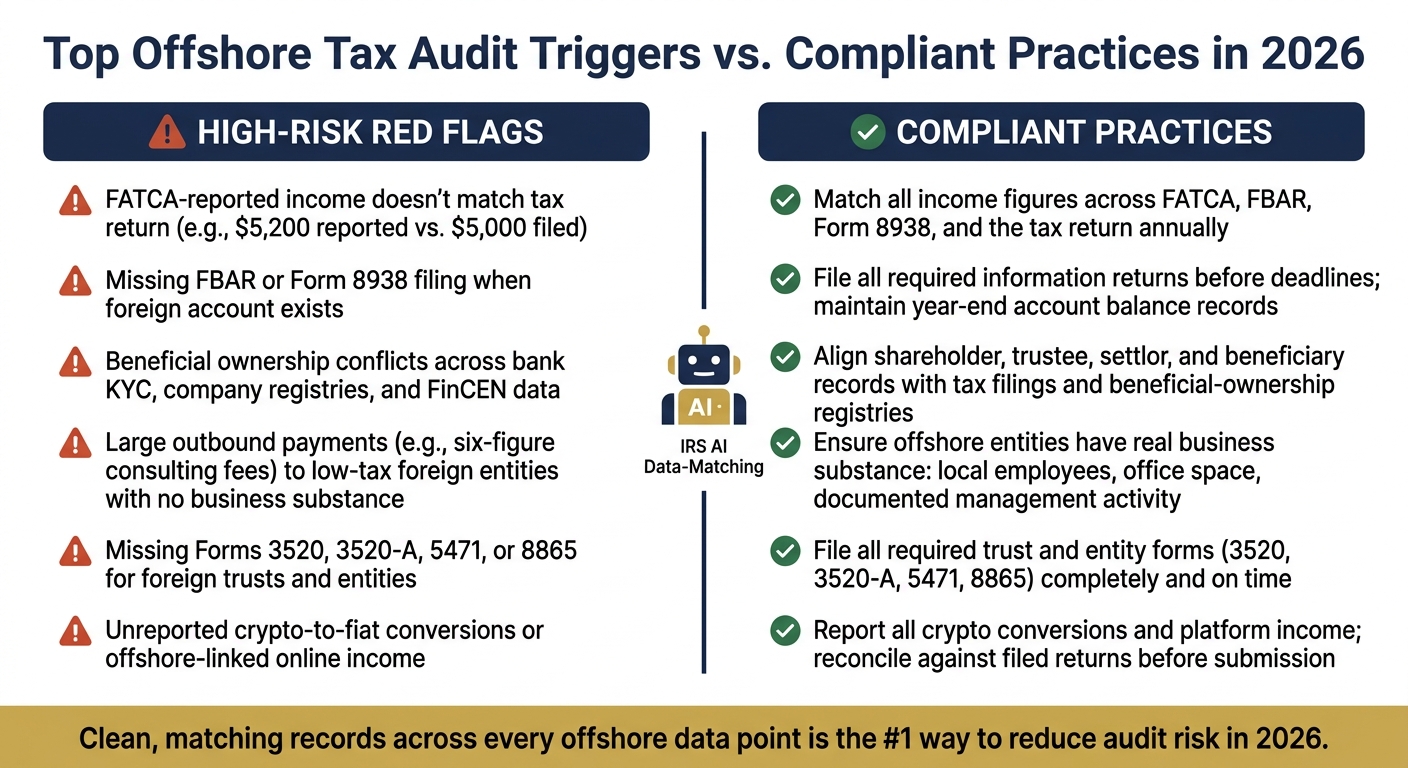
Offshore Tax Compliance: Common Mismatches vs. Compliant Setup (2026)
The most common offshore audit triggers in 2026
In 2026, automated matching can push a return into review even without a full manual audit. These systems spot mismatches fast, and even small gaps can set off a review. Once a mismatch shows up, the next step is often a notice or a request for documents.
The clearest triggers are FATCA data that doesn’t match filed returns, missing FBAR or Form 8938 filings, and large cross-border transfers that have no clear explanation. Ownership and control records are now checked across bank, entity, and tax filings. So if entity ownership, account reporting, or trust records don’t line up, the issue can get flagged fast.
A business registered in one country but effectively managed from another can also attract scrutiny, especially if the place of effective management doesn’t match the tax filings or account records. And these issues don’t usually stay in one lane. One mismatch often opens the door to a broader review.
Crypto holdings, crypto-to-fiat conversions, and income from online platforms that don’t match reported income can also draw attention. Missing filing deadlines or failing to update ownership records is a major red flag.
How enforcement typically escalates
That’s how most cases start in practice. It usually begins with an automated discrepancy notice or a document request, where the IRS points to a mismatch between what was reported and what third-party data shows. From there, the agency may ask for records, extend the review to prior years, or open a formal examination.
What tends to speed things up is repetition. One small gap may not lead anywhere. But repeated inconsistencies across multiple years, or mismatches tied to ownership, control, and management records, can move a case from a routine review to something much more serious.
Waiting for a notice before fixing a reporting problem is the highest-risk move. By that point, the IRS already has the data and has likely flagged the discrepancy.
Highest-risk filing failures
FBAR, Form 8938, and the information returns tied to foreign entities and trusts, including Forms 5471, 8865, 3520, and 3520-A, are among the highest-risk areas when reporting is incomplete or inconsistent. These failures can lead to back taxes, account holds, and steep civil penalties.
Willful noncompliance pushes the penalty risk up fast. If the IRS decides that a taxpayer knew about a filing duty and chose not to comply, or that records were arranged to hide ownership or control, the matter becomes far more serious.
The solution: compliance, cleanup, and safer offshore structuring
Reconcile every offshore data point before the IRS does
Once AI spots a mismatch, the next move is simple: reconcile every foreign record before the IRS gets there first. That means doing a full year-end check of every foreign bank statement and matching it against filed forms and third-party reports that already go to the IRS. Clean reporting does more than fix errors. It also helps support offshore planning that may need to stand up to close review.
Keep records that show how balances were converted and how each year-end peak account balance was worked out. If a mismatch gets flagged, those documents are your first line of defense.
Review beneficial ownership and reporting for every entity and trust
After the numbers match, the next step is to check who is listed as the actual owner and controller. Hidden or muddy ownership gets attention fast. As of 2026, more than 40 countries have changed their business-formation rules to require disclosure of who owns a company, who controls it, and where it is actually managed. When control records don’t line up, both tax compliance and asset protection can start to crack.
That’s why shareholder, trustee, settlor, and beneficiary records need to match tax filings and beneficial-ownership registries. Fixing those records now matters. Once a notice shows up, the IRS usually already sees the mismatch.
Use structures that reflect real business purpose and clear reporting
The same idea runs through every structure: the facts on the ground and the reporting need to match. Offshore companies, foreign trusts, and foreign-owned LLCs can still be used for lawful planning in 2026, but the structure needs real business substance behind it. In places like the UAE and Cyprus, tax benefits now depend on proof such as local employees, office space, and records showing where management activity happened. A substance file with lease agreements, payroll records, and notes showing where key decisions were made is no longer optional in practice.
The main risk shows up when a structure operates one way but gets reported another way.
| Structure Type | Compliant Setup | Core Issue If Mismatched |
|---|---|---|
| Foreign Corporation | Local management, physical office, reported place of management | Paper trail does not match where decisions are actually made |
| Offshore Trust | Independent licensed trustee; duress clause; full IRS disclosure | Control records conflict with what is filed |
| U.S. LLC (Foreign Owned) | Registered beneficial owners; clear link to personal tax residency | Ownership on paper does not match operating reality |
Conclusion: the offshore review checklist for U.S. taxpayers in 2026
The fix is simple: line up every offshore record before automated matching finds a gap. The checklist below focuses on the records most likely to draw review.
Annual filings, ownership records, and account balances need to match.
Review these items now
- Accounts: Match FBAR, Form 8938, and FATCA-reported balances.
- Entities and trusts: Once account balances match, review ownership records. Check that all required Forms 3520 and 3520-A are filed for foreign trusts. Missing trust filings can trigger steep penalties. If beneficial ownership records for any entity don’t match, update them under the Corporate Transparency Act and line them up with foreign registry data.
- Payments and crypto: Review large cross-border payments and crypto conversions for reporting gaps.
If anything is missing, fix it before filing season closes. Have a qualified international tax professional correct the records.
FAQs
What offshore records should I reconcile before filing?
Before filing, reconcile all offshore records so your tax forms line up with what financial institutions have reported.
Pull the details for each foreign account, including the exact account name, account number, institution address, account type, and maximum value during the year. Also verify that records for non-account assets, U.S. dollar conversions, and beneficial ownership and entity structure details are current and consistent.
Can small mismatches trigger an IRS review?
Yes. In 2026, the IRS uses AI-driven analytics, along with automated FATCA and foreign bank data, to compare your Form 8938 and related filings against information reported by foreign financial institutions.
In plain English: the IRS can line up what you report with what your bank reports.
That matters because even small mismatches can get flagged for review. And the risk isn’t limited to failing to file. Minor reporting mistakes, incomplete details, or differences between your filings and bank records can also lead to audits or extra scrutiny.
Which foreign forms have the highest penalty risk?
The highest penalty risk usually comes from FATCA Form 8938 and the FBAR (FinCEN Form 114). That’s especially true when the issue is willful or has gone on for years.
Missing Form 8938 starts at $10,000 and can climb to $60,000. On top of that, the IRS can add a 40% penalty on underreported tax tied to undisclosed foreign assets.
Willful FBAR penalties can be far steeper. They can reach the greater of $165,353 or 50% of the account balance. In some cases, there can also be criminal exposure.