
In 2026, a Plan B is less about returns and more about access. If you rely on one country for banking, travel, tax residence, and day-to-day life, one policy move can hit all four at once.
Here’s the short version: I’d treat a modern Plan B as a 4-part setup:
- mobility: a second residency or passport
- banking: cash access in more than one jurisdiction
- asset separation: legal structures that limit single-court reach
- relocation: a move plan you can use on short notice
The article’s core point is simple: geopolitical stress now spills into bank reviews, wire delays, visa limits, tax reporting, and border access. For U.S. citizens, that pressure is even tighter because offshore accounts still trigger FBAR, FATCA/Form 8938, and foreign income reporting rules. At the same time, some entry windows may get more expensive fast, like Panama’s investor route moving from $300,000 to $500,000 after 10/15/2026 if current terms expire.
If I had to boil it down further, I’d use this order:
- Lock in movement first if you have no legal fallback abroad
- Spread banking access next before a bank review becomes a cash problem
- Separate exposed assets if one court system can reach most of your wealth
- Write the relocation plan down so your backup works in practice
A few facts stand out:
- Grenada offers access to 140+ countries and a path tied to the U.S. E-2 treaty structure
- Panama’s investor residency route is still listed at $300,000 for now
- The article frames risk in 5 areas: banking, legal, currency, tax visibility, and mobility
Quick comparison
| Plan B piece | Main problem it addresses | Example from the article | Main tradeoff |
|---|---|---|---|
| Second residency | No legal place to live/work abroad | Panama | Cost and rule changes |
| Citizenship by investment | Travel limits and passport weakness | Grenada | Upfront cost |
| Multi-jurisdiction banking | Frozen wires, account limits, cash access issues | Singapore, Switzerland | More reporting work |
| Offshore structures | Single-court asset exposure | Trusts, LLCs, and foundations | Setup and tax/legal filing work |
| Relocation plan | Having documents but no workable exit plan | Housing, school, health care, liquidity | Requires prep before a crisis |
My takeaway: the 2026 Plan B boom is being driven by one fear above all else – losing access before you have a backup in place. The rest of the piece shows how to spot that risk and match it to the right tool.
sbb-itb-39d39a6
The risks behind the 2026 "Plan B" surge
The push for an international backup plan comes down to plain risk management. Most of the pressure shows up in three areas: banking access, mobility, and tax rules.
Capital controls, bank limits, and sanctions risk
When geopolitical tension climbs, banks tend to tighten compliance. If your business has ties to a higher-risk jurisdiction, your bank may flag transfers, hold up wires, or cut off access altogether. Those checks can drag out payments and throw cross-border operations off balance.
For entrepreneurs, that’s not just annoying paperwork. It can delay payroll, stop supplier payments, and lock up working capital at the exact moment you need it most.
U.S. citizens with offshore accounts deal with another layer of rules. FBAR and FATCA (Form 8938) reporting is mandatory, and the penalties for getting it wrong are steep. The Common Reporting Standard (CRS) adds even more pressure. Financial account data is shared automatically between jurisdictions based on tax residency, which makes it much harder to hold international accounts without a clear compliance setup.
That’s why multi-jurisdiction banking matters before access gets cut.
Political instability, conflict spillover, and travel limits
Border closures can happen fast. Visa rules can change with little notice. Regional conflict can spill into places that seemed stable a month earlier. When that happens, your options shrink fast.
For business owners who travel often, or families spread across countries, this becomes an immediate operating risk. It’s not just about getting on a plane. It’s about keeping client access, business activity, and personal movement in place when borders tighten or visa rules shift.
Permanent residency in a stable country gives you a legal fallback. It gives you the right to live and work somewhere else without relying on a visa that can be canceled or a border that can close. Countries such as Panama, Costa Rica, and Paraguay are drawing attention for stable residency paths.
That’s the argument for second residency or citizenship before a border closes, not after.
Tax and rule changes
Tax rules don’t sit still. Residency-based tax systems, territorial tax regimes, and citizenship-by-investment programs can all get more expensive, more restrictive, or harder to enter with very little warning.
For high-net-worth Americans, the risk runs deeper. Succession planning, company ownership, and asset location all depend on rules that can shift fast. Offshore trusts and LLCs are being used not only for tax efficiency, but also to shield assets from domestic instability and dollar devaluation.
Wait too long, and the cost can go up. The rules can tighten. Or a program you wanted may disappear altogether. When the ground keeps moving, structure matters as much as location.
The next step is matching each risk to the right Plan B tool.
How to assess your risk before picking a solution
Before you pick a Plan B, map where you’re exposed: residency, banking, tax, operations, assets, and mobility. The fastest way to do that is to sort your exposure into four buckets: banking, legal, mobility, and tax.
Where single-country exposure creates the most risk
Single-country exposure puts your legal, financial, and mobility risk under one system. If your citizenship, banking, tax residence, business operations, and assets all sit in one country, one policy change can hit several parts of your life at the same time.
A simple risk check for entrepreneurs, investors, and families
Score each area based on concentration, not account size or net worth.
| Risk Area | Key Question | Warning Sign |
|---|---|---|
| Banking | Could a bank freeze or capital control block cash access? | No verified backup access to liquidity outside your primary bank |
| Legal | Could one domestic court reach most of your assets? | Most assets are directly exposed to one court system |
| Currency | Are you fully exposed to one currency? | All wealth held in one currency, with no diversification |
| Tax visibility | Does one tax residency control visibility into your accounts? | Total exposure to a single tax jurisdiction |
| Mobility | Could travel restrictions or a visa change block relocation? | No legal fallback for living or traveling abroad |
If you answered yes to more than one, your setup carries real concentration risk. That’s especially true for entrepreneurs with lawsuit exposure, investors with single-country banking or currency exposure, and families that need mobility and family logistics protected across borders.
Start with the dependency that puts you at the most risk. That gap tells you which Plan B tool to use next.
The main "Plan B" options and what each one fixes
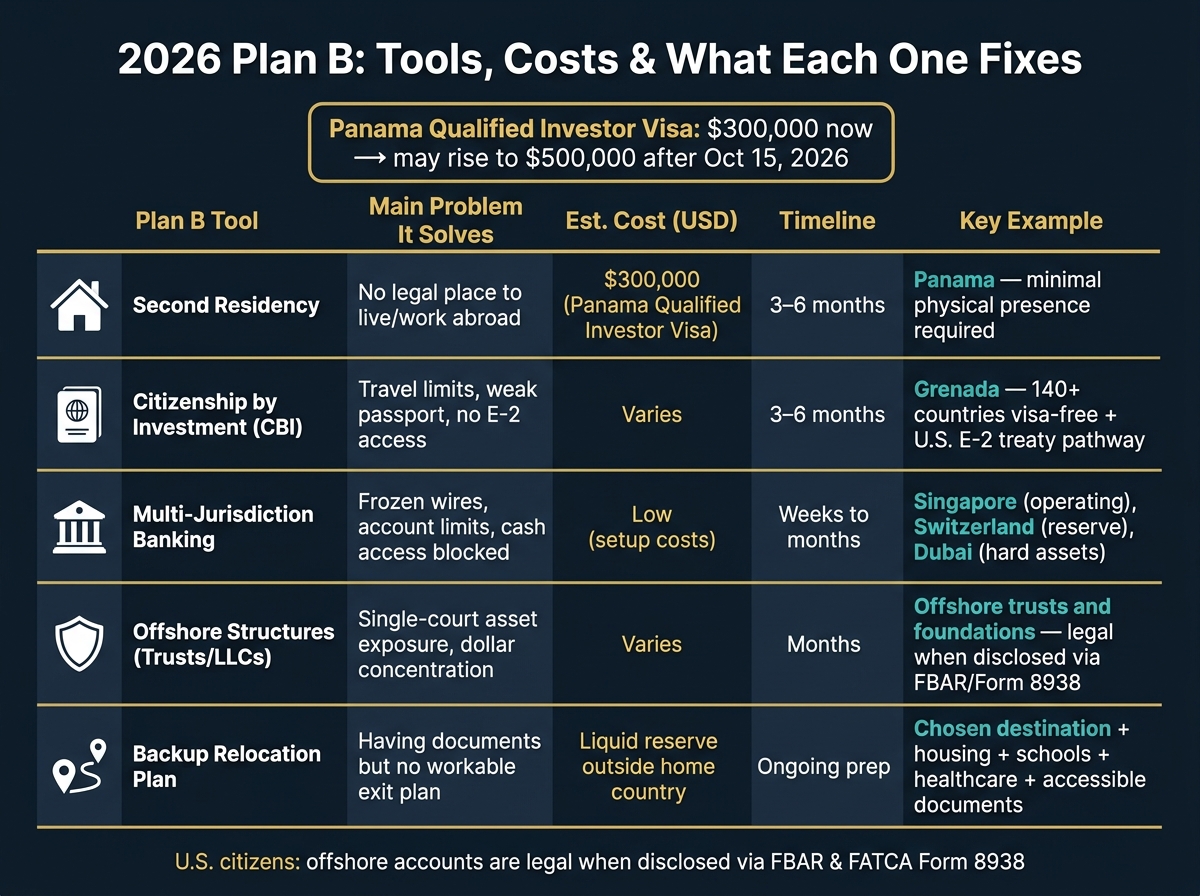
2026 Plan B Options: Cost, Timeline & What Each Solves
Once you know where you’re exposed, the next step is simple: match the right tool to the right weak spot. In 2026, a lot of people aren’t betting on just one answer. They’re building a layered Plan B.
Start with the gap that could lock you out first:
- movement
- banking
- relocation
Second residency and citizenship-by-investment for mobility and access
Second residency gives you a legal fallback. Citizenship-by-investment handles a different issue: faster travel access.
Take Grenada as an example. A Grenadian passport offers visa-free or visa-on-arrival access to more than 140 countries and is the only Caribbean CBI program with a bilateral E-2 Treaty Investor Visa pathway to the United States. For business owners from countries that don’t have a U.S. E-2 treaty, such as India or China, that can be a big structural edge.
The rules and price points are shifting fast. Panama’s Qualified Investor Visa is currently $300,000 and may revert to $500,000 after October 15, 2026.
| Program | Est. Cost (USD) | Timeline | Physical Presence | What it solves |
|---|---|---|---|---|
| Panama Qualified Investor Visa | $300,000 | 3–6 months | Minimal | A legal foothold and residency flexibility |
| Grenada CBI | – | 3–6 months | None | Immediate legal movement and U.S. E-2 pathway |
If travel is covered, the next issue is straightforward: can you still get to your money when you need it?
Offshore structures and multi-jurisdiction banking for asset and liquidity protection
Offshore trusts and foundations can separate personal wealth from business risk and reduce what a single domestic court can reach. For U.S. citizens, offshore accounts are legal when they’re fully disclosed through FBAR and Form 8938, and when all foreign income is reported.
A common setup is to split liquidity across operating cash, reserve cash, and hard assets in separate jurisdictions. That way, one problem in one country doesn’t freeze everything at once.
| Function | Jurisdiction | Key Feature |
|---|---|---|
| Operating cash | Singapore | Efficient multi-currency accounts for business and travel |
| Reserve cash | Switzerland | Multi-currency custody and estate transfer across borders |
| Hard assets | Dubai | Secure gold storage |
| Feature | Single-Country Banking | Multi-Jurisdiction Banking + Offshore Structures |
|---|---|---|
| Control risk | High | Lower |
| Foreign judgment exposure | High | Lower |
| Privacy | Domestic reporting only | Compliant transparency via CRS/FBAR |
| Compliance burden | Lower | Higher |
| Resilience during restrictions | Lower | Higher |
Of course, structure on paper only goes so far. If you can’t act fast, the setup can still fail when it matters most.
Backup relocation planning as the action layer of a real Plan B
A second passport or offshore account won’t do much if you can’t actually leave when you need to. That’s where backup relocation planning comes in. It’s the part that turns the idea into something usable.
The checklist many people ignore is pretty basic, but it matters:
- a chosen destination country
- housing options you’ve already checked
- school access for children
- local healthcare coverage
- current travel documents you can reach fast
Before moving, check the tax residency rules and how they impact global reporting. That’s one of those details people brush past until it becomes expensive.
It’s also smart to keep enough liquid funds outside your home country to cover housing, school, and healthcare on short notice. That’s the buffer that makes a Plan B usable under pressure instead of just something that sounds good in theory.
Build your 2026 Plan B before access gets tighter
A workable 2026 Plan B needs layers: mobility, banking, asset protection, and a clear relocation path. That matters now because access is getting tighter. Banks are making onboarding harder. Residency and citizenship windows can shrink fast. The earlier you act, the more paths stay open.
Once you know where you’re exposed, it’s time to move from diagnosis to action.
What to do first
Start with your weakest link: mobility, banking, or asset exposure. Then use the tool that fixes that first point of failure. The order matters.
Secure mobility first, because residency windows close the fastest. Citizenship and residency programs can change entry rules or jump in price with little warning. If there’s a program you may need, move before it gets costlier or shuts its doors.
Diversify banking before you need it. It’s far safer to set up operating, reserve, and emergency accounts across more than one jurisdiction now, with tested backup access and clean reporting, than to scramble later under pressure.
Separate high-risk assets and operating entities with offshore trusts and offshore companies. For U.S. citizens, these setups are legal when they’re disclosed the right way through FBAR and Form 8938.
Document a relocation plan, not just a residency filing. In plain English, that means picking a destination, sorting out the logistics of a physical move, and making sure you can reach offshore liquidity right away. Build the setup first. Then fund the program.
FAQs
What is a Plan B in 2026?
In 2026, a Plan B is a practical, multi-layered way to protect your wealth, mobility, and family security when politics and the economy get shaky.
It usually includes offshore structures for asset protection, second citizenship or residency for mobility, and diversified international banking to keep your options open and lower exposure to political, currency, and legal risks.
Which Plan B step should I start with?
Start by looking at what you own and where you may be exposed. A simple country-by-country list can help a lot.
Include assets like:
- Property deeds
- Bank statements
- Business registrations
- Investment accounts
Then map out the risks tied to those assets. That may include legal liability, economic instability, or tax uncertainty.
This step matters because it helps you pick the right jurisdiction and the right legal tools before any dispute shows up. In plain English: don’t wait for a problem to start before you get your plan in place.
How much does a second residency or passport cost?
Costs vary a lot depending on the program and the route you choose.
Citizenship-by-investment can start at about $200,000 in Dominica, range from $250,000 to $325,000 in St. Kitts and Nevis, and go up to €600,000 to €815,000 in Malta.
Residency options can come in lower. Latvia starts at about $54,000, while Greece and Portugal begin at $250,000.
On top of the main investment, you’ll also need to budget for due diligence, government, and professional fees. Those often add another $6,000 to $15,000+.