
Yes – if you already know why you want one and you can qualify. In 2026, simplest citizenship programs are still open, but costs are up, screening is tougher, and waiting often means paying more or losing access to a route.
If I strip the article down to its main point, here’s what matters:
- Demand is surging: some firms report a 400% jump in U.S. clients and a 1,000% increase in applications since 2020
- One passport means concentration risk: your travel access, relocation choices, and some banking options depend on one government
- The main 2026 routes are clear: Caribbean citizenship by investment, Turkey’s $400,000 real estate path, and ancestry claims through Italy or Ireland
- The tradeoff is simple: today’s paths are more expensive and harder to clear, but they are still open
- For U.S. citizens, this is not a tax escape: a second passport does not remove FBAR, FATCA, or other U.S. reporting duties
If I were deciding today, I’d frame it like this:
- Choose Caribbean programs if you want the fastest route and can accept that much of the cost is money spent, not money invested
- Choose Turkey if you want citizenship tied to a property purchase and can hold the asset for 3 years
- Choose Italy or Ireland if you may qualify by family line and want an EU passport without putting in $200,000+
Quick comparison
| Route | Best for | Typical cash requirement | Usual timeline | Main tradeoff |
|---|---|---|---|---|
| Caribbean CBI | Fast access and family coverage | About $200,000 to $250,000+ | About 3 to 9 months | Much of the money is a sunk cost |
| Turkey | Buyers who want a property-linked route | $400,000 real estate or $500,000 in other routes | About 3 to 6 months | Asset risk, paperwork, and a 3-year hold |
| Italy ancestry | People with an Italian family line | Usually low-to-mid five figures in fees and document work | About 1 to 4+ years | Heavy document work and delays |
| Ireland ancestry | People with an Irish parent or grandparent | Usually low-to-mid five figures in fees and document work | About 12 months, sometimes longer | Narrower eligibility than Italy |
Bottom line: I wouldn’t call 2026 the cheapest time or the easiest time. I’d call it a strong time to act for prepared applicants. If you want more mobility, a backup place to live, or more options for your kids, the case is solid. If your tax plan, family records, or source-of-funds file is still messy, waiting to get those in order may be the better move.
sbb-itb-39d39a6
Why a second passport matters more today than it did before
A decade ago, a second passport was often seen as a luxury. In 2026, it looks much more like a risk-management tool. People use it for mobility, tax planning, succession, and asset protection. That shift shows up most clearly in mobility, family planning, and the way programs are now built.
Mobility, political, and financial diversification in an unstable world
The practical case is stronger now than it was years ago. During the COVID-19 pandemic, 20 countries imposed no-entry rules based on nationality alone. That was a blunt reminder that a passport’s value can change fast in the real world. More recently, the EU suspended visa facilitation agreements for Russian nationals. Same lesson: geopolitical events can cut a passport’s usefulness with very little warning.
For U.S. investors, a second passport does not change reporting rules, but it can open more legal and banking options. In some markets, a non-U.S. passport may also draw less scrutiny when American travelers face higher political sensitivities. That matters on an individual level. For families, though, the bigger draw is continuity over the long run.
Family security, succession planning, and future relocation options
High-net-worth families now view second citizenship as a long-term family asset, not just a travel perk. Many citizenship-by-investment and ancestry-based programs let citizenship pass to children and, in many cases, grandchildren. That gives future generations the legal right to study, work, and live in those regions without relying on visa quotas that may shift over time.
Passport choice is also shaped by estate and tax planning, especially where inheritance, forced-heirship, and probate rules vary from one jurisdiction to another. A second citizenship can fit into cross-border structures such as offshore trusts, foundations, and LLCs, which helps families build a more stable legal setup across multiple places.
What makes today different from earlier eras
Earlier citizenship-by-investment programs were screened far more lightly. Today’s programs use deeper due diligence, interviews, and source-of-funds checks tied to tighter anti-money-laundering rules. At the same time, the passport gap has grown much larger. Top-ranked passports now offer visa-free or visa-on-arrival access to about 192 to 194 destinations, while the weakest may offer access to only 24 to 28.
That gap affects more than travel. It can shape banking relationships, business access, and relocation options, and those effects build over time. Knight Frank‘s Wealth Report found that about 19% of ultra-high-net-worth individuals planned to apply for a second passport or new citizenship in 2024.
The contrast with earlier eras is pretty clear:
- Motivation: once a status symbol; now a tool for risk management and asset protection
- Due diligence: once basic document checks; now independent screening, mandatory interviews, and source-of-funds reviews
- Cost and predictability: once lower and less predictable; now higher, more standardized, and often subject to threshold increases
Those tougher standards also push costs higher and change which route makes sense for each buyer.
The main second-passport routes available now and who each one fits
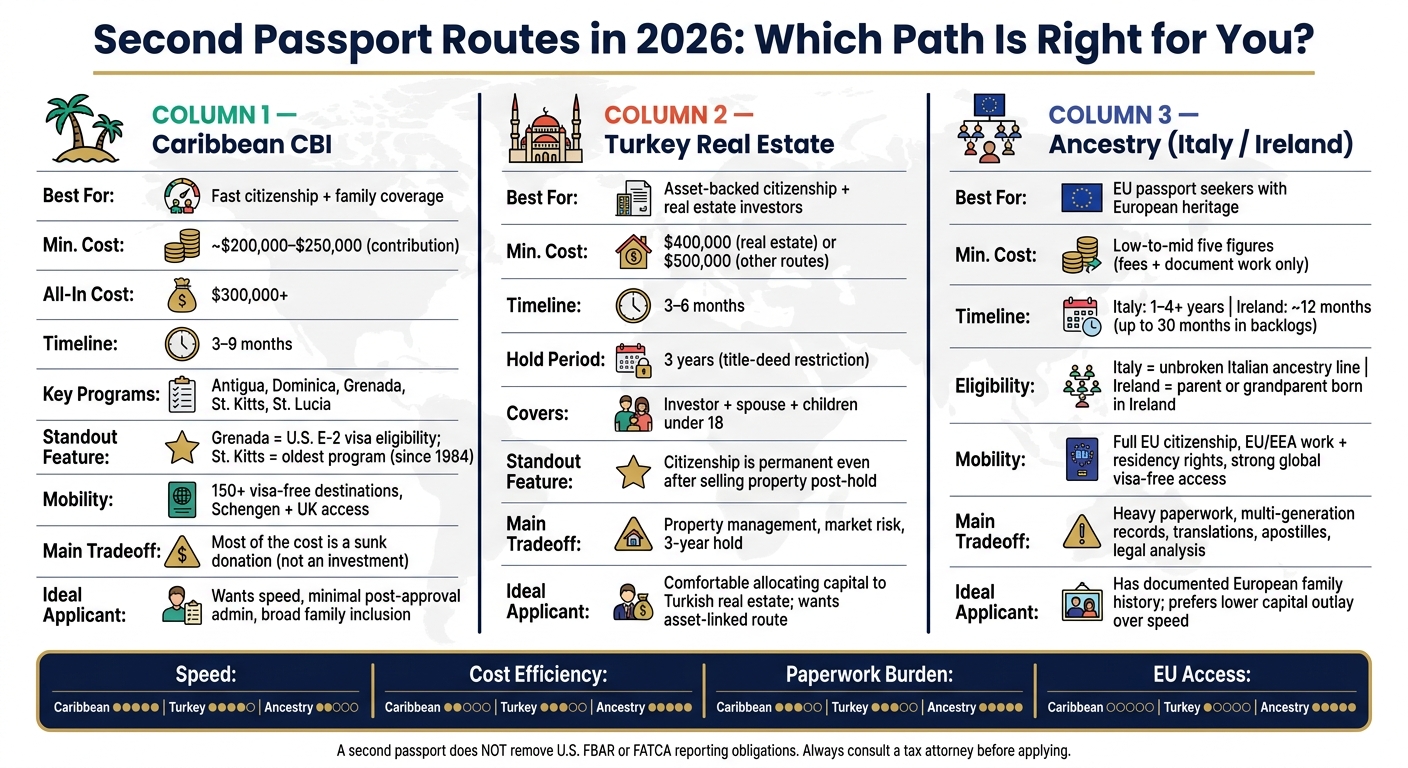
Second Passport Routes 2026: Caribbean vs Turkey vs Ancestry Compared
Not every second-passport route works for every buyer. The right pick comes down to your timeline, family setup, how much capital you can tie up, and what you want the passport to do for you.
In 2026, most buyers are choosing from three main paths: Caribbean citizenship-by-investment, Turkey’s real-estate-linked program, and ancestry-based claims through Italy or Ireland. Each one involves a different tradeoff between speed, capital, and long-term family use. The practical issue isn’t whether a second passport has value. It’s which route gives you that value with the least friction for your case.
Caribbean citizenship-by-investment: speed, simplicity, and travel diversification
The five Eastern Caribbean programs – Antigua and Barbuda, Dominica, Grenada, Saint Kitts and Nevis, and Saint Lucia – follow the same basic model: make a qualifying investment or contribution, pass due diligence, and receive citizenship, usually within three to nine months. Since mid-2024, all five programs have moved toward a $200,000 minimum.
For many buyers, this is the cleanest route. The process is usually direct, the timelines are short, and family inclusion can be broad.
Grenada gets extra attention because it is the only Caribbean CBI country with a U.S. E-2 treaty investor visa link. In plain English, a Grenadian passport can create a legal route to live and work in the U.S. under non-immigrant investor status. For non-U.S. family members, that can be a serious planning advantage.
Saint Kitts and Nevis has its own draw. It runs the oldest CBI program in the world, dating back to 1984, and its passport offers strong Schengen and UK access.
Antigua and Barbuda includes one small catch that buyers shouldn’t miss: a 5-day physical presence requirement within the first five years after citizenship is granted. That’s minor, but it still needs to go on the checklist.
| Program | Min. Contribution (USD) | Processing Time | Family Eligibility Highlights | Mobility Profile |
|---|---|---|---|---|
| Antigua and Barbuda | ~$230,000 | 9–12 months | Spouse, children up to age 30 if dependent, parents/grandparents 55+, siblings (additional fee) | 150+ destinations, Schengen, UK; 5-day presence requirement |
| Dominica | ~$200,000 | 3–6 months | Spouse, dependent children, parents | Mid-140s destinations, Schengen access |
| Grenada | ~$235,000 (up to 4 family members) | ~60 business days to approval | Spouse, adult children, parents, grandparents, siblings | 150+ destinations, Schengen, UK; U.S. E-2 treaty eligible |
| Saint Kitts and Nevis | ~$250,000 (up to 4 family members) | 4–6 months | Spouse, minor children, dependent parents; stricter adult child rules | 150+ destinations, Schengen and UK access |
| Saint Lucia | ~$200,000 | 3–6 months | Spouse, dependent children, parents | Mid-140s destinations, Schengen access |
With contribution-based Caribbean applications, most of the money is a sunk cost. That makes this path a strong fit for buyers who want fast citizenship, limited admin after approval, and broad family coverage. If you’d rather tie the process to an asset than make a straight contribution, Turkey is usually the next place people look.
Turkey citizenship by investment: a larger capital commitment tied to a real asset
Turkey’s program is built very differently from the Caribbean model. The main route requires a $400,000 real-estate purchase that must be held for three years under a title-deed sale restriction. Other qualifying options, such as bank deposits and government bonds, require $500,000 held in Turkey for the same three-year period.
That structure changes the buyer profile. This isn’t just “pay and done.” You are placing money into an asset and dealing with a holding period.
A key point, though, is that once the three years are over, the citizenship already granted stays in place even if the property is sold. Processing usually takes three to six months, and the program covers the investor, spouse, and children under 18.
This route tends to fit buyers who want a passport as part of a real asset allocation. Think of a U.S.-based real estate investor who is already comfortable putting capital into Turkish residential or commercial property in places like Istanbul or coastal markets. For that person, the passport may feel like an added layer of value rather than the whole point of the deal.
It’s less suited to someone who wants the fastest path and as little post-approval responsibility as possible. Property comes with management, paperwork, and market risk. That’s the trade.
Italy, Ireland, and ancestry routes: lower capital cost, higher paperwork burden
For Americans with European roots, ancestry-based citizenship can lead to an EU passport with broad travel and residency rights and no large investment requirement. The tradeoff is simple: less money, more paperwork. These routes fit people whose biggest asset is documented family history rather than liquid capital.
Italy’s jure sanguinis system allows citizenship claims through an unbroken line from an Italian ancestor. In some cases, that line can go beyond grandparents, but the claim depends on rules tied to the ancestor’s U.S. naturalization date and, in older matters, gender-line restrictions.
Ireland is more direct. If a parent or grandparent was born in Ireland, you can register in the Foreign Births Register and become an Irish citizen from the date of registration. After that, you can apply for an Irish passport. Irish authorities list a processing time of about 12 months, although some periods have seen delays of up to 30 months depending on application volume.
| Route | Eligibility Basis | Paperwork Intensity | Timeline Variability | Long-Term Mobility Benefits |
|---|---|---|---|---|
| Italy (jure sanguinis) | Unbroken citizenship line from an Italian ancestor; naturalization and gender-line rules apply | Very high: multi-generation records, translations, apostilles, legal analysis | High: 1–4+ years via consulate or in-country process | Full EU citizenship; settlement and work rights across the EU/EEA; broad global visa-free access |
| Ireland (Foreign Births Register) | Parent or grandparent born in Ireland | Moderate to high: simpler than multi-generation Italian cases | About 12 months officially; delays can stretch much longer during heavy backlogs | Full EU citizenship; UK-Ireland Common Travel Area access; strong global visa-free access |
Italy can reach farther back in the family tree, which gives more people a shot, but the process is often slower and more legally tangled. Ireland is narrower in who qualifies, yet the route is usually easier to map out once the family link is clear.
The tradeoffs in 2026: higher costs, stricter screening, and shifting rules
In 2026, the issue isn’t whether a second passport has value. The issue is whether today’s higher prices, tighter screening, and rule changes still make it worth moving now.
Rising investment thresholds and total acquisition costs
Costs are up across every path. Caribbean donation-based programs now have a coordinated minimum floor of about $200,000, and many all-in costs now land around $230,000 to $250,000. Once you add government processing fees, due diligence charges, and legal support, total out-of-pocket costs can reach $300,000+.
That same upward trend shows up in Caribbean property routes. Turkey has moved in the same direction too.
Ancestry routes can look cheaper at first glance, at least in cash terms. But the paperwork can add up fast. Record gathering, translations, name mismatches, and consular backlogs can still push total costs into the low-to-mid five figures.
And price is only part of the picture. The screening bar is higher now too.
Stricter due diligence and the end of easy anonymity
Modern programs screen far more aggressively than they did a decade ago. Standard checks now include source-of-funds and source-of-wealth review, sanctions screening, PEP checks, adverse-media searches, document verification, and interviews.
Caribbean programs typically charge:
- $7,500 for due diligence on the main applicant
- $4,000 per adult dependent
- Up to $25,000 in enhanced due diligence fees for applicants in higher-risk categories
For U.S.-based applicants with tangled financial histories, income across multiple countries, or closely held businesses, getting the file in shape usually means pulling in a CPA, tax attorney, and specialist advisory firm. This isn’t the kind of process you wing on a weekend.
This matters even more for Americans. A second passport does not change U.S. tax or reporting duties, including FBAR and FATCA. In plain English: a second citizenship can help with lawful mobility and diversification, but it is not a shortcut around compliance.
How government rule changes affect the cost of waiting
Program terms change, and they usually move in one direction: higher costs and tighter requirements.
Applicants who finished Caribbean applications before mid-2024 locked in lower minimums that are no longer available. So when people wait for a "better moment", they often end up paying more instead.
| Criterion | Act Now | Wait |
|---|---|---|
| Cost risk | Lock in current thresholds and fee structures before the next increase | Risk higher minimums, new fees, or added documentation requirements |
| Compliance burden | Meet today’s known standards with current professional support | Future rules may require more documentation or new compliance steps |
| Policy uncertainty | Reduce exposure to program suspension or route closure | Greater exposure to regulatory drift, international pressure, or program elimination |
Delay preserves liquidity. But it also leaves more room for higher thresholds, tighter screening, or rule changes that shut a route entirely. That’s the tradeoff the next section weighs.
Decision framework: should you act now, wait, or choose a specific route?
The choice here is pretty direct: move now, hold off, or pick the path that lines up with your goal.
Act now if your priority is mobility, asset protection, and family options
Move now if your finances are clean, your capital is in place, and you want mobility, asset protection, or family options.
That usually points to one of a few paths:
- Caribbean CBI if speed matters most
- Turkey if you want citizenship linked to a real asset
- Italy and Ireland if EU access matters and you can handle the paperwork
If those pieces aren’t in place yet, waiting often makes more sense than forcing a move too early.
Wait if your lineage, tax plan, or relocation strategy is still unresolved
Waiting is the smart call when your lineage, tax plan, or relocation strategy still isn’t settled.
If an ancestry route might work, check that first. There’s no reason to pay for a faster route before you know whether a lower-cost option is on the table.
For U.S. applicants, the main reason to pause is tax and residency alignment. A second passport does not change U.S. tax rules. So before you apply, sort out your residency, entity structure, and exit planning.
Key takeaways for US-based investors and entrepreneurs
Today’s market offers more structured and usable paths than earlier eras. But rising costs, tighter screening, and narrowing windows mean these programs now favor organized, compliant applicants, not people looking for a shortcut.
The right move depends on what you’re trying to do.
Use speed for mobility, Turkey for asset-backed diversification, and ancestry for lower-capital EU access. In every case, treat the passport as one part of a broader protection plan.
FAQs
How do I choose the right second-passport route?
Choose the right second-passport route by lining up your goal with what each path asks from you. Start with the reason you want it most: mobility, tax planning, asset protection, or family security.
Here’s the basic trade-off:
- Investment-based: the fastest route, but it comes with a high price tag
- Ancestry-based: often less expensive if you can document your family line
- Residency-based naturalization: lower cost up front, but it takes time and physical presence
That’s the headline. The fine print matters just as much.
A passport that looks perfect on paper can turn into a poor fit if the country limits dual citizenship, ties you to tax rules you didn’t expect, or asks for years of residency and a language exam. That’s why it helps to think beyond speed alone.
In plain English: don’t just ask, “How fast can I get it?” Ask, “What will this mean for my life after I have it?”
Also review:
- dual-citizenship rules
- tax obligations
- residency requirements
- language requirements
Those four factors often decide whether an option is smooth or a headache.
What documents do I need to qualify?
The paperwork changes based on the route you take.
For investment-based programs, you’ll usually need proof of funds, a government-issued ID, a clean criminal record, police clearances, and, in some cases, medical reports and proof of age.
Citizenship by descent is more document-heavy in a different way. You need certified birth, marriage, and death records that show an unbroken family line.
No matter which path you choose, some rules tend to show up again and again:
- Foreign documents often need an Apostille
- Translations may be required
- You must disclose criminal history
- You must disclose prior visa denials
This is one area where small paperwork gaps can cause big delays, so the details matter.
Can a second passport help my family long term?
Yes. A second passport can become a long-term asset for your family. It gives you a dependable way to move to a more stable country if political or economic conditions get worse at home.
It can also pass down to future generations. That means your children and grandchildren may gain access to better healthcare, education, travel freedom, and more flexibility for tax planning, wealth preservation, and international business.