
Yes, you can move part of your business offshore and still follow U.S. law – but only if the structure matches how the business is run, the reporting is complete, and the offshore company has actual activity.
If I had to sum it up in one line, it would be this: forming a foreign company does not remove U.S. tax filing duties. U.S. citizens and resident aliens are still taxed on worldwide income, and missed forms can get expensive fast. For example, Form 5471 can trigger a $10,000 penalty per form, and FBAR penalties can reach $16,536 per non-willful violation or more in willful cases.
Here’s the short version:
- I need to check whether an offshore move fits my customers, team, management, and where decisions are made.
- I need to review CFC, Subpart F, GILTI, FBAR, FATCA, and transfer pricing rules before forming anything.
- I need to choose a structure that fits the facts, such as a U.S. parent with a foreign subsidiary, a foreign branch, or a foreign corporation.
- I need to show actual offshore activity through local management, records, contracts, banking, and board actions.
- I need one filing calendar for both U.S. and foreign deadlines.
A lawful offshore move is less about low tax and more about structure, disclosure, and proof. If the paperwork, bank activity, and day-to-day facts do not match, the setup can fail under IRS or bank review.
That is the core point of this article: I should plan the ownership, tax exposure, filing duties, and management setup before I move money or form an entity.
Step 1: Decide whether moving offshore fits your business
Before you form any entity, line up the structure with how the business actually runs: where your customers are, where decisions get made, where the work happens, and where contracts are signed. That sounds simple, but this is where a lot of setups go off the rails.
If the business makes sense on those facts, move to the next check: ownership, tax residence, and reporting exposure.
| Factor | Better Fit for Offshore | Weak Fit for Offshore |
|---|---|---|
| Customer Base | International or non-U.S. | Primarily U.S.-based |
| Founder Location | Mobile or in low-tax/territorial hubs | Fixed in high-tax countries |
| Team Location | Remote/global contractors | Local employees in one high-tax country |
| Operations | Digital/service-based | Physical goods/local storefronts |
| Management | Decisions made where management actually happens | Decisions made in the U.S. or EU |
If most of your clients are in the United States and you want pass-through taxation, a U.S. LLC may still be the better fit.
Map ownership, control, and CFC exposure
Trace direct and indirect ownership before you do anything. CFC status can cause foreign earnings to be taxed to U.S. shareholders even if no dividend is paid. In plain English: the tax result can show up long before money lands in your pocket.
If the ownership chain creates CFC exposure, build the structure around that outcome before forming anything. Not after.
Check tax, reporting, and residency risks before you act
There are three big risks to flag before you open a single entity.
- Permanent establishment: If you sign contracts, hire people locally, or run the business from a foreign country, local permanent-establishment rules may create tax exposure there.
- Management and control: A company can become tax-resident where real decisions are made, not just where it was incorporated.
- FBAR and FATCA exposure: List every foreign account and entity now so FBAR and FATCA filings aren’t missed.
That last point matters more than many founders expect. Map every account and entity first, then open banking only after the filing duties are clear.
Once fit and risk are clear, you can choose the jurisdiction and entity that support day-to-day operations, banking, and filings.
sbb-itb-39d39a6
Step 2: Choose a lawful offshore structure and jurisdiction
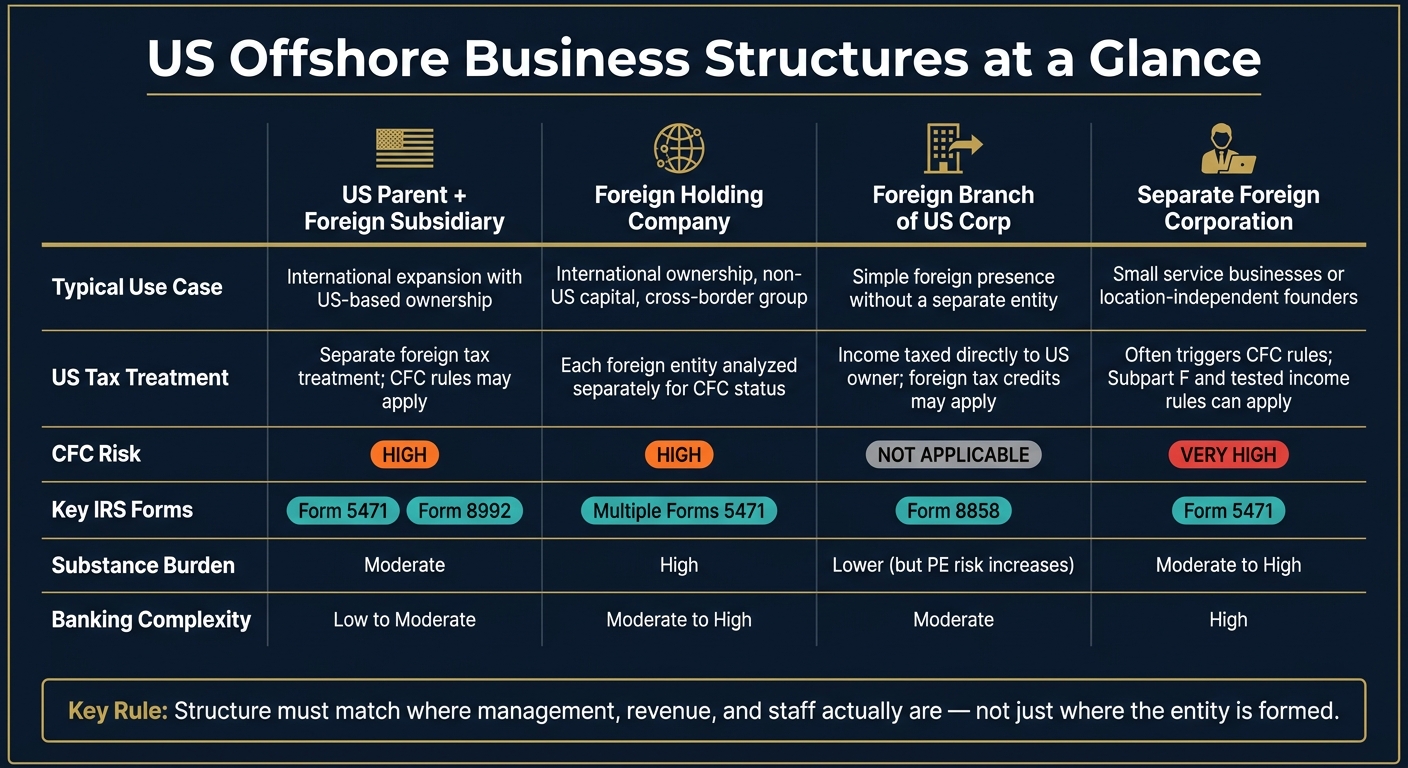
US Offshore Business Structures: Tax, Compliance & Risk Comparison
Next, pick the structure and jurisdiction that fit your actual facts. Start with the setup that lines up with ownership, control, and banking on the ground.
Compare the main offshore structures for US founders
Most US founders look at four common setups. Each one comes with its own tax rules, filing duties, and management demands.
| Structure | Typical Use Case | US Tax Treatment | CFC Risk | Key IRS Forms | Substance Burden | Banking Complexity |
|---|---|---|---|---|---|---|
| US parent + foreign subsidiary | International expansion with US-based ownership and management | Separate foreign tax treatment; CFC rules may apply | High | Form 5471, Form 8992 | Moderate | Low to moderate |
| Foreign holding company | International ownership, non-US capital, cross-border group | Each foreign entity analyzed separately for CFC status | High | Multiple Forms 5471 | High | Moderate to high |
| Foreign branch of a US corporation | Simple foreign presence without a separate entity | Income taxed directly to the US owner; foreign tax credits may apply | Not applicable | Form 8858 | Lower, but permanent establishment risk increases | Moderate |
| Separate foreign corporation owned by a US founder | Small service businesses or location-independent founders | Often triggers CFC rules; Subpart F and tested income rules can apply | Very high | Form 5471 | Moderate to high | High in low-tax jurisdictions |
The right pick still comes down to where management happens, where revenue is earned, and where staff actually work.
A US parent with a foreign subsidiary is often the cleanest route. The US company stays the main taxpayer, while the foreign entity handles defined offshore work like non-US sales, local hiring, or regional support.
A foreign holding company may fit if you have non-US investors or plan to raise capital outside the US. But there’s a catch: each company in the chain may need its own CFC review, and your records need to show where the holding company is actually managed.
A foreign branch can look simple at first. But simple on paper doesn’t always mean simple in practice. It can create permanent establishment risk, which means the foreign country may tax profits tied to a fixed place of business or local activity.
A separate foreign corporation owned directly by a US founder can work for small service businesses. Still, it often pulls in CFC rules and heavy reporting. This is the kind of setup you use only with focused tax advice.
How to pick a jurisdiction based on substance, banking, and operations
Choosing a jurisdiction is not just about low tax. It’s about whether the place matches how the business actually runs.
Start with company law. Does the jurisdiction support the entity type you need? Does it allow the ownership and management setup you’re planning? Then move to banking access. Some jurisdictions with a low-substance reputation, like Belize or Seychelles, tend to face more bank scrutiny and more friction during account opening. You also need to price out local compliance, including annual filings and any required registered agent, director, or audit work.
Economic substance rules are now a hard line in many low-tax jurisdictions. Since January 1, 2019, places like the BVI and Cayman Islands have required in-scope entities to show real local activity, including employees or contractors, physical premises, local spending, and core income-generating activities in the jurisdiction. In plain English, that means board decisions, management, and core operations need to happen locally.
Anguilla also requires enough staff, premises, and documented board meetings for relevant entities. Pure equity holding companies get lighter tests, but they still need clean governance records and annual filings.
If the facts don’t fit the jurisdiction, stop there and pick another one before you form anything.
How Global Wealth Protection can support your setup
If you want help with entity choice and paperwork, Global Wealth Protection supports the setup process with offshore company formation, private US LLC formation, and offshore trusts or private interest foundations. The GWP Insiders membership program includes jurisdiction selection, tax minimization strategies, and access to private consultations.
The point is simple: get the entity, records, and agreements right from day one. That way, they can hold up under IRS or bank review.
Once the structure and jurisdiction are set, the next step is forming the entity the right way and documenting intercompany terms before any transactions begin.
Step 3: Build the structure without triggering avoidable penalties
Most offshore failures come down to three things: weak paperwork, pricing that isn’t backed up, or management that still sits in the U.S. Those are the first cracks tax authorities tend to inspect. Once you pick the structure, the details have to line up. Contracts, bank flows, and filings should all tell the same story.
Form the entity and document intercompany relationships correctly
Order matters here. Start with a feasibility review and legal design before you file anything. After that, incorporate in the local jurisdiction, capitalize the entity with documented funds, and put shareholder agreements in place. If royalties will be paid, document the IP licenses before any of that money starts moving.
Don’t send money before the paperwork is signed. Every related-party transaction needs a signed agreement in place before the first payment goes out. That usually means a master service agreement or a license agreement, depending on what’s moving between entities. And those documents need to reflect arm’s-length terms, not a one-page memo pulled together after the fact.
Handle transfer pricing, banking, and IRS reporting from day one
Each related-party transaction should be priced at arm’s length, and the analysis should be documented before filing. Keep that transfer-pricing work in writing before the return is submitted.
Unmatched wires are the kind of thing that can set off an audit. Each capitalization, service payment, banking step, payroll action, and reporting item should tie back to a signed document and the right filing. Put plainly: every payment, invoice, and filing needs to point to the same structure.
Missed international filings can lead to steep per-form penalties. That’s why the compliance calendar needs to be built before the structure goes live, not after the first tax year ends.
Set governance rules that support the intended tax residence
Offshore status turns on real control, not just what the formation documents say. Board meetings, approvals, and decision-making need to happen where the company claims tax residence.
Board composition, meeting location, and delegated authority all feed into the substance analysis. Local directors should have actual decision-making power, not just a pen to sign papers prepared by someone else. Minutes should show real discussion, not rubber-stamp approvals. Core income-generating decisions, like approving contracts, setting pricing, and managing key relationships, need to happen in the jurisdiction where tax residence is being claimed.
Use local directors only when they have real authority. Keep proper minutes. Show local management through staff, office space, and actual decision-making. Local staff, premises, and real decisions help prove substance.
After the structure is live, the focus shifts to annual filings, renewals, and recordkeeping.
Step 4: Stay compliant as rules and requirements change
Once your structure is live, the day-to-day admin starts to matter. Formation gets things off the ground. After that, filings, records, and renewals are what keep the setup defensible.
Build an annual compliance calendar for US and foreign filings
Put all US and foreign deadlines on one calendar. That sounds simple, but it saves a lot of pain later.
On the US side, that usually includes Form 1040 with international schedules, Form 5471 for controlled foreign corporations, Form 8938 for foreign financial assets, and FinCEN Form 114 for foreign accounts. On the foreign side, Cayman entities must file the ES Notification by January 31 and the ES Return within 12 months of the financial year end. BVI entities must file their ES report within six months of the financial period end.
Here are the main recurring tasks, the rule or form tied to each one, and what can happen if you miss them:
| Task | Frequency | Key Form or Rule | Consequence of Missing It |
|---|---|---|---|
| Form 1040 and international schedules | Annual | Form 1040 + international schedules | Late filing penalties and interest |
| CFC reporting | Annual | Form 5471 | $10,000 per form penalty; potential audit escalation |
| Form 8938 | Annual | Form 8938 (FATCA) | Significant penalties and increased audit risk |
| FBAR filing | Annual (April 15 / October 15) | FinCEN Form 114 | Up to $16,536 per report (non-willful); up to $165,353 or 50% of account balance (willful) |
| Transfer pricing file review | Annual | OECD master file / local file | Income adjustments, double taxation, penalties |
| Economic substance notification and return | Annual | Local ES rules (e.g., Cayman, BVI) | Fines, public noncompliance listing, account friction, administrative dissolution |
| Local company renewal and annual return | Annual | Local corporate law | Loss of good standing; banking disruption |
Transfer pricing support also needs a yearly check. If the facts change or the pricing changes, update the comparables too.
Deadlines are one part of the story. The other part is proof.
Keep records strong enough for IRS or bank review
Keep ownership, governance, intercompany, operating, banking, and filing records together in one secure archive. If the IRS or a bank takes a look, those records are what show who owns the structure, who controls it, and whether the setup has substance.
This is where things can go sideways fast. Missing transfer pricing support or messy financial records can lead to adjusted taxable income, denied deductions, or a challenge to the entity’s claimed tax residency. On the banking side, incomplete files can trigger enhanced due diligence, account friction, or outright account closure under KYC and AML standards.
The goal is simple: the filings, bank records, and governance records should all tell the same story.
Conclusion: A lawful offshore move requires structure, substance, and reporting discipline
A lawful offshore move depends on steady structure, substance, and reporting discipline. Keep the calendar current, review the setup each year, and make sure the paperwork matches the actual business.
FAQs
Can I move my business offshore if I still live in the U.S.?
Yes. You can move your business offshore and still live in the U.S. But here’s the catch: you’ll still owe U.S. tax and reporting on your worldwide income.
That means a move offshore doesn’t take you off the IRS radar. Far from it.
Some of the big issues are CFC rules, filings such as Form 5471, FBAR, and Form 8938, possible U.S. tax residency if the company is managed from inside the U.S., and the need to show real economic substance offshore.
Careful structuring helps avoid double taxation and penalties.
In plain English, it’s not just about where the company is registered. It’s also about who controls it, where decisions are made, and whether the offshore setup has an actual business presence instead of just a paper address.
Done the right way, offshore structuring can work. Done carelessly, it can lead to extra tax, missed filings, and painful penalties.
What makes an offshore company look legitimate to the IRS and banks?
An offshore company looks legitimate when it shows real economic substance, not just a shell entity.
That usually means the company has actual operations in the jurisdiction, such as:
- a physical office
- qualified local staff
- local directors who take part in key decisions
It also needs clear corporate records. That includes board minutes and documentation of its core income-generating activities.
On top of that, the company should show full transparency through reporting standards like FATCA and the Common Reporting Standard.
Which offshore structure is usually safest for a U.S. founder?
There’s no one-size-fits-all “safest” structure for every U.S. founder. The right setup depends on your business goals, how you plan to operate, and your tax profile.
A CFC is often used for operating businesses with major fixed assets. A foreign partnership or disregarded entity may be a better fit for smaller ventures. In many cases, founders use a U.S. holding company with a foreign operating subsidiary.
Whatever structure you choose, two things matter a lot: real economic substance and full compliance.