
A foreign company does not cut U.S. tax by itself. If I want an offshore setup to work within the law, I need the right country, the right entity, clear control, market-based pricing, and full U.S. reporting.
Here’s the short version:
- U.S. tax still applies to worldwide income
- A 0% foreign tax rate does not mean 0% U.S. tax
- CFC, Subpart F, and GILTI can tax income now, even without a payout
- Paper-only setups can fail if management stays in the U.S.
- Missing forms like FBAR, Form 5471, or Form 8938 can trigger steep penalties
- Offshore tax planning is legal; hiding income is not
If I boil the article down, the rule is simple: the structure has to match what the business actually does. That means:
- I pick a jurisdiction that fits the income, banking access, and local presence rules.
- I choose an entity that matches how money is made, whether that is services, trading, holding assets, or licensing IP.
- I set ownership, board control, and cash flow in a way that lines up with tax and legal records.
- I support intercompany payments with pricing records and written agreements.
- I file every U.S. form on time, even if no foreign tax is due.
A few facts stand out:
- FBAR is triggered when foreign accounts top $10,000 at any point in the year.
- Transfer-pricing penalties can reach 40% in some cases.
- In the UAE, a free-zone company that misses local presence tests can lose the 0% rate and face 9% tax for the current year and the next 4 years.
Quick comparison
| Topic | What matters most |
|---|---|
| Jurisdiction | Tax system, banking, local presence rules |
| Entity type | Services, trading, holding, or IP use |
| Ownership | Tax, estate, lawsuit exposure, filing load |
| Management | Where top decisions are made |
| Profit flows | Fees, royalties, and loans must fit market terms |
| Compliance | Form 5471, FBAR, Form 8938, CFC rules |
My takeaway: offshore companies can help lower taxes legally only when the setup is open, documented, and tied to actual business activity. Anything built to hide income, fake control, or shift profit without support can turn into a tax problem fast.
sbb-itb-39d39a6
Step 1: Choose the right jurisdiction and entity for the income you earn
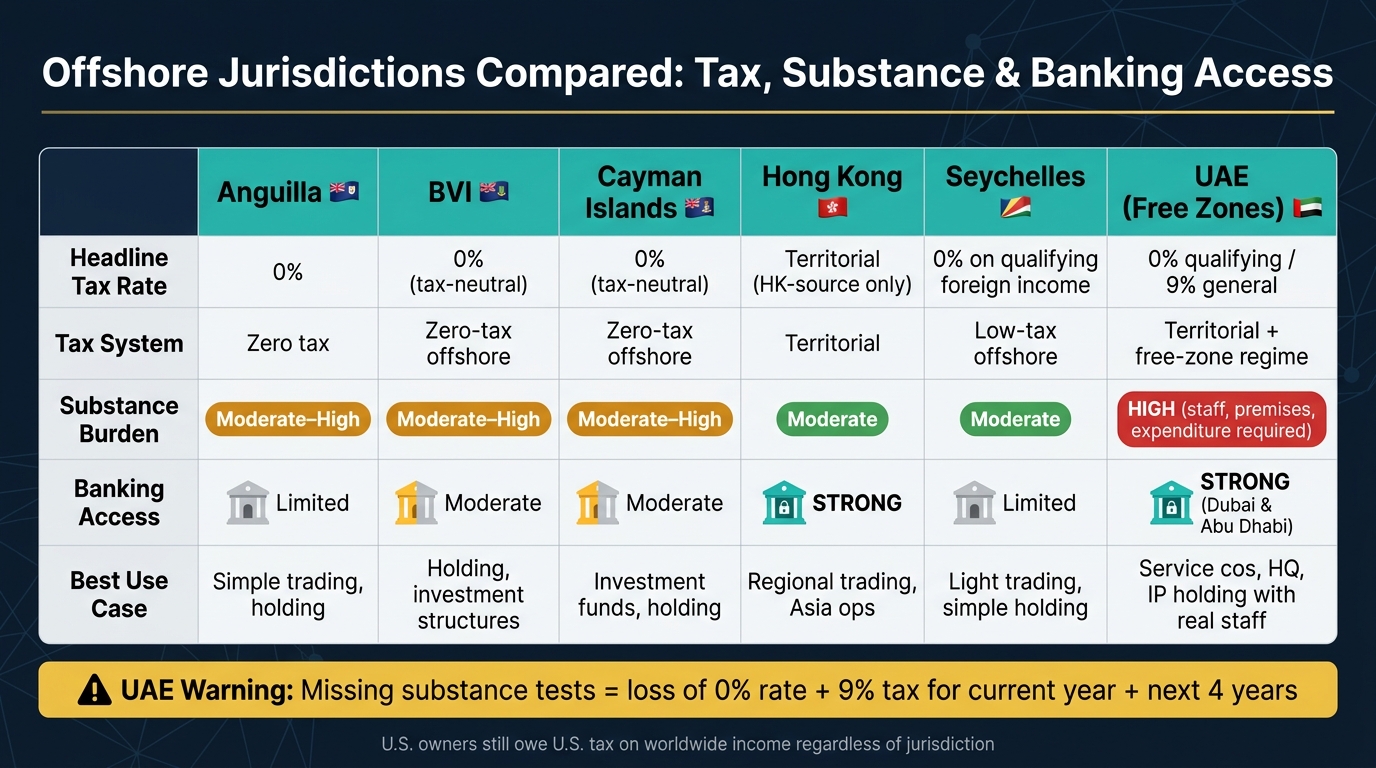
Offshore Jurisdictions Compared: Tax, Substance & Banking Access
Once you factor in U.S. tax rules, the next call is where the company can actually function. This choice should come from tax and day-to-day business needs, not from image. The right fit depends on where your customers are, where management happens, where the work gets done, and whether you can support real operations there.
How to compare jurisdictions: Anguilla, BVI, Cayman, Hong Kong, Seychelles, and the UAE
The best jurisdiction is the one that can support substance, banking, and the kind of income you earn.
That matters more now than it used to. Many low- or no-tax jurisdictions require local management, core activity, staff, premises, and spending for income that can be moved around easily, like IP, finance, and holding-company activity. For U.S. owners, the best option is the one that improves the total after-tax outcome, not simply the one with the lowest local tax rate.
| Jurisdiction | Headline tax treatment | Tax System | Substance Burden | Banking Access | Best use case |
|---|---|---|---|---|---|
| Anguilla | 0% corporate income tax | Zero tax | Moderate to high for relevant activities | Limited; often relies on external banks | Simple international trading, holding |
| BVI | Tax-neutral | Zero-tax offshore regime | Moderate to high for relevant activities | Moderate; enhanced due diligence is common | Holding companies, investment structures |
| Cayman | Tax-neutral | Zero-tax offshore regime | Moderate to high for relevant activities | Moderate; common for funds and institutional use | Investment funds, holding structures |
| Hong Kong | Taxed on Hong Kong-source profits | Territorial | Moderate; foreign-source claims require support | Strong; robust multi-currency banking | Regional trading, Asia-facing operations |
| Seychelles | No local tax on qualifying foreign-source income | Low-tax offshore regime | Moderate for relevant activities | Limited; scrutiny can be higher | Light trading, simple holding |
| UAE (free zones) | 0% on qualifying income; 9% general | Territorial with free-zone regime | High; staff, premises, and expenditure are required | Strong in Dubai and Abu Dhabi | Service companies, HQ, IP holding with real staff |
One practical note on the UAE: free-zone entities that fail substance tests can lose the 0% rate and be taxed at 9% for the current period and the following four years. That’s a direct cost of not having enough local presence.
When to use a foreign corporation, holding company, trading company, or IP company
After jurisdiction, the next step is entity choice. Match the structure to the income stream. Put simply: pick the entity based on how the business makes money.
A foreign operating corporation works for active income from non-U.S. customers, such as consulting, software subscriptions, or product sales. A holding company can own multiple subsidiaries, receive dividends, and make a future sale easier to manage. A trading company serves as the commercial hub for cross-border buying and selling of goods. An IP company holds intangibles and licenses them to operating entities, but only when the real development, enhancement, maintenance, protection, and exploitation functions happen in that same jurisdiction.
| Entity Type | Main Function | Tax Profile | Asset Protection Value | Reporting Complexity |
|---|---|---|---|---|
| Foreign corporation | Active business operations for non-U.S. markets | Subject to GILTI and Subpart F if a CFC; foreign tax credits may apply | Moderate; separates non-U.S. risk | Moderate; Form 5471 required |
| Holding company | Owns subsidiaries, receives dividends and capital gains | Passive income often falls under Subpart F; more complex in multi-tier structures | High; centralizes ownership | High; multiple Forms 5471 may be needed |
| Trading company | Buys and sells goods internationally | Active income treatment may be possible; transfer pricing is critical | Moderate | Moderate to high; pricing documentation required |
| IP company | Licenses intangibles to operating entities | Royalties are closely scrutinized under Subpart F and GILTI; DEMPE substance is required | High if structured correctly | High; transfer pricing and substance documentation are essential |
Use an IP company only if that same jurisdiction also has the real R&D, maintenance, protection, and exploitation work. If the people and activity sit somewhere else, the structure starts to look thin very fast.
Step 2: Build the structure around ownership, management, and profit flows
Before you form any offshore entity, map out four things: customers, ownership, control, and cash flow. Once you’ve picked the jurisdiction and entity type, the setup needs to line up with who owns the business, who runs it, and how money moves.
Set ownership layers that match your tax, estate, and asset-protection goals
For a U.S. owner, the simplest place to start is direct personal ownership of the foreign company. It’s easy to run. But there’s a tradeoff: the shares pass through your estate, and they may be more exposed in U.S. lawsuits.
A step up is a single-member U.S. LLC that is disregarded for U.S. tax and owns the offshore company. That keeps things fairly simple while still leaving room to place offshore vehicles underneath later, if the business grows into that need.
For higher-net-worth cases or companies with major IP exposure, an offshore trust or foundation can sit on top of the foreign company and add asset protection and succession planning. A common setup is an Anguilla company owned by an Anguilla trust. That pairing is often used because Anguilla has strong asset-protection statutes and short limitation periods for fraudulent transfer claims.
The big point here is simple: add layers only when they fix a real problem. If a layer doesn’t solve an asset-protection, estate, or partner-governance issue, it’s probably just extra paperwork. And that paperwork can be serious. Each added layer can trigger U.S. reporting, including Forms 3520, 3520-A, 5471, and 8938. Build in stages. Add complexity only when the business and the risk level call for it.
Once ownership is locked in, the next issue is where control sits in practice.
Place management and control where the company is intended to be tax-resident
A lot of tax authorities care less about where a company is formed and more about where its key decisions happen. In plain English: who approves budgets, signs major contracts, sets strategy, and authorizes senior hires?
If those calls are being made in the U.S., many countries may treat the company as tax-resident in the U.S. even if it’s registered abroad. That’s why an offshore board can’t exist only on paper. It needs real authority. Local directors should review materials ahead of time, ask questions, and make their own decisions on major issues.
The Australian Tax Office notes that board minutes help show where key decisions are made, and will accept complete minutes as prima facie evidence of where management is located. That makes recordkeeping more than a box-checking exercise. Keep board minutes, travel records, signed resolutions, and local bank approvals. And when possible, sign key contracts in the jurisdiction itself.
Design intercompany payments that can withstand transfer-pricing review
Payments between related entities need to make sense as if the parties were strangers doing a normal deal. That applies to management fees, royalties, service charges, and intercompany loans. This is the arm’s-length principle under IRC §482 and OECD transfer-pricing guidance.
The first step is a functional analysis. Document what each entity does, what assets it uses, and what risks it carries. That’s where many setups fall apart. A management fee paid to an offshore entity with no staff and no real management activity is an easy target. A royalty paid to an IP company that actually developed, maintains, and makes decisions about the IP is much easier to defend. The payment has to match the economic facts on the ground.
U.S. taxpayers who don’t keep enough contemporaneous transfer-pricing documentation can face net adjustment penalties of up to 40% on tax deficiencies tied to mispriced intercompany transactions, and the documentation must exist when the return is filed and be given to the IRS within 30 days of request.
| Transaction type | Key documentation required | Substance expectations | Common transfer-pricing methods |
|---|---|---|---|
| Management fees | Written management agreement; description of services; time records; organizational charts; board resolutions approving fees | Real management team with strategy, budgeting, and oversight functions; evidence of ongoing work | Cost-plus; TNMM |
| Royalties (IP use) | IP ownership records; license agreements; valuation reports or royalty-rate benchmarks | Genuine IP development, maintenance, and protection decisions made by the IP owner | CUP (comparable royalty rates); profit-split for complex IP |
| Service charges | Service contracts; detailed invoices; SOPs; staff evidence; KPIs or performance reports | Staff, systems, and processes to perform services; recurring operational activity | Cost-plus; CUP where comparable services exist |
| Intercompany loans | Loan agreements; interest-rate benchmarking; repayment schedules; security documents; board approvals | Lender has capital to lend; borrower uses funds for business; actual payments and repayments made | CUP (market interest rates); credit-spread analysis |
If the payments hold up, the next issue is whether the structure has real substance and whether the filing work has been done properly.
Step 3: Add real substance and meet U.S. and international compliance rules
Once ownership and pricing are set, substance and reporting decide whether the setup holds up. If the company lacks substance or the filings are incomplete, the tax upside can vanish.
Economic substance, beneficial ownership, and anti-sham standards
Many offshore jurisdictions that matter now, including the BVI, Cayman Islands, and UAE, have economic substance rules. In plain English, that means real activity, local decision-making, and actual spending in that jurisdiction. The place on paper should line up with where the company is run and where the work that drives income happens. If it’s just a shell with no meaningful footprint, it can be treated as a sham.
Privacy also has limits. It isn’t the same as secrecy. FATCA and CRS can still put ownership and account data in front of tax authorities.
The core test is simple: the company’s records, people, and decisions need to match the structure on paper.
And here’s the catch: even a real business can lose the tax upside if U.S. filings are missing or incomplete.
U.S. reporting forms and CFC rules that can offset offshore tax savings
For U.S. owners, compliance is part of the setup from day one. It’s not something to deal with later. Penalties for missed filings can be steep even when no tax was due. A U.S. owner of a foreign corporation may need to file Form 5471. FBAR (FinCEN Form 114) is required when the total value of foreign financial accounts goes over $10,000 at any point during the calendar year. Form 8938 may also apply under FATCA.
Then there’s the CFC reporting layer. Controlled Foreign Corporation rules under Subpart F can pull some types of passive income back into U.S. taxation in the year the income is earned, even if the offshore company never pays it out. The GILTI regime adds another tax layer by taxing a U.S. shareholder’s share of a CFC’s low-taxed income each year. In practice, Subpart F and GILTI can wipe out deferral when income is passive, mobile, or taxed at a low rate.
That’s why ongoing tax and reporting support should be part of the budget. A filing error can wipe out the savings fast. U.S. owners need professional tax support.
Conclusion: Offshore entities work only when the structure matches reality
Start with your U.S. tax status and the kind of income you earn. Those two factors shape the right jurisdiction, entity, ownership chain, and profit flow. Put simply: the setup needs to make sense in day-to-day business before it looks good on paper.
File every required report on time. A missed filing can wipe out the tax upside.
Offshore tax efficiency lasts only when the structure fits the business, the people involved, and the records behind it.
FAQs
Can I lower taxes offshore if I still manage the company from the U.S.?
Usually, no.
If you run an offshore company from the U.S., tax authorities may treat it as a U.S. tax resident based on where effective management and control take place.
That can mean the company is taxed on worldwide income. It may also trigger CFC rules for some offshore earnings.
A lawful offshore setup usually needs real economic substance and key decision-making outside the U.S.
Which offshore structure best fits my business?
The best offshore structure depends on what you want it to do. Some setups are built for asset protection. Others are better for tax planning or easier day-to-day management.
Common options include IBCs for trading, private LLCs for consulting or professional services, and holding companies for owning subsidiaries or intellectual property.
The key is to pick a structure that fits your business model, how you make money, and where your customers are. It also needs to meet economic substance rules in the jurisdiction you choose.
What filings do U.S. owners usually miss first?
U.S. owners often miss required reporting filings first. And that can lead to major penalties, even when no tax is due.
The forms people miss most often include:
- Form 5471
- FBAR (FinCEN Form 114) for foreign account balances over $10,000
- Form 8938
- Form 8865
- Form 3520
Missing these filings can get expensive fast. The same goes for weak or missing transfer pricing documentation, which can also trigger steep financial penalties.