
Yes – but only the company, not your life. I’d sum it up like this: Estonia e-Residency lets you open and run an Estonian OÜ online, sign documents with an EU-valid digital signature, file company paperwork, and manage admin from abroad. But it does not give you a visa, EU work rights, tax residency, or a bank account.
If you want the short answer, here it is:
- You can form an EU company online with Estonia’s e-Residency card
- You cannot use it to move to Europe
- You still face bank, tax, and filing work
- It fits online businesses best, like SaaS, consulting, agencies, and freelance work
- It fits poorly if you need local staff, inventory, cash handling, or place-based licenses
A few numbers make the tradeoff clear:
- Online OÜ registration fee: about €265
- Minimum share capital: €2,500 (payment can be delayed in some cases)
- Setup time after filing: often 1–3 business days
- Annual report deadline for most calendar-year companies: June 30
- Estonia corporate tax on retained profits: 0%
- Estonia tax on distributed profits in 2026: 22%
- Typical yearly admin cost for a small company: about $900–$2,800
What I’d watch most is the part many founders miss: e-Residency is a digital ID for business use. It does not change where you owe personal tax. If you’re a U.S. citizen or U.S. tax resident, you may still face IRS reporting on a foreign company, including forms like 5471, FBAR, and 8938.
Here’s the plain-English version of the whole model:
| What you get | What you still need to solve |
|---|---|
| Estonian digital ID | Banking or payment access |
| Remote company formation | Legal address in Estonia |
| EU-valid e-signing | Licensed contact person if board is abroad |
| Online state portals for filings | Bookkeeping and annual reports |
| An EU company structure | Home-country tax compliance |
So if you run a remote-first business and want an EU company you can manage online, this setup can work. If you expect it to fix immigration, banking, or personal tax, it won’t.
Below, I’ll break down where e-Residency helps, where it stops, and who should think twice before using it.
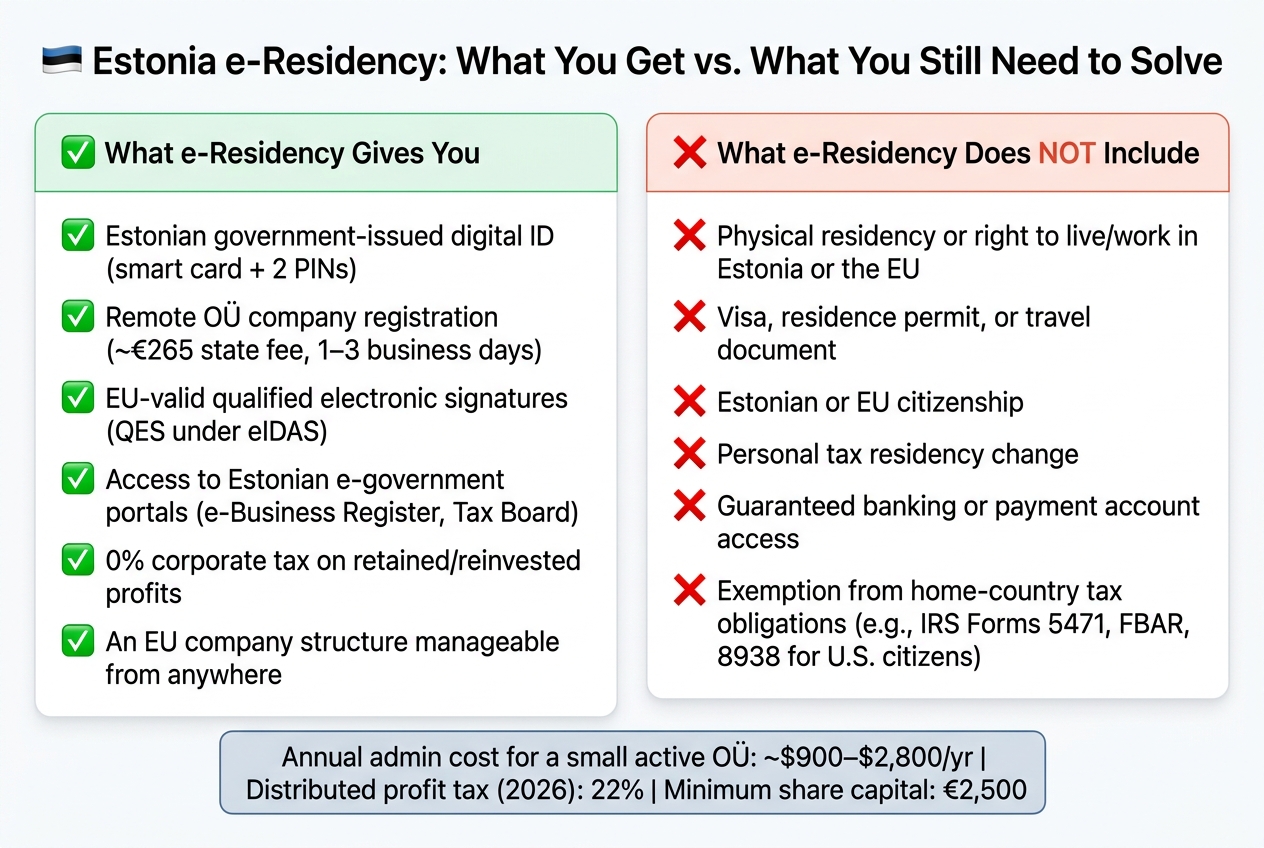
Estonia e-Residency: What It Includes vs. What It Doesn’t
What Estonia e-Residency gives you and what it does not
What you can do with the digital ID
The e-Residency card is a chip-enabled smart card that comes with two PIN codes. PIN1 lets you log in to Estonian government portals like the e-Business Register and the Tax and Customs Board. PIN2 lets you add a qualified electronic signature, or QES, to documents. Under EU eIDAS rules, that signature has the same legal effect as a handwritten one.
In plain English, this means you can set up and manage an OÜ from abroad. You can file reports, update company details, and sign contracts online without being in Estonia.
What e-Residency does not include
This is the big catch. The digital ID is a business tool. It is not an immigration document.
It does not give you the right to enter Estonia or the EU. It does not help you get a visa. And it does not let you live or work anywhere in the EU.
It also does not change your personal tax residency. That still depends on where you physically live. If you’re a U.S. citizen, the IRS still taxes your worldwide income no matter where your company is formed, making it essential to understand digital nomad taxes.
There’s another point people often miss: the card does not come with a bank account. You can run the company online, but banking is a separate step. Every bank or payment provider does its own KYC and AML checks, and many Estonian banks still want in-person verification from remote applicants. So it’s smart to expect delays – or even a rejection – instead of assuming banking access is part of the package.
That means the work doesn’t stop when the card arrives. You still need to handle company setup, compliance, and payment rails.
| What e-Residency includes | What e-Residency does not include |
|---|---|
| Government-issued digital identity (smart card + PINs) | Physical residency or the right to live in Estonia or the EU |
| Remote OÜ company registration | Visa, residence permit, or travel document |
| Qualified electronic signatures valid across the EU | Estonian or EU citizenship |
| Access to Estonian government e-services | Personal tax residency in Estonia |
| Ability to manage company filings and contracts online | Guaranteed banking access |
The next question is the practical one: how do you register the company, meet address rules, and run it from abroad?
sbb-itb-39d39a6
How to form and operate the company remotely
Application, company registration, and the standard entity choice
Once you understand what e-Residency does, the next step is the practical one: setting up and running the company from abroad.
Forming an Estonian company as a remote founder usually happens in two steps. First, you apply online, wait for approval, and collect your digital ID kit from an Estonian embassy or pickup location.
Only after you have the card can you register the company. In most cases, the standard setup is a private limited company, or OÜ, which you can register online with your e-Residency card. The state fee for online OÜ registration is about €265, and once everything is filed, the company often appears in the Commercial Register within 1–3 business days.
The minimum share capital for an OÜ is €2,500, although newer rules let founders delay payment in some cases. Before you start, have these details ready:
- Company name
- Legal address
- Board details
- Activity code
- Share capital plan
All of that tends to be the easy part. After registration, the bigger job is staying on top of address, banking, and filing rules.
Legal address and contact person requirements
Every OÜ must have a legal address in Estonia, and a PO box does not count. If the management board is based outside Estonia, the company must also appoint a licensed contact person in Estonia to receive official documents on the company’s behalf.
This is not optional. The contact person has to be a licensed local provider. In plain English, that means most remote founders pay a recurring monthly or annual fee for legal address and contact-person services.
Once that piece is handled, the focus shifts to how the company runs from day to day.
What remote management looks like day to day
Most of the workflow is digital. PIN2 is used to add a legally valid electronic signature to documents you approve remotely.
A normal setup looks like this: you send invoices and upload expense records into a cloud accounting tool, your Estonian accountant matches the books and points out any VAT or annual report duties, and you digitally approve filings before the deadlines arrive.
Official mail from the Tax and Customs Board or the courts goes to your contact person’s address in Estonia, and that person then forwards it to you electronically.
A few habits make this much smoother:
- Keep your PINs secure
- Test your setup early
- Track where key management decisions are made
That daily system only works when banking, accounting, and filings are handled cleanly.
Banking, payments, accounting, and tax compliance
Banking and payment tools for an e-resident company
After registration, the first hard part is usually getting payment access. Each provider runs its own KYC review, so approval is never automatic. Put simply: registering the company is easy. Getting dependable payment rails is where things start to get real.
That’s why many remote founders use more than one tool instead of betting everything on a single provider.
Wise Business is often used for multi-currency balances and international transfers. Payoneer is common for marketplace payouts and payments from overseas clients. Stripe can process card payments for websites or SaaS products, but it usually needs a separate payout account or IBAN behind it. A traditional Estonian bank is still an option too, but onboarding tends to be much harder for non-resident founders.
| Provider | Main use case | Onboarding style | Key limitation |
|---|---|---|---|
| Wise Business | Multi-currency balances and international transfers | Online KYC and business review | Approval is not guaranteed |
| Payoneer | Marketplace and client payouts | Online application and compliance review | Best suited to payouts, not a full banking substitute |
| Stripe | Card payments and SaaS billing | Online merchant onboarding | Needs a separate payout account or IBAN |
| Traditional Estonian bank | Full business banking | Compliance-heavy, case-by-case review | High friction for non-residents; approval not guaranteed |
Once payment access is sorted, the next non-negotiable job is bookkeeping and filing.
Accounting, annual reports, and ongoing filings
Even if payments are running smoothly, the company still needs clean books and on-time filings. An Estonian OÜ must keep proper bookkeeping and file an annual report with the register every year, even if the company had no activity.
The deadline matters. Annual reports are due within six months after the financial year ends, which means June 30 for most calendar-year companies. Miss that deadline and fines can follow. If the issue drags on, the company can even be deleted from the register.
Most remote founders hand this work to a local Estonian accounting firm. In practice, that usually means sending invoices, bank statements, and receipts through a shared folder or an accounting portal. The accountant keeps the books, prepares the annual report, and files VAT returns if the company is VAT-registered.
You should also budget for this from day one. A small, active company may spend about $900 to $2,800 per year once accounting, registered address, and contact person fees are included. If the setup includes VAT filings, payroll, or a high number of transactions, costs can climb. U.S. founders may also need separate U.S.-side tax advice.
Why e-Residency does not fix your personal tax position
This is where a lot of people get tripped up: e-Residency does not change your personal tax residence. Forming an Estonian company does not change where you personally owe tax.
For U.S. citizens and tax residents, a single-owner OÜ can trigger U.S. reporting rules, including Forms 5471, FBAR, and 8938. If you control the OÜ, those U.S. reporting duties can still apply. The practical move is simple: talk to a U.S. international tax specialist before assuming the Estonian setup leads to any personal tax savings.
The same basic idea applies elsewhere too. In other countries, tax residence and taxable presence can still follow where you live and where management decisions are made.
Who this model works for and how to decide
Who fits this model and who does not
If you can handle the admin side covered above, the next step is simple: does your business match Estonia’s remote setup?
This model works best for businesses that can run fully online. The clearest match is software, consulting, and other internet-based companies.
The sweet spot is a business that sells online and needs little to no physical presence. It’s a poor match for physical or licensed businesses. If you hold inventory, need staff on-site, rely on a professional license linked to one place, or need face-to-face banking, the Estonian setup won’t fix those issues. You’d be taking on extra compliance while the main problem stays put.
| Good fit | Poor fit |
|---|---|
| SaaS products, digital subscriptions | Physical retail or hospitality |
| Remote consulting and freelance services | Businesses with local inventory or warehousing |
| Online agencies and publishers | Regulated professions requiring local licensing |
| Digital nomads billing EU clients in euros | Operations needing in-person banking or cash handling |
Key points to review before you commit
Before you move ahead, make sure this setup lines up with your business, banking, and tax picture. The card is just the opening move. It only works when your legal address, contact person, payments, and accounting are already set up.
Your home-country tax rules still matter. Estonia taxes distributed profits at 22% as of 2026, while retained and reinvested profits stay at 0% at the corporate level. In plain English: the setup only works when legal address, contact person, payments, accounting, and home-country tax rules are all handled the right way.
If you have employees in more than one country, or your tax and residency solutions for complex compliance needs, get cross-border tax advice before you commit. It’s much easier to set this up properly at the start than to untangle a structure that never fit in the first place.
FAQs
Do I need to visit Estonia at any point?
Yes – you need to show up in person one time to confirm your identity and pick up your digital ID card at an Estonian embassy, consulate, or approved pickup spot.
After that, you can take care of company registration, day-to-day management, tax filing, and document signing online. So you don’t need to be in Estonia for the rest of the process.
Can I run an Estonian OÜ without an Estonian bank account?
Yes, you can technically register and run an Estonian OÜ without an Estonian bank account, but in practice, it’s usually a headache.
Without a dedicated business account, it becomes much harder to manage cash flow, receive payments, and keep business and personal finances separate. That line matters more than many founders expect. Once personal and company money start mixing, things can get messy fast.
On top of that, many services require a business account. Using a personal account instead can trigger compliance problems or even lead to account freezes.
Will my home country still tax the company’s income?
Yes, likely. Estonia’s e-Residency does not make you a tax resident or remove tax duties in your home country.
In most cases, tax residency depends on where you live, where you work, and where you run the business day to day.
If you’re a U.S. citizen, the IRS taxes your worldwide income. That means an Estonian company doesn’t put your U.S. tax rules on pause. You may also need extra filings, such as Form 5471 or FBAR.