
Where you incorporate your business matters. It affects taxes, investor appeal, and how easily you can operate globally. If you’re an online entrepreneur, choosing the right jurisdiction can save you time, money, and hassle.
Here’s a quick breakdown of three top options for online business incorporation:
- Estonia: Ideal for EU-focused businesses. Features 0% tax on retained profits, fast 2-hour registration, and remote management via e-Residency. However, distributed profits face a 22% tax.
- Singapore: Great for tech startups and those targeting Asia. Offers startup tax rates as low as 6–8% for the first three years, but requires a local director.
- UAE: Perfect for tax savings and residency benefits. Free zone businesses enjoy 0% corporate tax on qualifying income, though setup costs are higher.
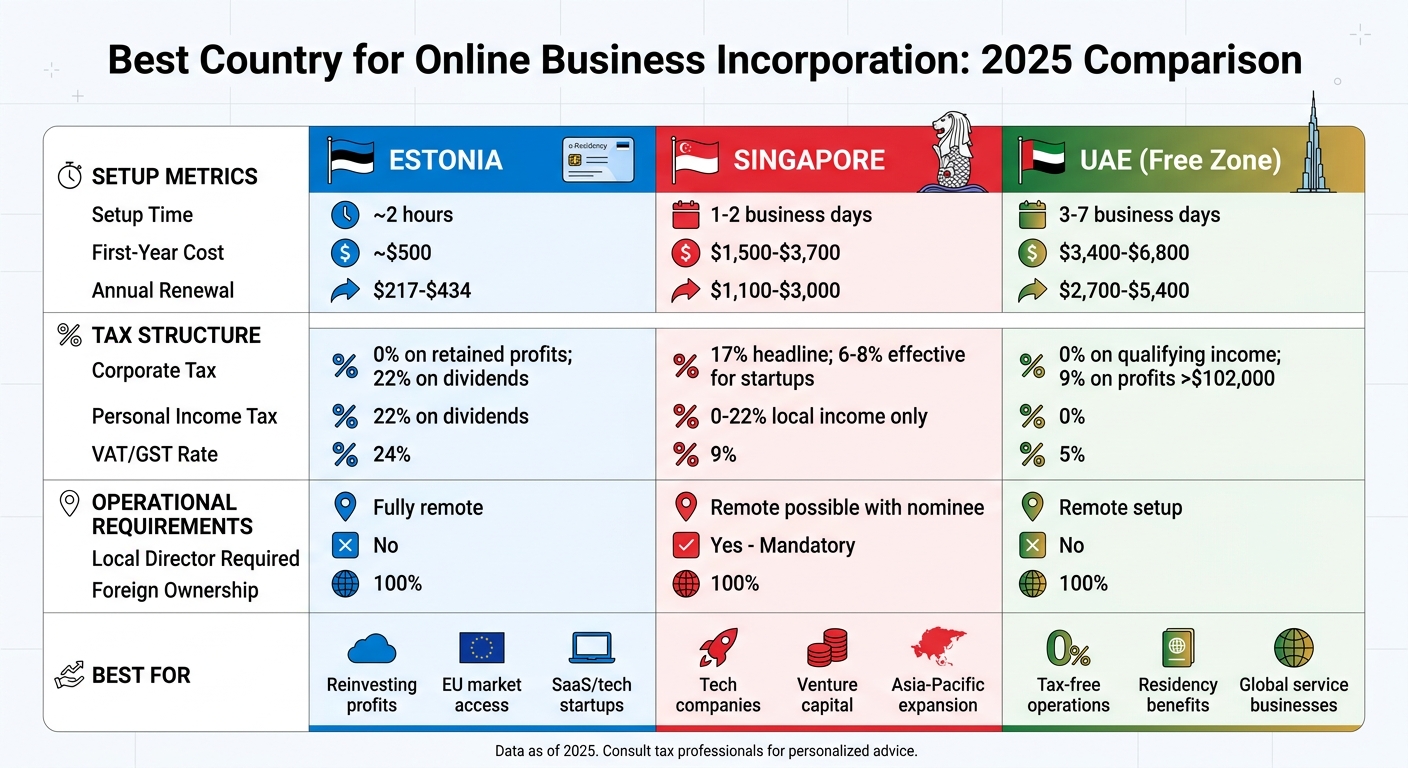
Quick Comparison:
| Factor | Estonia | Singapore | UAE (Free Zone) |
|---|---|---|---|
| Setup Time | ~2 hours | 1–2 business days | 3–7 business days |
| First-Year Cost | ~$500 | $1,500–$3,700 | $3,400–$6,800 |
| Corporate Tax | 0% on retained profits; 22% on dividends | 17% headline; 6–8% effective for startups | 0% on qualifying income; 9% on profits >$102,000 |
| Personal Income Tax | 22% on dividends | 0–22% (local income only) | 0% |
| Physical Presence | Fully remote | Remote possible with nominee | Remote setup |
Estonia is best for reinvesting profits. Singapore suits businesses needing regional access in Asia. UAE stands out for tax-free personal income and residency options. Choose based on your business goals.
1. Estonia
Tax Benefits
Estonia has a corporate tax system that stands out. It imposes 0% tax on retained and reinvested profits, meaning companies only pay taxes when distributing dividends. This approach is especially appealing to businesses like SaaS companies, agencies, and consulting firms that prioritize reinvesting profits.
However, distributed profits are taxed at a 22% rate. Starting in 2026, management board fees will face a 2% surcharge, raising personal income tax to 24%, and the standard VAT rate increased to 24% in July 2025.
"The 0% on retained profits is genuinely powerful – if you’re reinvesting in your business, you defer tax indefinitely."
– Remote Work Europe
For founders living in high-tax countries, Controlled Foreign Corporation (CFC) rules could mean their home country taxes retained profits, even if Estonia doesn’t. Luckily, Estonia has double taxation treaties with over 60 countries, which can help reduce this risk.
Next, let’s explore how Estonia simplifies the company setup process for digital entrepreneurs.
Ease of Setup
Estonia boasts the fastest business registration process in Europe, averaging just 2 hours. Thanks to the e-Residency program, entrepreneurs can manage an EU-based company remotely using a government-issued digital ID.
The setup process includes several steps: obtaining e-Residency (3–8 weeks), selecting a company name and EMTAK code, securing a local legal address and licensed contact person, submitting an online application via the e-Business Register, and paying a state fee of about $288 (€265). Share capital requirements are minimal, starting at just $0.01 per shareholder. Banking is often handled through fintech platforms like Wise or Revolut.
"E-Residency is the best option to set up a company for multiple founders without bureaucracy: our business was up and running cheaply within days."
– Georg Klausner, Mansiontech OÜ
Operating costs for the first year average $217 (€200), which is far less than Delaware (over $2,500) or Ireland (around $2,173). This streamlined process paves the way for a supportive regulatory environment.
Regulatory Environment
Estonia’s digital-first regulatory framework complements its tax and setup benefits, making operations smoother for online businesses. The country’s X-Road digital infrastructure enables nearly 100% online access to public services. Ranked 16th in the World Bank’s Ease of Doing Business report, Estonia has maintained one of the most competitive tax systems in the OECD for a decade.
Recent updates include stricter VAT ID requirements for e-Residency companies (2025–2026) and the need for real economic activity within Estonia. VAT registration becomes mandatory when annual taxable turnover exceeds $43,400 (€40,000). Many entrepreneurs use service providers like Xolo or Enty to handle compliance, with annual costs ranging from $217 to $434 (€200–€400).
"In Estonia everything is transparent by definition, and allows us to have a stable company structure, while working globally."
– Diana Derval, DervalResearch
It’s also important for founders to consider Permanent Establishment risks. If all business activities are conducted abroad, local authorities might classify the company as having a permanent establishment, making it subject to local corporate taxes.
Scalability
Estonia provides businesses with direct access to the EU single market of 440 million consumers through a European VAT number. The country ranks third in Europe for startup density and has attracted over 130,000 e-residents, who have launched more than 37,000 companies since 2014. Estonia’s digital infrastructure is highly advanced, scoring 139 points – 39% above the regional average – and digital signatures save an estimated 5 workdays annually.
To further enhance its digital capabilities, the government has invested around $105.8 million (€97.43 million) to modernize public services, including migrating IT systems to private clouds.
"Estonia remains the gold standard for truly location-independent companies."
– SIGTAX
That said, banking can be a hurdle for non-EU founders, who often rely on fintech solutions.
sbb-itb-39d39a6
2. Singapore
Tax Benefits
Singapore offers a corporate tax rate of 17%, but startups can benefit from substantial exemptions that significantly lower this rate. For early profits, the effective tax rate can drop to around 6%–8%, thanks to a 75% exemption on the first $74,000 (SGD 100,000) of chargeable income and a 50% exemption on the next $74,000 (SGD 100,000) during their first three years of operation. In 2026, businesses can also take advantage of a 40% corporate tax rebate, capped at $22,200 (SGD 30,000). Additionally, foreign-sourced income is not taxed unless it is brought into Singapore, and the country has an extensive network of over 80 tax treaties. Coupled with strong R&D tax credits, these factors make Singapore especially appealing for tech companies aiming to expand globally. On top of these tax perks, Singapore simplifies the setup process for new businesses.
Ease of Setup
Singapore is ranked #2 globally for ease of doing business. Foreign entrepreneurs can fully own a Singapore-based company, provided they appoint a local resident director. Incorporation through ACRA BizFile+ is quick, typically taking just 1–2 business days, and requires minimal paid-up capital of $0.74 (SGD 1). Initial costs for the first year usually range from $1,500 to $3,700, with annual maintenance expenses falling between $1,100 and $3,000.
"Singapore remains one of the fastest, safest and most business-friendly jurisdictions in Asia in 2025."
– Doing Business International
Regulatory Environment
Singapore’s regulatory framework is both efficient and reliable. Routine applications are often processed within 24 hours, all under a stable English common law system. The country is also recognized as the global leader in intellectual property protection, according to the World Economic Forum. Businesses must appoint a qualified company secretary within six months of incorporation and maintain a Register of Registrable Controllers. GST registration is required once taxable turnover exceeds $740,000 (SGD 1 million), with the current GST rate at 9%. While banking processes can take 1–4 weeks, traditional banks may require extensive KYC documentation and, in some cases, a physical visit from at least one director. These regulatory measures ensure a solid foundation for businesses to grow.
Scalability
Singapore’s position as a gateway to Asia-Pacific markets is strengthened by its strategic initiatives and robust banking infrastructure. The government actively supports growth in fintech and deep tech sectors, making it a prime location for companies aiming to scale regionally. Its strong global reputation also attracts external funding and multinational partnerships. For foreign entrepreneurs, obtaining an Employment Pass requires a minimum monthly salary of $4,144 (SGD 5,600) and is determined through a competitive, points-based system.
3. United Arab Emirates (UAE)
Tax Benefits
The UAE offers a 9% corporate tax rate on profits exceeding $102,000 (AED 375,000). However, businesses in free zones and small enterprises earning less than $816,000 (AED 3 million) enjoy a 0% corporate tax rate until December 31, 2026. This is particularly advantageous for online businesses in free zones. Qualifying Free Zone Persons (QFZP) benefit from 0% corporate tax on "qualifying income", which is ideal for e-commerce and digital services.
"If you are running a digital service business from a UAE free zone and your clients are outside the UAE, you almost certainly qualify for 0% tax." – The Middle East Insider
The benefits don’t stop there. The UAE also applies 0% personal income tax, 0% capital gains tax, and no taxes on dividends or inheritance. While the VAT rate is a modest 5%, businesses must register once their taxable turnover surpasses $102,000 (AED 375,000). The UAE has around 130 double tax treaties and doesn’t impose withholding taxes on domestic or international payments. These tax policies make the UAE a highly appealing option for entrepreneurs.
Ease of Setup
Setting up a business in the UAE is quick and straightforward. Free zone companies can be established in 1 to 5 days, while mainland setups usually take 2 to 4 weeks. Foreign entrepreneurs are allowed 100% ownership in all 40+ free zones and most mainland commercial activities. Additionally, the free zone incorporation process can be done entirely online, without requiring a physical presence in the UAE.
The initial costs for free zone setups vary widely, starting at $2,500 in RAKEZ and exceeding $30,000 in premium zones. First-year costs, which include licensing, a flexi-desk, and one visa, typically range between $4,750 and $10,200. Opening a corporate bank account takes 2–6 weeks and usually requires an in-person visit. Digital-first banks like Wio Bank often streamline the account setup process for smaller businesses. Business formation in the UAE also provides a direct path to residency visas, such as Investor, Green, or Golden Visas.
Regulatory Environment
The UAE has strengthened its digital commerce regulations to support online businesses. Federal Decree-Law No. 14 of 2023 aligns digital commerce with traditional trade, regulating goods, services, and data sold through websites, social media, and apps. Certain free zones, like DIFC and ADGM, operate under English Common Law, offering a familiar framework for international entrepreneurs. Additionally, free zones guarantee 100% repatriation of capital and profits.
Digital businesses must comply with cybersecurity standards, maintain secure infrastructure, and issue detailed digital invoices. To retain the 0% corporate tax in free zones, businesses must meet "substance" requirements, such as having a physical office and conducting core activities within the zone. With the UAE’s e-commerce market projected to reach $9.2 billion by 2026, the opportunities are immense. However, U.S. entrepreneurs should note that UAE incorporation does not exempt them from FBAR (for accounts over $10,000) or FATCA reporting to the IRS.
Scalability
The UAE’s infrastructure and policies make it a prime location for scaling digital businesses. With over 46 free zones housing more than 150,000 companies as of 2025, entrepreneurs have access to specialized ecosystems like Dubai CommerCity, which offers integrated e-commerce platforms and onsite service providers. A key development is Executive Council Resolution No. 11 of 2025, which allows free zone companies to open mainland branches without needing a local sponsor, broadening market access.
The DMCC, recognized as the world’s top free zone for nine straight years as of 2026, is home to more than 24,000 companies. For long-term stability, the UAE offers residency options like the 10-year Golden Visa and the 5-year Green Visa, reducing the need for frequent renewals. Combined with its position as a gateway to Middle Eastern and African markets, modern infrastructure, and competitive operational costs, the UAE is an excellent choice for businesses looking to expand. Annual renewal costs typically range from $2,700 to $5,400, depending on the zone.
Advantages and Disadvantages
Let’s break down the key advantages and disadvantages of each jurisdiction for digital entrepreneurs. Each option has its own strengths and trade-offs, depending on your business goals.
Estonia is known for its speed and low costs. You can register a company in about 2 hours, and the first-year costs are roughly $500. The entire process is conducted remotely through its e-Residency program. However, there’s a 22% tax on distributed dividends, meaning taxes are only incurred when profits are withdrawn.
Singapore strikes a balance between efficiency and tax benefits. Setting up a company takes 1–2 business days, with first-year costs ranging from $1,500 to $3,700. Its territorial tax system and startup exemptions can lower the effective tax rate to 6–8% for the first three years, making it appealing for tech-driven businesses. On the downside, foreign founders face the challenge of appointing a mandatory resident director, which adds complexity and increases annual costs.
The UAE offers unmatched tax advantages, including 0% corporate tax for qualifying free zone businesses and no personal income tax. While setup takes 3–7 business days, the first-year costs are higher, ranging from $3,400 to $6,800, with annual renewals costing $2,700 to $5,400. The UAE also provides a straightforward path to residency visas. However, businesses must meet economic substance requirements to maintain the 0% corporate tax status.
Here’s a quick comparison of these factors:
| Factor | Estonia | Singapore | UAE (Free Zone) |
|---|---|---|---|
| Setup Speed | ~2 hours | 1–2 business days | 3–7 business days |
| First-Year Cost | ~$500 | $1,500–$3,700 | $3,400–$6,800 |
| Corporate Tax | 0% on reinvested profits; 22% on dividends | 17% headline; 6–8% effective for startups | 0% on qualifying income; 9% on profits >$102,000 |
| Personal Income Tax | 22% on dividends | 0–22% (local income only) | 0% |
| Local Director | Not required | Mandatory | Not required |
| Physical Presence | Fully remote | Remote possible with nominee | Remote setup |
| VAT/GST | 24% (registration >$44,000) | 9% | 5% |
Estonia is an excellent choice for businesses focused on reinvesting profits and accessing the EU market with minimal setup costs. Singapore is ideal for tech and R&D-focused ventures that benefit from its tax efficiencies and strategic location in Southeast Asia. Meanwhile, the UAE appeals to high-income entrepreneurs seeking a tax-free personal income environment and easy residency options. This comparison helps narrow down the best fit based on your priorities.
Conclusion
A closer look at Estonia, Singapore, and the UAE highlights how each jurisdiction caters to different business needs and goals.
Picking the right location for your online business isn’t about a universal solution – it’s about matching your incorporation strategy to your business model and long-term objectives.
- Estonia: Perfect for tech startups, SaaS companies, and digital consultants looking to reinvest profits. The e-Residency program makes it easy and affordable to set up a remote business quickly.
- Singapore: A great choice for companies in international trade, fintech, or those seeking venture capital. Its effective 6-8% tax rate for startups during the first three years, combined with extensive double-tax treaties and excellent banking options, makes it ideal for accessing Southeast Asian markets or attracting institutional investors.
- The UAE: Offers unmatched benefits for entrepreneurs aiming for tax-free operations and residency. With 0% personal income and corporate tax for qualifying Free Zone entities, it’s a top pick for service-based businesses with global clients who want to reduce taxes while securing quick residency.
Your decision should reflect what matters most to your business: profit reinvestment (Estonia), credibility and regional reach (Singapore), or tax savings with residency perks (UAE). For tailored guidance, connect with Global Wealth Protection to simplify the decision-making process and align your strategy with your global vision.
FAQs
Which country is best for my business model (SaaS, agency, e-commerce)?
When deciding where to incorporate your business, the best choice often depends on factors like your business model – whether it’s SaaS, an agency, or e-commerce – and considerations such as tax advantages, ease of setup, and growth potential.
- Singapore stands out for SaaS companies, thanks to its low tax rates and excellent access to global markets.
- The UAE offers a 0% corporate tax rate for small businesses until 2026, making it an attractive option for startups looking to minimize costs.
- Hong Kong combines competitive tax policies with a robust banking system, making it a smart pick for businesses planning to scale.
Ultimately, your decision should align with your unique business needs and the markets you aim to serve.
Will my home country still tax me if I incorporate abroad?
Your home country could still tax your worldwide income, even if you set up a company overseas. This depends on factors like its tax laws, Controlled Foreign Corporation (CFC) rules, and any double-taxation treaties in place. It’s essential to review your country’s specific regulations to fully understand your tax responsibilities.
What do I need to keep the company compliant (VAT/GST and substance rules)?
To comply with VAT/GST and substance regulations, you need to follow the specific rules of each jurisdiction. This often means registering for VAT/GST if your revenue surpasses the set thresholds. Additionally, meeting "substance" requirements typically involves maintaining a physical office, employing local staff, and having active management in the region.
Staying compliant also hinges on keeping accurate transaction records, filing taxes on time, and proving genuine economic activity to align with local laws.
