
A holding company can help protect your business by keeping key assets in one company and day-to-day business risk in another. If you own real estate, trademarks, software, or shares in other businesses, this setup can help keep those assets out of reach when the company that serves customers gets sued or owes money.
Here’s the short version:
- I use a holding company to own assets
- I use a separate company that runs the business to deal with customers, staff, contracts, and day-to-day risk
- If one business gets hit with a claim, the damage may stay with that one entity
- This only works if I keep each company separate in practice, not just on paper
- It can fail if I mix money, sign in the wrong company name, personally guarantee debt, or move assets too late
A few key facts stand out:
- 1 lawsuit can threaten all assets if everything sits in one company
- 2+ entities are often used: one to own assets, one to run the business
- 0 protection from personal guarantees if I sign one myself
- 100% clean records matter when courts look at whether companies were kept separate
If you want the plain answer, it’s this: a holding company is a risk-separation tool, not a magic shield. I’d use it when one business owns high-cost property, strong IP, or multiple ventures that should not be tied together.
What matters most is not the chart on paper. It’s whether the setup is kept clean with separate bank accounts, written leases or licenses, filings, insurance, and records.
What a holding company is and how it differs from an operating company
A holding company owns assets – shares in other companies, LLC membership interests, intellectual property such as trademarks or software, real estate, or financial assets – but it does not run the day-to-day business.
The operating company does that work instead. It hires staff, signs agreements, invoices clients, handles payroll, and deals with customers. It also takes on the risks that come with those actions.
That split matters.
If a customer dispute, vendor claim, or premises incident turns into a lawsuit, that exposure usually stays with the operating company. And that’s where the asset-protection angle comes in: when high-value assets sit in a separate holding company, they aren’t automatically pulled into the operating company’s daily legal risk.
Put simply, liability usually follows the entity that creates it.
Basic structure: parent company, subsidiaries, and asset-owning entities
In many cases, one parent holding company sits at the top, with one or more subsidiaries below it, often LLCs or corporations.
The parent owns the shares or membership interests in each subsidiary. The subsidiaries, meanwhile, run the business.
Sometimes the setup is split even more:
- One entity holds commercial real estate
- Another owns trademarks or software
- A third handles daily operations
That kind of separation helps keep real estate, IP, and other assets away from the business activities that create day-to-day risk. From there, the practical issue becomes deciding which assets should sit in which entity.
Who should pay attention to this structure
This structure tends to matter most for:
- Business owners with more than one venture
- Entrepreneurs with high-value intellectual property
- Investors with real estate holdings
- Companies with large equity positions
- Businesses operating in high-risk industries
In those situations, separating ownership from operations can help shield intellectual property, real estate, and equity interests if one part of the business runs into trouble.
Of course, that protection depends on keeping the entities properly separate, which the next section addresses.
sbb-itb-39d39a6
How a holding company protects your business assets
A holding company protects business assets by placing them in a separate entity from the business that takes on day-to-day risk. That split matters most when your most important assets would otherwise sit inside the operating company.
Asset segregation: keep IP, real estate, and equity away from daily risk
Operating companies deal with contracts, employees, customers, and physical locations. Holding companies own the brand, software, real estate, or equity. So instead of keeping a trademark, commercial property, or software platform inside the same entity that handles daily business activity, you place those assets in the holding company or another separate entity.
The operating company can then lease the property or license the IP through a formal agreement. It still gets what it needs to run the business, but the assets remain outside the entity that faces the daily legal and business risk.
"Forming a holding company… is a strategic move that helps with the segregation of your core equity from front-line business risks." – Vincy Amirtharaj, Senior Corporate Structuring Consultant, Aziend
Use a written lease or license. That’s what makes the separation legally effective.
Liability containment: one lawsuit should not threaten the whole group
A claim against one entity stays with that entity. If a lawsuit comes from the operating business, it should stay with the operating LLC, not the separate LLC that owns the building or the parent company that holds the trademarks.
"The holding company serves as a legal barrier. This means that a lawsuit or creditor claim against one subsidiary does not automatically put other assets under the same umbrella or the personal wealth of the ultimate owner at risk." – Emifast
But this only works when the entities are kept separate in practice, not just on paper. That means:
- Separate bank accounts
- Contracts signed in the correct entity’s name
- No mixing of funds between entities
When those formalities break down, courts can pierce the corporate veil and hold shareholders or the parent company liable for a subsidiary’s debts.
Risk isolation across multiple ventures and subsidiaries
If you run more than one business, a holding company setup lets you place each venture in its own subsidiary. An e-commerce business, a consulting firm, and a rental property can each sit in a separate LLC, with one parent holding company owning them all.
That setup helps keep one venture’s liabilities from spilling into the others. The parent holding company sits above the group, owning the equity in each subsidiary without taking on their day-to-day legal risk directly.
That setup only works if each entity remains legally separate, which is where the limits start to show.
When this structure works well, and where its protection stops
Holding Company vs Operating Company: Structure, Benefits & Risks
Strong use cases for entrepreneurs and investors
After the entities are split, the next step is figuring out where this setup does the most work. A holding company tends to work best when high-value assets and day-to-day business risk are kept apart.
For instance, if an owner runs several unrelated businesses, each one can sit in its own subsidiary under one parent holding company. That setup helps stop trouble in one business from spilling into another. If one venture gets sued or runs into debt problems, the others are less likely to get dragged in with it.
Key limits: veil piercing, personal guarantees, and poor entity maintenance
This shield is only as good as the way the entities are run in real life. On paper, separation looks neat. In practice, it has to be treated seriously.
Courts can ignore the split through veil piercing. That happens when a parent and subsidiary are treated like one entity because the owners mix funds, skip formal steps, or leave a subsidiary too thinly funded to stand on its own.
That’s why each entity should have its own:
- Bank accounts
- Contracts
- Insurance
- Annual filings
Another common weak spot is the personal guarantee. If you personally guarantee a business loan or vendor contract, you’ve stepped around the holding structure yourself. The entity shield doesn’t block that promise.
There’s also timing to think about. If assets are moved after a claim is already easy to see coming, a court can unwind those moves as fraudulent transfers. In plain English, you usually can’t wait until the house is on fire to buy insurance. This structure works best when it’s set up well before any dispute starts.
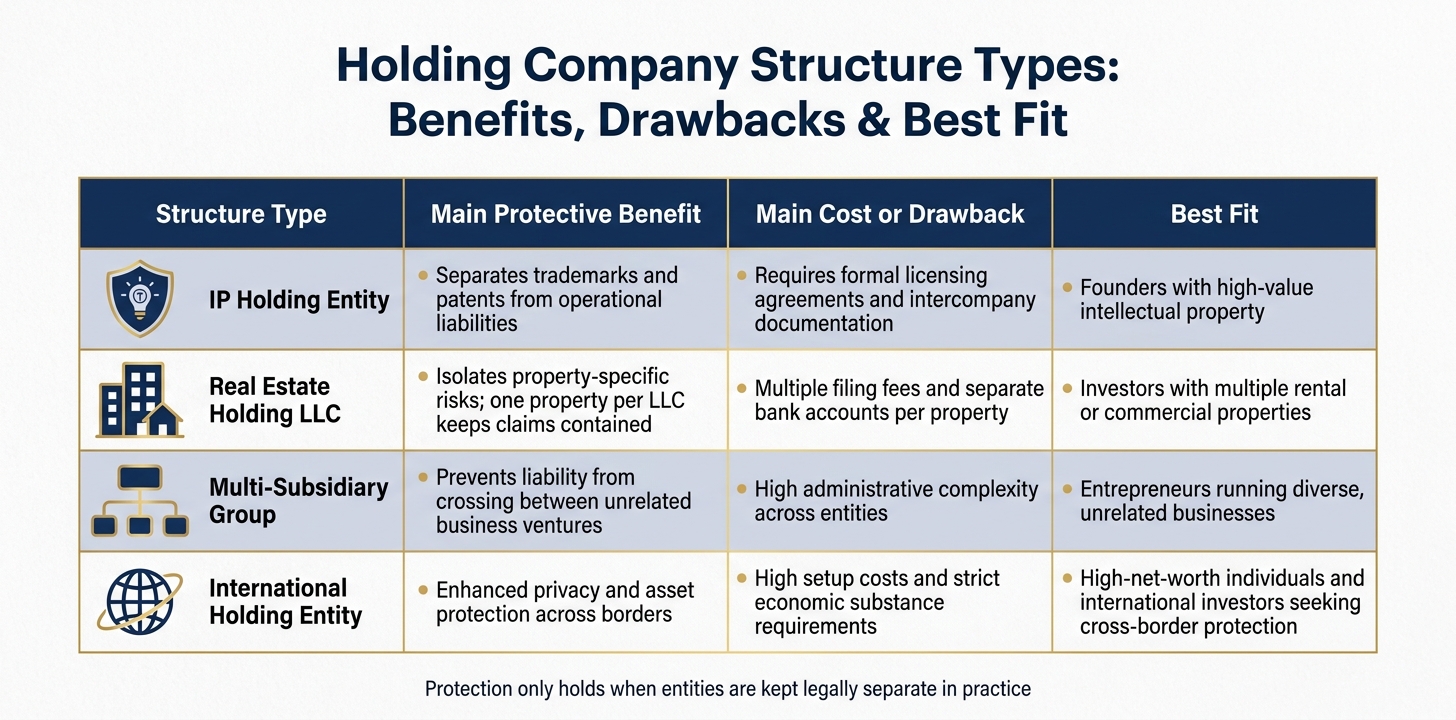
Comparison table: structure types, benefits, tradeoffs, and best fit
The table below shows the main tradeoffs.
| Structure Type | Main Protective Benefit | Main Cost or Drawback | Best Fit |
|---|---|---|---|
| IP Holding Entity | Separates trademarks and patents from operational liabilities | Requires formal licensing agreements and intercompany documentation | Founders with high-value intellectual property |
| Real Estate Holding LLC | Isolates property-specific risks from the rest of the portfolio using one property per LLC so a claim stays isolated in that property’s entity | Multiple filing fees and separate bank accounts per property | Investors with multiple rental or commercial properties |
| Multi-Subsidiary Group | Prevents liability from crossing between unrelated business ventures | High administrative complexity across entities | Entrepreneurs running diverse, unrelated businesses |
| International Holding Entity | Enhanced privacy and asset protection across borders | High setup costs and strict economic substance requirements | High-net-worth individuals and international investors seeking cross-border asset protection |
Conclusion: How to decide whether a holding company fits your risk-management plan
A holding company tends to work best when you set it up on purpose, as part of a risk-management plan, not as a last-minute fix after trouble starts. So the main question is pretty direct: does your business risk justify splitting things up?
Key takeaways for business owners
Start with an asset and liability audit. You need a clear list of what the business owns, what it owes, and where the main pressure points are. That review helps you see where your exposure sits and whether a holding structure would do much to reduce it.
If the goal is to keep high-value assets away from day-to-day operating risk, this setup may make sense. The same idea applies if you own more than one business. Using separate subsidiaries can help keep trouble in one company from spilling into the others.
That said, the structure only works if you treat it like a real business arrangement. Separate bank accounts, written agreements, clean records, and required approvals all matter. If the companies blur together on paper or in practice, the setup can start to fall apart.
Timing matters too. Before moving any assets, get legal and tax advice. Transfers made too late can be challenged as fraudulent.
When used early and maintained with care, a holding company can reduce exposure without adding more complexity than the business needs.
FAQs
Do I need a holding company for a single business?
It comes down to what you’re trying to do.
A single business can often run just fine as a simple LLC. But a holding company can make sense if you want to keep key assets – like intellectual property, real estate, or shares – separate from day-to-day business activity.
That split can help protect those assets from business debts, lawsuits, or creditor claims. If your business owns several assets or has different areas of risk, that extra layer of protection may help. The trade-off is that it also brings more complexity and more formal requirements.
Can a holding company own both real estate and intellectual property?
Yes. A holding company can own both real estate and intellectual property.
That setup is often used to keep those assets separate from an operating company’s day-to-day risks. If the operating business gets hit with a lawsuit or a creditor claim, assets owned by the parent company are generally better protected.
When should I set up a holding company?
Set up a holding company before any legal trouble, disputes, or lawsuits show up. If you move assets after a claim appears, a court may treat that move as a fraudulent conveyance. And that can weaken the very protection you were trying to put in place.
This structure makes the most sense when you want to centralize ownership, separate liability, protect assets like intellectual property or real estate, and support tax planning as part of a broader plan.