
If you want asset protection to work, I’d keep it simple: split risk across separate LLCs, place ownership above them with a trust or holding company, and only add offshore layers when they solve a clear problem.
Here’s the short version:
- I’d map each asset and each lawsuit risk first
- I’d keep business assets, rentals, cash, and IP in separate buckets
- I’d use LLCs for liability isolation
- I’d use a trust or holding company to keep ownership out of my personal name
- I’d add more than one jurisdiction only for bank risk, creditor pressure, or country risk
- I’d move assets before trouble starts, because bankruptcy law can reach back 10 years in some cases under 11 U.S.C. § 548(e)
- I’d keep separate books, bank accounts, records, and filings for every layer
In other words: one LLC is often not enough if you own a business, rentals, investments, or foreign accounts. A better setup gives each part of your wealth one job, one owner, and one paper trail.
A few numbers matter here. The article notes that a holding layer often starts to make sense at around $1 million to $3 million for U.S.-only setups, and around $5 million+ when offshore planning enters the picture. It also points out that missed filings for foreign trusts and accounts can lead to IRS and FinCEN penalties that were easy to avoid.
My takeaway: I’d build the structure early, fund it the right way, and keep it documented year after year.
| Layer | What I’d use it for | Main issue it helps address |
|---|---|---|
| LLCs | Business, rentals, equipment, high-risk assets | Lawsuits tied to one asset or business |
| Holding company or trust | Ownership above LLCs | Personal claims and creditor collection |
| Multi-jurisdiction setup | Banking and custody spread across places | Bank closures, country risk, judgment pressure |
If I had to say it in one line, it would be this: separate liability, separate ownership, separate custody.
Start with a risk map before forming any entities
Before you set up any entity, map your assets, who owns them, and where claims could come from.
List your assets, owners, and liability sources
Write down each asset category first: operating company shares, rental properties, brokerage accounts, cash reserves, intellectual property, vehicles, and foreign assets. Then add the legal owner next to each one. If one person owns everything directly, that means you have one exposed owner.
After that, map the liability sources. In most cases, these include professional liability, personal guarantees, business disputes, employee issues, vendor conflicts, tenant claims, divorce, and political or banking risk. Then match each risk to a layer.
Match each risk to the right layer
This is where the map starts to do its job. Different risks call for different layers.
| Risk Type | Recommended Layer | Primary Tool |
|---|---|---|
| Business lawsuits | Entity separation | Separate LLC or holding company |
| Tenant claims | Asset isolation | LLC with charging order protection |
| Personal guarantees | Fiduciary governance | Irrevocable trust (domestic or offshore) |
| Divorce or alimony claims | Jurisdictional leverage | offshore asset protection trust |
| Banking or political risk | Custody diversification | Multi-jurisdictional banking |
| Privacy risk | Ownership separation | Manager-managed LLC or trust |
Once you map the risks, the next move is to place each asset inside the right legal wrapper.
For example, if you own rental properties, each property should sit in its own LLC, ideally in a state such as Wyoming or Nevada that uses charging order protection. Put intellectual property in a separate holding entity. Spread liquid reserves across more than one bank and more than one jurisdiction.
In plain English: use the map to decide what belongs in a separate LLC, what should sit in a holding entity, and what should be owned through a trust. That sets up the core structure of the plan: separate LLCs, holding entities, and ownership separation.
sbb-itb-39d39a6
Build the core structure with LLCs, holding entities, and ownership separation
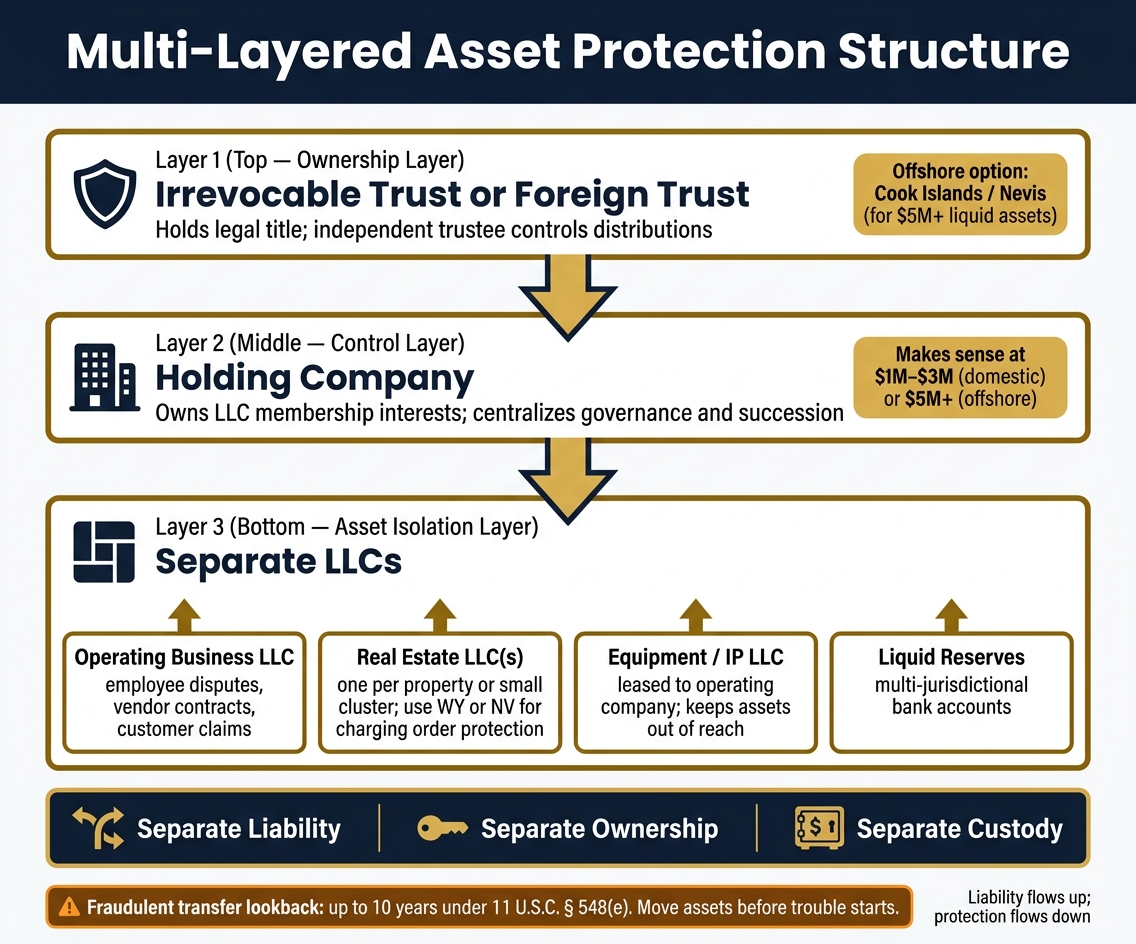
Start with the risk map and give each asset one legal wrapper. The goal is simple: keep operating risk away from ownership, so one claim doesn’t put everything on the table. Once that base is set, the next step is jurisdiction, custody, and compliance.
Use separate LLCs for operating businesses, real estate, and high-risk assets
Your operating business usually carries the most day-to-day liability. Think employee disputes, vendor contracts, and customer claims. That business should sit in its own LLC, apart from your passive wealth.
Real estate should follow the same logic. Each rental property, or a small cluster of lower-value properties, should generally go into its own LLC.
Equipment, vehicles, and aircraft need extra care. A common move is to place equipment in a separate entity, then lease it to the operating company. If the business gets sued, a creditor has a harder time reaching that equipment because the operating company doesn’t own it.
The mistake that often wrecks this setup is commingling funds. Pay personal bills from a business account, skip corporate minutes, registers, or contracts, or blur entity lines in any other way, and a court may ignore the LLC and treat you as personally liable. Strict bookkeeping and separate books aren’t optional.
Place a holding company or trust above selected LLCs
A holding company sits above individual LLCs and owns their membership interests. That gives you one place for governance, makes succession easier, and helps keep a creditor chasing one subsidiary from easily reaching the others.
Above that, an irrevocable trust can own the holding company itself. This separates your beneficial interest from legal ownership.
In practice, the founder often stays on as manager of the underlying LLCs and keeps day-to-day control. An independent trustee holds legal title and controls distributions under the trust terms. So you can still run the business day to day, while legal ownership stays out of your personal name. That’s the whole point of this vertical layer in the entity stack.
A holding layer usually starts to make economic sense when assets exceed $1 million to $3 million for domestic structures, or $5 million or more for offshore structures.
Series LLCs, holding companies, and layered structures compared
Each structure draws a different liability line. Some isolate one asset from another. Others separate ownership from control. Here’s how the main options compare.
| Structure | Primary Purpose | Liability Boundary | Best For | Common Weakness |
|---|---|---|---|---|
| Individual LLC | Asset isolation | Asset-to-asset separation: protects other assets from this asset’s risks | Single rental properties, specific business units | Administrative burden of multiple filings and tax returns |
| Holding Company | Centralized control | Ownership separation: protects subsidiaries from each other’s risks | Managing multiple LLCs or business subsidiaries | If "alter ego" status is proven, a court can ignore the LLC and treat you as personally liable |
| Series LLC | Internal segmentation | Creates "cells" with separate liability within one filing | Same-state, low-value asset clusters | Internal liability walls vary by state |
| Layered (Trust + Holding) | Maximum defense | Separates beneficial interest from legal ownership | High-net-worth individuals with $5M+ in liquid assets | High setup and maintenance costs; complex compliance |
The Series LLC deserves a closer look. It can be a lower-cost way to segment multiple assets inside one filing, which cuts down on the paperwork of running many separate LLCs. But there’s a catch: those internal liability walls have not been tested the same way across state courts. If you own property in more than one jurisdiction, separate LLCs are often the safer call.
Entity structure only works when ownership, management, and bookkeeping stay separate.
"The structures that work best are built during periods of stability, not crisis." – Vicky Katsarova, Founder & CEO, High Net Worth Immigration
Add jurisdictional diversification, offshore layers, and compliance controls
Once the domestic structure is stable, add international layers only when they solve a clear banking, creditor, or political risk. Geographic separation can reduce concentration risk. But it only works if the setup is lawful, well documented, and fully reported.
Separate operations, ownership, and custody across jurisdictions
A good cross-border structure splits three functions across different places.
- Operations stay in a domestic LLC, which helps isolate active business risk.
- Ownership moves to a foreign trust or holding company in a jurisdiction that may not readily enforce foreign judgments.
- Custody of liquid assets sits at a separate financial institution in another jurisdiction, away from the operating account.
For example, a U.S. owner can keep operations in a domestic LLC, place ownership in a foreign trust or holding company, and hold liquid reserves at a separate financial institution in another jurisdiction.
It also helps to keep a central compliance file. That file should show your identity, tax residence, source of wealth, and entity ownership chain. When a bank runs due diligence, that paper trail can keep the structure from looking suspicious.
From there, the next step is picking the offshore wrapper that fits the job each layer needs to do.
When to use trusts, offshore companies, or private foundations
Use the offshore tool that fits the risk. Trusts are often used for creditor resistance, offshore companies for intermediate ownership, and private foundations for civil-law planning or structured projects.
An offshore trust in the Cook Islands or Nevis can make sense if you live in a state like California, New York, or Texas, where domestic asset protection trusts may offer limited protection. Properly structured offshore trusts are designed to make creditor recovery difficult under local law.
An offshore company such as an IBC or PIC can work well as an intermediate holding company. It can hold liquid investment portfolios, intellectual property, or shares in subsidiary companies. In plain English, it sits between the trust and the U.S. operating entity and adds a jurisdictional buffer.
A private foundation is often a better fit for clients in civil-law jurisdictions that do not recognize trusts. It can also work for specific projects like DAOs and token launches that need a legal entity for fiat ramps and contracts.
U.S. persons must report foreign trust transfers and foreign accounts on the required IRS and FinCEN forms. Miss those filings, and you can trigger penalties that were easy to avoid.
Domestic, offshore, and mixed-jurisdiction structures compared
The right structure comes down to a tradeoff: how much protection you want versus how much reporting you can handle.
| Structure Type | Main Purpose | Risk Addressed | Reporting Burden | Typical Use Case |
|---|---|---|---|---|
| Domestic-Only (DAPT) | Probate avoidance and local liability | Basic lawsuits, local creditors | Low (standard U.S. tax filings) | Primary residence, small local business, or moderate domestic assets |
| Offshore-Only | Strong creditor protection | U.S. court override, high-stakes litigation, political risk | High (FBAR, Form 3520, Form 8938) | High-value liquid assets and international exposure |
| Mixed-Jurisdiction | Balance of control and protection | Country-level risk, interstate recognition gaps, estate tax | High (Form 5472, FBAR, coordinated filings) | Cross-border businesses or globally held assets |
A mixed structure is not automatically the better choice. It usually costs more to set up and maintain. It also needs professional coordination across jurisdictions and brings more reporting duties. The best option is the one that fits the actual risk profile, not the one that looks most advanced on paper.
Fund, document, and maintain the structure over time
Once operations, ownership, and custody are split across jurisdictions, the setup only works if each layer is funded and documented in its own name. After you pick the structure, execution matters more than formation. Paper entities do not protect assets.
Transfer assets into the right layer and document ownership and authority
Every asset needs to be retitled into the correct entity. If that step gets skipped, the whole setup starts to fall apart.
U.S. real estate should be deeded into its LLC, with the LLC interests then titled to a trust or holding company. Public securities can sit in a brokerage account titled to a trust or offshore company. Operating business shares should be issued to the holding company. Crypto holdings should be backed by custody records linked to the entity. Put each asset in the right entity. If assets stay in your personal name, the structure does not do its job.
| Asset Type | Recommended Holding Vehicle | Titling Method |
|---|---|---|
| U.S. Real Estate | Local LLC | Title deed to LLC; LLC interests to Trust |
| Public Securities | Brokerage Account | Title account to Trust or Offshore Co |
| Operating Business | Corporation/LLC | Assign shares or membership interests to the holding entity. |
| Crypto Assets | Cold Storage/Private Wallet | Custody records linked to the entity |
| Liquid Reserves | Multi-jurisdictional Bank | Open accounts in the trust’s or foundation’s name. |
Timing matters. Move assets while you’re solvent. Transfers made after a dispute starts can be challenged as fraudulent.
Each entity also needs to stand on its own. That means its own bank account, its own records, and its own expenses. Never pay personal bills with entity funds.
Meet U.S. reporting and governance requirements
After funding comes maintenance. Reporting, governance, and annual review are what make the structure hold up over time.
Funding alone is not enough. Each layer also brings its own U.S. reporting and governance duties. Track required filings by entity and account, including Form 709, FBAR, Forms 3520 and 3520-A, and Form 8938.
State and entity-level filings need to stay current too, along with the records that show the structure is real and separate. Miss filings or let governance records go stale, and you weaken the setup.
A simple way to stay on top of this is to keep one compliance file with:
- identification documents
- tax residency certificates
- a source-of-wealth summary
- a current ownership chart for every entity
Review that file every year and after any big change, like a business sale, a move to a new state or country, a new entity, or a change in trustee.
Final checklist: keep the structure simple, compliant, and tailored
With funding and filings in place, the last step is keeping the structure simple and current. A good structure does not need to be complicated. It needs to be accurate, current, and defensible.
Start with the risk map. Isolate assets by liability profile. Separate ownership from control where that makes sense. Add jurisdictional layers only when they solve a specific, documented risk. Then keep everything maintained the same way, year after year.
FAQs
How many LLCs do I need?
There’s no fixed “right” number of LLCs. It depends on your risk profile and the mix of assets you own.
The main goal is simple: separate liabilities so trouble with one asset doesn’t put the rest at risk.
Each LLC should have a clear job. For example, you might use one LLC to hold a single property, split operating activity from passive assets, or isolate a certain type of risk.
At the same time, more entities can mean more cost, more paperwork, and more moving parts. So the aim isn’t to create as many LLCs as possible. It’s to use them with a clear reason behind each one.
When does an offshore layer make sense?
An offshore layer makes the most sense when you need strong, long-term asset protection against serious legal or creditor threats. It can be a good fit if you face high litigation risk, hold assets outside the United States, or have family members living abroad.
This kind of setup works best when it’s put in place before any claim shows up. Timing matters. Once trouble is on the horizon, your options can shrink fast.
There’s also a trade-off. Offshore structures come with higher costs, more moving parts, filing duties such as FBAR and FATCA, and foreign trustees who act on their own rather than under your direct control. Because of that, they’re usually a better match for people whose level of risk is high enough to justify the extra work and expense.
Can I keep control without personally owning assets?
Yes. You can stay in charge without holding assets in your own name by separating ownership from control.
Here’s the basic idea: a trust can hold the assets as the legal owner, while a company owned by the trust handles management. That setup can help protect those assets from personal lawsuits or creditor claims, while you still keep day-to-day decision-making power.
