
If I had to give the short answer first: offshore trusts are usually harder for creditors to break, while domestic trusts are easier and cheaper to live with.
If you’re comparing the two, I’d focus on six things:
- Legal strength
- Creditor difficulty
- How much control you keep
- Startup cost
- Yearly upkeep
- Tax and filing work
Here’s the simple takeaway:
- A domestic asset protection trust (DAPT) in states like Nevada or South Dakota can work well for many U.S. owners and families.
- An offshore asset protection trust (OAPT) in places like the Cook Islands or Nevis usually gives a higher wall against creditors.
- But offshore planning also means more cost, less direct control, and more IRS and foreign-account filings.
A few facts stand out right away:
- Domestic trusts often cost about $1,000 to $5,000 per year to maintain.
- Offshore trusts can run $5,000 to $20,000+ per year, with setup often starting much higher.
- U.S. bankruptcy law can review some domestic trust transfers for up to 10 years.
- In places like the Cook Islands or Nevis, creditors may need to re-file the case locally, meet a very high proof standard, and in some cases post a $100,000 bond.
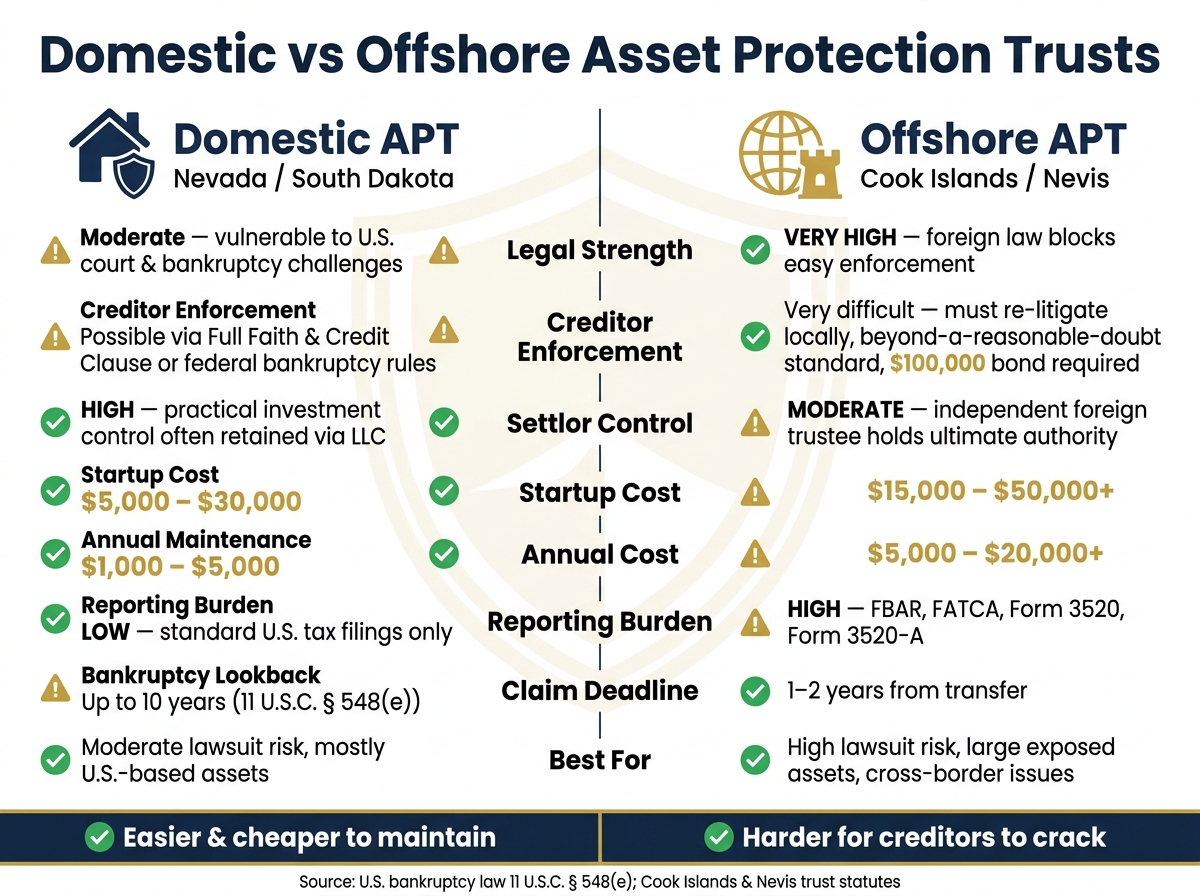
Quick Comparison
| Trust type | Main upside | Main downside | Best fit |
|---|---|---|---|
| Domestic APT | Lower cost, simpler U.S. setup, more day-to-day control | Still inside the U.S. court system | People with moderate lawsuit risk and mostly U.S.-based assets |
| Offshore APT | Harder for creditors to enforce against | Higher cost, more filings, less direct control | People with high lawsuit risk, big exposed assets, or cross-border issues |
Properly structuring offshore trusts is critical to maintaining this protection while managing the associated costs.
So if you want the plain-English version, it’s this: domestic trusts are often enough for lower-risk cases, but offshore trusts usually hit harder when asset protection strength is the top goal. The tradeoff is that you pay more and give up more control to get that extra wall.
sbb-itb-39d39a6
Domestic asset protection trusts: strengths and weak points
A domestic asset protection trust keeps assets inside the U.S. legal system. That usually makes it simpler and less costly to run than an offshore trust. The catch is pretty plain: the level of protection only goes as far as U.S. law allows.
For U.S. citizens and residents, that also means skipping the heavier offshore reporting burden. Annual upkeep usually falls between $1,000 and $5,000. So yes, domestic trusts are practical. They’re just not bulletproof.
Nevada and South Dakota as leading domestic trust jurisdictions
When people compare domestic trust states, the big issues are creditor resistance, privacy, and how long the trust can last.
| Feature | Nevada | South Dakota |
|---|---|---|
| Statute of Limitations | 2 years | 2 years |
| Exception Creditors | None | Child support only |
| Privacy | Judicial discretion to seal records | Automatic, perpetual sealing of court records |
| Trust Duration | 365 years | Perpetual |
| State Income Tax | None | None |
Nevada stands out because it has no exception creditors. That means claims such as alimony and child support are handled like other creditor claims. South Dakota has the stronger privacy rule: court records in trust litigation are automatically and permanently sealed, instead of being left to a judge’s call. Both states use a two-year statute of limitations.
The biggest weak point is built into the system itself. U.S. bankruptcy law can still reach DAPT transfers. Under 11 U.S.C. § 548(e), a court can look back 10 years for transfers made to hinder, delay, or defraud creditors.
Protection can also slip if a DAPT owns real estate outright in a non-DAPT state. Why? Because courts often apply the law of the state where the property sits, not the law of the trust’s home state. In one case, a Nevada trust that held California real estate lost its shield when California law was applied.
A common fix is pretty simple in concept: hold the real estate through an LLC formed in the DAPT state, then have the trust own the LLC interest rather than the property directly.
How much control the settlor can keep
Directed trusts and trust protectors can help keep investment decisions flexible. But there’s a hard line here. The settlor cannot keep unilateral control over distributions or principal. If that happens, courts may treat the trust assets as open to creditors.
That limit is often where offshore trusts start to look stronger.
Offshore asset protection trusts: why they are often seen as stronger
Offshore trusts are often viewed as stronger for one simple reason: a U.S. judgment does not automatically control what a foreign court does.
With a domestic trust, assets stay inside the U.S. legal system. With an offshore trust, those assets sit outside that system unless a court in the foreign jurisdiction agrees to help enforce the judgment. That gap can matter a lot, but only when a creditor actually moves from winning a case to trying to collect.
Cook Islands and Nevis: how they block enforcement
Cook Islands and Nevis do not automatically recognize U.S. judgments. So a creditor usually has to start over and relitigate the case in the local court. On top of that, creditor claims usually must be filed within 1 to 2 years of the transfer.
The bar is high. Creditors must prove fraudulent intent beyond a reasonable doubt, and they generally must post a $100,000 litigation bond before moving forward.
| Feature | Cook Islands | Nevis |
|---|---|---|
| Foreign judgment recognition | None; must relitigate locally | None; must relitigate locally |
| Claim deadline | 1–2 years from transfer | 1–2 years from transfer |
| Burden of proof | Beyond a reasonable doubt | Beyond a reasonable doubt |
| Required creditor bond | $100,000 | $100,000 |
| Trustee requirement | Independent foreign trustee | Independent foreign trustee |
| Typical setup fee | $15,000–$50,000+ | $8,000–$20,000 |
Nevis can add one more barrier through its LLC charging order rules. If a trust holds assets through a Nevis LLC, a creditor’s charging order against that interest expires after three years and cannot be renewed. In the U.S., charging orders can stick around with no set end point.
Of course, stronger protection isn’t free. You give up some control, pay more, and take on more reporting.
What you give up with an offshore trust
The upside is stronger protection. The downside is that the trade-offs are very real.
Cook Islands trust setup fees often land between $15,000 and $50,000+, with annual administration and compliance costs of $10,000 to $30,000. Nevis is usually cheaper, with setup costs of $8,000 to $20,000.
Control is also tighter than many people expect. An independent foreign trustee controls distributions, and the settlor cannot simply ask for the assets back. Most offshore trusts also use duress or flee clauses. If a court starts applying pressure, those clauses shift control to the foreign trustee. A U.S. court can still order repatriation, and if the court thinks the settlor kept hidden control, refusal can lead to civil contempt.
Then there’s compliance. Offshore strength does not erase tax and reporting duties. These trusts are usually treated as grantor trusts for federal tax purposes, which means the income is still taxable to the settlor. Settlors also must file Form 3520, Form 3520-A, FBAR (FinCEN 114), and FATCA Form 8938 each year. Miss those filings, and the penalties can be steep.
Those trade-offs are what the direct comparison below measures.
Domestic vs offshore: a direct comparison on strength, control, cost, and compliance
Here’s the plain-English version: domestic APTs are easier to live with, while offshore APTs are harder for creditors to crack.
| Feature | Domestic APT (Nevada/South Dakota) | Offshore APT (Cook Islands/Nevis) |
|---|---|---|
| Legal strength | Moderate; vulnerable to U.S. court and bankruptcy challenges | Very high; foreign law blocks easy enforcement |
| Creditor enforcement difficulty | Possible via the Full Faith and Credit Clause or federal bankruptcy rules | Very difficult; creditors must re-litigate locally and face a beyond-a-reasonable-doubt standard |
| Settlor control | High; the settlor can often keep practical investment control through an underlying LLC | Moderate; an independent foreign trustee generally holds ultimate authority |
| Startup cost | $5,000–$30,000 | $15,000–$50,000+ |
| Annual maintenance | $1,000–$5,000 | $5,000–$20,000+ |
| Reporting burden | Low; standard U.S. tax filings and any required Corporate Transparency Act filings | High; FBAR, FATCA, Form 3520, and Form 3520-A |
| Jurisdiction risk | Federal and interstate judicial hostility toward DAPT states | Political or regulatory change in the foreign jurisdiction |
Which structure holds up better against creditors and court orders
The chart lays out the tradeoff. What matters next is how that tradeoff shows up when a creditor gets serious.
U.S. courts can order domestic trustees to act. Offshore trustees are outside direct U.S. reach, which makes collection much tougher in practice.
That’s one of the weak spots with domestic trusts. They can run into interstate recognition fights, where a creditor with a judgment from California or New York argues that local law should control instead of Nevada or South Dakota law. In In re Huber, a Washington resident’s Alaska DAPT was ignored in bankruptcy because the settlor had no meaningful tie to Alaska.
Offshore trusts put up a much taller wall. A creditor usually has to start over in the foreign jurisdiction, which adds cost, delay, and a lot of friction. In the Cook Islands and Nevis, fraudulent intent must be proven beyond a reasonable doubt. In Nevis, a creditor may also need to post a $100,000 litigation bond before filing.
But there’s a catch: offshore strength depends on giving up some control. FTC v. Affordable Media is the warning sign here. The settlors kept the power to remove the trustee, and the court threw out their impossibility defense after finding they had kept backdoor control. That left them open to contempt.
Which structure is easier to maintain year after year
This is where domestic trusts usually feel less heavy.
A domestic trust is simpler to run. The trustee is in the U.S., the banking setup is more familiar, and annual costs tend to stay lower. Offshore trusts ask for more moving parts: foreign trustees, foreign accounts, and a full U.S. reporting stack that includes FBAR, FATCA, Form 3520, and Form 3520-A.
That paperwork is not something to shrug off. Failing to file Form 3520 can lead to penalties starting at 35% of the gross value of assets transferred to the trust. So while offshore trusts can offer more resistance, the admin burden and filing risk can eat into that edge fast if the structure isn’t handled cleanly.
For most people, this turns into a balancing act between enforcement resistance on one side and control, cost, and simplicity on the other.
Which trust fits your risk profile and goals
Matching the right trust to your situation
After weighing strength, cost, control, and compliance, the next step is simple: pick the structure that fits your level of risk.
Start with your litigation risk and the assets that could be exposed. If your liquid assets at risk are fairly modest and your liability profile looks like standard professional liability, a Nevada or South Dakota DAPT will often give you enough protection without the added cost and complexity. If your exposure is much larger, your debts cross borders or include personal guarantees, or you work in a high-liability field, an offshore trust in the Cook Islands or Nevis is usually the stronger play.
That changes fast when your exposure goes up, personal guarantees enter the picture, or your profession carries more liability. The case for offshore planning is also stronger if you live in a non-DAPT state like California or New York, where local courts may narrow the protection of an out-of-state trust.
Families with international assets or non-U.S. beneficiaries may also do better with offshore structures, since those structures can protect assets across more than one legal system.
Some families split the job between two layers. A domestic LLC handles the day-to-day management, while an offshore trust owns the LLC interest.
Key points to review before funding either structure
No matter which structure you choose, two things tend to decide whether it holds up under pressure: timing and control.
Fund the trust before any claim exists. If you move assets after a lawsuit is filed, or once a claim can be seen coming, those transfers can be treated as fraudulent and reversed.
Beyond timing, four practical checkpoints apply to both structures:
- Stay solvent after funding; if a transfer leaves you unable to pay your debts, you make a fraudulent-transfer claim much easier to bring.
- Give up real control; if you keep power over distributions, trustee decisions, or protector rights, the protection gets weaker.
- Match the jurisdiction to the assets; property located in a non-DAPT state may still fall under local law.
- Budget for compliance from day one; offshore trusts come with heavy reporting duties and steep penalties if filings are missed, with Form 3520 penalties starting at 35% of the gross value of assets transferred.
FAQs
When is a domestic trust enough?
A domestic asset protection trust (DAPT) is often enough if most of your wealth is liquid, like cash, marketable securities, or LLC interests, and the assets you’re trying to protect are usually in the $1 million to $3 million range or less.
This setup tends to work well for people with moderate liability exposure who want a lower-cost option, simpler administration, and the comfort of staying inside the U.S. legal and banking system. It can be a good fit in DAPT-friendly states such as South Dakota or Nevada, especially when the trust is funded well before any creditor claim is on the horizon.
What assets should not go into the trust directly?
Don’t place assets in the trust if they aren’t legally based in the jurisdiction that provides the protection. With domestic trusts, for example, real estate in a state that doesn’t recognize trust protection may still be exposed to claims through that state’s courts.
It’s also smart to avoid moving assets into the trust when active or threatened litigation is already in play. Courts may view those transfers as fraudulent and undo them.
Can I lose protection if I keep too much control?
Yes. Keep too much control, and the trust can lose its asset-protection value.
For example, trouble can start if you can:
- dissolve the trust on your own
- take back the principal
- force distributions
- use any kind of "backdoor" control
If that happens, a court may see the trust as your alter ego or even a sham.
A common way to lower that risk is pretty simple: use an independent professional trustee. And if you need someone to hold certain oversight powers, appoint a neutral Trust Protector instead of keeping those powers in your own hands.
