
If I had to boil it down to one line: trusts usually fit privacy and asset-shield goals, while foundations usually fit control and civil-law use.
Here’s the short answer before you read anything else:
- Choose a trust if I want more privacy, flexible distributions, and a structure often used for creditor planning.
- Choose a foundation if I want a separate legal entity, board-style governance, and fewer issues in many civil-law countries.
- Watch U.S. tax rules carefully. A foreign trust can trigger Forms 3520 and 3520-A. A foreign foundation may trigger CFC, PFIC, Form 5471, FBAR, FATCA, and related rules.
- Control can hurt protection. If a settlor or founder keeps too much power, a court may attack the structure.
- Timing matters. Transfers made after trouble starts are easier to challenge than transfers made years earlier.
- Cost matters too. Trust setup often falls around $6,500 to $26,000, while foundations often cost more due to filing and governance steps.
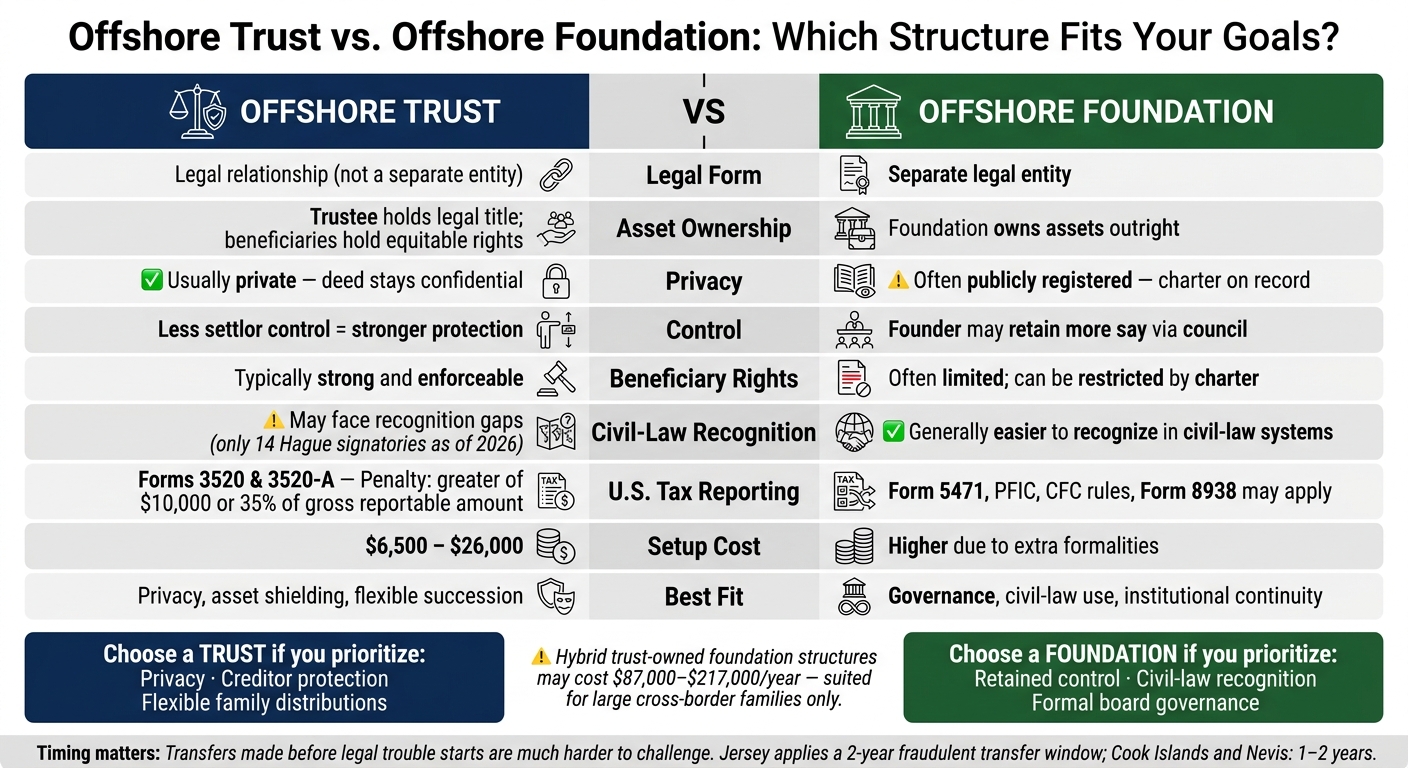
Quick Comparison
| Point | Offshore Trust | Offshore Foundation |
|---|---|---|
| Legal form | Legal relationship | Separate legal entity |
| Who holds assets | Trustee holds title | Foundation owns assets |
| Privacy | Often more private | Often public registration |
| Control | Less settlor control is usually safer | Founder may keep more say |
| Beneficiary rights | Often stronger | Often more limited |
| Civil-law fit | May face recognition issues | Often easier to use |
| U.S. reporting | Forms 3520/3520-A often apply | Form 5471, PFIC, CFC rules may apply |
| Best fit | Privacy, succession, asset shielding | Governance, continuity, cross-border entity use |
Bottom line: if you want privacy and flexible family planning, I’d lean trust. If you want formal governance and a structure that acts like its own person, I’d lean foundation.
That tradeoff is what this comparison of offshore trusts and foundations is about.
sbb-itb-39d39a6
How offshore trusts work
An offshore trust is a fiduciary relationship, not a separate legal entity. The trust deed sets the rules: how assets are managed, when distributions can happen, and what limits the trustee must follow.
Legal ownership, beneficial ownership, and trustee duties
The trustee holds legal title. The beneficiaries hold the beneficial interest, which means the right to benefit from the trust. That split is the core of how a trust works as an asset-protection tool. Once assets are transferred to the trustee, they become harder for the settlor’s personal creditors to reach. And the less control the settlor keeps, the harder it is to claim those assets still belong to the settlor.
Trustees have fiduciary duties. In plain English, they must act in the best interests of the beneficiaries and follow the trust deed. In a discretionary trust, the trustee has real say over when distributions happen and how much gets paid. That’s why many settlors appoint a protector: a third party who can veto certain trustee decisions or remove and replace the trustee if needed.
There’s a major risk here. If a settlor keeps too much control – by directing investments, keeping a power to revoke the trust, or treating the trust property like personal property – a court can decide the trust is a sham or a bare trust. A bare trust is one with little or no real trustee discretion. If that happens, the asset-protection shield can fall apart.
Beneficiary rights and how asset protection works in practice
The strength of the protection often turns on beneficiary rights. In a fixed trust, each beneficiary has a defined share of assets or income, and that right is legally enforceable. In a discretionary trust, beneficiaries have no guaranteed right to receive anything. The trustee decides who gets what, and when.
That difference matters most when a creditor tries to reach a beneficiary’s interest. In a divorce or bankruptcy, a discretionary trust usually gives creditors much less to grab because the beneficiary does not hold a fixed entitlement.
The whole setup also depends on a valid transfer. Once assets leave the settlor’s ownership, they become harder for personal creditors to reach. Timing matters too – maybe more than people expect. A trust funded long before any legal fight starts is much harder to attack than one funded after a lawsuit is filed. In some jurisdictions, the deadline for fraudulent-transfer claims can be as short as one to two years from the date of transfer.
Foundations aim for many of the same results, but they use a different legal form and a different governance setup.
How offshore foundations work
A foundation is a separate legal entity. It can hold property, enter into contracts, and sue or be sued in its own name. That move away from a fiduciary relationship to a stand-alone entity changes the way control, succession, and creditor exposure play out.
Legal personality, founder influence, and governance
Because the foundation is its own legal person, the setup will feel familiar if you’ve worked with companies before. The founder creates the foundation, moves assets into it, and sets the rules through two main documents: a charter, which is often filed publicly, and private bylaws or regulations, which usually stay confidential and cover details like beneficiary names and distribution rules.
Day-to-day management sits with the council, which works much like a board of directors. In many offshore jurisdictions, the founder can sit on the council and keep certain powers, such as changing bylaws or appointing council members. A supervisor can add another layer of oversight and help make sure the council follows the foundation’s purpose and charter. For families that want a more structured governance setup, that can be a big draw compared with leaving more room for trustee judgment.
Because it is a separate legal entity, a foundation can keep going after the founder’s death or incapacity. Foundations also tend to fit more naturally in civil-law systems, where trusts can run into recognition gaps.
Beneficiaries, purposes, and succession planning uses
Foundations can support named individuals, a class of descendants, or a stated purpose. That gives them a clear role in long-term family wealth planning. Since the foundation exists apart from the founder or any one council member, the private bylaws can lay out how wealth moves across generations, which family members can receive distributions, and the conditions attached to those distributions.
For multigenerational family wealth, the main upside is continuity. The main tradeoff is that beneficiaries usually have fewer direct rights. The council’s duties are owed to the foundation itself, not straight to the beneficiaries. That can be either helpful or frustrating, depending on what you want the structure to do, and it’s one of the biggest differences to weigh when comparing foundations with trusts.
These points shape the ownership, control, privacy, and succession differences discussed next.
Key differences: ownership, control, privacy, tax, and compliance
The biggest gaps between an offshore trust and an offshore foundation come down to ownership, control, privacy, tax, and succession.
At a high level, a trust is a legal relationship. A foundation is a separate entity. That one difference shapes almost everything else: who owns the assets, who makes decisions, what beneficiaries can demand, and how tax agencies may view the structure.
Side-by-side comparison table
| Feature | Offshore Trust | Offshore Foundation |
|---|---|---|
| Legal personality | No; it is a fiduciary relationship, not a separate legal person | Yes; it is a separate legal entity |
| Asset ownership | Split: trustee holds legal title, beneficiaries have equitable rights | The foundation owns assets outright |
| Control mechanisms | Trustee, with optional protector or reserved powers | Council or board; the founder can often serve as a member |
| Governance duty | Trustee owes fiduciary duty to beneficiaries | Council follows the charter and bylaws |
| Beneficiary rights | Typically strong, enforceable equitable rights and access to information | Often limited; rights can be restricted or removed in the charter |
| Public disclosure | Usually private; foundation registration is public | Registered with a public authority; existence and charter are public record |
| Creditor protection | Relies on separation of legal and beneficial ownership | Relies on the entity’s separate legal personality |
| U.S. tax treatment | Often a grantor or non-grantor trust; foreign non-grantor trusts can trigger throwback rules | Often treated as a foreign corporation; CFC rules may apply |
| IRS reporting | Form 3520 and Form 3520-A | Form 5471 if treated as a CFC; Form 8938 may also apply |
| Estate planning fit | Flexible, multi-generational distributions | Strong for continuity and institutional governance |
| Civil-law recognition | Can face recognition gaps in some civil-law jurisdictions | Generally easier to understand and recognize in civil-law settings |
In plain English: trusts are usually more private, while foundations are more visible on paper because they are often publicly registered. That said, beneficiary details may still stay confidential.
For U.S.-connected families, both can come with serious filing duties. Miss a Form 3520 or Form 3520-A for a foreign trust, and the penalty can be the greater of $10,000 or 35% of the gross reportable amount.
Common drawbacks and where each structure can fail
Neither structure is bulletproof. And when they fail, they tend to fail in familiar ways.
One of the biggest problems is retained control. If the settlor in a trust, or the founder in a foundation, keeps too much power, that can support sham arguments or trigger bad tax results. With a trust, that can weaken the very shield the structure was supposed to provide. With a foundation, too much founder influence over the council can create the same kind of problem.
Timing matters too. If assets are moved after a creditor claim has already surfaced, or when litigation is clearly on the horizon, the transfer may face fraudulent conveyance attacks. Jersey applies a two-year limitation period for most of those claims. Cook Islands and Nevis are also known for short windows, often one to two years.
Then there’s the quieter risk: jurisdiction mismatch. A common-law trust may look fine in theory, but if you place civil-law real estate into that trust and the local legal system does not fully recognize the trust concept, the whole setup can become shaky. The Hague Convention on the Law Applicable to Trusts has only 14 signatory states as of 2026, which leaves real recognition gaps in major civil-law jurisdictions like Germany and France.
That is where a foundation can have an edge. Because it has separate legal personality, it may be easier for courts, registries, and local counterparties in those markets to deal with. By contrast, a trust deed or foundation charter with vague reserved powers or loose governance terms gives courts and creditors more room to argue that the founder or settlor never gave up control in any meaningful way.
These tradeoffs feed straight into the decision framework that follows.
Which structure fits your goals: a decision framework with jurisdiction and cost factors
Matching structure to your goals
Start with the goal. That usually makes the choice much easier.
If your top priority is creditor resistance, a trust in a place like the Cook Islands or Nevis is often the better route. If you want to keep more say over how things are managed, a foundation often fits better because its governance can allow broader reserved powers.
For family wealth that needs to move across generations, a discretionary trust is usually the stronger pick. But for an operating business or real estate, a foundation is often simpler to run, especially in civil-law countries where trusts may not be recognized as well.
Put simply: foundations lean toward retained control, while trusts lean toward beneficiary protection.
Privacy matters too. Trusts are often more private because the deed stays private. Foundations are often more visible because they are registered publicly.
How jurisdiction and cost factors affect the decision
After the goal is clear, jurisdiction and cost often settle the issue.
Trust-friendly jurisdictions include Jersey, the Cayman Islands, the Cook Islands, and Singapore. Foundation-friendly jurisdictions include Liechtenstein, Panama, and the UAE’s DIFC and ADGM.
If a large share of your assets is in a civil-law country that does not recognize trusts well, a foundation can reduce recognition risk.
Cost can also shift the answer. A trust usually costs $6,500 to $26,000 to set up, depending on complexity. Foundations usually cost more to set up and maintain because of extra formalities. Hybrid trust-owned foundation structures can cost $87,000 to $217,000 per year and tend to make sense only for large cross-border families.
Conclusion: choosing the right structure
A trust is generally the stronger choice when your goals are asset protection, privacy, and flexible succession. A foundation tends to fit better when founder influence, civil-law recognition, and institutional governance continuity matter more.
The final call also turns on your asset mix, where your family members live, and how the structure will be treated under U.S. tax rules. The best fit is the one that lines up with your assets, your family’s footprint, and your tax profile.
FAQs
Which is better for my goals: a trust or a foundation?
It depends on where you live, how much control you want to keep, and what you want your asset plan to do.
A trust often works well for people who want privacy, strong asset protection, and a structure backed by a long track record in the courts. The trade-off is control: in many cases, you’ll need to hand that over to a trustee.
A foundation may be a better fit if you want a more formal governance setup and an entity that can hold assets or enter into contracts more easily.
Either way, professional advice matters. Tax reporting rules and local legal requirements can change a lot from one jurisdiction to another.
Can I keep control without weakening asset protection?
Yes, but too much control can make the setup look like a sham and weaken its asset protection.
With a trust, you hand legal ownership to a trustee. Even so, you may still keep some influence through a protector or through reserved powers.
With a foundation, sitting on the council can be part of proper governance rather than a sign of ownership. That tends to hold up better when independent members are involved and the formal steps are followed.
How do I choose the right offshore jurisdiction?
Choose based on your legal, tax, and governance goals. There’s no one-size-fits-all answer.
If most of your assets sit in civil-law countries, a foundation may be a better fit because it’s a recognized legal entity. In common-law systems like the United States or United Kingdom, trusts are often the go-to option because the legal precedent is well established.
You’ll also want to weigh a few practical trade-offs: control versus protection, tax reporting for U.S. persons, and the jurisdiction’s reputation, stability, transparency standards, and local expertise.
