
A private interest foundation can help you hold assets, skip probate, and set family rules across countries – but it can also create tax and filing problems, especially for U.S. persons.
If I had to boil the article down, here’s the short answer:
- A private interest foundation is a separate legal entity that owns assets in its own name.
- No person owns it. Once assets go in, the foundation holds legal title.
- People use it for succession planning, privacy, asset separation, and cross-border family holdings.
- It often fits better than a trust in many civil law countries because it is easier for local systems to recognize.
- It is not a simple fix. U.S. tax treatment may trigger Form 3520, 3520-A, or 5471, and penalties can start at $10,000 or reach 35% of the reportable amount.
- In Panama, setup often runs about $1,500 to $3,500 in the first year, with $1,000 to $2,000 a year after that.
So when would I use one?
I’d look at a private interest foundation if I needed one structure to hold business shares, real estate, or investment assets in more than one country, and I wanted those assets handled under private rules after death instead of probate.
I would not treat it as an automatic fit if:
- assets are simple and all in one country
- the estate plan is straightforward
- I’m a U.S. person without cross-border tax advice
- I want day-to-day personal control that is too close to direct ownership
Bottom line: this structure can work well for some families and founders, but only if the control rules, timing of transfers, country laws, and tax classification all line up.
| Quick point | What it means |
|---|---|
| Main use | Hold and pass assets under private rules |
| Ownership | The foundation owns the assets |
| Main upside | Probate avoidance, privacy, and cross-border succession |
| Main risk | Bad tax treatment or too much founder control |
| Best fit | Families or entrepreneurs with multi-country assets |
| Common jurisdiction | Panama |
Here’s the short version of the full article in plain English: a private interest foundation sits somewhere between a trust and a company. It can be a strong estate and holding tool, but it only works when the legal setup is clean and the tax side is checked first.
What is a private interest foundation and how does it work?
A private interest foundation is a separate legal person. That means it can own assets, sign contracts, and appear in court in its own name.
It is not a trust or a company. Instead, it stands on its own as a legal entity used to hold and manage assets under a set of written rules. That distinction matters. Once the foundation is set up, control moves away from direct personal ownership and into the documents that govern the foundation.
The founder creates the foundation by transferring assets into it and putting two governing documents in place: the charter and the confidential bylaws. The charter is public. The confidential bylaws stay private and spell out the beneficiaries, distribution instructions, and the specific assets held by the foundation. In plain English, those two documents decide who runs the foundation and how money or assets get distributed.
Why having no owner matters
Because the foundation owns the assets, those assets are generally outside the founder’s personal estate and do not pass through probate. The foundation also keeps going after the founder’s death.
That can make a big difference. Instead of assets moving person to person through an estate process, they stay with the foundation and are handled under the rules already written into its documents.
How governance works in practice
Once the documents are in place, the council handles the foundation’s affairs according to those rules. In Panama, the council must usually have at least three individuals or one legal entity. Council members owe duties to the foundation itself, not to individual beneficiaries, unless the charter says otherwise.
The founder can still keep some specific powers if the charter allows it. For example, the founder may keep the right to amend the confidential bylaws, direct investment decisions, or remove council members.
Many foundations also name a protector. This role is optional, but common. A protector can oversee the council and may have the power to veto decisions or remove members.
Put together, this setup separates ownership from control in a very direct way.
sbb-itb-39d39a6
Private interest foundation vs. trust vs. company: key differences
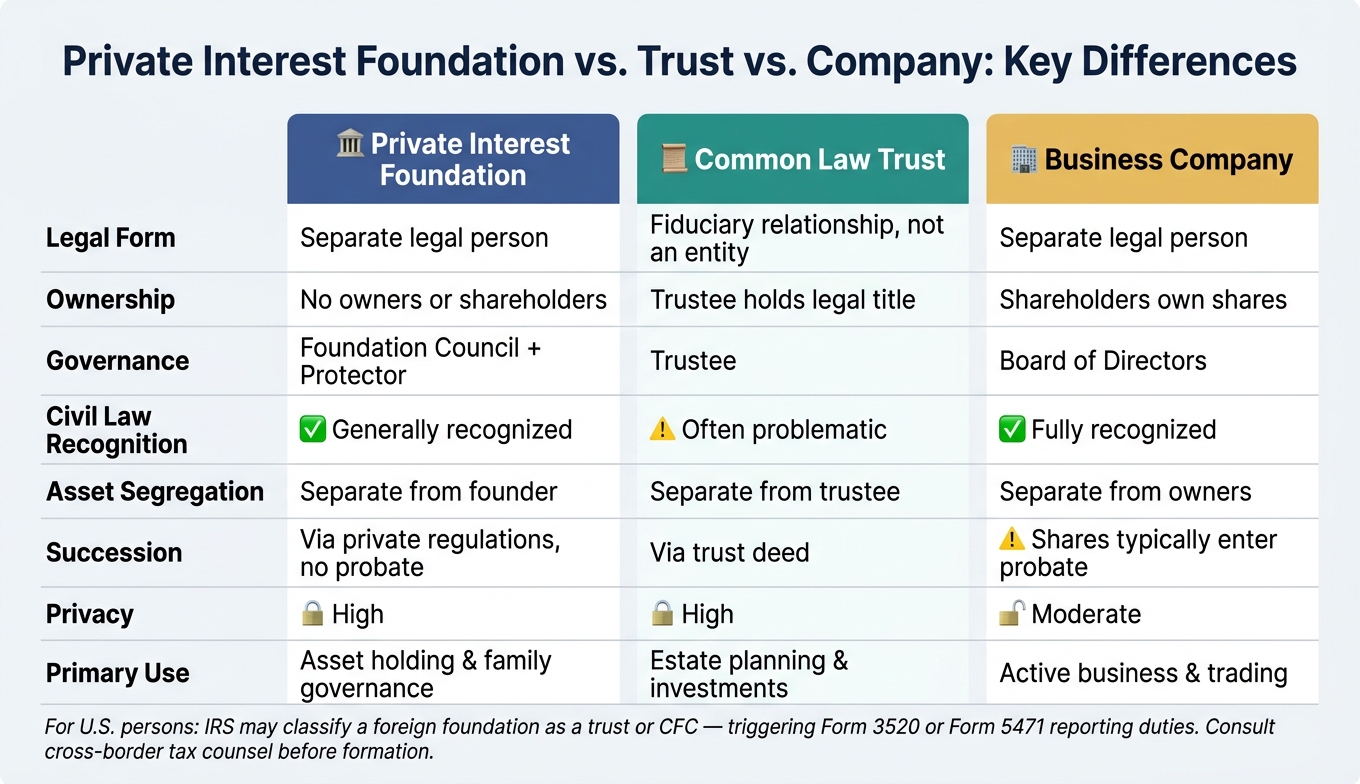
Those governance differences matter most when you look at ownership, succession, and cross-border recognition.
These structures do different jobs under the law. A trust is a fiduciary relationship, not a legal entity. A company is a legal entity owned by shareholders. A private interest foundation is a legal person with no shareholders or members.
That one point changes a lot. Because no one owns the foundation, there are no shares to go through probate. The assets belong to the foundation itself, not to the founder or the beneficiaries. With a company, shares sit in someone’s name and usually become part of that person’s estate. A foundation works differently, so the assets do not move through a personal shareholding chain.
When a foundation may be the better choice
A trust can be a good fit when your assets and heirs are mostly in common law countries like the US or the UK. But things can get messy when assets or beneficiaries are in civil law countries such as Mexico, France, Germany, or much of Latin America. In those places, trusts can run into recognition and administration problems.
A foundation avoids that problem because it is a separate legal person. Civil law jurisdictions generally recognize it more easily, much like they would a company. That can make day-to-day matters simpler, including opening bank accounts, holding real estate, and documenting ownership across borders.
A foundation can also make sense as a family holding structure. It can hold shares in operating companies or holding entities and keep those assets under one set of rules. When the founder dies, the foundation keeps going under its existing rules. The assets then pass to beneficiaries based on the private regulations, without probate applying to the foundation’s holdings. Side by side, the differences are pretty clear.
Comparison table: legal form, control, privacy, and succession
| Feature | Private Interest Foundation | Common Law Trust | Business Company |
|---|---|---|---|
| Legal Form | Separate legal person | Fiduciary relationship, not an entity | Separate legal person |
| Ownership | No owners or shareholders | Trustee holds legal title | Shareholders own shares |
| Governance | Foundation Council + Protector | Trustee | Board of Directors |
| Civil Law Recognition | Generally recognized | Often problematic or unrecognized | Fully recognized |
| Asset Segregation | Assets held separately from the founder’s personal assets | Trust assets separate from trustee | Corporate assets separate from owners |
| Succession | Direct transfer via private regulations | Distribution via trust deed | Shares typically enter probate |
| Privacy | High | High | Moderate |
| Primary Use | Asset holding and family governance | Estate planning and investments | Active business and trading |
For U.S. persons, the legal form is only one part of the picture. Tax classification can change the outcome in a big way. The IRS may treat a foreign foundation as a trust or a CFC, depending on the founder’s retained powers, and that can trigger reporting duties such as Form 3520 or Form 5471. That classification affects reporting, so it should be reviewed with cross-border tax counsel before formation. You can also schedule a private consultation to discuss your specific asset protection needs.
When should you use a private interest foundation?
Use a private interest foundation when you need one structure to hold assets, keep family control in place, and handle succession across borders. After you understand how a foundation differs from a trust or company, the next step is simple: does your case justify the extra moving parts?
Common use cases for entrepreneurs, investors, and families
One common case is a founder who owns operating businesses or real estate in civil-law jurisdictions like France, Spain, or many Latin American countries. In those places, trusts often aren’t commonly recognized and can run into legal friction. A foundation can fit better as a holding vehicle because it owns assets directly.
Succession planning is a big reason people use this structure, but it’s not the only one. A foundation can hold family company shares across generations and distribute assets under private rules instead of probate. Those private rules can also stagger distributions over time, which gives families more control over when and how assets pass.
It can also create a line between assets and personal ownership. That separation may help limit exposure to personal claims. In plain English, if someone is dealing with lawsuits, divorce proceedings, or business disputes, that separation can matter a lot.
Another use case comes up in places with forced-heirship rules. Some countries require certain relatives to receive fixed shares of an estate. If a foundation is set up and funded well before death, those assets may no longer sit inside the personal estate, which can reduce the effect of those rules.
Cases where a simpler structure may be enough
Sometimes, a private interest foundation is more than you need. If the assets are modest and domestic, the family transfer plan is simple, or the U.S. reporting burden would outweigh the upside, a simpler structure is often enough.
Cost is part of that equation. For Panama foundations, first-year setup costs usually range from $1,500 to $3,500, and annual maintenance often falls between $1,000 and $2,000. For U.S. persons, the tax compliance layer can be heavy too. The IRS may classify the structure in a way that triggers Form 3520 or 3520-A filing duties, and failure-to-file penalties can reach $10,000 or 35% of the gross reportable amount.
Risks, tax issues, and jurisdiction points to review before setting one up
A private interest foundation works well only when its setup, timing, and tax treatment match your goals and the places involved. The same traits that make a foundation useful for succession and privacy can also turn into weak spots if control is too tight or the tax treatment is off.
At this stage, the big issue is no longer how the structure is different. It’s where it can break down.
What can go wrong with a poorly designed foundation
Founder over-control is one of the most common trouble spots. If you keep too much direct control, a court may ignore the foundation and treat the assets as still belonging to you. That can gut the whole point of the structure. A protector can help reduce too much control sitting in one person’s hands.
Timing is another major risk. If assets are moved after a liability already exists, creditors may argue that the transfer was made to dodge claims. In Panama, creditors usually have a 3-year window to challenge asset transfers to a foundation. That protection matters only if the assets were transferred well before any dispute started.
Vague bylaws or unclear distribution rules can cause a different kind of mess. If the internal document that governs distributions is fuzzy, family conflict becomes much more likely, and the founder’s wishes can be hard to carry out. On paper, everything may look fine. In practice, one unclear clause can spark years of arguments.
U.S. tax treatment depends on control and substance, not just the name of the structure. A foundation isn’t judged by its label alone. If it’s classified the wrong way, that can lead to different filing duties and tax exposure.
Privacy is real, but it has limits. Beneficiaries don’t show up in public registries, but the foundation still has to follow KYC, AML, CRS, and FATCA rules. Put simply, this is a planning tool, not a secrecy tool.
These trade-offs usually fall into five areas:
- control
- timing
- privacy
- succession
- tax
Advantages and limitations table for decision-making
| Category | Strengths | Limitations |
|---|---|---|
| Asset Protection | Works best when funded early; statutory shield limits creditor windows | Vulnerable to late-transfer challenges |
| Succession | Avoids probate; assets transfer per private rules | Local inheritance rules may still apply to certain assets |
| Privacy | Beneficiaries stay private, but reporting still applies | Must comply with bank and tax reporting requirements |
| Governance | Flexible structure tailored to complex family needs | Depends heavily on the quality and integrity of the Council and Protector |
| Taxation | Can be tax-efficient on foreign-source income in the jurisdiction of formation | U.S. persons may face complex reporting rules and potential tax exposure |
| Compliance | Clear legal framework in mature jurisdictions like Panama | Increasing global transparency requirements demand ongoing reporting |
Conclusion: Key decision points to review with counsel
Before using a private interest foundation, test control, asset location, beneficiary residency, and tax classification with qualified counsel. The structure makes sense only when its control, compliance, and jurisdiction profile fit the assets and the people involved.
FAQs
Can I still control a private interest foundation after funding it?
Yes. A private interest foundation is a separate legal entity. But that doesn’t mean you have to give up all say over how it works.
If the foundation’s governing documents allow it, you can still keep a meaningful level of influence. For example, you may appoint yourself to the foundation council. You could also serve as a protector with approval or veto powers.
That setup can give you a say in key decisions while the foundation remains legally separate. It can also be written in a way that carries out your long-term wishes after your lifetime.
How do I know if a foundation is better than a trust for my situation?
It depends on your goals, jurisdiction, and how much control you want to keep.
A foundation is a separate legal entity. That often makes it easier to understand in civil law jurisdictions. It can also be simpler when the structure needs to own assets, open bank accounts, and enter into contracts.
A trust may be a better fit if you want a common law structure with well-established case law. It can also give you more room when setting up beneficiary classes.
Because both options come with tax, compliance, and reporting duties, consult professional advisors.
What tax filings could a U.S. person face with a foreign foundation?
For a U.S. person, the tax filings you need depend on how the IRS views the foreign private interest foundation. The IRS looks at substance over form, which means it focuses on how the foundation works in practice, not just what it’s called on paper.
That matters because the IRS may treat the foundation as either:
- a corporation
- a trust
If it’s treated as a corporation, CFC reporting may apply, along with possible Subpart F or GILTI issues.
If it’s treated as a trust, the rules shift to grantor trust or non-grantor trust reporting.
On top of that, U.S. taxpayers still have to report worldwide income and assets. So even if the classification feels like a technical detail, it can change which forms you file and how the income gets taxed.
