
If I want to shield real estate, I need to act before any claim shows up. In most cases, that means I use the right title setup, keep rentals in LLCs, use state home protections like homestead or tenancy by the entirety where allowed, carry enough liability insurance, and avoid sloppy moves like mixing personal and property funds.
Here’s the short answer:
- My home and my rentals should not be held the same way
- An LLC can help contain rental-property claims
- A homestead exemption may protect part or all of my home equity
- Tenancy by the entirety may help married couples in some states
- Umbrella coverage often needs to be in the $5,000,000 to $10,000,000 range for owners with multiple properties
- Many landlord policies stop at $500,000 to $1,000,000 in liability coverage
- A lien from a court judgment can block a sale or refinance until it gets paid
- Last-minute transfers can be reversed as fraudulent transfers
The big idea is simple: title, insurance, and clean entity records do more than panic moves after a lawsuit starts. A land trust may hide my name from public records, but it does not stop liability by itself. And if I own several rentals, keeping each one in its own LLC may stop one bad claim from putting the whole group at risk.
Quick comparison
| Tool | Main job | Best fit | Main limit |
|---|---|---|---|
| LLC | Separate rental risk from personal assets | Rentals, commercial property | Can fail if I mix funds or sign in my own name |
| Homestead exemption | Protect home equity under state law | Primary residence | Does not stop mortgages, taxes, or many federal claims |
| Tenancy by the entirety | Block creditors of one spouse in some cases | Married couples in certain states | Does not help with joint debts |
| Umbrella insurance | Add liability coverage above base policies | All property types | May not cover LLC-owned rentals unless listed the right way |
| Land trust | Privacy on title records | Home or rental privacy | Privacy only; no liability shield |
| Equity stripping | Cut exposed equity with a valid lien | High-equity investment property | Can be attacked if done late or with fake insider loans |
If I’m serious about asset protection, I build the setup early, follow state law, and get legal advice before moving title or adding trust layers.
sbb-itb-39d39a6
Choose the right ownership structure for each property
Your ownership setup should fit the risk tied to each property.
If you hold a property in your personal name, all of your assets sit in one bucket. That means a judgment from one dispute can put equity in your other properties at risk. A home, a rental, and a business property should not all be treated the same way.
Hold rentals and investment properties in LLCs
An LLC puts a legal wall between the property and your personal assets. If a tenant sues, the claim will usually stop with the LLC’s assets instead of reaching into your personal finances.
If you own more than one rental, the big decision is simple: group properties together or split them apart.
Putting several rentals in one LLC costs less and keeps admin work lighter. But it also puts those properties into the same risk pool. One major lawsuit can threaten every property inside that entity. The cleaner move is often one LLC per property. That way, trouble at one address stays at that address.
Some states offer stronger charging-order protection, which can limit a creditor to distributions.
The setup only works if you treat the LLC like a separate business:
- Rent should go into the LLC’s bank account
- Repairs should be paid from that same account
- Leases should be signed in the LLC’s name, not your own
Privacy and liability are two different issues.
Use land trusts and proper titling for privacy and control
A land trust hides title, not liability. So if your goal is privacy, a land trust can help. If your goal is liability protection, you still need an LLC.
For example, if a rental sits in a land trust and you are the beneficiary, a creditor who gets a judgment can still reach your beneficial interest. In plain English: the trust may hide your name from public title records, but it does not stop the claim.
For a primary residence, titling depends on your state and marital status. Individual ownership is simple, but it offers no protection beyond statutory exemptions. In states that recognize tenancy by the entirety, married couples may be able to keep a creditor of one spouse from reaching the home.
Offshore structures sit at the far end of the risk spectrum.
When advanced owners consider offshore holding structures
Use offshore trusts only after domestic layers are in place. Owners with large amounts of exposed equity may place an offshore trust above U.S. entities to split legal ownership from control and add another barrier against aggressive creditors.
These setups are not cheap. They often cost $20,000 to $50,000+ to establish, and they usually come with annual administration fees. That means they tend to make sense only when the amount of equity at stake is big enough to justify the cost and added complexity.
Here’s a quick way to match the property type to the structure:
| Property Type | Recommended Structure |
|---|---|
| Primary residence | Homestead exemption or TBE |
| Single rental | Standalone LLC |
| Multi-property portfolio | Separate LLCs, or a Series LLC where allowed |
| Commercial building | Property-holding LLC + management LLC |
| High-equity portfolio | LLCs owned by an irrevocable trust |
Homes usually rely on state-law protection first. Rentals and commercial properties usually need entity protection first.
Apply state-law protections to your home and exposed equity
For a primary residence, state-law protection usually matters more than an entity structure. And as equity grows, the property tends to look more tempting to creditors.
Use homestead exemptions to protect a primary residence
A homestead exemption protects some or all of your home equity from certain judgment creditors. The amount depends heavily on the state. Some states offer unlimited protection, including Florida and Texas. Others limit the exempt equity to only a few thousand dollars.
That said, homestead exemptions have clear limits. They do not stop voluntary liens, like your mortgage, and they do not stop property tax liens. Government claims and most federal debts also sit outside the exemption’s reach. In plain English, this tool mainly helps against unsecured judgment creditors.
The filing rules also change from state to state. In some places, the protection starts on its own once you live in the home. In others, you need to file a formal homestead declaration with your county recorder’s office. If your state requires filing, do it right after you buy the property. Waiting until a claim is on the horizon can make the filing look like a fraudulent transfer.
If you move, the old protection does not come with you. You have to meet the new state’s rules from scratch.
For married owners, title can add one more layer of protection when state law allows it.
Use tenancy by the entirety where available
Tenancy by the entirety, or TBE, is a form of joint ownership limited to married couples in about 25 states. When a home is titled as TBE, the law treats the couple as a single owner. That usually means a creditor of only one spouse cannot place a lien on the property or force a sale.
But TBE is not a magic shield. It does not help if both spouses are liable for the same debt. It also ends if the couple divorces. And the deed has to clearly show TBE titling. Being married by itself is not enough.
Here’s a simple side-by-side look at the main ownership options for a primary residence:
| Protection Tool | Who It Protects | Property Covered | Main Limitations |
|---|---|---|---|
| Homestead Exemption | Homeowner and family | Primary residence only | Caps vary by state; does not block mortgages or tax liens |
| Tenancy by the Entirety | Married couples | Primary residence; in some states, other real estate as well | Only available in ~25 states; does not protect against joint debts |
| Standard Joint Ownership | Any co-owners | Any real estate | Creditors of one owner can often force a sale of that owner’s interest |
If you’re married and live in a TBE state, check the deed itself. The wording needs to clearly state tenancy by the entirety for the protection to apply. A deed that only lists both spouses’ names may not be enough.
After title is set, the next step is reducing what a creditor can recover in the first place.
Add insurance and financial barriers that make recovery harder
Once the title is set, add insurance and financing layers that make a claim harder to collect.
Raise liability limits with umbrella insurance
Most umbrella policies kick in only after you meet the minimum limits on the policies underneath them. In plain English, an umbrella sits on top of your current coverage and pays when the base policy runs out.
For high-net-worth owners with several properties, coverage often starts in the $5,000,000 to $10,000,000 range. Bigger portfolios may need $25,000,000 or more.
There’s a catch, though. Most personal umbrella policies leave out business use and entity-owned rentals. That means you need to make sure each owning LLC or management entity is listed the right way, either as a named insured or an additional insured.
It’s also smart to check the exclusions line by line. Standard landlord and umbrella policies often leave out claims tied to tenant discrimination, wrongful eviction, and habitability issues. If those risks matter for your properties, ask for endorsements that address them.
Reduce exposed equity with lawful equity stripping
Equity stripping means putting a valid senior lien on a property, such as a mortgage or HELOC, to cut down the amount of equity a creditor can reach. The idea is simple: if a property looks less profitable to chase, a plaintiff may think twice about pushing a lawsuit.
For that lien to stand up in court, it should come from an unrelated lender. Courts often toss aside related-party notes and family loans as sham liens, and they may treat them as fraudulent transfers. If you use a HELOC or mortgage in a protection plan, make sure there’s a real business reason behind it, such as paying for repairs or funding new acquisitions.
Timing matters here. If equity stripping happens after a lawsuit is filed, or even after one is threatened, it can be attacked as a fraudulent transfer or voidable transaction. It works best when done early, before any claim shows up.
Which tools fit a residence, rental, or commercial property
No single tool works for every setup. Some are better for liability, some for privacy, and some for making a property less tempting to pursue.
| Tool | Primary Purpose | Approx. Cost | Helps Against | Best Suited For |
|---|---|---|---|---|
| LLC Ownership | Risk isolation | Moderate (setup + annual fees) | Tenant and contractor lawsuits | Rental and commercial property |
| Umbrella Insurance | Excess liability coverage | Low (annual premium) | Catastrophic judgments | All property types |
| Equity Stripping | Reducing reachable equity | High (financing costs) | Judgment creditors | High-equity investment property |
| Land Trust | Privacy only | Low (legal setup) | Adds privacy only; does not protect against claims | Personal residence and rentals |
The right setup depends on the property. A personal residence, a rental, and a commercial building don’t carry the same risks, so the mix of coverage, liens, and entity names should match the job.
Build a protection plan before a claim arises
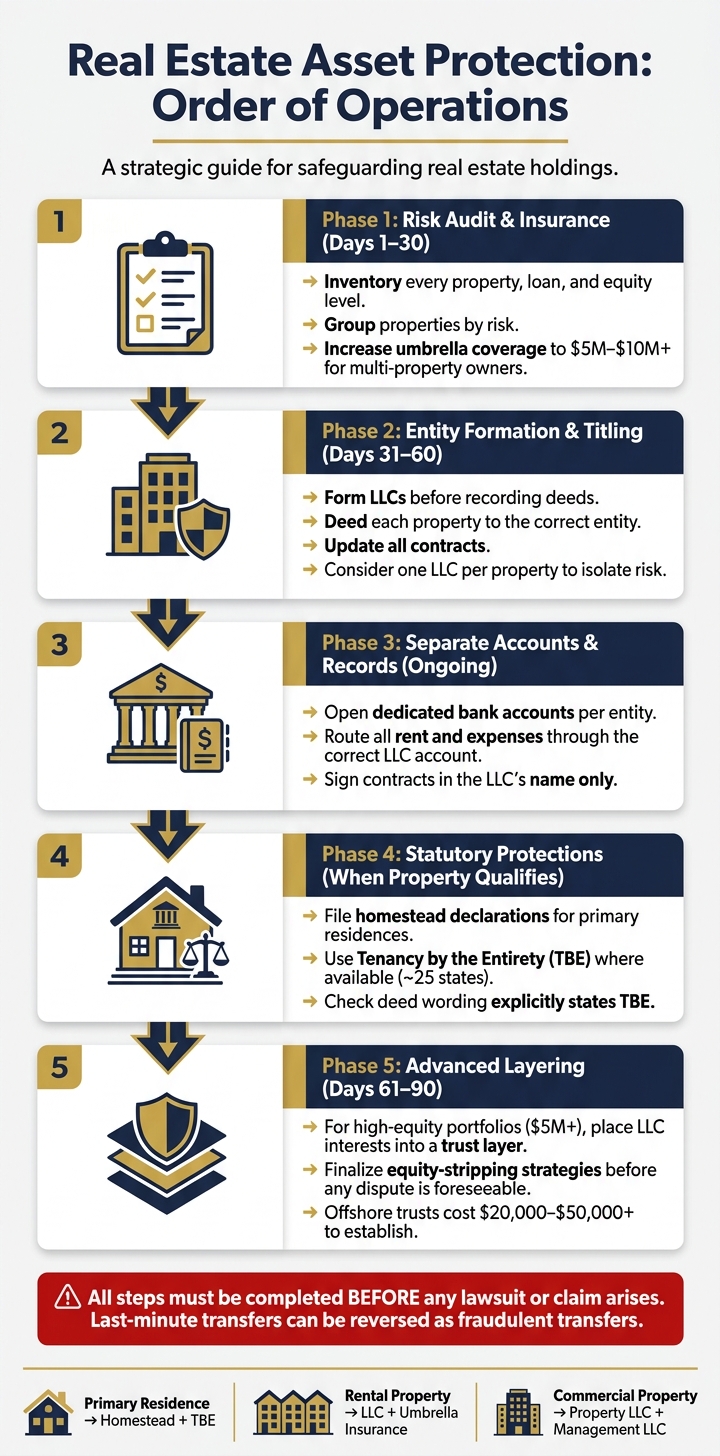
These tools only help before a claim shows up. Once a lawsuit is on file, title and timing decide how much equity a creditor may be able to touch.
After the tools are in place, the next piece is order: title, insurance, entity discipline, then added layers.
That order shifts based on the property. Homes usually begin with statutory protection. Rentals and commercial property usually begin with entities.
A step-by-step order of operations for U.S. property owners
| Phase | Timeline | Key Actions |
|---|---|---|
| Phase 1: Risk audit and insurance | Days 1–30 | Inventory every property, loan, and equity level. Group properties by risk and increase umbrella coverage to cover exposed assets. |
| Phase 2: Entity formation and titling | Days 31–60 | For rentals and commercial property, form the LLC before you record the deed. Form the needed LLCs, deed each property to the right entity, and update contracts. |
| Phase 3: Separate accounts and records | Ongoing | Open dedicated bank accounts for each entity. Keep rent and expenses in the correct accounts. Sign contracts in the LLC’s name with your title. |
| Phase 4: Statutory protections | When the property qualifies | File homestead claims for primary residences and use tenancy by the entirety where your state recognizes it. |
| Phase 5: Advanced layering | Days 61–90 | For high-equity investment property ($5 million+), place LLC interests into a trust layer. Finalize equity-stripping strategies before any dispute is foreseeable. |
State law affects every phase here. Homestead exemption amounts, tenancy by the entirety eligibility, Series LLC recognition, and charging order protection all change from state to state. That’s why a local attorney review matters.
Common mistakes that weaken asset protection
Most plans don’t fall apart on paper. They fall apart because of what owners do after setup.
Mixing personal and entity funds can weaken LLC protection. If you pay a personal bill from a property LLC’s account, or send rent into your personal checking account, you hand a creditor an argument for piercing the corporate veil.
Personal guarantees are another big problem. If you sign one on a loan or vendor contract, you skip right past the entity shield. Moving property after a threat appears is just as risky. Courts can unwind those transfers as fraudulent transfers.
And one more point: land trusts give privacy, not liability protection.
Conclusion: The core rules for shielding real estate
The order matters because a late transfer can be unwound.
No single tool does the whole job. Different property types need different layers. Homes lean on homestead exemptions and spousal title. Rentals and commercial property lean on entity structure and clean account separation. Creditor risk follows exposed equity. LLCs, homestead protection, and spousal title limit reach. Insurance and early financing moves add another barrier. Last-minute transfers don’t.
FAQs
Do I need a separate LLC for each rental?
A separate LLC for each rental is often recommended because it puts each property in its own legal box. If one property gets sued, liability is generally limited to that entity, which can help protect your personal assets and your other rentals.
You can hold multiple properties in one LLC. But there’s a trade-off: one claim may put the entire portfolio at risk. A Series LLC or a parent holding company can give you a similar kind of segmented protection.
Can a creditor take my home if it has a homestead exemption?
A homestead exemption can help shield your primary residence from certain creditors. How much it shields, though, depends on your state’s rules.
In some states, the exemption covers all of your home equity. In others, it covers only a fixed dollar amount.
A few points matter here:
- It usually applies only to your primary residence
- It generally protects against unsecured creditors
- It usually does not protect against secured creditors, such as mortgage lenders
- If your state requires a filing, you need to submit that paperwork for the exemption to apply
Think of it like a state-level safety net. The net may be wide in one state and much smaller in another, so the amount of protection can vary a lot.
When is it too late to move property for protection?
Once a claim is foreseeable or a lawsuit is already pending, it’s often too late. If you move property at that point, a court may treat it as a fraudulent conveyance. That can let a judge reverse the transfer and may also damage your credibility.
Asset protection works best before any near-term threat shows up. If you’re already dealing with one, talk to an attorney right away about the limited options that may still be open.
