
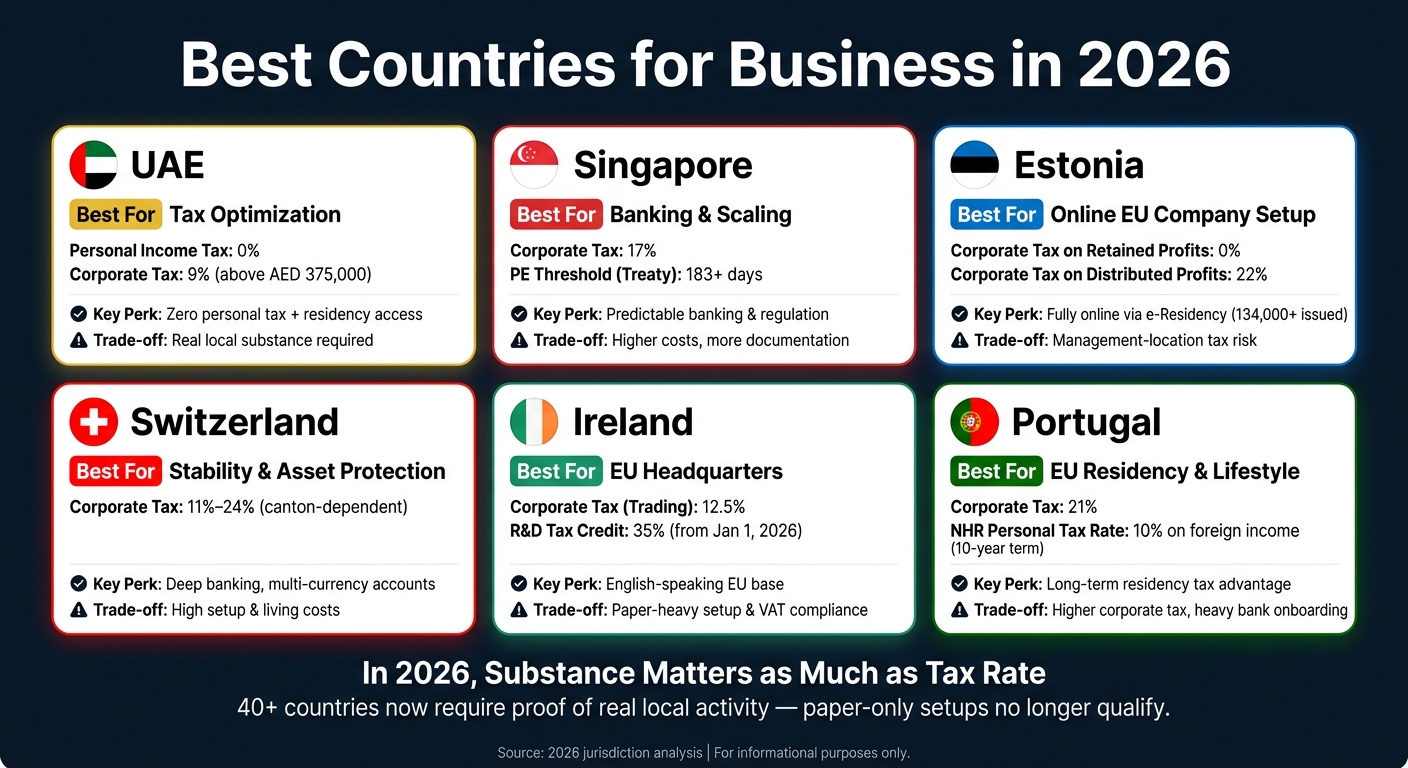
In 2026, the best country for business depends on what you need most: low tax, banking, EU access, digital setup, or a path to live there. I’d put the list this way: UAE for low tax, Singapore for banking and rule clarity, Estonia for online-first EU setup, Switzerland for banking depth and stability, Ireland for an English-speaking EU base, and Portugal for founders who want to live in Europe.
Here’s the short version:
- UAE: low personal tax, but you need an office, local activity, and proof management happens there
- Singapore: 17% corporate tax and steady banking, but more paperwork
- Estonia: 0% on retained profits and 22% on distributed profits, with online formation
- Switzerland: 11%–24% corporate tax by canton, with strong banking and high costs
- Ireland: 12.5% tax on trading income and EU access, plus a 35% R&D credit from January 1, 2026
- Portugal: 21% corporate tax and a residency-led pitch, with 10% tax on some foreign income for 10 years under the NHR setup described in the article
What changed? Substance now matters as much as tax. A low-rate company with no office, no staff, and no local management is much harder to defend. Banks, tax agencies, and company registries now want proof of where the business is run and who controls it.
Quick Comparison
| Country | Best use case | Main tax angle | Main trade-off |
|---|---|---|---|
| UAE | Low-tax setup | 0% personal income tax; 9% corporate tax above AED 375,000 for many cases | You need local substance |
| Singapore | Banking and scale | 17% corporate tax | More checks and higher costs |
| Estonia | Online EU company | 0% retained / 22% distributed profits | Tax risk if management sits elsewhere |
| Switzerland | Banking and stability | 11%–24% by canton | High setup and living costs |
| Ireland | EU team and trade | 12.5% trading income tax | Paper-heavy setup and tax admin |
| Portugal | Living in Europe | 21% corporate tax; 10% foreign-income rate under NHR terms in the article | Less tax upside for the company |
If I were narrowing this down fast, I’d ask four things: Where do you live? Where do you make decisions? Where is revenue earned? Do you need a bank that works well across borders? Those four points rule out bad-fit countries much faster than tax rates alone.
sbb-itb-39d39a6
1. United Arab Emirates
The UAE stands out for tax efficiency and residency access, but there’s a catch: founders need to show real local substance. For founders looking at 2026, the UAE still has strong appeal because its tax system remains competitive, especially for eligible entities.
Tax Environment
Those tax perks now come with stricter local presence rules. Companies need to show that their real place of management is inside the country to qualify for local tax treatment. A virtual office, PO box, or paper-only setup won’t cut it anymore. Founders now need a physical office, proof that management decisions happen locally, and local employees or contractors on the ground.
Company Setup
Free Zone entities are usually the top pick. They’re easier to bank with and easier to defend under 2026 compliance rules than pure offshore structures.
Banking Access
Banking in the UAE is still workable, but banks want more proof than they used to. They now ask for evidence of real business activity, tax residency and reporting proof, and physical presence before approving an account. It’s also smart to keep personal and business accounts separate to lower the risk of account freezes under tighter AML/KYC checks.
Talent and Residency
Founders usually get residency through Free Zone company formation or a remote work visa. For solo founders and consultants, the remote work visa is usually the fastest route. In 2026, tax residency depends more on where a founder actually lives and where the business is run. That means tracking travel days and keeping records of where business decisions happen is no longer optional in practice.
| Feature | Status (2026) |
|---|---|
| Personal Income Tax | 0% |
| Corporate Tax | 0% (eligible entities); 9% on profits over AED 375,000 |
| Residency Pathway | Remote work visa or Free Zone entity |
| Economic Substance | Required: local office, staff, and management activity |
| Banking Ease | Moderate: requires proof of physical presence and activity |
Low tax still matters. So does residency access. But in the UAE, those upsides now depend on whether a founder can back them up with a real setup on the ground. Next is Singapore, which gives up some of the UAE’s low-tax pull in exchange for deeper institutions and a more established regulatory setting.
2. Singapore
Singapore offers less tax upside than the UAE, but it gives founders something many care about just as much: predictability. The banking system is steadier, the rulebook is clearer, and compliance is usually cleaner. Put simply, the UAE leans on low tax and substance, while Singapore stands out for institutional depth and consistency.
Tax Environment
Singapore’s standard corporate tax rate is 17% on profits. One point needs close attention: the management location test. If the company is managed from another country, that country may try to tax the business there instead.
Transfer-pricing rules are also tighter. So if your company does business with related parties, you’ll need proper documentation to support those transactions.
Company Setup
For international founders in 2026, the usual go-to structure is a Singapore private limited company. It offers a cleaner path for compliance and is often easier to bank with than old-school offshore entities.
There is a catch, though. Foreign directors can face stricter identity checks, so it helps to get paperwork ready early. If you wait until the last minute, setup can slow down fast.
Banking Access
Singapore’s big edge is banking predictability. Banks and fintechs still ask for proof of business activity, tax residency, and sometimes physical presence. But the process tends to be more steady and easier to plan for than in many other places.
It also helps to keep beneficial ownership records current and update them at least once a year. That lowers the odds of account issues or sudden disruptions. For founders who live in more than one country or run teams outside their home market, that kind of stability can make day-to-day operations a lot less stressful.
Talent and Residency
Singapore comes with moderate PE risk for cross-border founders. Under a tax treaty, PE liability can be triggered if service activities go past 183 days. Without a treaty, the threshold can drop to 60 days.
Hiring matters too. If you place core revenue staff in Singapore, a support office can start to look more like a strategic base, which pushes PE risk higher.
| Feature | 2026 Status |
|---|---|
| Corporate Tax Rate | 17% |
| PE Risk Level | Low-Medium |
| PE Threshold (Treaty) | 183+ days |
| PE Threshold (No Treaty) | 60+ days |
| Banking Ease | Strong, with proof of activity required |
| Compliance Focus | Management location and transfer pricing |
Singapore fits best for founders who can show real local management activity and keep their compliance records in good order. Estonia, by contrast, takes a more digital and admin-light path.
3. Estonia
Estonia stands out for easy EU company setup and tax deferral on profits you keep in the business.
Tax Environment
Estonia’s corporate tax system works differently from most countries. Companies pay 0% tax on retained profits and 22% on distributed profits. So if the money stays inside the company, there’s no corporate tax at that stage.
For founders in growth mode, that can make a big difference to cash flow. You can put profits back into hiring, product work, or day-to-day operations without facing a yearly corporate tax charge. The 2025 change kept things simple with one 22% rate on distributions.
That said, registering a company in Estonia does not cancel out management-location rules in other countries.
Company Setup
Estonia launched e-Residency in 2014, the first national transnational digital identity program of its kind. It lets non-residents get a digital ID and register an OÜ online. By 2026, the program had issued 134,000+ e-residencies.
Another plus: the minimum share capital rule for private limited companies was removed in 2023, which cut one more hurdle for new founders. With a digital ID, you can file documents, sign forms, and submit tax declarations from anywhere.
There is still one practical catch. You’ll need a local legal address and a contact person. Even so, the setup process stays very simple for non-residents.
Banking Access
Traditional banks and EEA fintechs can both be good options, but remote founders should expect tighter due diligence. If the business is seen as higher risk, checks can get stricter. It helps to sort out your banking plan early instead of treating it as an afterthought.
Talent and Residency
Estonia’s e-Residency is not a visa or residence permit. If you want to live in Estonia, you’ll need a separate immigration path. The country also has digital nomad and remote-work-friendly policies that may let some remote workers stay for a limited period.
Local hiring is strongest in tech and engineering.
| Feature | 2026 Status |
|---|---|
| Corporate Tax on Retained Profits | 0% |
| Corporate Tax on Distributed Profits | 22% |
| Company Type | Private Limited (OÜ) |
| Setup Method | Fully online via e-Residency |
| E-Residents Issued | 134,000+ |
| Banking Options | Traditional banks and EEA fintechs |
| Minimum Share Capital | None (lifted in 2023) |
Estonia makes the most sense for lean, digital businesses that plan to reinvest profits instead of paying them out. Switzerland is the next point of comparison, especially for founders who care more about banking depth and institutional standing than online simplicity.
4. Switzerland
Switzerland is often the first pick for founders who care more about deep banking access, policy stability, and institutional trust than lower costs or a slick online setup.
If Estonia leans digital-first, Switzerland sits at the other end of the spectrum: more expensive, more strict, and much stronger on banking.
Tax Environment
Switzerland uses a canton-based corporate tax system. That means your effective corporate tax rate can land anywhere from 11% to 24%, depending on the canton. For founders, that matters a lot. You can’t look at Switzerland as one flat tax jurisdiction and call it a day.
Tax enforcement is moderate by global standards, which makes it more business-friendly than the "Very Strict" stance seen in Germany and France.
There’s one detail you don’t want to gloss over. Under OECD PE rules, a home office can create taxable presence if an employee works there 50% or more of the time. So if your team is spread out, you need to track workdays and work locations with care .
Banking Access
Swiss banks are known for multi-currency accounts, private banking services, and stability.
But that strength comes with friction. Swiss banks often ask for higher minimum balances for corporate accounts and private banking than places like Singapore. In plain English: the banking is strong, but getting in can cost more and take more paperwork.
And while Switzerland is famous for discretion, this isn’t some cloak-and-dagger setup. The Common Reporting Standard (CRS) is enforced strictly, so tax transparency is the normal rule, not the exception.
Company Setup
Rules and tax rates vary by canton, so you need to compare local requirements, not just federal ones. A founder setting up in Zug may face a different picture than one setting up elsewhere.
Beneficial ownership disclosure is also required under 2026 transparency standards.
Talent and Residency
Canton-level rules shape hiring, office requirements, and tax treatment. That’s another reason Switzerland rewards founders who are willing to get into the weeds before they set things up.
| Feature | 2026 Status |
|---|---|
| Corporate Tax Rate | 11%–24% (canton-dependent) |
| PE Risk Level | Medium |
| Enforcement Strictness | Moderate |
| Banking Strength | High discretion; multi-currency accounts |
| Compliance Standard | Strict CRS enforcement |
| Beneficial Ownership Disclosure | Required |
Switzerland fits founders who want institutional-grade banking and are comfortable working through a canton-dependent tax setup.
Next is Ireland, which moves the comparison away from banking depth and toward a more familiar EU base.
5. Ireland
Ireland changes the discussion a bit. Instead of deep banking strength, it offers a lighter English-speaking base inside the EU. Its main draw is EU market access, English as the working language, and a 12.5% corporate tax rate on trading income. In 2026, the appeal here isn’t secrecy. It’s a clean, rules-based EU setup for trading, hiring, and R&D.
Tax Environment
Ireland taxes trading income at 12.5% and non-trading income at 25%. For R&D-heavy companies, the picture gets better. From Jan. 1, 2026, the 35% R&D credit lowers the after-tax cost in a meaningful way. Budget 2026 also increased the first-year refund threshold to €87,500.
If you’re building in software, life sciences, or any business that leans hard on R&D, this credit can change the numbers in a big way.
Company Setup
Incorporation goes through the Companies Registration Office (CRO) using its online CORE portal. The fee to form an online LTD is €50, and processing usually takes 5–10 working days, based on the filing route. If a foreign founder doesn’t have an EEA-resident director, a bond is required during incorporation.
After the company is registered, Revenue requires a Statement of Particulars within 30 days of first trading. So while setup is fairly direct, there are still a few moving parts from day one.
Banking Access
Banking in Ireland is established, but foreign-owned companies should expect a paper-heavy onboarding process. Banks often ask for:
- beneficial ownership documents
- a business plan
- proof of local substance
Because of that, many founders begin with a fintech or EMI account while they build some operating history. Later, once the company has more substance on the ground, they switch to a full business bank account.
Talent and Residency
For founders who need both hiring and immigration options, Ireland has an English-speaking workforce with strong international business experience, especially in tech, life sciences, and financial services. Dublin has depth, but hiring specialized talent can be tough.
The Critical Skills Employment Permit gives companies a path to hire non-EEA specialists. The permit fee is €1,000, and the eligible occupations list was updated in May 2026 to add roles such as Intellectual Property Professionals and Construction Planner/Scheduler.
For founders who want to live in Ireland, the Start-up Entrepreneur Programme (STEP) is another route. But it isn’t simple. It requires an innovative, internationally traded business idea, a €50,000 funding threshold, and a €350 application fee.
| Feature | 2026 Status |
|---|---|
| Trading Corporate Tax Rate | 12.5% |
| Passive Income Tax Rate | 25% |
| R&D Tax Credit | 35% (from Jan. 1, 2026) |
| Online Incorporation Fee | €50 |
| Incorporation Speed | 5–10 working days |
| STEP Funding Requirement | €50,000 |
| Critical Skills Permit Fee | €1,000 |
Ireland works well for companies that want an EU trading base, especially in tech, SaaS, or life sciences. It’s a weaker fit if your main goal is low overhead, passive income planning, or an easy residency route. Portugal offers a different trade-off, with lower costs and more appeal on the residency side.
6. Portugal
Portugal is mostly a residency play, not a low-tax one. It gives up the UAE’s tax upside and Singapore’s institutional depth in exchange for a more lifestyle-led EU option. So if your main goal is moving to Europe, Portugal makes sense. If your main goal is squeezing corporate tax as low as possible, it’s a harder sell.
Tax Environment
Portugal’s standard corporate tax rate is 21%. That alone tells you a lot: this is not the place people pick for pure entity trimming.
The main draw is the NHR regime, which offers 10% tax on foreign income for 10 years. That changes the math for founders who plan to live there and earn much of their income from abroad. On the PE side, Portugal sits in the low-medium risk range, which makes it a bit safer for remote-run companies than some stricter EU countries. The upside here is personal residency, not company tax cuts.
Company Setup
Portugal now has simpler online incorporation and clearer residency rules for remote founders. That helps, especially if you want a setup process that feels a little less tangled.
Still, there’s a line you can’t ignore: you need real local presence, not just a registered address. In plain English, paper-only setups won’t do much for you if the facts on the ground point somewhere else.
Banking Access
Banking in Portugal can be document-heavy. Banks may also ask for proof that you’re physically present in the country.
In most cases, expect to provide:
- Proof of address
- Source of funds
- Business activity details
- Tax residency documents
- Beneficial ownership information
It’s not unusual, but it can feel like a lot if you’re used to lighter onboarding.
Talent and Residency
For many founders, the NHR regime is the whole reason Portugal makes the list. If you apply early, you can lock in that 10% rate for a full decade. That’s a long runway, and for someone planning to settle in Europe, it matters.
Lisbon gets most of the attention, but it’s not the only option. Braga and Madeira stand out for lower costs and strong remote-work infrastructure. That can make a big difference if you want EU residency without taking on Lisbon-level living costs.
| Feature | 2026 Status |
|---|---|
| Corporate Tax Rate | 21% |
| NHR Personal Tax Rate | 10% on foreign income (10-year term) |
| PE Risk Level | Low-Medium |
| Key Hubs | Lisbon, Braga, Madeira |
| Enforcement Strictness | Moderate |
Portugal fits founders who plan to live in Europe and earn most of their income from foreign sources. It’s less appealing if low corporate tax is the top priority. The trade-off is pretty clear, which makes Portugal one of the easier options to size up.
Pros and cons by jurisdiction
The table below boils the six options down to the trade-offs that matter in practice. Think of it as a quick side-by-side shortlist, not a final decision.
| Country | Best For | Main Advantages | Main Drawbacks | Best Fit |
|---|---|---|---|---|
| UAE | Tax optimization | Zero personal income tax; 9% corporate tax above AED 375,000 | Stricter substance checks; higher operating costs. | Founders who can maintain real local substance |
| Singapore | Scaling and banking | Predictable banking and regulation | More documentation for foreign directors; higher operating costs. | Growth founders who need predictable banking |
| Estonia | EU market entry | E-residency and fully online company management | 22% tax on distributed profits; "place of management" rules can trigger tax liability in your home country | Solo founders and digital-first operators who want EU access without relocating |
| Switzerland | Stability and asset protection | Canton tax rates from 11% to 24%; banking depth and stability; political and financial stability | Very high setup and operating costs; complex canton-level rules | Founders prioritizing stability and asset protection |
| Ireland | EU headquarters | 12.5% corporate tax; English-speaking; access to the EU single market | Strict beneficial ownership disclosure; VAT compliance burden | Founders targeting the EU with a physical team |
| Portugal | Lifestyle and EU residency | 10% NHR rate on foreign income for 10 years; lower-cost hubs like Braga and Madeira | Higher corporate tax; tighter residency rules; heavier bank onboarding. | Founders living in Portugal on foreign income |
Each jurisdiction comes out ahead on a different goal. UAE leans toward tax savings. Singapore stands out for banking and a steady rulebook. Estonia is a clean option for online-first founders who want EU access. Switzerland is about stability, though you pay for it. Ireland fits founders building an EU base with staff on the ground. Portugal makes more sense for people already planning to live there and earn foreign income.
The next move is simple: rank these places by the one thing you care about most – tax, banking, residency, or simplicity.
Conclusion
These six jurisdictions each stand out for different reasons: tax, banking, digital formation, stability, EU access, and residency. In 2026, being business-friendly isn’t just about the headline tax rate. All five factors matter at the same time.
So the right pick is a practical decision, not an abstract one. The best jurisdiction is the one that lines up with how your business actually runs. In plain English, that usually comes down to four things: where management happens, where revenue is earned, whether you plan to hire locally, and what you need from a bank.
In 2026, substance matters just as much as structure. More than 40 countries have updated their business-formation rules to target paper setups without real activity. If the setup on paper doesn’t match what the business is doing day to day, that’s where problems start.
Use the trade-offs from the previous section to narrow your shortlist. Then get jurisdiction-specific legal advice before you commit. Choose the place that fits where management happens, where revenue is earned, and where the business can operate cleanly.
FAQs
How do I choose the right country for my business?
Choose the right country by matching your goals with the place itself. If you care most about lower taxes, asset protection, access to new markets, or a setup that’s simple to run, you need a jurisdiction that lines up with those priorities.
Focus on tax, legal stability, compliance rules, banking access, ease of company formation, support for your business model, and your long-term plans for residency or growth. Cross-border rules can get messy fast, so expert guidance can help you stay compliant in the U.S. and abroad.
What does local substance mean in 2026?
In 2026, local substance means a company needs to show real, active operations in the place where it’s set up if it wants to support its tax position and avoid being seen as a shell company.
In plain English, that usually means the business has an actual presence on the ground. Think office space, local employees or directors, and key management decisions being made there. It also means the company’s income-producing work should happen in that same place.
These rules are getting tighter, largely to match global reporting standards like CRS and FATCA.
Which country is best for both residency and tax efficiency?
The United Arab Emirates is the strongest all-in-one pick, especially if you’re looking at remote work residency options and free zones.
Here’s why it stands out: it offers 0% personal income tax, 0% corporate tax in qualifying free zones, and 9% tax on mainland profits above AED 375,000. On top of that, residency is fairly direct through investment routes or remote work visas.
