
If you want the short answer: Singapore, Switzerland, Ireland, Hong Kong, New Zealand, Luxembourg, Denmark, and Estonia are the main names to know. They rank near the top for market freedom, property rights, tax setup, business rules, and cross-border money movement.
Here’s the simple takeaway: there is no one “best” place for everyone. If I were choosing, I’d sort them like this:
- Best for business setup: Singapore, Estonia, Ireland
- Best for moving and investing money across borders: Singapore, Hong Kong, Luxembourg
- Best for wealth shelter and legal stability: Switzerland, Luxembourg
- Best for lifestyle and relocation: New Zealand, Switzerland
A few numbers show why this matters:
- Free economies average about $112,351 in GDP per person
- Repressed economies average about $10,316
- The U.S. ranks #22 in 2026 with a score of 72.8
- Singapore leads the 2026 Heritage ranking with 84.4
- Switzerland follows at 83.7
- Ireland comes next at 83.3
What stands out most is this: low tax rates alone are not enough anymore. The new 15% global minimum tax has cut some of the old tax-game edge. So if I were comparing these places, I’d focus more on court quality, rule stability, ease of setup, and capital access.
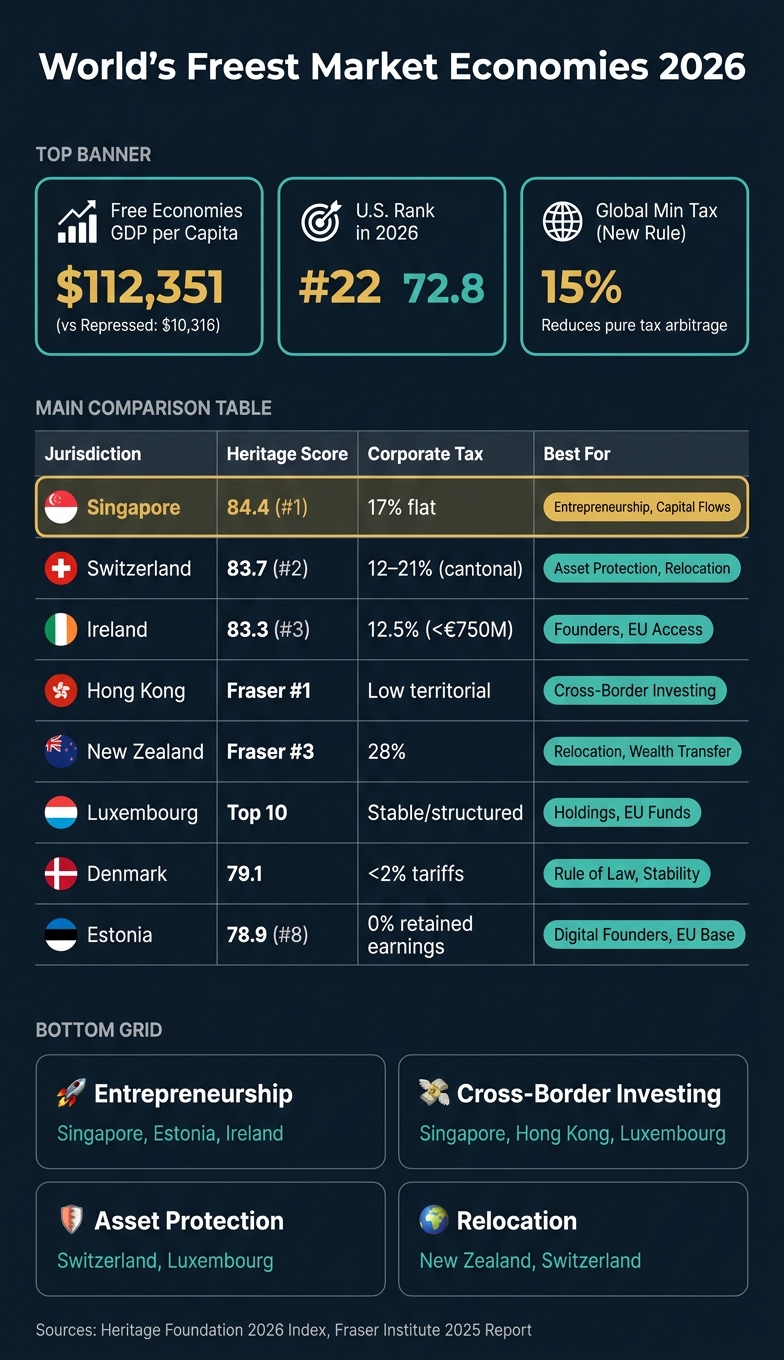
Quick Comparison
| Jurisdiction | Best Known For | Main Trade-Off |
|---|---|---|
| Singapore | Top freedom score, 17% corporate tax, zero tariffs | High living costs, exposed to global trade swings |
| Switzerland | Strong courts, property rights, cantonal tax competition | Tax edge is smaller for large firms, canton-by-canton differences |
| Ireland | 12.5% corporate tax for smaller firms, EU access | More exposed to global capital and tax rule shifts |
| Hong Kong | Low-tax system, open capital flows, deep finance sector | More political and legal uncertainty |
| New Zealand | Stable legal system, easy setup, no inheritance tax | Far from major markets |
| Luxembourg | EU fund hub, holding companies, strong banking access | Small local market, heavy reliance on finance |
| Denmark | Strong institutions, flexible labor market | High taxes |
| Estonia | 0% tax on retained earnings, e-Residency, digital setup | Small market, regional security concerns |
So if you’re asking, “Which free market economies are strongest right now?” my answer is simple: Singapore and Switzerland lead the pack, Ireland and Estonia are strong for founders, Luxembourg is built for cross-border structures, and New Zealand or Switzerland fit people thinking about relocation. The right pick depends on what you want to do with your business, money, or move abroad.
sbb-itb-39d39a6
1. Singapore
Singapore mixes top-tier economic freedom with fast execution, which is why so much mobile capital flows there. It ranks first in the 2026 Heritage Foundation Index of Economic Freedom with a score of 84.4 out of 100. It is rated economically free across every category in the index. For founders and investors, that usually means clear rules, fast setup, and smooth capital movement.
Rule of Law
Singapore’s courts operate without political interference. Commercial disputes are decided under established law, and contracts are enforceable. As a signatory to the New York Convention, Singapore recognizes and enforces international arbitration awards. If you’re doing cross-border deals, that kind of legal certainty matters. You want agreements to hold up when money is on the line.
Tax Competitiveness
Singapore uses a territorial tax system with a flat corporate rate of 17%. The tax code is simple and relatively light. Like Ireland and Switzerland, Singapore is also adjusting to the OECD global minimum tax framework, so more of its edge now comes from regulatory speed and workforce quality, not just the headline tax rate.
Regulatory Efficiency
Starting a company in Singapore is fast. Registration is fully online and usually takes just a few days. Labor laws also give employers room to adjust headcount without the heavy severance costs common in many European markets. Put simply, the system is built to reduce admin drag and help businesses get moving fast.
Trade and Capital Openness
Singapore imposes zero tariffs on imports and places almost no limits on foreign investment. Its trade openness score is 97.62 out of 100. The country’s port is one of the busiest in the world, and its financial sector serves as a major Asian capital hub. That same openness has a trade-off, though: it also leaves Singapore more exposed to global shocks.
Next is Switzerland, which pairs strong rule of law with a different tax and banking profile.
2. Switzerland
Switzerland ranks 2nd worldwide in the 2026 Heritage Foundation Index of Economic Freedom, with a score of 83.7. It sits that high for a simple reason: the country pairs legal stability with cantonal tax competition and strong property rights.
Rule of Law
Switzerland’s courts operate without political pressure, and that independence is built into the system. The country is also a signatory to the New York Convention, which means international arbitration awards are recognized and enforced. On top of that, Switzerland ranks 1st in the 2025 Human Freedom Index, which measures 87 personal and economic liberty indicators.
Tax Competitiveness
Switzerland’s tax system is decentralized. Cantons set their own rates, so there’s real internal competition instead of a one-size-fits-all approach. Combined federal, cantonal, and municipal corporate tax rates usually land between 12% and 21%.
Switzerland is also adjusting to the OECD Pillar Two framework. So its edge now comes less from headline tax rates and more from legal certainty and competition between cantons.
Regulatory Efficiency
Switzerland keeps government relatively lean. Public spending is 35% of GDP, which keeps the state’s footprint fairly small. Only one in six workers is employed by the government, about half the rate seen in Scandinavian countries.
For businesses, that often means less regulatory drag. The country also keeps a low tolerance for corruption, and that stance is built into its legal framework.
Trade and Capital Openness
Switzerland is a major wealth-management center, backed by political neutrality and monetary stability. That mix helps it stand apart.
Note: Switzerland has no national Golden Visa; residency usually depends on cantonal approval or direct economic activity.
Ireland takes a different path. It leans more on low taxes and EU market access than on neutrality or private banking.
3. Ireland
Ireland ranks 3rd in the world in the 2026 Heritage Foundation Index of Economic Freedom, with a score of 83.3. That puts it just behind Switzerland (83.7) and Singapore (84.4). A lot of Ireland’s appeal comes down to a simple mix: low corporate taxes, strong legal institutions, and close ties to global trade. For many companies, the big selling point is clear – a stable EU base with low taxes and fast access to major markets.
Rule of Law
Ireland’s independent judiciary handles commercial disputes through established law, not political pressure. That matters. When a company signs a contract or buys an asset, it wants to know the rules won’t shift overnight.
In the 2026 Index, property rights score 80.0 out of 100, and judicial effectiveness also scores 80.0. Ireland also enforces international arbitration awards, which gives firms another layer of legal certainty. On top of that, public registries for land and business assets help cut down on ownership disputes.
Tax Competitiveness
Ireland’s 12.5% corporate tax rate on trading income is still one of its biggest draws. It continues to apply to businesses with annual revenue below €750 million. For large multinationals above that mark, Ireland has adopted the OECD Pillar Two framework, which sets a 15% minimum effective rate.
The tax code is predictable and fairly simple, which helps lower compliance costs. And that’s a big part of the pitch. A low rate gets attention, sure, but predictability is what helps firms plan with confidence.
As global minimum tax rules get tighter, Ireland is relying more on legal certainty and workforce quality to stay attractive, not just on headline tax rates.
Regulatory Efficiency
Starting a business in Ireland is fast. Companies can register online and get up and running within a few days. That kind of speed can make a real difference, especially for firms that don’t want to get stuck in paperwork before they even open the doors.
The labor market is also flexible, with moderate costs and fewer restrictive severance rules. Taken together, the regulatory setup helps keep costs and red tape down for both startups and larger firms.
Trade and Capital Openness
Ireland operates inside the EU’s open trade framework, which means few tariffs and minimal limits on foreign investment. That openness has helped turn the country into a global hub for pharma and tech companies.
Of course, open economies don’t get all upside and no downside. Ireland is also more exposed to global shocks, as the 2008 banking crisis showed. Next is Hong Kong, which combines openness with a very different legal and political model.
4. Hong Kong
Hong Kong takes a different path than Ireland. It offers more freedom for capital and less tax drag, but weaker political certainty. That split matters.
On one side, Hong Kong is still one of the world’s freest market economies. On the other, its standing is less clear than it used to be. It stays very open on tax, trade, and capital, while looking less settled on politics and the courts. The Fraser Institute still ranks it 1st in the world for economic freedom in its 2025 report, using 2023 data. The Heritage Foundation no longer ranks it as a separate economy, citing its deeper integration with mainland China’s governance. That’s the core trade-off.
Rule of Law
Hong Kong’s common-law system still supports contracts and property rights. But the Fraser Institute points to weaker judicial independence and more political interference. So while the legal framework still looks strong on paper, there’s more strain in practice. For investors, that adds a layer of uncertainty that’s hard to ignore.
Tax Competitiveness
Hong Kong uses a territorial tax system, which means foreign-sourced income is generally not taxed. Corporate and personal tax rates remain low, and the tax code is simple.
Regulatory Efficiency
Regulatory conditions have slipped. The Fraser Institute flagged higher barriers to entry, limits on foreign labor, and rising business costs.
Trade and Capital Openness
Hong Kong still stands out in trade and capital mobility. Money moves with few restrictions, and its wealth-management sector remains a major global player, with $5.38 trillion in AUM. That mix keeps Hong Kong in the picture, even as the next jurisdiction presents a steadier, but less globally connected, model.
5. New Zealand
Compared with Hong Kong’s political uncertainty, New Zealand offers open markets and a steadier institutional setting. It ranks 3rd in the world in the Fraser Institute’s Economic Freedom of the World 2025 report. That standing comes from a mix of stable institutions, open markets, and business rules that don’t get in the way.
Rule of Law
New Zealand’s legal system is based on British common law, with an independent judiciary that handles commercial disputes under established law instead of political pressure. It is also a signatory to the New York Convention, which means international arbitration awards are recognized and enforced there. For cross-border contracts, that adds a layer of certainty that many investors care about.
Tax Competitiveness
The corporate tax rate is 28%, which is higher than in Singapore or Ireland. Even so, New Zealand balances that with a simple tax code and no inheritance tax. For families thinking about long-term wealth transfer, that can make a big difference.
Regulatory Efficiency
Company registration in New Zealand is fast and mostly online, and firms can often get up and running in just a few days. That kind of setup matters, especially for founders who don’t want to spend weeks stuck in paperwork. Around 18% of the workforce is self-employed, a sign that small businesses can operate without too much friction.
Trade and Capital Openness
New Zealand’s 1984 farm liberalization helped turn its export sector into a strong global player. Its trust and holding structures also help with asset protection and succession planning. That makes the country stand out for internationally mobile families and long-term investors.
Next comes Luxembourg, where investor access and financial depth create a different kind of market advantage.
6. Luxembourg
For investors who want access to the EU without giving up legal certainty, Luxembourg stands out. It ranks in the top 10 of the 2026 Heritage Foundation Index of Economic Freedom. It also matters a lot for investors using holding companies, funds, and cross-border portfolios.
Rule of Law
Luxembourg’s edge isn’t its size. It’s the mix of legal stability and deep financial infrastructure. Property rights are well protected, and Luxembourg is a signatory to the New York Convention, which means international arbitration awards are recognized and enforced. The Atlantic Council ranked Luxembourg 7th in the world in its 2026 Freedom Index.
Tax Competitiveness
Luxembourg’s tax appeal now has less to do with chasing the lowest headline rate and more to do with stability and structure. As the OECD’s Pillar Two global minimum tax reduces the upside of low headline rates, that predictability is a big reason Luxembourg still matters for serious investors.
Regulatory Efficiency
Starting a business is fast and largely online. Luxembourg scores 9.28/10 on the Admin Ease Index, so owners can spend less time dealing with paperwork and more time running the company.
Trade and Capital Openness
Capital can move across borders with few limits, and banking access scores 9.20/10. In plain English, Luxembourg is useful for setting up international holdings, not just parking money .
Next is Denmark, which takes a different path to free-market strength.
7. Denmark
Denmark mixes high personal taxes and a big welfare state with strong public institutions. Even with that setup, it ranks 9th in the 2025 Economic Freedom of the World report and 7th in the 2025 Index of Economic Freedom with a score of 79.1. That’s what makes Denmark stand out: free markets don’t depend ONLY on low taxes. They also depend on rules that work, courts people can trust, and a government that plays it straight.
Rule of Law
Denmark ranked 1st overall in the Freedom Index, which looks at legal, political, and economic institutions as a whole. Its legal system scores well for judicial effectiveness, government integrity, and private-property protection. In plain English, businesses can count on contracts being enforced, and commercial disputes tend to be handled in a steady, predictable way.
Tax Competitiveness
Denmark puts a heavy tax load on personal income. Still, its labor model helps keep the market flexible, pairing a flexible labor system with strong social protections. That balance matters. High taxes don’t automatically choke off market activity if hiring, job changes, and business operations can still move without too much drag.
Tariffs on industrial goods average below 2%, which lines up with other top-tier free-market economies.
Regulatory Efficiency
Starting a business in Denmark is fully digital and low-friction. That cuts down on delays and paperwork, which is a big deal when speed and clarity matter.
Trade and Capital Openness
As a member of the EU, Denmark keeps strong investment freedom and open trade policies, with free movement of capital and goods across the bloc.
Next is Estonia, which takes a more digital, lower-friction approach to market freedom.
8. Estonia
Estonia punches well above its weight in global freedom rankings. It scored 78.9 in the 2025 Index of Economic Freedom, which put it 8th globally. In the 2026 Freedom and Prosperity Index, it ranked 3rd in the world for overall freedom.
Its biggest edge is digital government. Compliance is fast, clear, and easy to track. So Estonia offers a different type of free market economy: small in size, but highly efficient.
Rule of Law
Estonia performs well on judicial independence, legal clarity, and government integrity, which gives investors more predictable property rights. For business owners and investors, that kind of consistency cuts uncertainty and makes long-range planning a lot easier.
Tax Competitiveness
Estonia taxes distributed profits only. Retained and reinvested earnings are taxed at 0%, which suits businesses focused on growth.
Regulatory Efficiency
The e-Residency program allows entrepreneurs anywhere in the world to start and manage an EU-based company remotely. That’s a big deal for founders who want an EU base without a lot of admin drag.
Trade and Capital Openness
Estonia’s clear, digital-first system supports remote ownership, simple administration, and cross-border use. Its startup ecosystem is one of the most productive per capita, which reflects secure property rights and ease of doing business.
For digital businesses and cross-border owners, Estonia stands out as a clean, low-friction option.
Next, compare Estonia’s strengths against the trade-offs in the jurisdiction-by-jurisdiction breakdown.
Pros and Cons by Jurisdiction
No single jurisdiction works for everyone. If you’re thinking about wealth protection and global mobility, the main issue is pretty simple: does a place lean more toward tax efficiency, legal certainty, or fast setup?
| Jurisdiction | Key Pros | Key Cons |
|---|---|---|
| Singapore | Ranked #1 globally with a 2026 Heritage score of 84.4; zero tariffs on imports; almost no barriers to foreign investment | High cost of living; significant exposure to global trade shocks |
| Switzerland | Cantonal tax competition keeps corporate rates between 12% and 21%; strong legal certainty | OECD Pillar Two narrows the tax edge for large multinationals; internal regulatory variation between cantons |
| Ireland | 12.5% corporate tax rate for companies with revenues under €750 million; EU market access | A 15% minimum effective rate now applies to large multinationals; vulnerable to global capital flow shifts |
| Hong Kong | Simple low-tax regime; common-law base | Higher political and regulatory uncertainty |
| New Zealand | Strong property rights; high trade and capital openness; no agricultural subsidies | Geographic isolation limits market access; exposure to commodity swings |
| Luxembourg | Stable financial services hub; strong banking access; deep fund and holding-company infrastructure | Smaller domestic market; heavily dependent on financial sector performance |
| Denmark | Strong rule of law; "flexicurity" labor model | High tax burden to support social safety nets; less competitive on tax rates than low-tax peers |
| Estonia | Taxes only distributed profits, allowing easier reinvestment of capital; e-Residency program for remote EU company management | Small domestic market; potential regional geopolitical exposure given proximity to Russia |
As Pillar Two spreads, the pure tax advantage of low-rate jurisdictions gets smaller.
Some patterns stand out. Singapore and Switzerland are the standouts for consistency. Ireland and Estonia make a strong case for founders, especially if reinvestment and market access matter. Hong Kong still gives you mobility, but the political risk is harder to ignore. Denmark and Luxembourg tend to fit investors who care more about stability than chasing the lowest tax rate.
That leads to the main decision: which jurisdiction lines up best with your goals for wealth protection, business formation, or relocation?
Which Free Market Economy Fits Your Goals?
The right jurisdiction comes down to what you’re trying to do. Some places are better for starting a company. Others shine when money needs to move across borders, when wealth needs legal shelter, or when a full relocation is on the table.
Here’s the short version:
| Your Goal | Best Fit | Why |
|---|---|---|
| Entrepreneurship | Singapore, Estonia, Ireland | Fast setup, low tax for small businesses, minimal regulation |
| Cross-border investing | Singapore, Hong Kong, Luxembourg | Open capital flows and financial depth |
| Asset Protection | Switzerland, Luxembourg | Political neutrality and strong rule of law |
| Relocation | New Zealand, Switzerland | High personal freedom, safety, and living standards |
The table gives you the quick answer. The notes below show where the trade-offs sit.
For entrepreneurship, Singapore stands out for its territorial tax system, 17% corporate rate, and light bureaucracy. Estonia takes a different route: it taxes only distributed profits, which means reinvested capital avoids tax at that stage. Ireland still holds appeal for many firms, with its 12.5% corporate rate applying to companies under €750 million.
If the goal is cross-border investing, Singapore, Hong Kong, and Luxembourg all make sense for the same basic reason: money can move with less friction, and each market has strong financial depth. That matters when you’re building an international portfolio instead of running a local-only business.
For asset protection, Switzerland leans on legal stability tied to its politically neutral cantonal framework. Luxembourg brings deep financial infrastructure, which is useful for holding companies and cross-border portfolios.
For relocation, the picture shifts a bit. New Zealand fits people who care most about open markets and strong property rights. Switzerland offers a similar blend of personal freedom and stable institutions.
One thing has changed the math across the board: the 15% global minimum corporate tax is trimming pure tax arbitrage between jurisdictions. So the old playbook of chasing the lowest headline rate matters less now. In practice, legal certainty, regulatory efficiency, and workforce quality are doing more of the heavy lifting.
FAQs
How are free market economies ranked?
Free market economies are usually ranked with annual, data-driven indexes that look at a country’s rules and policy setup.
The best-known examples are the Heritage Foundation’s Index of Economic Freedom and the Fraser Institute’s Economic Freedom of the World report. These indexes review factors like rule of law, property rights, tax rates, public debt, regulatory efficiency, and trade openness.
Why does the 15% global minimum tax matter?
The 15% global minimum tax matters because it changes how cross-border tax rules work under the OECD’s Pillar Two framework.
For multinational groups with annual revenue above €750 million, it cuts the tax edge that low-rate jurisdictions once used to draw in foreign investment. In plain English, a very low tax rate is no longer the easy selling point it used to be.
That shifts the competition. Instead of leaning mostly on low taxes, countries now have more pressure to stand out through regulatory efficiency, legal certainty, and workforce quality.
Which country is best for my goals?
The best country depends on what you want your money to do.
If your top priority is economic freedom, light regulation, and a business-friendly setup, Singapore and Switzerland tend to sit near the top year after year.
Singapore is a strong pick for trade and finance. Switzerland stands out for stability and long-term wealth preservation. Ireland is a leading option if you’re thinking about corporate expansion or a technology-focused business.
A smart next step is to check major economic freedom indices and compare the latest rankings with your own goals. That makes it easier to match the country to the outcome you want.
