
If you only care about face value against the U.S. dollar, Kuwait is still No. 1 in 2026. The top unit-value currencies in this article are KWD, BHD, OMR, JOD, GBP, CHF, KYD, EUR, USD, and SGD.
Here’s the short version: the highest-priced currency unit is not always the most useful one to hold. Some currencies stay high because they are pegged to the dollar. Others, like GBP, CHF, and EUR, are easier to access and more useful for payments, savings, or non-U.S. currency exposure.
If you want the full takeaway fast, this article says:
- KWD, BHD, OMR, and JOD rank high mostly because of fixed or managed exchange-rate policy.
- GBP is the top free-floating currency on this list by unit value.
- CHF stands out for stability and cross-border buying power.
- EUR matters less for face value and more for scale, liquidity, and daily use.
- USD ranks lower by unit price, but it still leads global trade and FX use.
- SGD is lower by face value, yet it remains useful for Asia-focused cash planning.
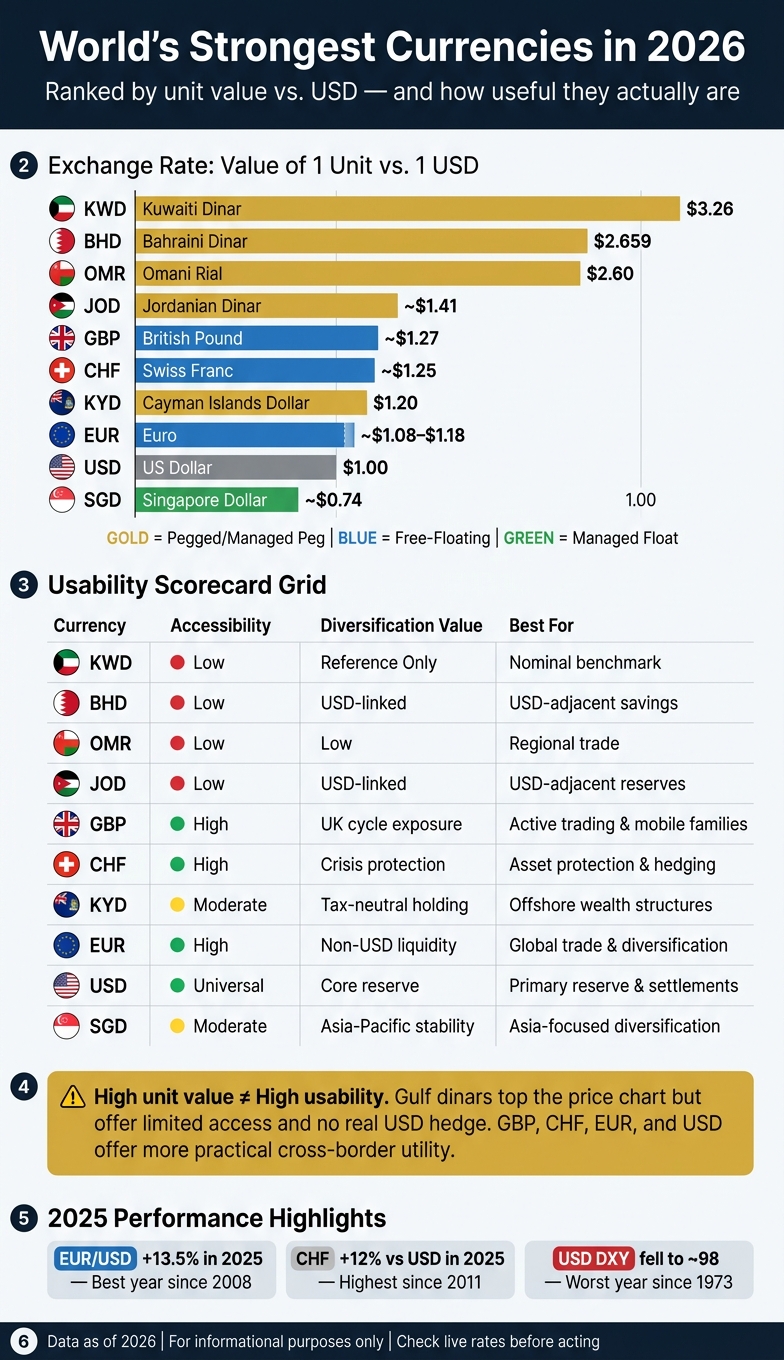
World’s Strongest Currencies in 2026: Value vs. Usability
Quick Comparison
| Currency | Approx. value vs. $1 USD | Main driver | Best read on its role |
|---|---|---|---|
| KWD | $3.26 per 1 KWD | Managed basket peg | Highest nominal unit |
| BHD | $2.659 per 1 BHD | USD peg | High-value, dollar-linked |
| OMR | $2.60 per 1 OMR | USD peg | High-value, policy-led |
| JOD | Above $1.00 per 1 JOD | USD peg | Stable, but dollar-linked |
| GBP | Above $1.00 per 1 GBP | Free float | High unit value plus market access |
| CHF | About $1.25 per 1 CHF | Market demand, safe-haven flows | Stability-focused holding |
| KYD | $1.20 per 1 KYD | USD peg | Offshore use, not a USD hedge |
| EUR | About $1.08–$1.18 per 1 EUR | Free float | Liquid non-USD exposure |
| USD | $1.00 | Global reserve and settlement use | Main world payment currency |
| SGD | Below $1.00 per 1 SGD | Managed float | Stable Asia-Pacific option |
So if you’re asking, “Which currency is worth the most per unit?” the answer is the Kuwaiti dinar. But if you’re asking, “Which currencies are easier for me to use, move, and hold?” the answer shifts toward GBP, CHF, EUR, and USD.
That’s the main point of the article: nominal rank looks simple, but access, liquidity, and use matter more once money has to move.
sbb-itb-39d39a6
1. Kuwait (Kuwaiti dinar, KWD)
The Kuwaiti dinar still ranks as the highest-value currency here. It also shows how exchange-rate policy can help keep a currency strong.
Kuwait uses a managed peg linked to an undisclosed weighted basket of international currencies, not just one currency like the U.S. dollar. That basket gives the Central Bank of Kuwait some protection when one major currency moves sharply. In plain English, it spreads the pressure around. That goes a long way toward explaining why the dinar stays near the top of global currency rankings.
For U.S. investors and expats, though, access is limited. Offshore managed accounts can be hard to get into, and that makes the currency less useful in practice.
For most readers, KWD makes more sense as a benchmark for purchasing power than as something you’d hold for day-to-day use. If you’re thinking about cross-border wealth planning, it still matters as a reference point. The next currencies in this ranking also rely on fixed or managed exchange-rate systems.
2. Bahrain (Bahraini dinar, BHD)
The Bahraini dinar is one of the highest-value currencies in the world. Since 1987, it has been pegged directly to the U.S. dollar at 1 BHD = $2.659.
That peg helps keep the BHD steady. But there’s a tradeoff: it gives you very little exchange-rate diversification. For U.S. investors and expats, the BHD is mostly a purchasing-power benchmark rather than a currency they’re likely to hold in practice.
Next up is Oman, which also depends on a tightly managed exchange rate.
3. Oman (Omani rial, OMR)
At about $2.60 per rial, the OMR sits among the highest-value currencies in the world. And, much like Bahrain, that high face value comes from government policy, not a market-driven float.
Oman pegs the rial to the U.S. dollar, which helps keep it near $2.60. That peg is the main reason the currency stays near the top of this ranking. The trade-off is pretty simple: because the rial is fixed to the dollar, it doesn’t offer much protection if the U.S. dollar loses strength. So while Oman stays high on the list, it doesn’t serve well as a diversification hedge.
Next comes Jordan, another currency held high through a managed exchange rate.
4. Jordan (Jordanian dinar, JOD)
The Jordanian dinar is pegged to the U.S. dollar. So while its value tends to stay steady, it doesn’t move on its own from the dollar. In plain English, that can make planning easier, but it also means JOD usually follows the dollar instead of balancing against it.
For U.S. investors and expats, there’s another piece to watch: offshore accounts can trigger FATCA and FBAR (FinCEN Form 114) reporting once combined balances go over $10,000.
Next up: the British pound.
5. United Kingdom (British pound sterling, GBP)
The British pound is one of the strongest free-floating currencies. Its value moves with UK economic and policy conditions, so it gives investors exposure to a separate economic cycle. Unlike the pegged currencies listed above, the pound responds to market demand instead of a fixed exchange rate.
That independence gives GBP diversification value for investors who want currency exposure that doesn’t move in step with the U.S. dollar.
GBP is highly liquid and easy to access. It pairs a high unit value with broad day-to-day use, which makes it strong not just on paper, but in practice too. That’s part of why GBP works well for international payments and multi-currency portfolios. The downside is that it can swing with changes in UK growth and interest rates.
Next comes Switzerland, where strength comes from safe-haven demand rather than a peg.
6. Switzerland (Swiss franc, CHF)
In 2026, 1 Swiss franc trades at about $1.25, or roughly 0.8 CHF per $1. That gives CHF clear cross-border buying power and makes it one of the strongest currencies in practical terms.
Unlike the Gulf pegs mentioned above, the franc is strong for a different reason. Switzerland’s stability, neutrality, and central bank policy all help support demand. The SNB has kept rates low to reduce inflows and currency swings, with rates reaching 0.0% in 2025. In plain English, CHF often works as a hedge when investors want steadiness outside the U.S. dollar. It also tends to behave differently from U.S. assets during periods of market stress.
Demand has picked up as some wealthy Americans grow more concerned about dollar weakness and U.S. fiscal pressure. In that context, CHF is less of a simple cash position and more of a defensive part of a cross-border wealth plan. There’s a catch, though: when money flows into CHF, access can get tighter. Swiss banks often set high minimums for international clients, usually $250,000 to $1 million. And Swiss banks no longer accommodate undisclosed foreign assets.
The downside is yield. In late 2025, U.S. cash paid much more than CHF deposits, so the franc is mainly a capital-preservation currency, not an income play. For asset protection, that makes CHF more useful as a stabilizer than as a return driver.
Next is the Cayman Islands dollar, another high-value currency tied to a fixed exchange regime.
7. Cayman Islands (Cayman Islands dollar, KYD)
In 2026, 1 Cayman Islands dollar equals $1.20 USD. That high face value comes from the currency peg, not from market demand. So while KYD can work as a benchmark, it doesn’t do much as a diversification hedge.
Against the euro, KYD tends to move with the U.S. dollar. When the dollar slips, KYD usually slips too.
The Cayman Islands is a major offshore financial center with no direct tax and a strong legal framework for trusts, funds, and holding structures. That matters for a simple reason: Cayman strength comes from both the peg and its role in cross-border structuring.
Some institutions allow remote account opening for qualifying applicants. The process often includes notarized or apostilled paperwork, a video identity verification call, and source-of-funds documentation. Monthly fees can reach $100, and FX spreads usually run from 0.5% to 2%.
For U.S. persons, compliance matters fast. If Cayman accounts go above $10,000 in aggregate, you must file an FBAR through FinCEN Form 114. FATCA reporting may also apply through IRS Form 8938, with thresholds that change based on residency and filing status. The Cayman Islands also takes part in the OECD‘s Common Reporting Standard, and as of 2026, that reporting includes digital assets such as cryptocurrencies and stablecoins.
Next comes the euro, a major floating currency with broader day-to-day use.
8. Eurozone (euro, EUR)
In 2026, 1 euro trades at about $1.08 to $1.18. That doesn’t make the euro “strong” just because one unit is worth more than one U.S. dollar. Its weight comes from something else: scale and liquidity. The euro is used across 20 Eurozone countries, and EUR/USD is the most traded currency pair in forex. So the euro sits in a different lane from the pegged Gulf currencies mentioned above.
The euro also floats freely, which means the market sets its price instead of a peg. In 2026, that mattered because the Federal Reserve cut rates while the ECB stayed more steady. For U.S. readers who want some distance from the dollar, that kind of movement can be useful. It also means the euro can swing hard when U.S. policy and Europe’s policy stop moving in sync.
That played out in a big way in 2025. EUR/USD climbed 13.5%, moving from about $1.03 in January to the mid-$1.17s by December. It was the pair’s strongest year since 2008. Analysts now say it could reach about $1.19 to $1.22 by the end of 2026.
For U.S. investors, the euro is one of the most practical ways to get liquid foreign-currency exposure. EUR transfer conversion costs can be as low as 0.3% to 1%, and forward contracts can lock in exchange rates for large euro-denominated expenses. Next is the U.S. dollar, which still serves as the world’s main reference point even though it isn’t the highest-value unit.
9. United States (US dollar, USD)
The U.S. dollar sits ninth by nominal exchange value. But that number doesn’t tell the whole story. A high face value is one thing. Being the currency the world actually uses is another.
The dollar’s edge comes from liquidity, deep financial markets, and its central role in trade and reserve holdings. It appears on one side of nearly 90% of forex trades and makes up more than half of official foreign exchange reserves. In plain English: the dollar is still the main reference point for cross-border payments, commodity pricing, and global finance.
That practical strength showed up in a different way in 2025. The dollar fell about 10% to 11% against major currencies, its worst year since 1973, and the U.S. Dollar Index (DXY) slipped to about 98.00 by late December, its lowest level since 2022. At the same time, much of the euro’s 13.5% gain came from dollar weakness, not from Europe pulling far ahead on performance.
For anyone dealing with offshore cash, that’s the part that counts. Face value alone doesn’t decide how useful a currency is. Liquidity, convertibility, and reporting friction matter more when money needs to move across borders fast and in large amounts.
Take the Kuwaiti dinar as a simple example. Its higher nominal value mainly shows how many U.S. dollars it takes to buy one unit of that currency. It doesn’t automatically make it more practical for holding cash abroad or pricing offshore assets. That’s where the dollar still stands apart.
Next comes Singapore, where strong trade flows support another highly practical currency.
10. Singapore (Singapore dollar, SGD)
The Singapore dollar stands out for stability and market trust, not for having one of the highest face values. It doesn’t rank near the top on nominal value, but its managed-float system makes it different from the pegged Gulf currencies higher on this list.
The Monetary Authority of Singapore manages the SGD against a basket of trading-partner currencies, which helps keep the currency steady. A weaker U.S. dollar in 2026 also supported the SGD’s relative strength. For investors, that makes the SGD a useful option if they want stability without relying on a hard peg.
For U.S.-based investors and expats, the SGD is fairly easy to use through multi-currency banking accounts. These accounts let people hold and spend SGD without forced conversion. That kind of day-to-day function matters more than face value when you’re planning cross-border cash use.
The SGD ranks lower on nominal value, but that’s not the main reason investors pay attention to it. What tends to matter more is its stability, liquidity, and role in Asia-Pacific cash planning. In practice, that matters most when currency strength is part of diversification and asset protection.
How Currency Strength Affects Diversification and Asset Protection
Nominal strength matters less than liquidity and access when wealth needs to move. The Gulf currencies at the top of this list – KWD, BHD, OMR, and JOD – have the highest face values, but that alone does not make them the best tools for diversification or asset protection. In practice, strength is about access, not just exchange-rate rank.
The main split here is simple: high face value is not the same thing as usable liquidity. The Kuwaiti dinar trades at about $3.26 per KWD, yet it is not widely offered on standard trading platforms and can be hard for U.S. retail investors to buy directly. By contrast, the Swiss franc rose about 12% against the USD in 2025 and hit its highest level since 2011. The euro climbed 13.5% against the USD in 2025, its best annual performance since 2008, and it remains one of the most liquid currencies in the world.
For U.S. persons, foreign accounts and offshore structures can add reporting friction. That doesn’t shut the door, but it does mean the setup matters a lot. Private U.S. LLCs, offshore companies, and offshore trusts are often used to hold assets in foreign currencies while handling compliance duties. The Cayman Islands dollar (KYD) is a good example. It is pegged to the USD at 1 KYD = $1.20 USD, so it does not hedge against dollar weakness. Even so, the jurisdiction is a well-established, tax-neutral hub for international funds and wealth planning structures.
"Currency, tax, estate, and cash-flow choices work best when planned together."
The table below turns that into a plain planning view.
| Currency | Practical Use | Accessibility for U.S. Persons | Diversification Role | Main Limitation |
|---|---|---|---|---|
| Kuwaiti Dinar (KWD) | Value benchmark | Low (limited retail access) | Reference point only | Low liquidity; wide spreads |
| Swiss Franc (CHF) | Safe-haven holding | High (standard FX accounts) | Crisis protection | Low to zero interest yields |
| British Pound (GBP) | Active trading and yield | High (standard FX accounts) | UK financial hub exposure | Sensitive to UK political shifts |
| Euro (EUR) | Global trade and liquidity | High (standard FX accounts) | Alternative to USD dominance | Driven by eurozone dynamics |
| Cayman Islands Dollar (KYD) | Offshore wealth planning | Moderate (via offshore entities) | Tax-neutral capital holding | Pegged to USD (no USD hedge) |
| Bahraini Dinar (BHD) | Stable USD-linked asset | Low (specialized accounts) | USD-linked stability | Direct dependence on USD and oil |
| US Dollar (USD) | Base liquidity and settlement | Universal | Core reserve asset | Inflation and purchasing power risk |
For asset protection, liquidity comes first. After that, the useful question is where each currency helps – and where it falls short.
Pros and Cons of the Strongest Currencies in 2026
No currency comes out on top in every category. Gulf dinars lead on nominal value, while the U.S. dollar still dominates on liquidity and global reach. And that distinction matters. A high face value can look impressive, but it doesn’t automatically make a currency more useful in day-to-day investing or cross-border planning.
Among free-floating currencies, GBP stands out the most. It pairs nominal strength with practical access: deep markets, broad use, and solid utility for people who hold assets across borders.
| Currency | Main Pros | Main Cons | Best Use |
|---|---|---|---|
| Kuwaiti Dinar (KWD) | Highest nominal value globally | Very low liquidity; wide spreads; limited retail access | Nominal value benchmark |
| Bahraini Dinar (BHD) | Stable; backed by oil reserves | Peg break risk; regional concentration | USD-adjacent savings |
| Omani Rial (OMR) | High nominal value; predictable pricing | Oil-dependent; low diversification value | Regional trade |
| Jordanian Dinar (JOD) | Low inflation (1.11% in early 2026); $28.17 billion in foreign reserves as of Feb. 2026 | Limited natural resources; geopolitical exposure | USD-adjacent reserves |
| British Pound (GBP) | High liquidity; free-floating; deep capital markets; reserve status | Sensitive to UK macro data and Bank of England policy shifts | Active trading; internationally mobile families |
| Swiss Franc (CHF) | Premier safe-haven; appreciates during crises; low inflation; political neutrality | Low interest rates | Asset protection; crisis hedging |
| Cayman Islands Dollar (KYD) | Tax-neutral jurisdiction; offshore utility | Pegged to USD; limited use outside offshore finance | Offshore wealth structures |
| Euro (EUR) | Second most traded currency globally; high liquidity | Value often driven by USD weakness rather than EU growth | Global trade; reserve diversification |
| US Dollar (USD) | Unmatched liquidity; 89.2% of all FX trades | Lowest nominal value on this list; weakening trend in early 2026 | Primary reserve asset; global settlements |
| Singapore Dollar (SGD) | Stable managed float; strong monetary policy credibility | Limited reserve currency role | Asia-Pacific diversification |
The main takeaway is pretty simple: high unit value and cross-border usefulness usually don’t travel together. KWD, BHD, and OMR rank near the top by price per unit, but they offer less flexibility for active diversification, especially for U.S.-based investors. On the other hand, USD, EUR, and GBP have lower unit values, yet they carry far more weight when the goal is global mobility, portfolio access, and cross-border wealth planning.
Conclusion
Nominal rank and practical use are not the same thing. The Gulf dinars sit at the top on unit price, but that strength mostly comes from pegs and policy, not broad market demand. KWD and BHD don’t reduce dollar exposure in a meaningful way; they mostly re-denominate it. That matters a lot when you’re picking currencies for a portfolio, day-to-day spending, or offshore holdings.
For expats and mobile investors, liquidity and settlement access matter more than a headline exchange-rate rank. In cross-border portfolios, GBP, CHF, EUR, and USD tend to matter more because they combine liquidity, settlement depth, and broad access.
So the right pick depends on the goal: stability, access, or preservation. Use KWD, BHD, OMR, and JOD for nominal value. Use CHF for defense. Use USD, EUR, and GBP for liquidity and settlement. Nominal strength can be a useful reference point, but the core of any plan should be liquidity, access, and simple reporting. The British pound remains the only currency on this list that consistently combines unit value, reserve status, and trading depth.
In offshore planning, the best currency is the one you can actually move, hold, and use without much friction. Check live rates before acting, since thinly traded currencies can come with wider spreads than EUR/USD.
FAQs
Why isn’t the highest-value currency always the best one to hold?
A currency’s face value – its exchange rate against the U.S. dollar – often says more about policy than raw economic strength. A high-priced currency like the Kuwaiti dinar usually sits inside a managed exchange-rate system built to keep things steady and support trade.
On the flip side, a currency with a lower face value, like the U.S. dollar, can still have far more global use, liquidity, and influence. For investors and businesses, price per unit is usually not the main thing to watch. Inflation, productivity, diversification, and institutional credibility matter much more.
Which strong currencies are easiest for U.S. readers to buy and use?
For U.S. readers, the British pound (GBP) is the most practical high-value currency to buy and use. It trades freely on global markets, which makes it liquid and easy to exchange through standard financial institutions.
By contrast, the Kuwaiti dinar, Bahraini dinar, Omani rial, and Jordanian dinar are pegged currencies with limited retail trading. For most U.S.-based readers, those currencies work better as regional benchmarks than as practical holdings.
Do pegged currencies protect against U.S. dollar weakness?
No. Pegged currencies are tied straight to the U.S. dollar, so they work more like dollar stand-ins than actual diversification tools.
They can offer stability and predictability, but they won’t shield you from a weaker dollar. If the dollar falls, the pegged currency will usually fall with it.
