
The short answer: Iceland is still the safest country in the world in 2026, with a GPI score of 1.095. It is followed by Ireland, New Zealand, Austria, Switzerland, Singapore, Portugal, Slovenia, Finland, and Japan.
If I were skimming this for the main takeaway, here’s what I’d want up front:
- #1 overall: Iceland – very low crime, no standing army, steady public systems
- Best for English-speaking relocation: Ireland and New Zealand
- Best for low violent crime in cities: Singapore and Japan
- Best for stability and public order in Europe: Switzerland and Austria
- Best lower-cost move in Western Europe: Portugal
- Best mix of trust, order, and public services: Finland
- Best quieter Central European option: Slovenia
The key point is simple: a “safe country” is not just about crime. The Global Peace Index also looks at conflict, political calm, and military posture. That’s why Singapore and Japan score so well for street safety, while Iceland and Ireland stand out for low conflict and low militarization.
Quick Comparison
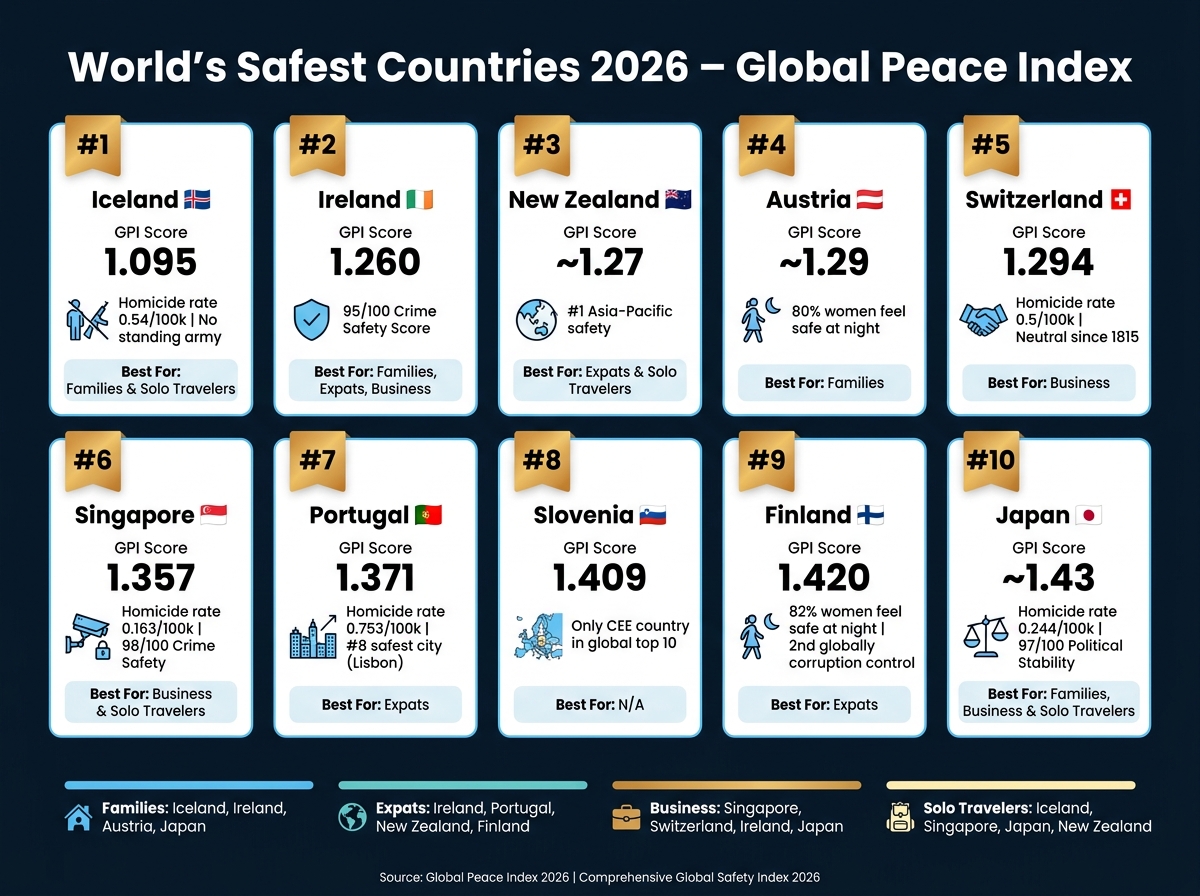
| Country | 2026 GPI Rank | What stands out | Main tradeoff |
|---|---|---|---|
| Iceland | #1 | Lowest peace risk, very low crime, no army | High cost of living, volcanic risk |
| Ireland | #2 | Low militarization, English-speaking, stable politics | Housing pressure, petty crime in cities |
| New Zealand | #3 | Low conflict, low crime, distance from global flashpoints | Earthquake risk, remote location |
| Austria | #4 | Stable politics, low crime, central Europe location | Higher costs, German language barrier |
| Switzerland | #5 | Neutrality, order, very low homicide rate | Very expensive, harder move for non-EU residents |
| Singapore | #6 | Ultra-low crime, strict law enforcement, clean urban setting | Tight rules, dense city life |
| Portugal | #7 | Low violent crime, mild climate, easier residency paths | Petty theft in tourist zones |
| Slovenia | #9 | Low violent crime, stable democracy, lower costs than many peers | Small market, language barrier |
| Finland | #9 | High trust, low crime, stable public systems | Close to Russia, high taxes, long winters |
| Japan | #10 | Very low violent crime, strong public order, top transit | Earthquake risk, language barrier |
So if you’re choosing based on your own goal, the list shifts a bit:
- For families: Iceland, Ireland, Austria, Japan
- For solo travelers: Iceland, Singapore, Japan, New Zealand
- For expats: Ireland, Portugal, New Zealand, Finland
- For business owners: Singapore, Switzerland, Ireland, Japan
That’s the main picture in one place. The rest of the article breaks down how each country differs on crime, public order, political calm, and daily life.
sbb-itb-39d39a6
1. Iceland
GPI Score (2026): 1.095 | Global Rank: #1
Iceland ranks first on the 2026 Global Peace Index for the 17th year in a row, with a GPI score of 1.095. It stays at the top for a simple reason: very low crime, no standing army, and stable public institutions. Put those together, and Iceland sets the standard for the countries behind it.
Crime and Personal Safety
Iceland’s homicide rate is just 0.54 per 100,000, and 97% of residents say they feel safe walking alone at night. Most reported offenses involve property, not violence. The country is also policed by a small, unarmed force of about 660 officers.
That’s a big deal because the GPI doesn’t look at crime in isolation. It also measures day-to-day safety alongside state stability.
Political Stability
Iceland scores well on civil liberties and has no domestic or international conflict. Its public institutions help keep things steady.
Militarization and Conflict Risk
One of Iceland’s clearest differences is that it has no standing army, which is rare even among other top-ranked countries.
"Iceland retains its position as the world’s most peaceful country… with no standing army and exceptionally low crime levels that set it apart in the data."
Best Fit: Travelers, Expats, Families, and Entrepreneurs
Iceland is a strong match for solo travelers, women, and families who care more about safety and stability than low costs. Expats and entrepreneurs may like the strong digital infrastructure and 100% renewable energy, though the small market and high cost of living can limit the upside.
Still, the main safety issue in Iceland isn’t crime. It’s nature. Seismic and volcanic activity are real risks, so both visitors and residents should follow updates from the Icelandic Meteorological Office and the Department of Civil Protection and Emergency Management.
New Zealand has a similar low-conflict profile, but the tradeoffs around geography and public safety are different.
2. New Zealand
GPI Rank (2026): #3 Globally | #1 in Asia-Pacific
New Zealand sits just behind Iceland for a simple reason: it pairs low crime, light militarization, and steady politics with more exposure to natural disasters. So while it’s on par with Iceland in many safety measures, it comes with a bit more seismic risk.
Crime and Personal Safety
Crime is low, homicide is about 1.33 per 100,000, and strict gun laws help support public safety.
Political Stability
New Zealand scores highly for political stability and corruption control, which adds to its low-risk profile.
Militarization and Conflict Risk
Its defense force is small, and low weapon imports help keep militarization down.
Best Fit: Travelers, Expats, Families, and Entrepreneurs
New Zealand is a strong match for solo travelers, families, and expats thanks to its stable institutions and low conflict profile. For entrepreneurs, the Active Investor Plus visa gives qualifying investors a path to long-stay relocation.
The main trade-off is seismic risk, so disaster preparedness matters.
Switzerland offers a different safety model: less isolation, stronger central European order, and lower natural-disaster exposure.
3. Switzerland
GPI Rank (2026): #5 Globally | #2 in the Comprehensive Global Safety Index
Switzerland earns this spot for a simple reason: it combines neutrality, direct democracy, and strong public institutions in a way few countries do. Its 2026 GPI score of 1.294 points to low crime, steady institutions, and limited conflict risk. Compared with Iceland and New Zealand, Switzerland is less isolated, but it makes up for that with dense, highly ordered stability.
Crime and Personal Safety
Switzerland’s homicide rate is just 0.5 per 100,000 people, one of the lowest figures in the world. In places like Zurich and Geneva, walking at night is generally fine, though petty theft can still happen, so basic caution makes sense. The country also scores 96/100 on the Comprehensive Global Safety Index.
Political Stability
Switzerland’s federalist system and direct democracy give people a direct say in public policy. That matters. When citizens feel heard, social tension tends to stay lower than in places where decisions feel far away. This model has helped Switzerland avoid major conflicts since 1815. High GDP per capita and effective governance also help keep public order steady.
Militarization and Conflict Risk
Neutrality is still Switzerland’s biggest strength on this front. The country often hosts international peace talks, which fits its long-standing role on the world stage. At the same time, it has made a slight increase in defense spending due to tensions in the region. Even with that shift, its peace profile remains strong.
Best Fit: Travelers, Expats, Families, and Entrepreneurs
Switzerland works well for several groups, but for different reasons.
- Families often look for order, low crime, and fast healthcare access.
- Entrepreneurs and investors tend to care more about legal clarity and asset protection.
Those strengths help explain its appeal. The tradeoff is pretty clear: safety is excellent, but living here is expensive.
Slovenia follows with a smaller, quieter safety profile and lower costs.
4. Slovenia
GPI Rank (2026): #9 Globally
Slovenia ranks 9th globally on the 2026 Global Peace Index, with a score of 1.409. It also stands out as the only Central and Eastern European country that consistently makes the global top 10 for peace.
Crime and Personal Safety
Slovenia’s homicide rate is 0.599 per 100,000, and violent crime is still rare, even though overall crime increased in 2024. Its crime safety score is 92/100.
Political Stability
Since gaining independence in the 1990s, Slovenia has kept a stable democracy. That shows up in its political stability score of 93/100. Its EU and NATO membership, along with steady spending on public safety and healthcare, help keep overall risk low.
Militarization and Conflict Risk
Slovenia has no active domestic or international conflict, which helps keep militarization risk low. Its geopolitical position also helps explain why it continues to score so well on the Global Peace Index.
Best Fit: Travelers, Expats, Families, and Entrepreneurs
Slovenia does well on travel and road safety, so it’s a solid choice for self-drive trips and long-term relocation. For families, strong social cohesion and a 90/100 health security score add peace of mind.
For entrepreneurs, there’s one catch: Slovenia does not offer a formal Golden Visa program. In most cases, business residency means setting up a company and investing €50,000 to €100,000. Slovenia also generally bans dual citizenship, which can matter a lot if naturalization is part of your long-term plan.
Portugal follows with a similar peace profile, but the climate, cost, and residency tradeoffs are different.
5. Ireland
GPI Rank (2026): #2 Globally
Ireland ranks #2 on the 2026 Global Peace Index, sitting just behind Iceland and ahead of New Zealand. That spot comes from a simple mix: low crime, political stability, and very low militarization. Its score, at about 1.260, keeps it near the top of the list.
Crime and Personal Safety
Ireland’s homicide rate is 0.690 per 100,000 people, which backs up its low-crime reputation. It also has a crime safety score of 95/100. For day-to-day peace of mind, that matters.
There’s another useful signal here: about 78% of Irish women say they feel safe walking alone at night. That said, Ireland isn’t risk-free. In cities, petty crime is still the main issue, so it’s smart to keep an eye on your bag, phone, and wallet.
Political Stability
Ireland scores 96/100 for political stability. Its democratic system is steady, and the peace dividend from the Good Friday Agreement helped lower unrest and terrorism risk. For visitors, that can mean a calmer trip. For expats or business owners, it can make day-to-day life feel far more predictable.
Militarization and Conflict Risk
Ireland has a small military footprint, which helps keep conflict risk low and supports its place among the world’s most peaceful countries.
Best Fit: Travelers, Expats, Families, and Entrepreneurs
Ireland is a strong match for English-speaking expats, families, and entrepreneurs who want low crime, stable public systems, and no language barrier. That makes it a good pick for long-term relocation, not just a short stay.
Its economic stability score of 93/100 also helps with long-range planning. If you’re thinking about work, family life, or building a business, that kind of steadiness can go a long way. The main downside is slow elective care, so private health insurance is worth considering for longer stays.
Austria comes next with a similarly low-risk setup, but in a more central European location and with a different cost structure.
6. Austria
GPI Rank (2026): #4 Globally
Austria ranks #4 on the 2026 Global Peace Index, just behind Ireland and ahead of Switzerland. That spot comes from a simple mix: low crime, steady politics, and low conflict risk. Its long-held neutrality also helps keep its peace profile strong.
Crime and Personal Safety
Austria’s homicide rate is 0.827 per 100,000 people, and its crime safety score is 94/100. That puts it below Switzerland at 96, but ahead of Slovenia and Portugal at 92.
There’s another sign people feel secure day to day: about 80% of women in Austria report feeling safe walking alone at night. For most visitors, that matters more than any index score. In Vienna, the main tourist issue is pickpocketing.
Political Stability
Austria scores 96/100 for political stability, matching Ireland and sitting just under Switzerland’s 97. Protests do happen, but they’re usually small and peaceful.
If you’re thinking long term, that steadiness is a big part of the appeal. Austria tends to feel predictable in the best way.
Militarization and Conflict Risk
Austria’s neutrality keeps its conflict risk low. That’s one of the main reasons the country stays near the top of the GPI.
Best Fit: Travelers, Expats, Families, and Entrepreneurs
Austria ranks 3rd safest for travelers in 2026. For families, high-quality healthcare and safe outdoor settings stand out as major pluses.
Expats also get a lot from Austria’s social-insurance system. It’s coordinated, care access is fast, and it’s rated better than systems in the UK and Australia.
For entrepreneurs, Austria scores 91/100 for economic stability and 90/100 for cybersecurity. One weak spot: corruption control is not as strong as it is in Switzerland and Finland.
Portugal follows with similar peace indicators but a different cost and residency profile.
7. Portugal
GPI Rank (2026): #7 Globally
Portugal ranks #7 on the 2026 Global Peace Index, with a GPI score of 1.371. That’s a big move from 18th place in 2014 to the global top 10 by 2026, helped by lower crime and steadier public institutions.
Put simply, Portugal sits just under the very safest group. It’s safer than most of Europe, though everyday theft in cities is still more common than in Iceland, Ireland, or Austria.
Crime and Personal Safety
Violent crime is low in Portugal, with added police presence in Lisbon and Porto helping support public safety. The intentional homicide rate is 0.753 per 100,000 residents. Lisbon also ranked as the 8th safest city in the world in 2026, which lines up with the country’s strong safety record.
The main issue is petty theft, especially in tourist-heavy areas. Pickpocketing and bag snatching are the kind of problems visitors are more likely to run into than violent crime. About 72% of women in Portugal say they feel safe walking alone at night.
Political Stability
Portugal scores 94/100 for political stability. It has a stable democracy, strong institutions, and no active domestic or international conflict.
Militarization and Conflict Risk
Portugal keeps both conflict risk and militarization low.
Best Fit: Travelers, Expats, Families, and Entrepreneurs
Portugal works well for several groups.
- Travelers get a country with low violent crime, though tourist zones still call for extra care around wallets, phones, and bags.
- Expats and retirees are often drawn to the mild climate, lower living costs, and the D7 visa, which calls for €920 per month in passive income.
- Families may like Portugal’s LGBTQ-friendly policies and broad social tolerance.
- Entrepreneurs get a stable political setting, though slow access in the public health system means private top-up insurance can make sense for elective care.
Singapore offers a very different model: denser, more urban, and more tightly controlled.
8. Singapore
GPI Rank (2026): #6 Globally
Singapore ranks #6 on the 2026 Global Peace Index, with a GPI score of 1.357. It gets there through ultra-low crime, strict law enforcement, and low conflict risk. What makes Singapore different is that its safety comes less from geography and more from tight enforcement, low corruption, and the kind of urban order you can feel almost right away.
Crime and Personal Safety
Singapore’s crime figures are strikingly low. The intentional homicide rate is just 0.163 per 100,000 residents. Its Crime Safety score is 98/100, the highest in this group. Violent crime and drug offenses are rare, and people report a very high sense of personal security.
There is a clear trade-off, though. Singapore applies its laws strictly, including penalties for minor offenses. The safety is real, but daily life is more regulated than in Iceland or Portugal.
Political Stability
Singapore scores 96/100 for political stability, matching Ireland and Austria. Its government is highly predictable, corruption is extremely low, and it ranks 5th least corrupt globally. The rule of law is applied with consistency. There are no active domestic conflicts or recent terror incidents.
Militarization and Conflict Risk
Unlike Iceland, Singapore does keep a standing military, but its stance is defensive and it faces no external conflict. Its military position does not feed active international disputes. Singapore also has minimal exposure to natural disasters like earthquakes and volcanic activity, which helps it place above Japan and New Zealand in some broad safety rankings.
Best Fit: Travelers, Expats, Families, and Entrepreneurs
- Travelers get one of the safest city environments in the world. English is widely spoken, and personal safety is rarely a concern, day or night.
- Families benefit from clean streets and a 100/100 family travel safety score in a 2025 study.
- Expats and entrepreneurs face a selective residency path. Long-term stays usually depend on employer sponsorship or active business involvement, not passive income.
Finland follows with a quieter model built on social trust and cohesion.
9. Finland
GPI Rank (2026): #9 Globally
Finland ranks #9 in the 2026 Global Peace Index with a GPI score of 1.420. The reason is pretty clear: peace in Finland isn’t just about good-looking numbers on a chart. It’s built into daily life. Low crime, steady government, and high public trust all work together here. Finland sits just outside the very top group largely because it faces more regional-security pressure than places like Iceland or New Zealand. Even so, its safety profile stays strong, driven by low crime, solid institutions, and limited conflict risk.
Crime and Personal Safety
Finland scores 94/100 on Crime Safety, the same as Austria and just behind Singapore’s 98. Personal safety also stands out in day-to-day life. Around 82% of Finnish women feel safe walking alone at night. On top of that, Finland earns a 95/100 overall score on the 2026 Comprehensive Global Safety Index.
Political Stability
Finland scores 96/100 for Political Stability, putting it level with Ireland, Austria, and Singapore. It also ranks 2nd globally for Corruption Control with a score of 88/100, plus 3rd globally for Human Rights & Freedom at 94/100. Put simply, this is the kind of place where rules are clear, institutions work, and daily life feels predictable.
Militarization and Conflict Risk
Finland’s proximity to Russia naturally brings more regional-security attention. That said, domestic security remains stable despite proximity to Russia. Compared with Switzerland or Singapore, Finland leans less on tight central control and more on social trust. For many people, that’s a big part of the appeal: strong safety without the feel of a heavily regulated city-state.
Best Fit: Travelers, Expats, Families, and Entrepreneurs
Finland works well for travelers, families, expats, and entrepreneurs alike. Low crime, steady institutions, and high trust make everyday life feel settled, though healthcare wait times can lead some residents to pay for private top-ups. For business owners, the case is also strong. Finland posts a 90/100 Economic Stability score and an 88/100 Corruption Control rating, which supports a dependable business climate.
Japan follows with a different safety profile, shaped more by order, infrastructure, and low violent crime than by Europe’s institutional trust model.
10. Japan
GPI Rank (2026): #10 Globally
Japan ranks #10 in the 2026 Global Peace Index. Its safety story is pretty clear: very low violent crime and strong public order do most of the heavy lifting. In Japan, safety comes less from isolation or neutrality and more from day-to-day order and low levels of violence.
Crime and Personal Safety
Japan’s crime data is hard to argue with. It has a 98/100 Crime & Safety score and an average intentional homicide rate of just 0.244 per 100,000 people. That is the second-lowest rate among 49 major nations studied, behind only Singapore. For solo travelers, that matters in a practical way. Japan is often picked as a place where people feel safe walking at night in major cities.
Political Stability
Japan also posts a 97/100 Political Stability score. That rests on strong democratic institutions and high social cohesion. On top of that, Japan ranks #1 globally for healthcare quality and accessibility, which adds to its image as a country with public systems people can count on.
Militarization and Conflict Risk
Japan has little involvement in external conflicts and scores well for domestic calm. The bigger issue is nature, not politics. Its Disaster Resilience score is 60/100, held back by exposure to earthquakes and volcanic activity. That helps explain why Japan can rank so well in the GPI while landing lower in some broader safety indexes.
Best Fit: Travelers, Expats, Families, and Entrepreneurs
Japan scored a perfect 100/100 in a 2025 family travel safety study. That nod came from its clean infrastructure, stroller-friendly transit, and child-welcoming setting. For expats who care a lot about health outcomes, Japan’s avoidable mortality rate is 135 per 100,000, which points to strong care and public health systems.
For entrepreneurs, the appeal is easy to see:
- High cybersecurity scores
- Strong political stability
- Public systems that tend to work well
The trade-off is disaster risk. If you plan to stay long term, earthquake planning isn’t optional in Japan.
Japan makes a strong case on personal security. Still, once you stack it up against the other top countries, the pecking order shifts.
How These Countries Compare in Practice
Looking across these countries, the rankings tell one story. Daily life tells another.
A country’s spot on the Global Peace Index doesn’t always tell you whether it’s the right fit for your life. What matters most is your top priority. Are you after low violent crime, political calm, easier relocation, or a strong base for business? The table below turns those rankings into plain, practical tradeoffs.
| Criterion | Top Performers | Key Tradeoffs |
|---|---|---|
| Lowest Violent Crime | Singapore, Japan, Iceland | Strict law enforcement in Singapore; geographic isolation in Iceland |
| Most Stable Politics | Switzerland, Ireland, Austria | High cost of living in Switzerland; stricter immigration for non-EU citizens in Austria |
| Best Practical Fit | Portugal (relocation), Ireland (English speakers), Singapore (business) | Wildfire risk in Portugal; strict entry rules in Singapore |
Street safety is only part of the story. Singapore and Japan stand out for day-to-day safety, but they get there in different ways. Singapore leans on strict enforcement. Japan leans more on public order. In both places, daily life tends to feel highly predictable.
Ireland makes sense for EU-linked relocation. New Zealand makes sense if distance itself feels like a form of safety. Ireland offers full EU market access, along with a GDP per capita above $100,000. That gives English-speaking expats and EU-focused business owners a strong base. New Zealand, by contrast, sits far from major conflict zones, which cuts spillover risk.
Portugal is the easiest low-risk relocation option. Switzerland is the most institutionally reliable. Singapore is the most selective. Portugal’s residency routes are more straightforward, while Switzerland and Singapore use much tighter entry requirements.
Those differences shape the tradeoffs that matter most, and the next section breaks them down country by country.
Pros and Cons of Each Country
The table below gives you the big picture: where each country stands out on safety, where the friction points show up, and who it’s most likely to suit. Safety isn’t just about crime rates. It also comes down to how a place handles day-to-day security, mobility, healthcare, social order, and cost.
| Country | Main Safety Advantages | Main Drawbacks | Best For |
|---|---|---|---|
| Iceland | 17-year GPI leader with a score of 1.095; no standing army; record-low crime | Extreme geographic isolation; very high cost of living; tiny domestic market | Remote workers and affluent residents prioritizing peace |
| New Zealand | Top-ranked Asia-Pacific country for safety; strict gun laws; far from global conflict flashpoints | Remote from major markets; high seismic risk | Families and outdoor enthusiasts prioritizing distance from global instability |
| Switzerland | Long-standing neutrality; excellent healthcare; homicide rate of 0.5 per 100,000 | High cost of living; harder for non-EU movers | High-net-worth individuals focused on asset protection and institutional stability |
| Slovenia | Very low violent crime; stable democracy; high road safety | Language barrier for non-Slavic speakers; small domestic market | Budget-conscious expats and retirees seeking European safety at lower cost |
| Ireland | Military neutrality; English-speaking; 78% of women feel safe walking alone at night | Urban petty crime; housing shortages; high cost of living | English-speaking professionals, tech workers, and EU-focused entrepreneurs |
| Austria | Central European location; effective justice system; over 80% of women feel safe at night | Increasing social tensions; German language barrier for many expats | Families and culture-focused expatriates seeking a stable European hub |
| Portugal | High LGBTQ+ tolerance; accessible D7 visa; recent crime reduction | Petty crime in Lisbon and Porto tourist areas; lower average salaries | Retirees and digital nomads seeking a low-cost, warm-climate base |
| Singapore | Intentional homicide rate of 0.163 per 100,000; world-class infrastructure; top-tier cybersecurity | Heavily regulated society; strict legal penalties; high urban density | Business leaders, high earners, and globally mobile entrepreneurs |
| Finland | High-trust society; 82% of women feel safe walking alone at night; strong social welfare | Proximity to Russia; high tax burden; harsh winters | Families and expats who value public services and equality |
| Japan | Exceptional urban order; minimal violent crime; family-friendly infrastructure | High seismic risk; significant language barrier; rigid social norms | Solo travelers, retirees, and families seeking orderly, predictable daily life |
These tradeoffs matter most when safety is only one part of the move. A country can feel calm and well-run, but still be a tough fit if housing is tight, taxes are high, the local language is hard to pick up, or the market is too small for your work and plans.
Conclusion
The 2026 Global Peace Index makes one thing clear: safety isn’t one-size-fits-all. Iceland takes the top spot for the 17th year in a row, with a GPI score of 1.095. After that, the rankings point to a mix of tradeoffs that matter if you’re trying to make a serious move.
The next step is fit. Iceland stands out for the lowest peace risk. Ireland and New Zealand make sense for English-speaking relocation. Switzerland and Singapore appeal to readers who care a lot about institutions. Portugal, Austria, Slovenia, Finland, and Japan all offer strong safety too, but each comes with a different way of life and its own set of tradeoffs.
And here’s the part people sometimes miss: even the top-ranked country can fall short on your personal checklist. Use this list to trim down your shortlist. Then look closely at digital nomad visas, taxes, healthcare access, schooling, and legal stability. Safety is the first filter. Visas, taxes, healthcare, and schools shape the final call.
FAQs
How does the Global Peace Index define safety?
The Global Peace Index defines safety as a country’s overall peacefulness. It measures that across 23 qualitative and quantitative indicators grouped into three areas: Societal Safety and Security, Ongoing Domestic and International Conflict, and Militarization.
In plain English, it looks at things like violent crime, homicide, political instability, terrorism, military spending, and external conflicts. Each country gets a score, and lower scores mean more peaceful and secure countries.
Which safe country is easiest for Americans to move to?
For Americans looking for a Global Peace Index-style safest country to move to, Canada is usually the simplest choice in the Americas.
It ranks as the region’s top option for low violent crime and strong social stability, while the U.S. sits much lower overall.
Why do some very safe countries still have major risk tradeoffs?
Even countries that rank as very safe can come with big tradeoffs. Global Peace Index rankings measure broad national stability. They do not promise day-to-day personal safety.
A country might score well because it has low violent crime or strong public institutions. At the same time, it may have high living costs, strict residency rules, natural-disaster risk, or closely monitored legal systems. And local conditions can vary a lot from the national picture.
