
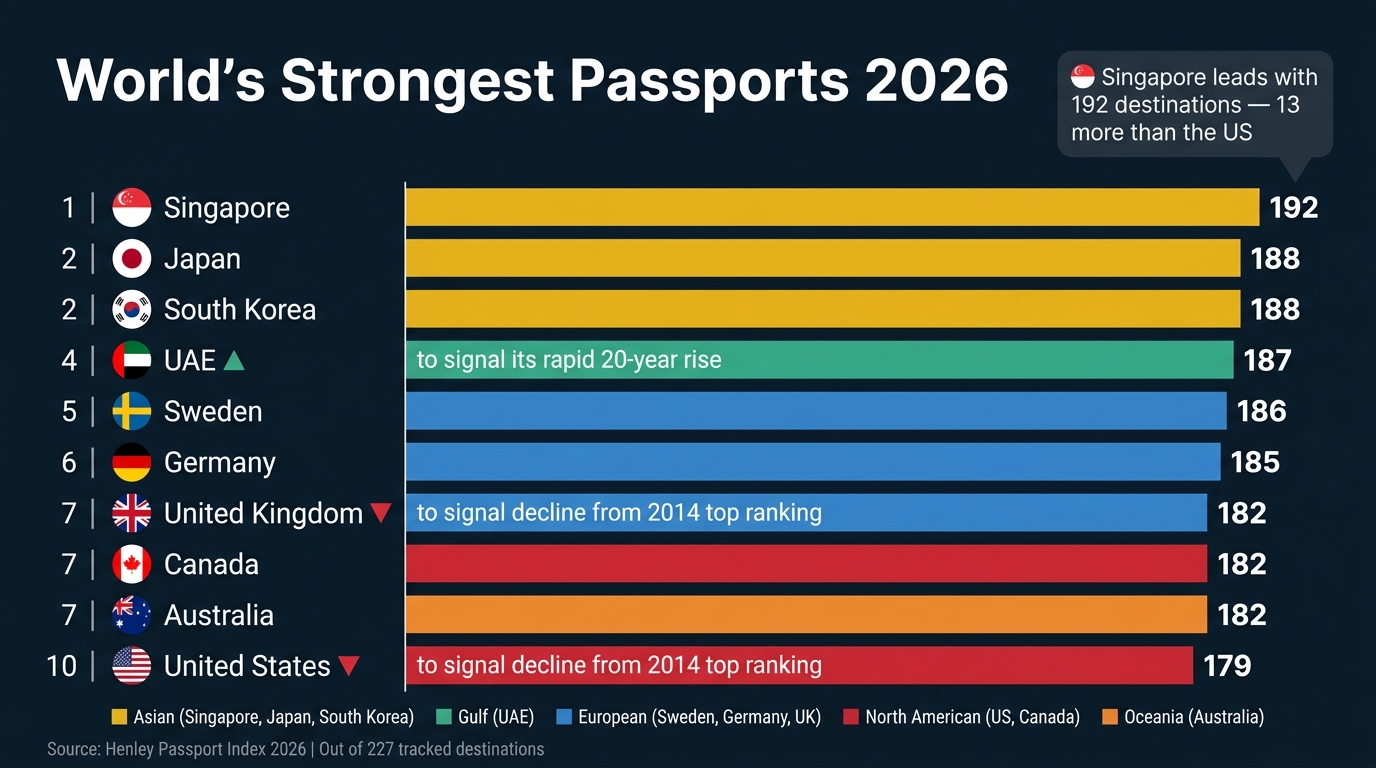
Singapore leads the world with the strongest passport in 2026, granting visa-free access to 192 destinations. Following closely are Japan and South Korea, tied at 188 destinations. The United Arab Emirates (UAE) and Sweden round out the top five, reflecting a shift in global mobility toward Asian and Gulf nations. Meanwhile, passports from traditional powerhouses like the United States and the United Kingdom have declined in strength, ranking 10th and 7th, respectively.
Key Highlights:
- Top Passport: Singapore (192 destinations)
- Runners-Up: Japan and South Korea (188 destinations each)
- Rapid Growth: UAE (187 destinations, 4th place)
- Declining Influence: U.S. (179 destinations, 10th place) and U.K. (182 destinations, 7th place)
- European Leaders: Sweden and Germany remain strong with 186 and 185 destinations.
These rankings, based on the Henley Passport Index, reflect not only travel freedom but also shifts in global diplomacy and economic influence. For frequent travelers, a strong passport simplifies international movement, while declining rankings signal emerging geopolitical and mobility challenges. For those seeking more stability, exploring the simplest citizenship programs can provide a reliable path to a second passport.
1. Singapore Passport
The Singapore passport leads the 2026 Henley Passport Index, granting holders access to 192 visa-free destinations out of 227 tracked globally. This puts it four destinations ahead of its closest competitors, Japan and South Korea, which are tied at 188. Such a ranking not only boosts travel convenience but also offers significant advantages for international business and investment activities.
Despina Wilson, Business News Editor at CEOWORLD magazine, explains this achievement succinctly:
"Singapore’s position at the top is the outcome of decades of consistent foreign policy, trade openness, and a deliberate strategy to become a global hub for finance, logistics, and technology."
For business travelers and investors, the benefits are clear. Singaporean passport holders enjoy access to 180 to 190+ markets with minimal restrictions. This is a stark contrast to countries like India (55 destinations) or Indonesia (73 destinations). Additionally, the passport includes visa-free access to the United States, a feature that distinguishes it from other high-ranking passports, including the UAE.
Singapore has maintained its top position on the Henley Index since mid-2023. On another ranking, the Passport Index, Singapore scores an impressive 174, further solidifying its lead. While slight adjustments have been made regarding access to certain destinations, the passport’s dominance remains intact.
More than just a travel document, the Singapore passport is increasingly seen as a "mobility balance sheet" – a strategic tool that enables holders to adapt quickly to geopolitical changes or seize cross-border business opportunities. This unique advantage underscores its strength in the 2026 passport rankings.
sbb-itb-39d39a6
2. Japan Passport
Japan holds the 2nd position on the 2026 Henley Passport Index, granting visa-free or visa-on-arrival access to 188 out of 227 destinations, just four fewer than Singapore.
This ranking reflects Japan’s long-standing focus on stable foreign relations, secure travel documentation, and its strong role in global trade networks. These factors have built the kind of trust that leads to extensive visa-free agreements. As Misha Glenny puts it:
"Passport power ultimately reflects political stability, diplomatic credibility, and the ability to shape international rules."
Japan checks all these boxes, surpassing countries like the United Kingdom, Canada, and the United States in the 2026 rankings.
For business professionals and investors, the Japan passport is a powerful tool, offering streamlined access to key markets, including the U.S. through the Visa Waiver Program. However, a 2026 U.S. Customs and Border Protection proposal may require Japanese travelers to provide more detailed personal information to maintain this privilege, showing that even top-tier passports must adapt to changing border policies.
Japan has consistently ranked among the best for over a decade, even claiming the top spot as recently as early 2025. For executives and high-net-worth individuals, the Japan passport isn’t just a travel document – it’s a critical asset for seamless international movement and business opportunities.
These factors highlight why Japan’s passport remains a key player in global mobility rankings, with unique advantages for its holders.
3. South Korea Passport
South Korea holds a joint second-place spot on the Henley Passport Index, offering access to 188 destinations without needing a visa or through visa-on-arrival agreements. It shares this rank with Japan, but only 25 countries require South Korean passport holders to obtain an advance visa, making it one of the most accessible passports globally.
What sets South Korea apart, even from Japan, is its visa-free access to the United States – a benefit not extended to holders of the United Arab Emirates passport. For business travelers and investors frequently moving between Asia and North America, this feature adds tremendous convenience and value. It reinforces South Korea’s strategic importance for international business and travel.
Dr. Christian H. Kaelin, Chairman of Henley & Partners, highlights the growing importance of passport privileges in today’s world:
"Today, passport privilege plays a decisive role in shaping opportunity, security, and economic participation, with rising average access masking a reality in which mobility advantages are increasingly concentrated among the world’s most economically powerful and politically stable nations."
South Korea’s strong economy and its diplomatic efforts to secure reciprocal visa-free agreements have helped it achieve extensive travel freedoms across Europe, the Asia-Pacific region, and the Americas.
For wealthy individuals, the South Korean passport is more than just a travel document – it serves as a "mobility balance sheet." It reflects access to numerous trade and investment opportunities and allows for seamless travel across multiple nations.
4. United Arab Emirates Passport
In 2026, the UAE passport stands out as one of the most powerful globally, granting visa-free or visa-on-arrival access to 187 destinations. Impressively, it ranks as the strongest passport outside of East and Southeast Asia, surpassing even long-established leaders like the United Kingdom and the United States. This remarkable position reflects years of focused diplomatic efforts.
Since 2006, the UAE has added 149 destinations to its travel roster and climbed approximately 60 spots in global rankings. This progress stems from a carefully planned strategy involving high-level state visits and reciprocal visa agreements across regions like the European Union, Latin America, and East Asia. No other passport has achieved such rapid advancement.
"The UAE stands out as the strongest performer on the Henley Passport Index over the past 20 years… driven by deliberate diplomatic engagement and reciprocal visa waiver negotiations." – Henley & Partners
However, there is one notable limitation. Unlike passports from Singapore, Japan, and South Korea, the UAE passport does not offer visa-free access to the United States as of 2026. This could pose challenges for investors and business professionals frequently traveling between the Gulf and North America.
5. Sweden Passport
Sweden boasts the 3rd strongest passport in the world in 2026, sharing the spotlight with other leading EU nations. Swedish passport holders can access 186 destinations visa-free or with visa-on-arrival options – just six fewer than Singapore, which tops the list. This ranking highlights Sweden’s role in global mobility, aligning with other top-performing countries.
As a member of both the EU and the Schengen Area, Sweden benefits from the collective diplomatic power of the EU. These agreements extend to countries across Latin America, Africa, and Asia, further enhancing travel opportunities for Swedish citizens.
"Sweden anchors the European leaders, closely followed by a block of Northern and Western European economies… reflecting EU free movement and dense diplomatic networks." – Despina Wilson, Business News Editor, CEOWORLD magazine
Swedish passport holders also enjoy simplified travel processes. They only need pre-arranged visas for 24 countries. According to the Passport Index Power Rank, Sweden holds a Mobility Score of 174, which includes 131 visa-free destinations and 43 visa-on-arrival options.
When compared to other Western nations, Sweden’s passport offers broader access: seven more destinations than the U.S. passport (179 destinations) and four more than the U.K. passport (182 destinations).
6. Germany Passport
Germany holds the 4th spot on the Henley Passport Index for 2026, sharing this rank with 10 other European nations like France, Italy, and the Netherlands. With access to 185 destinations either visa-free or via visa-on-arrival, German passport holders benefit from impressive global mobility.
Thanks to Germany’s membership in the EU and the Schengen Area, travel within Europe often requires only a national ID. This convenience is further reflected in its high Mobility Score of 174, with traditional visas needed for just 13 countries.
This strong mobility framework makes the German passport particularly advantageous for business travelers. Senior executives with this passport can access 180 to 190+ markets with minimal hurdles, simplifying international business ventures.
Germany’s passport strength is anchored in its political stability and well-established diplomatic relationships. These factors play a key role in maintaining broad visa-free agreements and ensuring continued global access.
However, even top-tier passports face evolving challenges. A recent proposal by U.S. Customs and Border Protection now requires German citizens to provide five years of social media history and ten years of email addresses for visa-free travel under the Visa Waiver Program. As Greg Lindsay from the Atlantic Council noted:
"For Europeans long accustomed to near-frictionless travel, the implications go far beyond inconvenience."
7. United States Passport
The U.S. passport has seen noticeable changes in its global standing over the years, reflecting broader trends in international mobility. In 2026, it ranks 10th on the Henley Passport Index, offering visa-free or visa-on-arrival access to 179 destinations. This marks a significant drop from its 1st-place position back in 2014. Over the past two decades, the U.S. passport has slipped from 4th to 10th place, with a loss of 7 visa-free destinations just in the past year. Meanwhile, on the Arton Capital Passport Index, it holds a Global Mobility Score of 169, earning it the 8th spot.
With access to 179 destinations, U.S. passport holders can still reach major financial hubs with relative ease. However, as Despina Wilson, Business News Editor at CEOWORLD magazine, points out:
"For globally active investors, founders, and senior executives, that divergence [in passport power] is no longer a technicality – it is a structural advantage or constraint."
One of the challenges the U.S. faces is a notable imbalance in openness. While U.S. citizens enjoy visa-free entry to 179 countries, the U.S. itself grants visa-free access to only 46 nationalities, placing it 78th on the Henley Openness Index. In comparison, China, ranked 59th overall, allows visa-free entry to 77 nationalities. This disparity highlights the shifting dynamics of global mobility. For instance, in April 2025, Brazil revoked visa-free access for U.S. citizens due to non-reciprocity, while countries like Vietnam and Papua New Guinea expanded their visa-free policies but excluded the U.S. from these changes.
Christian H. Kaelin, Chairman of Henley & Partners, summed up the significance of these shifts:
"The declining strength of the U.S. passport over the past decade is more than just a reshuffle in rankings – it signals a fundamental shift in global mobility and soft power dynamics."
These developments reflect deeper changes in the balance of passport power and global influence.
8. United Kingdom Passport
The UK passport currently holds the 7th spot globally, allowing visa-free or visa-on-arrival access to 182 destinations as of 2026. But its journey over the years tells a more complex story. Back in 2014, it shared the top position with the U.S., yet it has since lost access to eight destinations in just one year – a record drop. Over the last two decades, the passport has slipped four places, marking it as the fourth-worst decline in passport strength since 2006. Experts point to policy changes during the Brexit era as a key factor behind this downward trend.
For business travelers, the UK passport still offers considerable advantages, particularly in terms of "last-minute" mobility. This flexibility allows professionals to attend urgent meetings, conferences, or project launches in over 180 markets without waiting for visa approvals.
However, travel friction is on the rise. British passport holders now face new requirements, such as applying for ETIAS before visiting the Schengen Area. For trips to the United States, travelers may soon need to submit biometric data like facial recognition and DNA, which could be stored for up to 75 years.
Greg Lindsay, a Non-resident Senior Fellow at the Atlantic Council, highlighted the broader implications:
"For Europeans long accustomed to near-frictionless travel, the implications [of new data collection proposals] go far beyond inconvenience."
Similarly, Misha Glenny, Rector of the Institute for Human Sciences in Vienna, observed:
"The erosion of mobility rights for countries like the US and UK is less a technical anomaly than a signal of deeper geopolitical recalibration."
In response to these changes, applications for alternative residence and citizenship by UK nationals hit record levels in 2025. This trend underscores the growing realization that even a strong passport might not be enough in today’s fragmented travel landscape. The UK’s declining passport ranking reflects the evolving challenges of global mobility.
9. Canada Passport
When it comes to global mobility in 2026, the Canadian passport stands out as a strong contender. Ranked 7th on the May 2026 Henley Passport Index, it offers visa-free or visa-on-arrival access to 182 destinations. This number could rise to 188 with electronic travel authorizations, showcasing its global reach. Within North America, Canada surpasses its regional peers, including the 10th-ranked U.S. passport, which provides access to 179 destinations. This highlights how passports are increasingly becoming tools for international mobility, not just travel documents. For Canadians, this access is more than just convenience – it’s a strategic advantage that supports the country’s reputation as a "Gold Standard" in global mobility.
One of the key benefits of holding a Canadian passport is its "Gold Standard" designation, which allows visa-free travel to both the United States and the European Union. This is a major asset for business travelers who frequently navigate between these two significant economic regions. The ability to bypass visa applications for these areas saves time and effort, making it invaluable for those with demanding schedules. The estimated travel value of a Canadian passport is pegged at $487,000, reflecting the practical advantages of such wide-ranging access.
"For business travelers and globally mobile families, this reduction in administrative effort adds up quickly."
- Savory & Partners
In the Americas, Canada outshines regional competitors like Chile (13th), Argentina (15th), and Brazil (15th), emphasizing its superior global mobility. On the world stage, it ranks just behind top-tier nations such as Singapore, Japan, South Korea, and several leading European countries, which offer access to between 185 and 192 destinations.
Interestingly, while Canadians enjoy extensive outbound travel privileges, Canada itself is less accessible to foreign nationals. The country ranks low on the Henley Openness Index, granting visa-free entry to far fewer nationalities than the number of destinations its citizens can visit. This imbalance is a trend shared with countries like the United States and Australia.
10. Australia Passport
The Australian passport ranks 7th globally on the 2026 Henley Passport Index, offering visa-free or visa-on-arrival access to 182 destinations. It shares this position with the United Kingdom, Latvia, and Liechtenstein, while staying ahead of the U.S. passport, which allows access to 179 destinations and is ranked 10th. However, this year marks a drop from its 2025 coverage of 189 destinations – a reduction of seven – reflecting changes driven by broader geopolitical factors. This decline impacts not only its global ranking but also its utility for frequent travelers.
For business professionals, the Australian passport remains a valuable tool. It facilitates seamless access to Europe’s single market, major North American cities, and leading Asian financial hubs without the hassle of advance visa applications. This convenience acts as a form of "soft economic infrastructure", saving time for those juggling last-minute, multi-country itineraries.
While Australians enjoy significant outbound mobility, the country itself offers visa-free entry to fewer than 50 nationalities. This creates one of the largest gaps between inbound and outbound access worldwide, second only to the United States. Additionally, a 2026 proposal from U.S. Customs and Border Protection may require Australians to provide up to 10 years of personal and biometric data to retain visa-free travel under the Visa Waiver Program. Such changes could complicate travel for frequent flyers between Australia and the U.S..
Pros and Cons of Each Passport
No passport ticks every box. Each of the top 10 passports in 2026 comes with its own set of strengths and limitations, which can be crucial depending on your travel habits and destinations. The table below highlights these trade-offs side by side:
| Passport | 2026 Rank | Visa-Free Destinations | Key Strength | Key Limitation |
|---|---|---|---|---|
| Singapore | 1 | 192 | Exceptional global access | High disparity between outbound freedom and inbound openness |
| Japan | 2 | 188 | Regained visa-free access to China in 2025 | Subject to proposed U.S. data disclosure requirements |
| South Korea | 3 | 188 | Expanding network across Latin America and Africa | Mandatory military service requirements for male citizens |
| UAE | 4 | 184 | Added 149 visa-free destinations over 20 years | No visa-free access to the United States |
| Sweden | 5 | 186 | Full EU/Schengen freedom of movement and work | Rising EU visa fees and processing reform impacts |
| Germany | 6 | 185 | Deep integration in global trade and extensive EU diplomatic reach | Increasing administrative barriers for non-EU travel |
| United States | 7 | 179 | Strong global economic integration | Long-term rank decline; only 46 nationalities admitted visa-free |
| United Kingdom | 8 | 182 | Strong Commonwealth ties and broad global reach | Loss of EU freedom of movement and work rights post-Brexit |
| Canada | 9 | 181 | High political stability and consistent access | Significant gap between outbound mobility and inbound openness |
| Australia | 10 | 182 | Strong regional influence across Asia-Pacific | Widest global disparity between outbound and inbound openness |
A clear pattern emerges here: countries with the highest outbound mobility often restrict inbound access. For instance, the U.S. and Australia illustrate this imbalance most prominently, with Australia holding the widest gap between outbound and inbound openness in the rankings. This disparity creates challenges in global travel reciprocity. The U.S., for example, has lost visa-free agreements with Brazil, China, and Vietnam due to its inability to offer similar terms in return.
Adding to these challenges, proposed U.S. border policies could complicate matters further. These policies may require travelers from multiple nations to provide extensive historical data, which raises concerns about privacy and fairness. As Greg Lindsay, Senior Fellow at the Atlantic Council, explains:
"For Europeans long accustomed to near-frictionless travel, the implications go far beyond inconvenience. This level of data collection enables real-time ideological screening and creates the risk that personal information could be shared, repurposed, or weaponized."
The UAE, on the other hand, stands out as a major success story. Over the past 20 years, it has climbed an impressive 57 spots in the rankings. However, its lack of visa-free access to the U.S. remains a significant hurdle for business travelers and frequent flyers who rely on American routes. These imbalances highlight the broader difficulties global travelers face, as reflected in the 2026 rankings.
Conclusion
These passport rankings do more than just simplify travel – they’re a strategic resource for safeguarding assets through offshore trusts and planning global mobility. The 2026 rankings highlight a clear trend: Singapore leads the pack, with Japan and South Korea close behind. Asian and Gulf nations now dominate the top positions, a notable shift from a decade ago when European and North American passports were at the forefront.
European passports, like those from Sweden and Germany, still hold strong appeal for individuals tied to the EU single market. Meanwhile, passports from Singapore, Japan, South Korea, and the UAE offer streamlined visa requirements for navigating key financial and trade hubs. These changes reflect the ever-evolving landscape of global mobility.
Although U.S. and U.K. passports remain powerful, their decline from a shared 1st place in 2014 to lower rankings today mirrors broader geopolitical shifts.
For individuals focused on international risk management and asset protection, recognizing these changes is critical. The growing interest in alternative residence and citizenship programs highlights a rising demand for flexible mobility strategies in uncertain times. As Prof. Peter J. Spiro of Temple University Law School puts it:
"What was once seen as an extreme contingency has become a mainstream form of risk management – a durable Plan B that offers security, mobility, and peace of mind in an increasingly unpredictable world."
Ultimately, passport rankings are anything but fixed. Visa agreements shift, digital screening practices evolve, and the meaning of "visa-free" continues to change. Staying informed is the smartest move for any global traveler.
FAQs
What does “visa-free” include (visa-on-arrival, eVisa, ETAs)?
"Visa-free" refers to places you can travel without needing to secure a traditional visa ahead of time. It covers a few different scenarios, including:
- Visa-free entry: You simply show your passport at the border, and you’re good to go.
- Visa-on-arrival: The visa is issued once you arrive at your destination.
- eVisas/ETAs: These are electronic authorizations you apply for online before your trip.
These options make travel easier by cutting down on the paperwork and preparation typically required before departure.
Why are the U.S. and U.K. passports losing rank despite wide access?
The global ranking of U.S. and U.K. passports is slipping, largely due to reduced reciprocity in travel agreements. Factors like stricter border controls, increased visa fees, and more rigorous screenings have prompted other nations to scale back visa-free privileges for their citizens. This trend highlights shifting geopolitical dynamics, such as strained international relationships and policies that prioritize domestic concerns, which have eroded the longstanding travel advantages these passports once offered.
How can I legally improve my travel mobility with a second passport or residency?
To expand your travel options legally, think about combining citizenship and residency rights. By holding a primary citizenship, a secondary passport, and additional residencies, you can minimize dependence on one specific country.
Citizenship offers a passport and long-term protections, while residency grants the ability to live and work in a particular location. Look into programs that match your priorities, whether it’s visa-free travel, tax advantages, or better living standards.
