
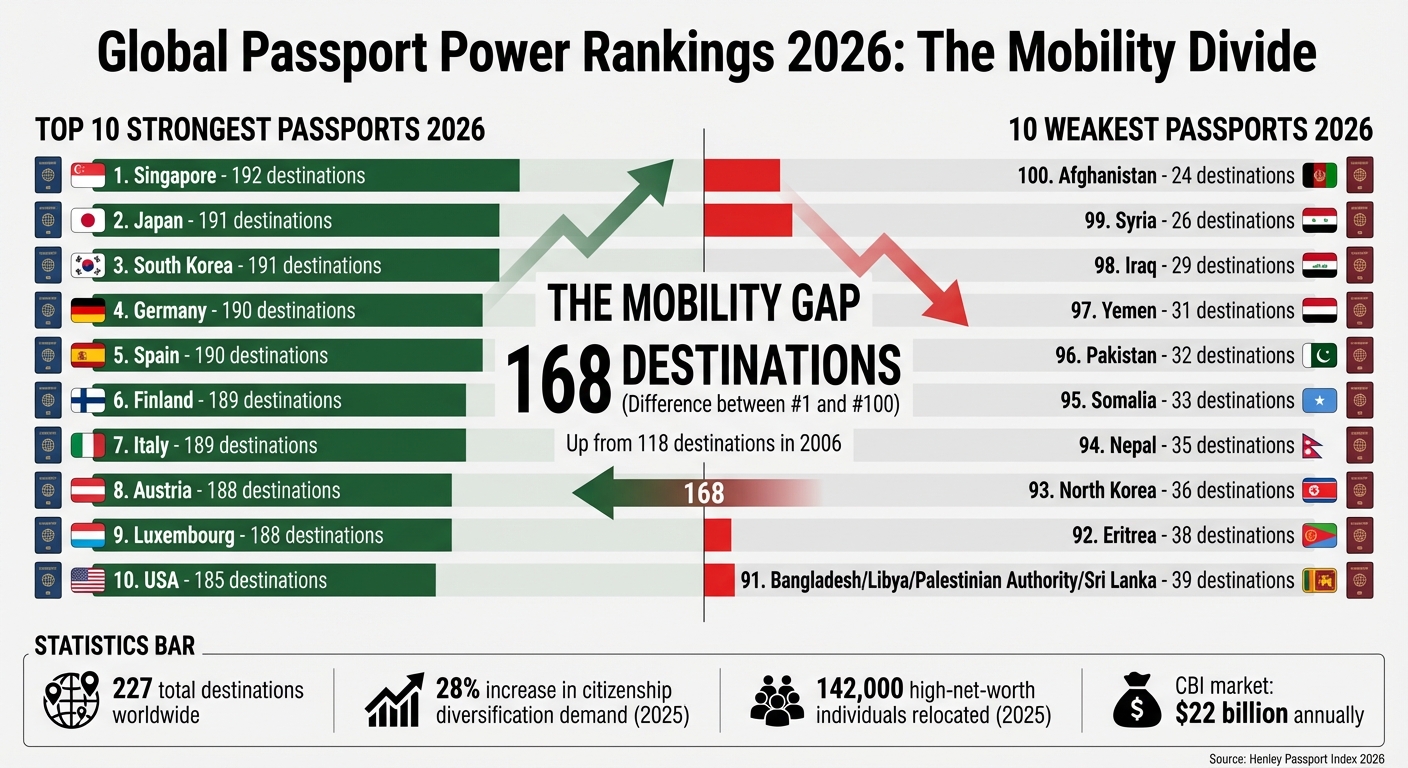
Your passport determines more than just travel – it shapes access to opportunities, security, and wealth. In 2026, the gap between the strongest and weakest passports is wider than ever. For example, Singaporeans enjoy visa-free access to 192 destinations, while Afghan citizens can only travel to 24. This disparity impacts everything from business deals to basic mobility.
Key takeaways:
- Top passport in 2026: Singapore (192 visa-free destinations).
- Weakest passport: Afghanistan (24 destinations).
- Why it matters: Limited passports restrict global access, business opportunities, and economic freedom.
- Solution: Citizenship diversification, such as simplest citizenship programs through investment or ancestry, helps overcome these barriers.
This growing inequality has made acquiring additional citizenships a practical way to secure global mobility, protect assets, and reduce risks. For business owners, asset protection for the entrepreneur is a critical component of this strategy. Here’s how it works and why it’s becoming essential.
How Global Passport Rankings Work
Passport rankings shed light on why some travel documents make international travel effortless while others impose hurdles. The Henley Passport Index is one of the most widely recognized systems for measuring this. It evaluates 199 passports using data from the International Air Transport Association (IATA) Timatic database, which monitors travel documentation requirements across 227 destinations worldwide.
The methodology is straightforward: a passport earns 1 point for visa-free access or immediate entry options like visa-on-arrival, visitor permits, or approved electronic travel authorizations. If a pre-approved visa is required, the passport scores 0 points. The rankings are based on the assumption of adult, solo travelers making standard short-term visits.
What Makes a Passport Strong?
Passport strength is closely tied to a country’s diplomatic standing and global influence. As Misha Glenny, Rector of the Institute for Human Sciences in Vienna, puts it:
"Passport power ultimately reflects political stability, diplomatic credibility, and the ability to shape international rules."
Countries with strong passports tend to have stable governments, thriving economies, low emigration rates, and trusted diplomatic relationships. These factors encourage visa-free agreements and facilitate smoother travel. A prime example is the United Arab Emirates, which has achieved remarkable progress through active diplomacy. Between 2006 and 2026, it added 149 visa-free destinations, marking the largest increase in the history of the Henley Passport Index.
The Gap Between Strong and Weak Passports
The divide between the world’s most powerful and least powerful passports has grown wider than ever. In 2006, the gap between the highest-ranking U.S. passport and Afghanistan’s was 118 destinations. By 2026, that gap had expanded to 168 destinations.
This disparity highlights how mobility privileges are increasingly concentrated among economically dominant nations. Even traditionally strong passports are not immune to change. For instance, the U.S. passport, ranked 4th in 2006, had dropped to 10th by 2026, marking one of the steepest declines over two decades. On the other hand, passports at the bottom of the index remain heavily restricted, leaving their holders isolated and facing significant travel barriers. These trends underscore the stark contrast in global mobility, setting the stage for a closer look at the passports on both extremes of the spectrum.
sbb-itb-39d39a6
The 10 Weakest Passports in 2026
Afghanistan ranks at the very bottom for 2026, offering its citizens access to only 24 visa-free destinations. Following closely are Syria with 26 destinations and Iraq with 29. These rankings highlight a clear trend of geopolitical isolation and limited diplomatic connections. Yemen (31 destinations), Pakistan (32), and Somalia (33) also occupy the lower end of the spectrum. Nepal (35), North Korea (36), and Eritrea (38) round out the list, while Bangladesh, Libya, the Palestinian Authority, and Sri Lanka tie for the 91st position with 39 visa-free destinations each.
| Rank | Country | Visa-Free Destinations |
|---|---|---|
| 100 | Afghanistan | 24 |
| 99 | Syria | 26 |
| 98 | Iraq | 29 |
| 97 | Yemen | 31 |
| 96 | Pakistan | 32 |
| 95 | Somalia | 33 |
| 94 | Nepal | 35 |
| 93 | North Korea | 36 |
| 92 | Eritrea | 38 |
| 91 | Bangladesh / Libya / Palestinian Authority / Sri Lanka | 39 |
This list underscores not just travel restrictions but also the broader geopolitical and economic hurdles these nations face. Afghanistan is the only country with access to fewer than 25 destinations, a situation largely attributed to the Taliban administration’s lack of widespread international recognition and minimal diplomatic engagement.
What Holders of Weak Passports Face
For citizens of these nations, limited passport power creates challenges that extend far beyond travel. Many seek additional citizenships to access broader opportunities, but those without such options encounter what experts describe as a triple burden: restricted mobility, high visa rejection rates, and limited economic prospects. For example, Schengen visa rejection rates for African applicants rose from 18.6% in 2015 to 26.6% by 2024, with seven of the ten countries with the highest rejection rates located in Africa.
These restrictions have real-world consequences. Business travel, studying abroad, and even accessing medical care in other countries become nearly impossible. As Mehari Taddele Maru, Adjunct Professor at the European University Institute, explains:
The poorest individuals face the greatest difficulties when seeking to travel or move to more prosperous countries.
The barriers don’t stop there. New proposals from U.S. Customs and Border Protection could require up to 10 years of digital history – including emails, IP addresses, and social media accounts – along with biometric data. Visa reforms are also increasing fees, extending processing times, and applying stricter surveillance measures, particularly for applicants from these nations. For many, this level of scrutiny makes international travel an unattainable goal.
Prof. Mehari Taddele Maru highlights the inequities of the current system:
What we are witnessing is a form of conditional racial discrimination in visa policymaking, shaped by geopolitical power rather than individual risk.
For millions, their passport represents a barrier to global opportunities rather than a means to access them. These challenges underscore the systemic issues behind weak passport rankings and the need to address the inequalities they reflect.
Why Some Passports Rank So Low
The ranking of a passport isn’t just a random number – it’s a reflection of a nation’s political climate, diplomatic relationships, and economic standing. Countries with low-ranking passports often face a combination of challenges that limit their citizens’ mobility.
Take Afghanistan, for instance. Its passport allows visa-free access to only 24 destinations. This limited access stems from ongoing political instability, conflict, and a lack of international recognition. Similar struggles are seen in Syria and Iraq, where visa-free scores are 26 and 29 respectively. These countries face fractured diplomatic relationships and persistent unrest, which directly impact their citizens’ ability to travel freely.
Economic factors also play a significant role. Passport power often aligns with a nation’s GDP and its access to global wealth. However, the story doesn’t end there. Discriminatory visa policies based on identity or cultural background exacerbate the problem. As Prof. Mehari Taddele Maru from the European University Institute points out:
"Weak economies and discriminatory policies based on identity and culture explain the high rate of rejection for African Schengen visa applicants."
The statistics back this up. While the global average Schengen visa rejection rate is about one in six, African applicants face rejection rates that are far higher. In 2023, African countries made up just 2.8% of global visa applications, yet rejection rates tell a stark story: Comoros saw a 61.3% rejection rate, Guinea-Bissau 51%, and Ghana 47.5%.
Diplomatic isolation further compounds the issue. Countries with limited international engagement struggle to negotiate visa-waiver agreements, leaving their citizens at a disadvantage. This has widened the global mobility gap to unprecedented levels. By 2026, Singapore’s passport will allow visa-free access to 192 destinations, while Afghan citizens will have access to only 24. This staggering 168-destination gap highlights not just economic inequalities but also deeper issues of how nations and their citizens are perceived on the global stage.
These challenges underline the growing importance of diversifying citizenship, as the disparity in mobility rights continues to grow.
Why Citizenship Diversification Matters
The gap between strong and weak passports is growing, making citizenship diversification more important than ever. For individuals with limited mobility due to their passport’s restrictions, acquiring a second citizenship opens doors to global opportunities, greater security, and enhanced economic freedom.
What Citizenship Diversification Means
Citizenship diversification involves obtaining multiple citizenships or residencies to create a more versatile passport portfolio. Instead of depending solely on one country for mobility and legal rights, this strategy gives you options across various jurisdictions. It’s a way to reduce reliance on a single government’s policies or economic conditions.
Think of it as geopolitical insurance. Just like diversifying your financial investments protects your wealth, diversifying citizenship protects your future. Dr. Juerg Steffen, CEO of Henley & Partners, highlights this shift in mindset:
"Investors and wealthy families are adopting a strategy of geopolitical arbitrage to acquire additional residence and/or citizenship options to hedge against jurisdictional risk."
What was once considered a niche strategy has now gained mainstream appeal. For instance, following a significant political event in late 2024, inquiries about citizenship-by-investment skyrocketed by 392%. Prof. Peter J. Spiro of Temple University Law School emphasizes:
"What was once seen as an extreme contingency has become a mainstream form of risk management – a durable Plan B."
This growing interest shows how citizenship diversification can provide tangible benefits, from enhanced travel opportunities to legal and geopolitical flexibility.
Benefits of Holding a Second Citizenship
Diversifying citizenship helps individuals overcome the limitations of weaker passports while unlocking access to global opportunities. Once you have a second citizenship, it can significantly strengthen key aspects of your global strategy.
Here’s how a second citizenship can make an impact:
- Travel freedom: This is often the most immediate benefit. For example, while an Afghan passport allows visa-free travel to just 24 destinations, a Caribbean passport opens access to over 140 countries. The Henley Passport Power score measures this impact by showing how much of the global economy a passport connects you to without a visa. A strong passport can serve as a gateway to international markets.
- Asset protection: A second citizenship can enhance wealth security. Some jurisdictions, like Nevis, have legal structures that protect assets by requiring claimants to post a $100,000 bond before filing a case against a trust. Combined with offshore accounts and trusts, this creates multiple layers of financial protection.
- Geopolitical security: Even traditionally strong passports are facing new restrictions. Between 2025 and 2026, the U.S. and UK lost seven and eight visa-free destinations, respectively, marking their steepest annual declines. This has driven demand for alternative citizenships, with U.S. nationals making up 21% of all applications received by Henley & Partners in 2024. These trends reflect growing concerns about political instability and eroding conditions in previously secure nations.
For families, a second citizenship serves as a legal safe haven during crises like pandemics or civil unrest. It guarantees entry to a stable country and can provide children with better access to education and healthcare systems. In today’s unpredictable world, having multiple citizenships offers an essential layer of security and peace of mind.
How to Get a Second Citizenship or Residency
If you’re looking to overcome the limitations of a less powerful passport, there are several ways to secure a second citizenship or residency. These options vary in cost, time, and requirements, allowing you to choose one that aligns with your goals and resources.
Citizenship by Investment Programs
Citizenship by Investment (CBI) programs offer one of the quickest ways to obtain a second passport. By making a financial contribution – such as a donation, real estate investment, or purchase of government bonds – you can gain citizenship without having to meet lengthy residency requirements.
The Caribbean leads in this space, with five countries – Antigua and Barbuda, Dominica, Grenada, St. Kitts and Nevis, and St. Lucia – setting their minimum investment at $200,000 in 2024. These programs are a major revenue source; for example, Dominica earned approximately $230 million in 2023, accounting for about 37% of its GDP.
Here’s a quick comparison of some popular CBI programs:
| Country | Minimum Investment | Processing Time | Key Advantage |
|---|---|---|---|
| Dominica | $200,000 | 3–6 months | Lowest cost in the Caribbean |
| Grenada | $235,000 | 3–4 months | Access to US E-2 Visa; visa-free to China |
| St. Kitts & Nevis | $250,000 | 3–4 months | Oldest and most stable program |
| Vanuatu | $130,000 | 1 month | Fastest processing globally |
| Turkey | $400,000 | 6–12 months | Real estate in a G20 economy |
Other options include Nauru’s climate resilience program launching in 2025 ($105,000 minimum), São Tomé and Príncipe ($90,000), and El Salvador’s cryptocurrency-based program requiring $1 million in Bitcoin or USDT.
The global CBI market generates around $22 billion annually, with smaller nations earning up to 40% of their GDP from these programs. However, due diligence has become stricter. Many programs now exclude applicants from countries like Russia, Belarus, Iran, and North Korea. For instance, Dominica revoked 260 citizenships in 2023 due to false information provided by applicants.
"Citizenship by investment offers governments economic benefits while providing individuals with global freedom, asset diversification, and security."
– Global Citizenship HQ
For those who prefer a lower upfront cost and are willing to meet residency requirements, residency-based options might be a better fit.
Residency by Investment Programs
Residency by Investment (RBI) programs, often known as "Golden Visas", provide residency permits that can lead to citizenship after meeting certain physical presence requirements, typically over 5–10 years. These programs usually require less initial investment compared to CBI but involve a longer commitment.
Some popular RBI destinations include:
- Greece: €250,000 minimum investment in real estate
- Spain: €500,000 minimum investment
- United States (EB-5 program): $800,000 minimum investment
RBI programs allow you to obtain a residency permit relatively quickly – sometimes in just 2–3 months – but the pathway to full citizenship often takes years.
Following a 2025 European Court of Justice ruling, traditional "Golden Passports" in the EU have largely been phased out. Malta now offers a "Citizenship by Merit" program, which requires 12–36 months of residency and a genuine connection to the country. Investments for this program range from €600,000 to €750,000, including property and donation requirements.
These residency options not only enhance global mobility but also serve as a foundation for long-term security and asset protection.
Citizenship Through Ancestry and Other Routes
If you have family ties to certain countries, you might qualify for Citizenship by Ancestry (Jus Sanguinis, or "right of blood"). This option allows you to claim citizenship if you can prove that a parent or grandparent held citizenship in countries like Ireland, Italy, or Poland.
Other legal pathways include:
- Birthright citizenship (Jus Soli): Granted based on being born in a country.
- Marriage: Some countries expedite naturalization for spouses of citizens.
- Exceptional merit: Available to individuals with extraordinary skills or contributions.
Sierra Leone even offers a unique program for individuals of verified African ancestry, requiring a $100,000 investment confirmed through DNA testing.
To avoid pitfalls, always work with licensed representatives to ensure your application is legitimate. Keep in mind that your current nationality could influence eligibility for certain programs.
"The investment citizenship market is undergoing a transformation from competition based on price to competition based on speed and the conditions for obtaining passports for the entire family."
– Elena Garnitsarik, Head of Legal Department, Passportivity
Whether you’re aiming for immediate citizenship through investment or a slower residency-based route, the key is finding a program that aligns with your travel needs, family situation, budget, and timeline. These options can provide the mobility and security you need to navigate passport limitations effectively.
Using Citizenship Diversification in Wealth Management
Citizenship diversification plays a strategic role in wealth management, offering solutions to the travel restrictions and limitations previously discussed. It has become an essential tool in international planning, complementing strategies like asset protection, tax planning, and privacy measures. A second citizenship functions as a flexible option to relocate, bank, and invest in more secure jurisdictions, ensuring greater financial and personal freedom.
The citizenship-by-investment industry is booming, with an annual market size exceeding $20 billion, alongside $30 billion in residency programs. This growth signifies a shift in perspective: wealthy families now view citizenship as a strategic asset class rather than just a contingency plan. In 2025 alone, an estimated 142,000 high-net-worth individuals relocated globally.
"Real wealth isn’t just about the money in your bank account. It’s about having options – the freedom to choose where you live, work, bank, invest, and protect your family, no matter what happens in any one country."
– Jake Claver, QFOP
This approach takes advantage of varying legal, economic, and political conditions across nations to optimize financial outcomes. When combined with offshore company formation, international banking, and jurisdictional selection, a second citizenship offers enhanced protection and opportunities.
Benefits for Entrepreneurs and Investors
For entrepreneurs and investors, citizenship diversification solves challenges that extend beyond personal mobility. A second passport can unlock banking access that might otherwise be denied due to nationality. Citizens of sanctioned or high-risk countries often face automatic account restrictions at international banks, complicating global business operations. A second citizenship simplifies compliance with Know Your Customer (KYC) requirements and removes these barriers.
Tax planning is another key advantage, particularly for citizens of countries with citizenship-based taxation. For example, U.S. citizens are taxed on their worldwide income, regardless of where they live. By acquiring a second citizenship, American entrepreneurs have a legal pathway to renounce U.S. citizenship and shift to jurisdictions with 0% income tax, such as certain Caribbean or Pacific nations. Following the abolition of the U.K.’s non-domiciled tax regime, applications from British nationals for citizenship-by-investment programs increased by 183% in the first quarter of 2025.
"The tax optimization potential of multiple citizenships isn’t just about lower rates. It’s about alignment between your citizenship, residency, and business interests to create legitimate structures that maximize efficiency while maintaining compliance."
– Tax Attorney specializing in international planning
There are notable examples of this strategy in action. In 2011, billionaire Peter Thiel obtained New Zealand citizenship through investments and philanthropy, securing residency rights well before the country gained popularity as a "safe haven" during global crises. Similarly, former Google CEO Eric Schmidt acquired Cypriot citizenship with a $2.5 million investment, granting him EU travel freedoms and potential tax benefits.
A second passport doesn’t just enhance mobility – it also provides political and financial security. It acts as a hedge against political instability, exit bans, or asset freezes in one’s home country. For example, U.S. citizens accounted for 21% of all investment migration applications in 2024, signaling that even residents of stable nations are seeking additional options.
Building a Complete International Plan
To fully leverage the benefits of citizenship diversification, it should be part of a broader international strategy. This requires a coordinated approach involving legal, tax, and estate planning. Here’s how to build an effective plan:
- Start early, during stable times. Citizenship processes can take months or even years, so it’s crucial to establish a "Plan B" before a crisis arises.
- Align citizenship with your business goals. For example, if your business operates in Europe, a Portuguese passport offers EU mobility. Alternatively, Singapore might be ideal for its political stability and zero capital gains tax.
- Diversify your citizenship portfolio. Wealthy families are increasingly acquiring two or three citizenships to maximize global mobility and tax efficiency.
- Coordinate with offshore structures. Pairing a second citizenship with offshore companies, international trusts, and multi-jurisdictional investments creates a robust financial framework. For instance, Caribbean citizenship with 0% personal income tax complements offshore business structures.
- Explore emerging opportunities. With traditional European programs facing regulatory challenges, new options in Africa and the Pacific are gaining traction. Programs like Nauru’s Climate Resilience Fund also align investments with socially impactful projects.
Citizenship diversification is no longer just for the ultra-wealthy. Families with net worths between $5 million and $10 million are increasingly adopting this strategy as part of a comprehensive international plan. When combined with asset protection, tax planning, and privacy measures, it creates a powerful framework for long-term financial security and freedom.
Conclusion
By 2026, the gap between the world’s most powerful and weakest passports has widened to a staggering difference of 168 destinations, highlighting stark disparities in economic opportunities and personal freedoms. For instance, Singapore passport holders can travel visa-free to 192 countries, while Afghan citizens have access to only 24.
What was once a niche consideration – citizenship diversification – has now become a mainstream strategy for managing global risks. Even individuals from traditionally influential nations are exploring alternatives. In fact, the demand for alternative citizenship options rose 28% year-over-year in 2025, with approximately 142,000 high-net-worth individuals relocating internationally. These numbers reveal a shift in how people view citizenship and its role in shaping opportunities.
"Today, passport privilege plays a decisive role in shaping opportunity, security, and economic participation."
– Dr. Christian H. Kaelin, Chairman, Henley & Partners
Planning ahead is crucial. Citizenship applications can take months or even years, so acting during stable times is key. Whether you’re looking to overcome visa restrictions, optimize taxes, or protect against political risks, a second citizenship offers the flexibility to live, work, and safeguard your assets in a country of your choice.
As discussed earlier, strategic citizenship planning is no longer the exclusive domain of the ultra-wealthy. More individuals and families are incorporating alternative citizenship into their broader wealth management strategies. Paired with tools like offshore accounts, international banking, and jurisdictional diversification, this approach ensures both financial security and global mobility. Start planning now to build a more resilient financial future.
FAQs
How do I choose the best second passport for my goals?
When deciding on the best second passport, focus on a few critical factors: how quickly the process can be completed, the range of visa-free travel it provides, and the financial investment required. Opt for countries with streamlined, efficient programs and passports that grant broad travel access. Match your choice to your specific goals – whether you’re seeking tax advantages, greater mobility, or added security. Also, evaluate the country’s political stability and any potential limitations to ensure the passport aligns with both your personal and professional priorities.
What are the biggest risks of citizenship-by-investment programs?
The risks tied to citizenship-by-investment (CBI) programs are worth considering carefully. Geopolitical instability, for instance, can jeopardize both your investment and citizenship status if the country faces political turmoil.
There’s also the issue of regulatory changes. International scrutiny often surrounds these programs, especially when concerns arise about their misuse for illegal activities such as tax evasion or money laundering. Such scrutiny can lead to sudden changes in program policies or even their suspension.
Another factor is reputational concerns. Some nations impose restrictions or withdraw benefits, like visa-free travel, for participants in CBI programs. This can significantly reduce the advantages you initially sought when opting for such citizenship.
Ultimately, these risks highlight the importance of thorough research and strategic planning before committing to any CBI program.
Can a second citizenship reduce visa denials and banking restrictions?
A second citizenship can open doors to smoother travel and fewer banking hurdles. With it, you gain access to more countries without the need for visas, significantly reducing the chances of visa denials. On top of that, it can provide easier access to financial services by lessening the impact of regulatory restrictions. This added mobility and flexibility can make pursuing global opportunities far more convenient.
