
Portugal’s Golden Visa program has shifted significantly since October 2023. Real estate investment is no longer an option, and the focus is now on regulated funds, donations, and company investments. While the five-year path to citizenship remains, processing times have extended to 12–18 months. Here’s what’s new:
- Key Changes: Real estate routes were eliminated, replaced by €500,000 fund investments or €250,000 donations.
- Residency Requirements: Still minimal – just 7 days per year in Portugal.
- Citizenship Timeline: Stays at 5 years after investment, with language requirements.
- Investment Liquidity: Funds are locked for 7–10 years; donations are non-refundable.
- Returns: Fund investments can yield 3–15%, depending on the type.
If you’re looking for EU residency and citizenship without property ownership, the program still offers a clear path. However, it now suits those prioritizing portfolio diversification or simple donation-based residency.
What Changed in the Portugal Golden Visa Program in 2026
In October 2023, Portugal introduced sweeping reforms to its Golden Visa program through Decree-Law No. 56/2023. These changes eliminated all real estate investment options, including the €500,000 property purchase and €350,000 rehabilitation routes. These two options alone had accounted for approximately €6.45 billion – or 88% of the €7.3 billion total investment since 2012. The reforms also removed the €1.5 million capital transfer and bank deposit routes, shifting the program’s focus toward investments in productive sectors.
The reforms were driven by growing concerns about housing affordability. Between 2012 and 2023, property prices surged by 55%, while local incomes increased by just 9%. By 2022, nonresident buyers were responsible for more than 11% of home purchases in Lisbon. The Mais Habitação law aimed to curb foreign speculation in residential markets, particularly in Lisbon, Porto, and the Algarve, where Golden Visa investments were often seen as contributing to rising costs and displacing local residents.
New Investment Options
The updated program now emphasizes different investment routes. Key options include:
- €500,000 investments in CMVM-regulated funds (e.g., venture capital, private equity, or real estate funds), with at least 60% of the capital required to support Portuguese companies.
- Cultural heritage donations of €250,000 (€200,000 in low-density areas).
- Scientific research contributions of €500,000.
- Company investments of €500,000, provided they create at least five permanent jobs.
Despite legislative proposals to extend the citizenship eligibility timeline from five to ten years, the Constitutional Court blocked this change in late 2025. The five-year timeline for citizenship remains intact.
Streamlined Processing and Strong Demand
Processing times for Golden Visa applications have significantly improved, dropping to 12–18 months in 2026 from over 24 months in 2024. This improvement is largely due to a €70 million digital modernization initiative that cleared a backlog of around 20,000 cases. The program generated approximately €30 million in fees in 2025.
Interestingly, demand for the program remained strong even after the removal of real estate options. In 2024, the program issued 4,990 permits – a 72% increase compared to the previous year – making it the most successful year on record.
"€500,000 is now the floor for most eligible fund investments, replacing the old real-estate shortcut." – Sofia Duarte, The Portugal Post
sbb-itb-39d39a6
1. Pre-2023 Real Estate Investment Route
Before the 2023 reforms, the real estate pathway was the cornerstone of the Portugal Golden Visa program. From 2012 to 2026, this route attracted over 12,000 international investors and their families, generating more than €7.5 billion in foreign investment. The process was straightforward: investors purchased property, held it for five years, and became eligible to apply for citizenship.
Minimum Investment Amount
The program offered four distinct investment thresholds based on property type and location:
- Standard properties (residential or commercial): $527,000 (€500,000).
- Low-density areas: A 20% discount applied, reducing the threshold to $422,000 (€400,000).
- Rehabilitation projects: Properties over 30 years old or in urban renewal zones required $369,000 (€350,000).
- Rehabilitation in low-density areas: The lowest threshold was $295,000 (€280,000).
Residency and Citizenship Path
This route offered flexibility, requiring minimal time spent in Portugal. Investors could live elsewhere while working toward citizenship. After five years of property ownership and passing an A2-level Portuguese language test, applicants could apply for citizenship. The program also extended benefits to family members, including visa-free travel across the Schengen Area for spouses, children, and dependent parents.
Investment Liquidity and Returns
Real estate investments typically yielded annual returns of 3%–5%, though these were subject to a 28% tax rate. However, the upfront and ongoing costs were notable:
- Transfer taxes (IMT): 5%–6.5%.
- Stamp duty: 0.8%.
- Annual municipal taxes (IMI): 0.3%–0.45% of the assessed property value.
Unlike fund-based investments, real estate lacked liquidity. Selling required finding a buyer, negotiating terms, and covering agent commissions. Investors could only liquidate their assets after securing permanent residency or citizenship, typically at the five-year mark.
Regulatory Risks
In October 2023, Portugal ended all real estate options under Decree-Law No. 56/2023. This decision was driven by concerns about housing affordability, particularly in Lisbon and Porto, where property prices had surged 55%, while local incomes rose just 9%. However, investors who entered the program before the reforms were protected by grandfathering clauses, allowing them to complete the five-year path to citizenship if they retained their properties until then.
This regulatory shift highlighted how residency-by-investment programs can be influenced by political and economic factors. In the next section, we’ll explore the updated 2026 investment options and how they compare to these earlier pathways.
2. 2026 Fund and Cultural Donation Options
Portugal’s revamped Golden Visa program has shifted its focus to investments in productive sectors and supporting cultural initiatives. The two main pathways now include investment funds and cultural donations. For the fund route, applicants must invest a minimum of $527,000 (€500,000) in a CMVM-regulated Portuguese investment fund. The cultural donation option involves a non-refundable contribution of $263,500 (€250,000) to projects promoting arts, culture, or the preservation of national heritage – or $211,000 (€200,000) in designated low-density areas. A third option, focused on scientific research, requires $527,000 (€500,000), with a reduced threshold of $422,000 (€400,000) in low-density regions.
Minimum Investment Amount
For the fund option, the investment must go into a CMVM-registered fund, with at least 60% of its capital allocated to Portuguese companies or projects. These funds typically target various sectors, such as:
- Venture capital: Expected returns of 8–15%
- Private equity: Anticipated returns of 6–12%
- Real estate funds: Projected returns of 4–8%
- Balanced portfolios: Estimated returns of 3–7%
Cultural donations, by contrast, are one-time non-refundable contributions. The standard requirement is $263,500 (€250,000), reduced to $211,000 (€200,000) in low-density areas. All projects must first receive approval from GEPAC, the Ministry of Culture in Portugal.
Additional government fees apply to both pathways. These include an initial residence permit fee of about $8,500 (€8,060) and processing charges of around $850 (€807) per applicant. Renewals, required every two years, cost approximately $4,250 (€4,030) per person.
Residency and Citizenship Path
Both pathways share the same residency requirements: applicants must spend at least seven days per year in Portugal. Citizenship eligibility is granted after five years, provided the investment is maintained. In late 2025, Portugal’s Constitutional Court rejected a proposal to extend the citizenship timeline to 10 years, keeping the five-year track intact for 2026 applicants. However, processing delays have stretched the timeline for residence card issuance to 12–18 months, despite official estimates of 6–8 months. Applicants must also pass an A2-level Portuguese language test to qualify for citizenship.
Investment Liquidity and Returns
Fund investments are typically illiquid, as most are structured as closed-end funds with a capital lock-in period of seven to 10 years – often exceeding the five-year citizenship requirement. For instance, a 2% annual management fee on a $527,000 (€500,000) investment would amount to roughly $73,800 (€70,000) over seven years. On the other hand, cultural donations do not offer any financial returns, as they are purely contributions without ongoing market exposure or asset management concerns.
Between 2019 and 2024, the fund route raised about $275 million (€260.85 million), while cultural donations saw a 165% surge in 2024 due to their lower entry cost. For investors, understanding these liquidity constraints is crucial when aligning either option with their broader financial goals.
"The fund route had existed before 2023 but was rarely used because real estate was simpler… Now that real estate is gone, the fund ecosystem has matured rapidly." – Golden Keys Global
Regulatory Risks
CMVM-regulated funds ensure audited financials and independent custodians, but they do not guarantee returns or protect against losses. Fund performance depends on the expertise of fund managers and market conditions, making it essential for investors to work with professionals familiar with Portuguese markets. While cultural donations carry no market risk, due diligence is still necessary to ensure compliance with GEPAC-approved project standards. Both pathways remain subject to potential legislative changes in the future.
Advantages and Disadvantages
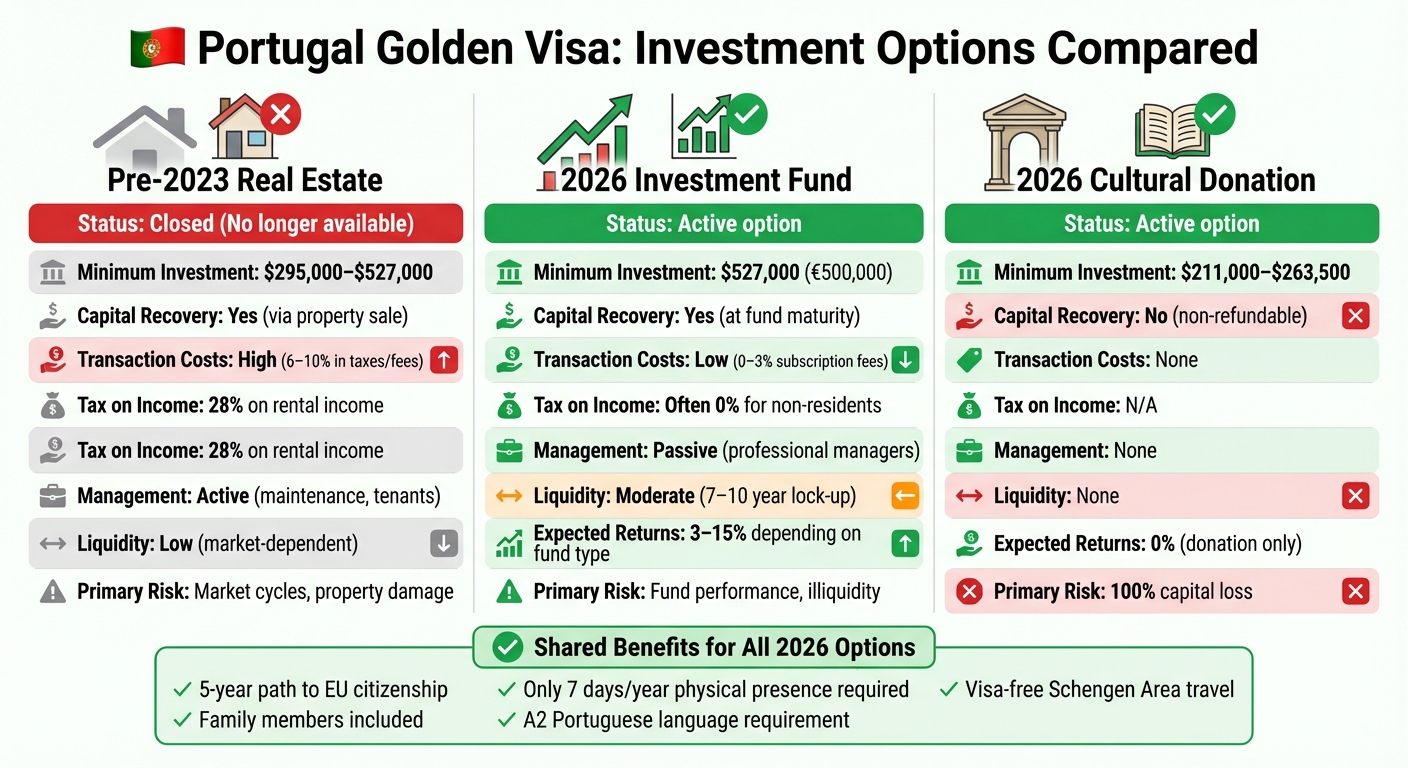
Let’s break down the benefits and challenges of the pre-2023 real estate path compared to the 2026 fund and donation options.
The pre-2023 real estate route allowed for direct ownership of a physical asset – something tangible you could visit, rent out, or sell later. However, it came with high transaction taxes and a flat 28% tax on rental income. On top of that, annual property taxes (IMI) ranged from 0.3% to 0.45% of the property’s assessed value. While resale could recover capital, profits depended heavily on market conditions. On the other hand, the 2026 options shifted the burden of management, either through professional fund oversight or straightforward cultural contributions.
The 2026 fund route offers a passive investment approach. Managed by CMVM-regulated professionals, these funds often provide tax advantages, with non-residents frequently paying 0% tax on dividends. Venture capital funds aim for an 8–15% internal rate of return (IRR), while real estate funds target 4–8%. However, the downside is illiquidity – your capital is typically locked up for 7–10 years, with possible extensions of 1–2 years. You also lose direct control over the asset.
Cultural donations come with the lowest entry cost: $263,500 (€250,000) or $211,000 (€200,000) in low-density areas. There’s no market risk or management hassle, but the capital is entirely non-recoverable – it’s a one-way contribution with no financial return. This option is best suited for those prioritizing residency over investment growth.
Here’s a quick comparison of the three pathways:
| Feature | Pre-2023 Real Estate | 2026 Investment Fund | 2026 Cultural Donation |
|---|---|---|---|
| Minimum Investment | $295,000–$527,000 | $527,000 | $211,000–$263,500 |
| Capital Recovery | Yes (via sale) | Yes (at maturity) | No (non-refundable) |
| Transaction Costs | High (6–10% taxes/fees) | Low (0–3% subscription fees) | None |
| Tax on Income | 28% on rental income | Often 0% for non-residents | N/A |
| Management | Active (maintenance, tenants) | Passive (professional managers) | None |
| Liquidity | Low (market-dependent) | Moderate (7–10 year lock-up) | None |
| Primary Risk | Market cycles, property damage | Fund performance, illiquidity | 100% capital loss |
Despite their differences, both the fund and donation routes provide the same residency benefits. These include visa-free travel across the Schengen Area, the right to live and work in Portugal, and eligibility for citizenship after five years. Additionally, the physical presence requirement is minimal – just seven days per year. This shared benefit makes the program attractive for those focused on wealth management and asset protection. For tailored advice on these structures, consider private consultations to align your investment with your long-term goals.
Conclusion
The Portugal Golden Visa has transitioned from focusing on direct real estate ownership – often burdened with high transaction costs – to emphasizing professionally managed funds and non-refundable cultural contributions. Although the approach has evolved, the core advantages of EU residency and access to diverse investment opportunities remain intact.
This program still offers a 5-year path to EU citizenship, requires just 7 days of physical presence per year, and includes visa-free mobility within the Schengen Area. These elements make it an attractive option for investors seeking long-term value. The updated structure also invites different investor profiles to reevaluate their strategies.
The program now resonates with three main groups: those looking for a "Plan B" for mobility without immediate relocation, investors integrating a $527,000 (€500,000) fund investment into their broader portfolio, and individuals aiming for the quickest route to an EU passport. These categories highlight how the Golden Visa continues to address various objectives, from wealth management to asset protection. Mark Damsgaard, Founder of Global Residence Index, emphasizes:
"Because the current rules [5-year citizenship path] remain in place, now is a good time to begin the process. Applicants who start the process now put themselves in the strongest possible position before any future changes take effect."
The move away from property ownership has added a layer of professionalism to the investment process. Funds regulated by CMVM now offer target returns ranging from 3–15%, depending on the investor’s risk tolerance. For those comfortable with lock-up periods of 7–10 years and who prefer passive management over hands-on control, this fund-based option provides both residency benefits and the potential for capital growth.
If your priorities include EU mobility, tax diversification, and long-term citizenship rather than owning property outright, the Portugal Golden Visa remains a compelling choice in 2026.
FAQs
Can I still qualify if I previously bought property for the Golden Visa?
Yes, you can still qualify for the Portugal Golden Visa if you’ve already purchased property under the program. Although Portugal has phased out the direct property-to-residency option, owning real estate can still play a role in supporting other visa applications. Plus, the pathway to citizenship remains available.
Which CMVM-regulated funds are eligible, and how do I vet them?
To qualify for Portugal’s Golden Visa in 2026, investment funds must meet specific criteria. These funds need to be registered and supervised by the Portuguese Securities Market Commission (CMVM), with a minimum investment requirement of €500,000.
When evaluating these funds, it’s crucial to:
- Verify CMVM Registration: Ensure the fund is officially registered with the CMVM.
- Understand the Fund’s Details: Look into its management team, investment strategy, associated risks, lock-up period, and potential returns.
- Seek Professional Advice: Work with a financial advisor who has expertise in CMVM-regulated funds to guide your decisions.
This approach helps ensure your investment aligns with both the Golden Visa requirements and your personal financial goals.
With 12–18 month processing, when does the 5-year citizenship clock start?
The 5-year countdown to Portuguese citizenship begins only after your Golden Visa application is approved. Since the processing period usually takes about 12–18 months, the timeline for citizenship officially starts once this approval is finalized.
