
In today’s unpredictable global environment, relying on a single citizenship can expose you to risks like travel restrictions, sudden tax hikes, or limited financial access. A passport portfolio – holding multiple citizenships – offers flexibility to live, work, invest, and secure your wealth across borders. Here’s what you need to know:
- Why Multiple Citizenships Matter: They enhance global mobility, reduce tax burdens, protect assets, and unlock business opportunities.
- How Many Passports?: It depends on your goals. Two or three well-chosen options often suffice for most people.
- Top Programs:
- Caribbean: Quick processing, low taxes, visa-free travel to 150+ countries (e.g., St. Kitts, Grenada).
- Europe: Long-term residency-to-citizenship paths (e.g., Portugal, Malta).
- Special Features: Grenada offers U.S. E-2 Visa eligibility; Malta provides full EU rights.
- Costs: Investments range from $90,000 (São Tomé) to $750,000+ (Malta), with legal fees and compliance costs.
- Risks: Stay compliant with tax laws and monitor geopolitical shifts that may impact program benefits.
Building a passport portfolio isn’t just about travel; it’s a tool for safeguarding your financial future and personal freedom. Start planning during stable times to ensure you’re prepared for any changes.
Benefits of Holding Multiple Citizenships
Having multiple citizenships gives you the flexibility to live, work, manage finances, and invest in different parts of the world. It’s like having a key that unlocks options across borders.
One of the most obvious perks is greater global mobility. For instance, a St. Kitts and Nevis passport provides visa-free access to 152 countries, while Portugal’s passport opens doors to over 180. Some citizenships go even further, granting access to entire regions. An EU passport allows you to live and work across all 27 member states, while Caribbean citizenships facilitate movement within the Caribbean Community. This level of freedom is not just about travel – it’s a cornerstone of broader strategies for financial security and personal freedom.
Tax benefits are another big draw, especially when combined with thoughtful residency planning. Many Caribbean nations, like St. Kitts & Nevis, Antigua & Barbuda, and Dominica, don’t impose personal income, capital gains, or inheritance taxes. For U.S. citizens, a second passport can help manage the challenges of global taxation. This setup allows individuals to structure their lives as "fiscal nomads", avoiding high-tax residency while maintaining permanent rights elsewhere.
In addition to mobility and tax planning, holding citizenships in multiple jurisdictions bolsters asset protection. For example, Nevis’s International Exempt Trusts require a $100,000 bond before creditors can make claims, adding a layer of financial security. Furthermore, alternative citizenship can resolve banking challenges, particularly as international banks grow more cautious about serving clients from sanctioned or high-risk countries.
Beyond personal and financial advantages, multiple citizenships can unlock business opportunities. Grenada’s citizenship program, which generated $412 million in 2024, provides access to the U.S. E-2 Investor Visa, making it easier to establish a business in the U.S.. Similarly, EU citizenships grant access to top-tier healthcare and education systems across Europe, offering long-term benefits for families.
Whether you’re looking to expand your options, protect your assets, or improve your quality of life, multiple citizenships offer a range of opportunities that go far beyond just holding a passport.
sbb-itb-39d39a6
How Many Citizenships Do You Need?
The number of citizenships you should hold depends entirely on your personal goals. For some, two passports might be enough, while others might find value in holding four or more. The key is aligning your passport strategy with your unique needs, rather than aiming for an arbitrary number.
Define Your Goals and Priorities
Start by identifying your primary objectives. Are you looking for visa-free travel to specific regions? Do you want to reduce your tax obligations? Are you aiming for asset protection against political or economic instability? Or is your focus on securing better healthcare and education for your family?
Your existing citizenship plays a significant role here. For instance, U.S. citizens are subject to worldwide taxation, making a second citizenship vital for those planning to renounce their U.S. citizenship. On the other hand, individuals from countries with limited visa-free access often prioritize passports that open doors to major economic hubs.
For entrepreneurs, a citizenship offering regional access – like an EU passport – can be a game-changer. The citizenship-by-investment industry, now valued at over $20 billion annually, is increasingly seen as a way to gain "call options" for relocating, banking, or investing in different jurisdictions as global conditions evolve.
Once you’ve set your priorities, consider diversifying your citizenships across regions to reduce risks tied to specific areas.
Geographic and Economic Diversification
To protect your assets and ensure mobility, it’s wise to spread your citizenships across regions with different political and economic climates. This strategy helps mitigate risks tied to specific countries or regions.
A popular framework is the "Four Passport" rule, which suggests:
- An EU citizenship for access to 27 member states
- A North or Latin American passport for economic stability
- A Middle Eastern or Asian passport for market access
- A "wild card" passport in an emerging market for growth potential
While four passports offer comprehensive diversification, many people find that two or three carefully chosen citizenships can meet their needs just as effectively.
Geographic diversification also enhances what’s called "Economic Mobility" – the percentage of global GDP you can access visa-free. This highlights the practical value of a passport that connects you to major economic centers, rather than just smaller or less significant economies.
Balancing the geographic spread of your passports with the financial costs involved is essential for a smart citizenship strategy.
Cost vs. Benefit Analysis
Investing in a new citizenship is a major decision that requires weighing upfront and ongoing costs against long-term benefits. Think of it as a way to protect and grow your assets.
Here’s a comparison of some of the simplest citizenship programs in the world:
| Factor | Caribbean (e.g., St. Kitts) | Oceania (e.g., Vanuatu) | Europe (e.g., Portugal) | Africa (e.g., São Tomé) |
|---|---|---|---|---|
| Min. Investment | $250,000 | $130,000 | $500,000 (Fund) | $90,000 |
| Processing Time | 3–6 months | 1–2 months | 5 years (Residency) | 2 months |
| Tax Regime | 0% income tax | 0% income tax | EU tax reporting | Varies |
| Visa-Free Access | 150+ countries | 90+ countries | 180+ countries | 70+ countries |
| Key Benefit | Tax efficiency | Fast processing | EU market access | Low entry cost |
Additional costs include legal fees ($50,000–$100,000 per application), ongoing compliance, tax reporting, and maintenance. Some programs allow you to recover real estate investments after 3–5 years, while others require non-refundable contributions.
The immediate perks of a new citizenship include visa-free travel and expanded banking options. Over the long term, the benefits extend to future generations through transferable citizenship rights.
"Think of additional citizenships as call options with no expiration date. You might not exercise them for years, but they provide the right – not the obligation – to invoke citizenship privileges." – Jake Claver, QFOP, Digital Ascension Group
It’s smart to start building your citizenship portfolio during stable times. The process can take anywhere from a month (Vanuatu) to several years (Malta). Waiting for a crisis to act often means it’s too late. The citizenship-by-investment market continues to change, with EU programs phasing out after a 2025 European Court ruling and new opportunities emerging in Argentina, Botswana, and St. Vincent and the Grenadines in 2026.
Top Countries for Second Citizenship Programs
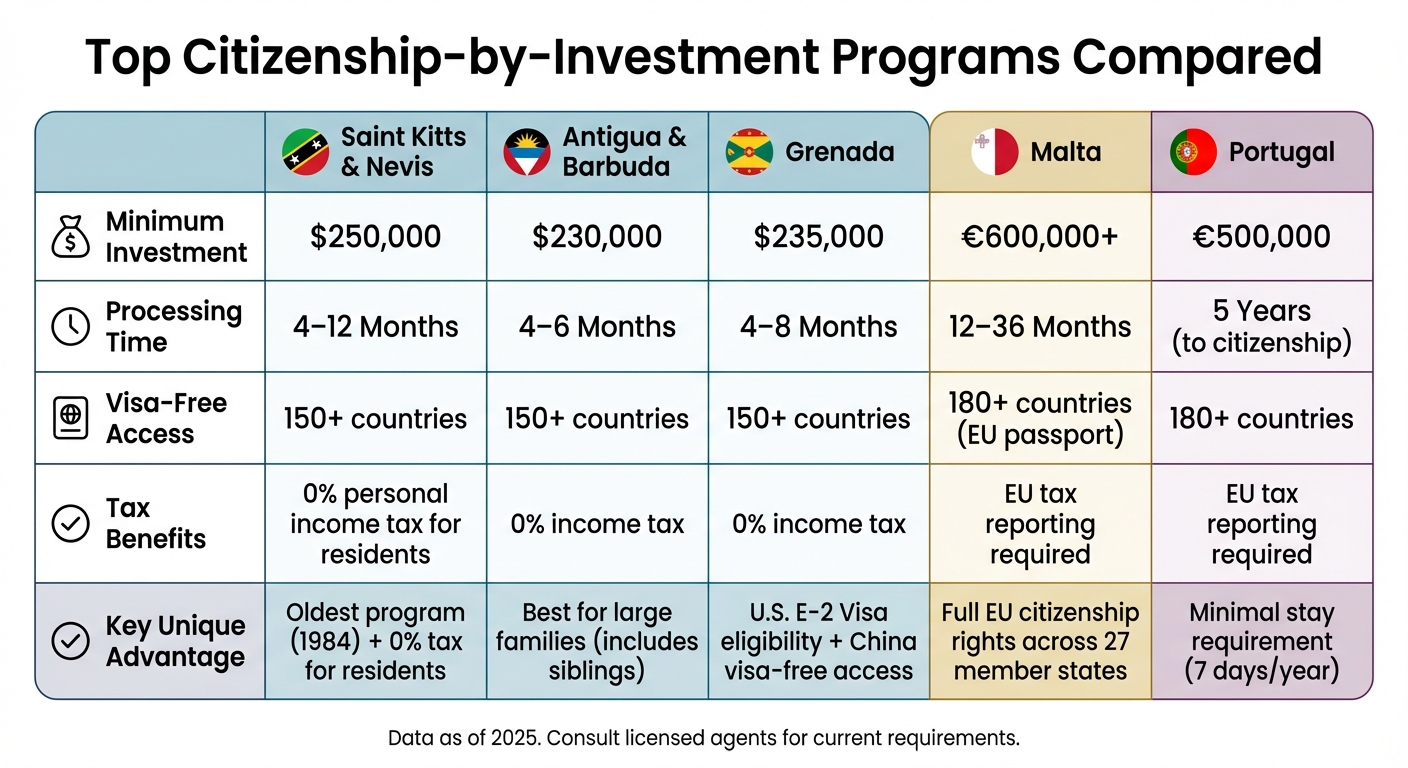
When considering second citizenship programs, it’s essential to evaluate them based on your specific goals – whether that’s global mobility, tax benefits, or family inclusion. Since the European Court of Justice ended direct EU-based programs in 2025, the focus has shifted to Caribbean nations and alternative paths that offer tailored benefits. Below, we explore some of the leading programs and their standout features.
Saint Kitts and Nevis
As the oldest citizenship-by-investment program, established in 1984, Saint Kitts and Nevis has built a reputation for reliability.
The program requires a minimum investment of $250,000 through the Sustainable Island State Contribution or $325,000 in approved real estate. Processing takes between 4–12 months, and the passport offers access to over 150 destinations visa-free or with visa-on-arrival privileges, making it the most robust travel document among Caribbean programs.
One of its key advantages is the 0% personal income tax for tax residents, which appeals to entrepreneurs and investors looking for tax efficiency. However, you’ll need to establish official tax residency to benefit from this perk. Starting April 14, 2026, biometric data will be required for new applicants, with existing citizens needing to comply by July 31, 2027.
Antigua and Barbuda
Antigua and Barbuda’s program is particularly appealing to families. It’s the only Caribbean option that allows unmarried siblings of both the main applicant and spouse to be included, with no age restrictions.
The investment starts at $230,000 for a family of four. For larger families, the University of the West Indies (UWI) Fund option costs $260,000 and covers up to six members. The program also offers broad travel access and requires only five days of physical presence within the first five years of citizenship. Processing typically takes 4–6 months, and applications must go through licensed agents.
Grenada
Grenada stands out for its unique benefits, including eligibility for the U.S. E-2 Investor Visa and visa-free access to China – features unmatched by other Caribbean programs.
The minimum contribution is $235,000 for a family of four or $270,000 in approved real estate. Processing takes 4–8 months, and the program has seen a surge in popularity, with applications increasing from 1,251 in 2022 to around 1,700 in 2023.
To qualify for the U.S. E-2 Visa, applicants must reside in Grenada for at least three years, making it an ideal option for those planning genuine business expansion into the U.S. market.
"Grenada’s program ranks first for 2025, combining US E-2 Investor Visa eligibility, visa-free access to China, and the Saudi Arabia eVisa arrangement." – NTL International Specialized Team
Malta
Malta offers the only legal route to full EU citizenship through investment following the 2025 changes. Its program, now known as "Citizenship by Merit", requires 12–36 months of residency before citizenship is granted.
The investment ranges from €600,000–€750,000, along with a €10,000 donation and either property purchase or rental. Though it’s more expensive and time-intensive than Caribbean options, Malta provides full EU rights, including the ability to live, work, and study across all 27 member states.
The previous program generated over €1.8 billion in revenue for Malta, and the current model continues to maintain strict due diligence standards, ensuring compliance with EU regulations.
Portugal
Portugal’s Golden Visa offers a residency-to-citizenship pathway rather than direct citizenship. With minimal physical presence requirements – just seven days per year – it’s an attractive option for those willing to wait five years for citizenship.
The investment starts at €500,000 in qualifying funds. After five years of residency, applicants can apply for full Portuguese citizenship, which grants visa-free access to over 180 countries and full Schengen Area privileges. This program remains a compliant and accessible route to EU membership rights, even as other EU citizenship-by-investment options have closed.
| Country | Min. Investment | Processing Time | Key Unique Advantage |
|---|---|---|---|
| St. Kitts & Nevis | $250,000 | 4–12 Months | 0% personal income tax for residents |
| Antigua & Barbuda | $230,000 | 4–6 Months | Best for large families (includes siblings) |
| Grenada | $235,000 | 4–8 Months | U.S. E-2 Visa eligibility & China access |
| Malta | €600,000+ | 12–36 Months | Full EU citizenship rights |
| Portugal | €500,000 | 5 Years (to citizenship) | Minimal stay (7 days/year) for EU path |
How to Build and Maintain Your Passport Portfolio
Creating a diversified passport portfolio requires thoughtful planning and a commitment to staying compliant with legal and tax obligations. Here’s how to get started and keep your portfolio in good standing.
Step 1: Define Your Goals and Priorities
Before diving in, take a moment to clarify your objectives. Think of additional citizenships as strategic tools – similar to "call options" with no expiration date. To narrow your focus, evaluate what matters most to you across these seven parameters: Business Opportunity, Climate Resilience, Economic Mobility (access to global GDP), Premium Education, Quality of Life, Private Healthcare, and Safety and Security.
Ask yourself what’s driving your decision. Are you looking to escape political instability or high taxes? Or are you drawn to opportunities like expanding your business or securing better education for your kids? Don’t forget to think long-term. Citizenship can often be passed down to your children and grandchildren, offering benefits like settlement rights, access to top schools, and streamlined inheritance planning.
Timing is key. Building your portfolio during stable periods is far more effective than scrambling during a crisis, when processing times may increase or eligibility rules could tighten. Once your goals are clear, you can move on to finding the right citizenship programs.
Step 2: Research Citizenship Programs
With your priorities in mind, the next step is to research programs that align with your goals. Use tools like the Henley Citizenship Program Index to compare options. Make sure the programs you’re considering are legitimate – look for government approval and adherence to regulations like Anti-Money Laundering (AML) and Counter-Terrorism Financing (CTF). Reputable programs conduct thorough checks on applicants and funding sources, so transparency is critical to building a sustainable portfolio.
Some programs, especially in Europe, have "genuine link" requirements. For example, Malta’s Citizenship by Merit program typically requires 12–36 months of residency before granting citizenship. When evaluating investment options, pay attention to the minimum holding period for real estate (usually 3–7 years) and the differences between donation-based and real estate-based pathways. To avoid scams, work with government-authorized agents, especially since many Caribbean programs now require interviews for adult applicants.
Step 3: Apply and Diversify
A well-rounded passport portfolio benefits from regional diversity. Instead of relying on just one citizenship, consider combining a Caribbean passport with one from Europe. This approach helps balance regulatory and mobility advantages while spreading risk across jurisdictions with different political and economic environments.
Processing times vary widely. Programs in places like Vanuatu and Nauru can take as little as 1–3 months, while those in the Middle East often require 6–12 months. Malta’s residency-to-citizenship route takes longer – typically 12–36 months. Holding assets in a country where you hold citizenship can also provide legal protections, as local courts may require creditors to re-litigate claims under local laws.
Step 4: Maintain Compliance with Tax and Reporting Obligations
Getting a second passport doesn’t automatically change your tax obligations. To adjust your tax residence, you’ll need to follow formal procedures with the help of experienced international tax attorneys. Keep in mind that most countries require citizens to report their worldwide income and assets. For U.S. citizens, this is especially important, as the U.S. enforces citizenship-based taxation regardless of where you live.
Compliance is critical. Stay on top of regulations like the Foreign Account Tax Compliance Act (FATCA) and the Common Reporting Standard (CRS) to avoid legal trouble. Banks also perform strict Know Your Customer (KYC) checks, and having a reputable second citizenship can make this process smoother.
For U.S. citizens, a second passport is often a necessary step before considering renunciation of U.S. citizenship to manage tax liabilities. However, renouncing citizenship is a permanent decision that requires careful consideration and legal advice. Finally, ensure all offshore structures are properly reported to the relevant authorities and prioritize transparent, well-established programs to maintain the integrity of your passport portfolio.
Compliance and Risks of Multiple Citizenships
Building a passport portfolio can be appealing, but it comes with legal challenges and risks that demand careful consideration. Being aware of these complexities ahead of time can help you avoid costly missteps and maintain a sound citizenship strategy.
Dual Citizenship Legality
While many countries now allow dual or multiple citizenships, the rules vary significantly. For instance, nations like the United States, United Kingdom, Canada, and France impose no restrictions on holding multiple citizenships. On the other hand, countries such as China and Japan generally forbid dual citizenship, requiring individuals to renounce their original nationality when acquiring a new one. Germany recently changed its stance, permitting dual citizenship in all cases as of June 27, 2024. Spain follows a selective policy, permitting dual citizenship mostly with Ibero-American countries, Portugal, and the Philippines, while requiring others to give up their original citizenship.
Some countries make renunciation almost impossible. For example, Argentina and Iran do not acknowledge voluntary renunciation, meaning you could remain subject to their laws indefinitely. If you’re considering a second citizenship, ensure you understand the process for exiting that arrangement if necessary. Also, be mindful of specific passport requirements. For example, U.S. citizens are required by law to enter and leave the United States using their U.S. passport. These legal nuances are just the beginning; financial compliance adds another layer of complexity.
Tax Reporting and Regulatory Compliance
Having additional citizenships doesn’t exempt you from tax obligations. The United States and Eritrea are the only two countries that tax their citizens on worldwide income, regardless of where they live. For U.S. citizens, this means filing annual tax returns even if tax credits or exclusions reduce your liability. You’re also required to report foreign financial accounts through FBAR (FinCEN Form 114) if the total balance exceeds $10,000 at any point in the year. Additionally, Form 8938 under FATCA must be filed if specified foreign assets exceed thresholds ranging from $200,000 to $600,000 for those living abroad.
Failure to comply can result in hefty penalties – ranging from thousands to hundreds of thousands of dollars per violation – and could even lead to passport issues. The IRS has the authority to notify the U.S. State Department of unpaid tax debts, which could result in the denial or revocation of your passport. Furthermore, certain U.S. states, like California, Virginia, South Carolina, and New Mexico, may continue to tax you until you formally cut all residency ties.
Geopolitical Risks and Program Sustainability
Beyond legal and tax obligations, geopolitical shifts can impact your citizenship portfolio. Citizenship-by-investment programs, for example, are particularly vulnerable to sudden changes. In 2025, Malta ended its "golden passport" program following a ruling by the European Union’s top court. That same year, Italy tightened its citizenship-by-descent rules, limiting eligibility to two generations, and Portugal proposed doubling its residency requirement for naturalization from five to ten years.
"The receiving countries are getting wise to these calculated uses of citizenship. There’s an understanding that even if you’re eligible today, you may not be tomorrow. Eligibility is not set in stone." – Peter Spiro, Professor of Law, Temple University
The value of a passport can also decline if other countries adjust their policies. For instance, in 2025, the United States implemented stricter rules for Grenada citizens applying for E-2 investor visas, requiring applicants to have lived in Grenada for three years before applying – a move aimed at closing a loophole used by investors acquiring citizenship solely for visa perks. Dual nationals may also face conflicting obligations, such as mandatory military service, or even exit bans in cases of civil or familial disputes, which can prevent them from leaving a country for extended periods.
In some situations, holding citizenship in a particular country can complicate matters if you’re detained there. Local authorities might refuse to acknowledge your other nationality, potentially denying you consular assistance from your other home country.
Adding to the scrutiny, U.S. Senator Bernie Moreno proposed the "Exclusive Citizenship Act" in December 2025, which seeks to ban Americans from holding other citizenships. While many experts believe this proposal is unconstitutional, it highlights the increasing political attention on multiple citizenship arrangements.
To protect your passport portfolio, it’s essential to monitor the host country’s relationships with major powers like the EU or the U.S. Changes in visa-free access or regulatory oversight can have a direct impact on the value of your citizenship. By staying informed about these risks, you can better navigate the challenges of maintaining multiple citizenships.
Conclusion
Building a passport portfolio isn’t about collecting as many citizenships as possible; it’s about ensuring each one aligns with your specific goals. Whether you’re aiming for tax advantages, stronger asset protection, enhanced global mobility, or new business opportunities, every citizenship should play a role in your overall strategy. A well-thought-out portfolio often includes jurisdictions from different regions, reducing the risk of any single government having too much influence over your wealth or freedom to travel.
It’s also crucial to prioritize compliance. For instance, U.S. citizens are subject to worldwide income taxation and strict reporting requirements under FBAR and FATCA. Additionally, geopolitical changes can quickly alter the benefits of certain programs. Starting early and consulting experts can help you navigate these complexities before external pressures force your hand.
These challenges highlight how a carefully planned passport portfolio can reshape your approach to wealth management.
"I’ve watched clients transform their entire outlook on wealth after securing their second or third citizenship. Suddenly, they’re thinking decades ahead instead of quarterly. They’re making decisions from a position of confidence, not fear." – Jake Claver, QFOP
Citizenship should be seen as a long-term strategic asset, one that can extend its advantages to future generations. It’s far more than just a travel document – it’s a tool for legal protection, tax planning, and diversifying jurisdictions to safeguard your wealth across borders. Adopting this perspective has helped many individuals secure financial stability and peace of mind.
At Global Wealth Protection, we specialize in helping entrepreneurs incorporate citizenship planning into broader wealth strategies. With expertise in international tax law, asset protection, and citizenship programs, we work to ensure your financial goals are met. When approached thoughtfully, citizenship becomes more than a transactional purchase – it becomes a cornerstone of your global financial security.
FAQs
What’s the easiest way to choose my “best” second passport?
The simplest way to decide on the "best" second passport is to align your choice with your personal goals – whether that’s for easier travel, tax advantages, or safeguarding your assets. Begin by pinpointing countries that offer clear, legally established routes to citizenship. Then, assess each option based on how easy it is to obtain, the country’s legal and political stability, and how well it matches your financial plans and lifestyle preferences. Seeking advice from a professional can provide personalized guidance to make the right decision.
Will a second citizenship actually lower my U.S. taxes?
U.S. citizenship comes with worldwide tax obligations, meaning that obtaining a second citizenship won’t automatically lower your U.S. taxes. The IRS taxes U.S. citizens on their global income, regardless of any additional citizenships they hold. That said, there are ways to ease the tax burden. Tools like the Foreign Tax Credit and the Foreign Earned Income Exclusion can help reduce the amount you owe. To navigate these options effectively, it’s wise to consult with a tax professional who can provide guidance tailored to your specific circumstances.
Can my extra citizenship be revoked or lose visa-free access?
Extra citizenship can be taken away, or visa-free access can be restricted, if you break the rules tied to it or fail to follow international laws. This often happens if you don’t meet residency obligations or are involved in illegal actions. Each country has its own set of rules, so it’s important to know and follow their guidelines to keep your citizenship and the privileges that come with it.
