
Having a second passport is more than just a travel perk – it’s a safeguard for your wealth and freedom. By holding citizenship in another country, you reduce the risks tied to political instability, heavy taxation, or economic challenges in your home country. A second passport provides:
- Asset Protection: Shields wealth through laws in countries like St. Kitts & Nevis, where foreign court judgments are not recognized.
- Geographic Diversification: Prevents a single government from controlling all your financial resources.
- Access to Global Banking: Opens doors to international financial systems and better privacy.
- Tax Benefits: Countries like Antigua & Barbuda and Dominica offer 0% income, capital gains, and inheritance taxes.
- Estate Planning: Simplifies cross-border inheritance and bypasses forced heirship laws.
Programs like St. Kitts & Nevis (starting at $250,000) and Malta (€1,100,000+) offer different advantages, from quick processing to broader mobility. Acting now ensures you’re prepared before any crisis limits your options.
How a Second Passport Protects Your Assets
A second passport serves as a shield for your wealth by spreading your legal rights across multiple jurisdictions. This dual citizenship setup ensures that no single government has the authority to freeze your accounts, seize your assets, or limit your ability to travel.
Stronger Legal Protections for Your Assets
Some countries offering second citizenship have established legal systems that protect assets from foreign creditors and lawsuits. For instance, St. Kitts & Nevis does not recognize foreign court judgments, freeze orders, or creditor claims on assets held within its borders. If a court ruling is issued against you in another country, it cannot be automatically enforced in Nevis. Instead, the case must be re-litigated in local courts, which tend to favor asset owners.
In practical terms, claimants face significant hurdles – they must post a US$100,000 bond, hire local legal representation, and meet a high evidentiary standard of "beyond reasonable doubt" for civil claims. Additionally, the statute of limitations for contesting asset transfers is generally limited to two years. By selecting jurisdictions with inheritance laws that align with your goals, you can also bypass forced heirship rules. For example, Antigua & Barbuda enforces strict confidentiality for new citizens, adding another layer of security for your wealth.
Reducing Risk Through Geographic Diversification
Owning assets across multiple countries ensures that no single government has complete control over your financial resources. If your home country imposes capital controls or faces economic turmoil, assets secured in other jurisdictions remain accessible. This diversification acts as a form of "geopolitical insurance." As one wealth management expert explained:
"Dual citizenship has become ‘a kind of insurance against political instability’ – an asset potentially as valuable as any physical investment."
High-net-worth individuals often create "passport portfolios", combining citizenships in regions with distinct advantages. For example, a Caribbean passport might offer strong asset protection laws, while an EU passport provides stability and enhanced mobility. This approach not only safeguards your wealth but also opens doors to broader financial opportunities, including better access to international banking.
Access to International Banking Systems
A second passport grants entry to world-class financial institutions in global hubs like Switzerland, Singapore, and Dubai. With multi-currency accounts, you can protect your wealth from local currency devaluation or inflation. It also provides alternative banking options if your home country imposes sudden restrictions.
For non-U.S. citizens, obtaining citizenship from countries like St. Kitts & Nevis offers another advantage: banking privacy in the United States. The U.S. does not enforce the OECD’s Common Reporting Standard on such accounts, ensuring greater confidentiality. Additionally, a second passport can unlock access to investment markets restricted to citizens. When paired with offshore structures like Nevis International Exempt Trusts or LLCs, it creates a robust framework for protecting and growing your assets.
sbb-itb-39d39a6
Tax Benefits and Estate Planning with a Second Passport
Tax Advantages in Select Jurisdictions
Obtaining a second passport from certain countries can lead to significant tax savings. Nations like St. Kitts & Nevis, Antigua & Barbuda, and Vanuatu offer 0% personal income, capital gains, inheritance, and wealth taxes. This means investment profits, dividends, and even asset transfers can remain completely untaxed.
For instance, transferring a US$50 million estate under St. Kitts & Nevis law would result in zero estate taxes, compared to potential U.S. federal estate taxes exceeding US$19 million. Additionally, by strategically distributing global income across favorable tax regimes, dual citizens can save upwards of US$50,000 annually.
Caribbean nations often follow territorial taxation principles, taxing only income earned within their borders. This approach exempts foreign-sourced dividends, interest, and royalties from taxation. For example, Dominica imposes no taxes on dividends, interest, royalties, or capital gains, while St. Lucia fully exempts foreign income from taxation.
| Tax Type | St. Kitts & Nevis | Antigua & Barbuda | Vanuatu | Dominica (on foreign income) |
|---|---|---|---|---|
| Personal Income Tax | 0% | 0% | 0% | 0% (on foreign income) |
| Capital Gains Tax | 0% | 0% | 0% | 0% |
| Inheritance/Estate Tax | 0% | 0% | 0% | 0% |
| Wealth Tax | 0% | 0% | 0% | 0% |
These tax benefits go hand in hand with streamlined estate planning, making a second passport a compelling option for preserving and growing wealth.
Cross-Border Estate Planning Made Easier
Dual citizenship offers more than just tax savings – it simplifies estate planning across international borders. Many countries impose restrictions on foreign nationals inheriting property, which can complicate the process of passing assets to heirs. A second passport helps bypass these barriers, granting your descendants the same property ownership rights as local citizens.
Another advantage is the ability to avoid forced heirship laws, which require estates to be divided among specific relatives. By aligning your estate with the legal framework of your second citizenship, you retain control over how your assets are distributed. Citizenship obtained through investment is typically permanent and can be passed down to future generations. For example, St. Kitts & Nevis has reduced the fee for adding newborns to citizenship from US$30,000 to US$7,500, making it easier to extend these benefits to your family.
Pairing citizenship with structuring offshore trusts for asset protection can further safeguard your wealth. A Nevis International Exempt Trust is a prime example, offering unparalleled asset protection. This trust has no public registry, and anyone challenging it must post a US$100,000 bond before their case can even be heard. Additionally, the statute of limitations for contesting asset transfers is just two years, and claimants must meet a "beyond reasonable doubt" standard – an extremely high threshold. These measures make it exceptionally difficult for foreign entities to contest your estate or seize assets, providing robust protection against legal and economic uncertainties.
Best Citizenship by Investment Programs for Asset Protection
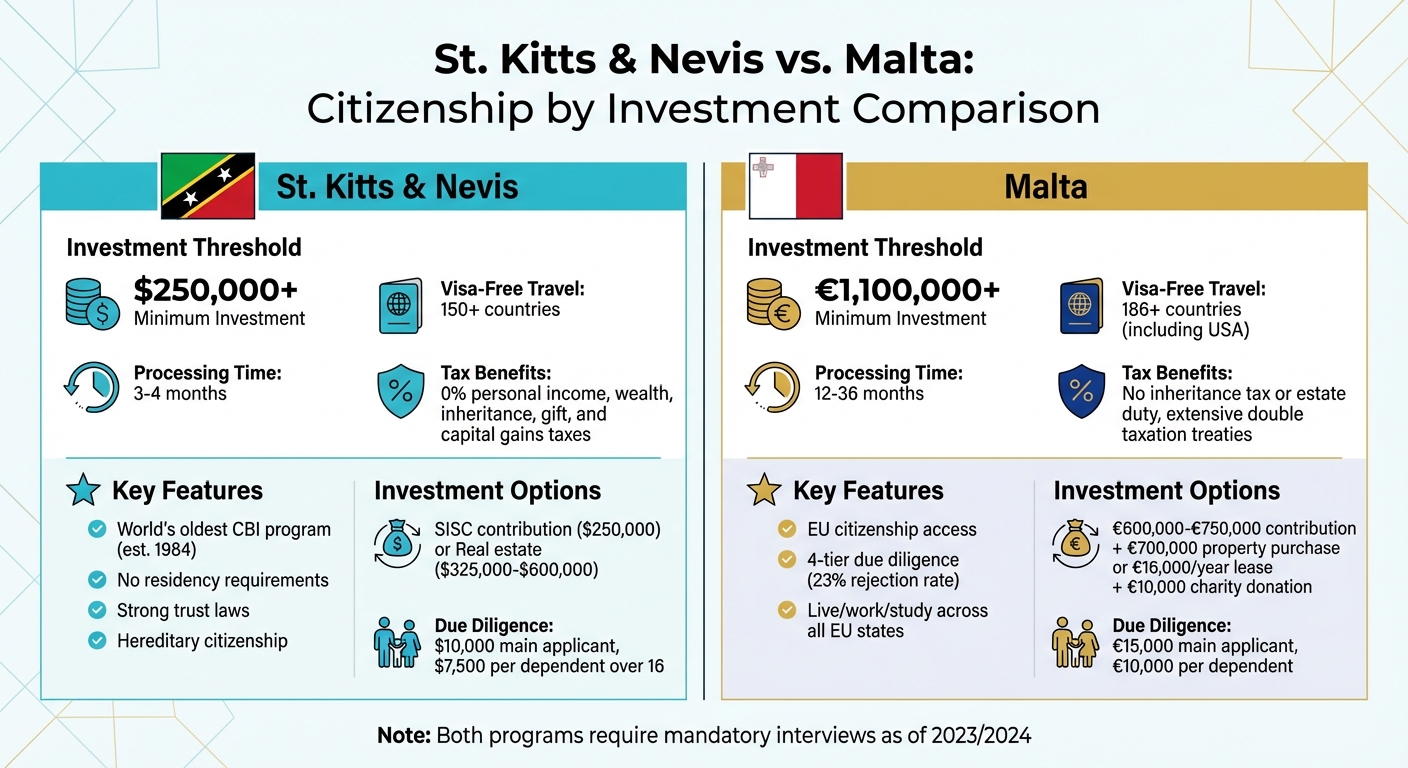
If you’re looking to safeguard your wealth, these simple citizenship-by-investment programs offer efficient ways to secure your assets while gaining global mobility.
St. Kitts & Nevis Citizenship by Investment
St. Kitts & Nevis boasts the world’s longest-running citizenship-by-investment program, established in 1984. Known for its quick processing – just 3–4 months – this program is perfect for those who want asset protection without relocating. There are no residency requirements, making it a convenient option for international investors.
The investment options include:
- Sustainable Island State Contribution (SISC): Starts at $250,000 for a single applicant or a family of four.
- Real Estate Investment:
- $325,000 for government-approved properties (7-year holding period)
- $600,000 for a private single-family home.
Additional fees include $10,000 for the main applicant and $7,500 for dependents over 16 for due diligence.
"St. Kitts and Nevis is one of the world’s most sought-after destinations for travel and to acquire a second home. This program has set industry standards."
– Nuri Katz, Founder of Apex Capital Partners Corp.
This program stands out for its flexibility and tax benefits. St. Kitts & Nevis has no personal income, wealth, inheritance, gift, or capital gains taxes. The passport provides visa-free or visa-on-arrival access to over 150 countries and is hereditary, ensuring benefits for future generations. Additionally, the nation is a hub for digital banking, offering robust support for international financial services.
Malta Citizenship by Investment
Malta offers a direct path to European Union citizenship, granting access to live, work, and study across all EU member states. This program is a premium choice for those seeking long-term asset protection within a stable and legally reliable environment.
The investment requirements are higher compared to Caribbean programs:
- Contribution: €600,000 after 36 months of residency or €750,000 after 12 months.
- Property: Purchase residential property worth at least €700,000 or lease property for at least €16,000 annually for five years.
- Philanthropy: A €10,000 donation to a registered charity.
- Due Diligence Fees: €15,000 for the main applicant and €10,000 for each dependent.
Malta’s program is known for its rigorous four-tier due diligence process, with a 23% rejection rate. Processing times range from 12 to 36 months, depending on the residency path. A Maltese passport provides visa-free access to 186 countries, including the United States, United Kingdom, Canada, and Australia. The program also offers estate planning advantages, with no inheritance tax or estate duty on inherited assets and extensive double taxation treaties for tax planning.
"The Malta Citizenship by Investment Program maintains one of the world’s most rigorous due diligence processes, reflecting Malta’s commitment to accepting only the highest-caliber applicants."
– CitizenX
St. Kitts & Nevis vs. Malta: Side-by-Side Comparison
Here’s a quick comparison of the two programs:
| Program | Investment Threshold | Processing Time | Visa-Free Travel | Asset Protection Features |
|---|---|---|---|---|
| St. Kitts & Nevis | $250,000+ | 3–4 months | 150+ countries | Zero-tax jurisdiction; strong trust laws |
| Malta | €1,100,000+ | 12–36 months | 186+ countries (incl. USA) | EU legal protections; extensive tax treaties |
Both programs require mandatory interviews for main applicants (as of 2023/2024) and enforce strict due diligence to maintain high standards. They not only offer a second passport but also serve as key components in a broader strategy for international asset protection.
How to Obtain a Second Passport
Securing a second passport is a smart way to protect your assets and mitigate geopolitical risks. However, the process requires careful planning and attention to detail. The first step is selecting a program that aligns with your personal and financial goals.
Choosing the Right Program
When selecting a citizenship program, consider these factors:
- Processing time: Some programs are quicker than others. For instance, Vanuatu can issue a passport in as little as 60 days, whereas Malta’s process might take anywhere from 12 to 36 months, depending on your residency path.
- Investment thresholds: The required financial commitment varies widely. For example, São Tomé and Príncipe‘s program starts at $90,000, while Malta’s ranges between $700,000 and $900,000.
- Visa-free access: Look at the travel benefits each passport offers. Grenada, Egypt, and Turkey, for instance, provide eligibility for the U.S. E-2 business visa.
- Tax benefits: Many Caribbean nations, like St. Kitts & Nevis, have no personal income, capital gains, or inheritance taxes.
- Family inclusion: Most programs allow you to include spouses, dependent children, and parents. Some, such as Sierra Leone‘s, even extend eligibility to siblings and business partners.
If you’re considering the real estate investment route, note that most programs require you to hold the property for three to seven years before selling it without affecting your citizenship status.
Application Requirements and Documentation
To streamline the process, gather the required documents early. These typically include:
- Current passports, birth certificates, and marriage or divorce certificates for all applicants
- Police clearance certificates from your home country and any other country where you’ve resided for an extended period
- Financial records proving the legal source of your funds
- Medical reports confirming you’re free of contagious diseases
Governments conduct rigorous due diligence, including background checks, anti-money laundering reviews, and counter-terrorism financing evaluations. Some Caribbean programs now mandate interviews for main applicants and adult dependents. After receiving approval in principle, you’ll complete your financial contribution or property purchase before your second passport is issued.
Enlisting professional help can make the process much smoother.
Working with Professionals to Simplify the Process
To avoid pitfalls, submit your application through government-authorized agents. These licensed professionals ensure your application is legally compliant, manage technical submissions, and coordinate with government offices to keep your application on track.
"Rigorous due diligence has become a non-negotiable standard in responsible CBI programs." – International Financial Regulator
If you’re pursuing the real estate route, verify that the property developer and project are government-approved. Advisors can help you navigate these details and prepare for any required interviews. Given the extensive documentation and checks involved, it’s wise to begin the application process well before any potential crisis arises.
Conclusion
In today’s unpredictable world, having a second passport has become a powerful way to safeguard both your wealth and personal freedom. Dual citizenship is often seen as a safety net against political and economic instability. For instance, after a significant political event in late 2024, citizenship-by-investment inquiries spiked by an astonishing 392%, highlighting the growing demand for this form of security.
A second passport isn’t just about protection – it’s a strategic tool for global mobility and financial independence. By diversifying your legal and financial ties, you can ensure that no single government has complete control over your assets or ability to travel. Take the example of the St. Kitts & Nevis investment program, where citizenship options provide strong legal protections. Additionally, such a passport can open up access to international banking systems, enhance financial privacy, and even offer legal ways to optimize your tax obligations.
The benefits extend far beyond immediate concerns. A second passport can secure opportunities for future generations, allowing your family to live, work, and study in stable regions without the hassle of visa restrictions. For business owners, it provides the flexibility to relocate operations quickly if the domestic environment becomes challenging. These long-term advantages underline the importance of acting sooner rather than later.
Securing dual citizenship is not an overnight process – it can take anywhere from a few months to several years. Acting now ensures you’re prepared before a crisis arises. Whether you’re drawn to a Caribbean program for its financial benefits or a European option for broader mobility and stability, the time to take control of your financial future is now.
FAQs
Will a second passport protect my assets if my home country sues me or freezes accounts?
A second passport can offer benefits like spreading legal risks and opening doors to favorable jurisdictions. However, it’s important to understand its limitations. If your home country pursues legal action, having a second passport won’t necessarily protect your assets. For example, U.S. courts have the ability to enforce claims on foreign-owned property through international legal agreements and mechanisms.
How can a second passport change my taxes without moving abroad full-time?
A second passport offers a way to legally reduce your taxes without the need to relocate permanently. By adjusting your tax residency, you can distribute tax obligations across different jurisdictions. This can give you access to countries with tax policies that are more favorable, potentially decreasing your overall tax expenses.
What are the biggest risks or downsides of citizenship by investment?
Citizenship by investment (CBI) programs come with potential risks that investors should carefully consider. One major concern is the possibility of misuse. These programs can sometimes be exploited for illegal activities such as money laundering, tax evasion, or even identity fraud. Such misuse can lead to serious legal troubles and harm the investor’s reputation.
Another issue is the uncertainty surrounding some CBI programs. These programs may face political or economic instability, leading to sudden changes or even cancellation. This could directly impact the benefits an investor was counting on, such as visa-free travel or tax advantages.
To navigate these risks, thorough research is essential. Investors should perform detailed due diligence to ensure the program aligns with their goals and offers the protections they expect. Without this careful preparation, they might encounter increased scrutiny or find themselves in situations where the program no longer delivers the promised advantages.
