
Dual citizenship can be a game-changer for entrepreneurs, offering benefits like visa-free travel, access to new markets, tax advantages, and asset protection. However, it also comes with challenges such as complex tax obligations, legal responsibilities, and significant financial commitments. Here’s a quick breakdown:
- Pros: Simplified global mobility, expanded business opportunities, tax optimization in certain jurisdictions, and diversified asset protection.
- Cons: U.S. citizens face global taxation, higher compliance costs, potential reputational risks, and legal complexities like mandatory military service in some countries.
Whether dual citizenship is right for you depends on your business goals, financial situation, and tolerance for additional responsibilities. Consulting with a tax specialist and immigration attorney is crucial to navigate these complexities effectively.
1. Benefits of Dual Citizenship for Entrepreneurs
Business Opportunities
Having a second passport can be a game-changer for entrepreneurs. It allows for quick access to major markets without the hassle of waiting for visas. Imagine being able to attend meetings, explore markets, or close deals without delays. For instance, Grenadian citizenship provides visa-free access to China and Russia – two markets that are often challenging to enter for Western passport holders. This kind of access can open doors that might otherwise remain closed.
In regions like ASEAN and Latin America, having a local presence often makes all the difference in business success. Dual citizenship can provide the flexibility to establish or expand operations in these areas.
It also serves as a safety net during times of political or economic instability. If your home country faces turmoil or introduces restrictive policies, dual citizenship gives you the legal right to relocate and keep your business running. This "Plan B" ensures you can maintain operations even when things go south at home.
Naturally, this level of access and flexibility leads to considerations around tax optimization.
"For entrepreneurs and investors looking to future-proof their businesses, acquiring second citizenship through CBI programs is no longer a luxury but a necessity in today’s competitive global market." – Andrea Galvan, Author, globalEDGE
Tax Implications
Many Citizenship by Investment (CBI) programs offer tax advantages, such as tax and residency solutions that offer no taxation on worldwide income. Additionally, treaties – like the one between the U.S. and Canada – protect individuals from being taxed twice on the same income. Both the United States and the United Kingdom have over 100 double taxation treaties in place, helping entrepreneurs navigate international tax systems.
However, U.S. citizens should remember that their tax obligations follow them globally. Even with a second passport, you’re still required to file U.S. tax returns and report foreign income.
Some countries, like Malaysia, Paraguay, and Uruguay, operate under territorial tax systems. This means they only tax income earned within their borders. Structuring your business to generate revenue outside these countries could lead to a much lighter tax burden. Malta is another example, offering lower corporate tax rates along with access to the EU Single Market, creating opportunities for optimizing corporate taxes.
Dual citizenship doesn’t just help with taxes – it also broadens access to financial resources. Entrepreneurs can take advantage of government-backed financing programs in both countries, such as U.S. Small Business Administration (SBA) loans or Mexico’s Bancomext. This dual access provides more funding options and greater flexibility for growing your business.
Beyond financial perks, dual citizenship also helps safeguard your assets from legal risks.
Asset Protection
Spreading assets across multiple countries can shield your wealth from being entirely frozen by one government or court. If one country imposes capital controls or unfavorable legal rulings, your assets in the other jurisdiction remain accessible and secure.
Certain jurisdictions, like Nevis, offer robust protections. They block foreign court judgments and enforce strict requirements for creditor claims. For example, creditors must post a $100,000 bond and meet a high legal threshold of "beyond reasonable doubt" to pursue claims – a significant deterrent to frivolous lawsuits.
Privacy is another key benefit. Countries like Antigua & Barbuda keep citizenship details confidential, allowing entrepreneurs to hold assets and conduct business discreetly. This can be especially valuable for high-profile individuals looking to avoid unnecessary scrutiny or legal challenges. Dual citizenship also simplifies cross-border inheritance, ensuring that heirs can access assets across jurisdictions without navigating complex legal hurdles.
Legal and Financial Obligations
While dual citizenship offers many advantages, it also comes with added responsibilities. For instance, U.S. citizens must comply with FATCA regulations, even if they hold another nationality.
Some countries impose mandatory military service for citizens. Greece and Turkey, for example, require male citizens of certain ages to serve. Additionally, serving in a foreign military that conflicts with U.S. interests could jeopardize your American citizenship. Entrepreneurs need to weigh these obligations carefully before applying.
Banking compliance becomes more intricate but also more rewarding. With dual citizenship, you can access stable banking systems in financial hubs like Switzerland, Singapore, or the UAE. These systems often provide better security and fewer capital controls compared to others. However, business owners must navigate the reporting requirements of both countries to stay compliant.
"Just like a savvy investor diversifies their assets, diversifying your citizenships gives you long-term options and stability." – Joe Elvin, Writer, Nomad Capitalist
The application process itself varies in complexity and cost. Caribbean CBI programs typically take 3 to 6 months to complete. European programs, like Malta’s, require longer timelines and larger investments. For example, Vanuatu offers one of the most affordable options at around $135,000 for a single applicant, but you’ll need to show at least $250,000 in assets. Entrepreneurs must ensure these costs and timelines align with their business priorities and budget.
sbb-itb-39d39a6
2. Drawbacks of Dual Citizenship for Entrepreneurs
While dual citizenship offers plenty of perks, it also comes with challenges that can complicate operations, taxes, and asset management.
Business Opportunities
Dual citizenship may limit access to government contracts or positions requiring security clearance. Authorities often see dual citizens as potential risks for divided loyalty, which can block access to classified information and lucrative opportunities.
Banks and financial institutions also tend to scrutinize Citizenship-by-Investment (CBI) passports. This heightened due diligence can delay critical, time-sensitive transactions.
Perception is another hurdle. Some business contacts may view acquired citizenship as a shortcut rather than a strategic move, which could harm professional relationships or damage your brand’s reputation.
These operational issues are only the beginning. Tax obligations add another layer of complexity.
Tax Implications
Tax compliance becomes a juggling act with dual citizenship. For U.S. citizens, tax obligations follow you no matter where you live. The IRS requires you to report all global income.
"The U.S. taxes based on citizenship, so holding a second passport does not reduce or eliminate your U.S. filing obligation." – Mike Wallace, CEO, Greenback Expat Tax Services
Double taxation is a real concern. While tax treaties aim to prevent it, many include "saving clauses" that let each country tax its own citizens. Entrepreneurs must also file forms like FBAR (FinCEN Form 114) for foreign accounts over $10,000 and FATCA (Form 8938) for foreign financial assets above certain thresholds. Failure to file these forms can result in severe penalties – even if you owe no actual taxes.
The Foreign Earned Income Exclusion (FEIE) allows up to $132,900 of foreign-earned income to be excluded for the 2026 tax year. However, this doesn’t cover self-employment taxes, which are around 15.3%. Managing income, properties, and retirement accounts across different tax systems adds another layer of difficulty, especially when countries operate on different tax year cycles.
For high-net-worth individuals, the exit tax is another obstacle. If you renounce U.S. citizenship and meet the "covered expatriate" criteria – such as a net worth of $2 million or an average annual tax liability exceeding $211,000 over the past five years – you’ll face a hefty expatriation tax. This tax treats all assets as if sold at fair market value the day before renunciation, though the first $910,000 of unrealized gains is exempt for 2026.
"The exit tax… treats expatriation as a deemed sale, potentially leaving you with a significant tax bill. And it’s not just for billionaires." – Katelynn Minott, CPA & CEO, Bright!Tax
Beyond taxes, asset management also presents unique challenges.
Asset Protection
While diversifying assets across borders can provide some protection, it often introduces new risks. For instance, foreign investments like non-U.S. mutual funds or ETFs are subject to PFIC (Passive Foreign Investment Company) rules, requiring Form 8621. These rules impose high tax rates and complicated reporting requirements, which can erode the returns on offshore assets.
Global transparency initiatives like FATCA and the Common Reporting Standard (CRS) have made financial privacy harder to maintain. Banks now share account details with tax authorities worldwide, further complicating asset management for dual citizens. Additionally, enhanced scrutiny of CBI passports can delay asset transfers, potentially causing liquidity problems when funds are urgently needed.
Political and diplomatic shifts can also impact mobility. For example, Vanuatu lost its EU visa-free access in 2022 due to security concerns, demonstrating how quickly travel privileges tied to a second passport can disappear.
Legal and Financial Obligations
Conflicting legal responsibilities can create serious complications. Some countries require mandatory military service, and serving in a foreign military could jeopardize U.S. citizenship.
"Dual citizenship USA status offers great benefits. But you must understand both countries’ laws. Also, tax obligations can be complex." – Hector Herrera, Houston Immigration Attorney
Political risks also loom large. The proposed "Exclusive Citizenship Act of 2025" in the U.S. could force dual citizens to choose one nationality within 12 months or risk losing their U.S. citizenship. Though not yet enacted, it highlights the uncertain legal landscape surrounding dual citizenship.
State-level taxes add another layer of difficulty. Some states, like California and Virginia, may continue taxing your income even after you move abroad unless you formally sever all ties. Foreign retirement plans, such as Germany’s Riester or Canada’s TFSA accounts, may not be recognized by the IRS and could be treated as complex foreign trusts or PFICs.
Coordinating different tax years and filing deadlines between countries also increases costs and administrative headaches. As of April 13, 2026, the fee to renounce U.S. citizenship is $450.
Entrepreneurs must carefully weigh these obligations against the potential benefits of dual citizenship.
Comparison: Pros and Cons
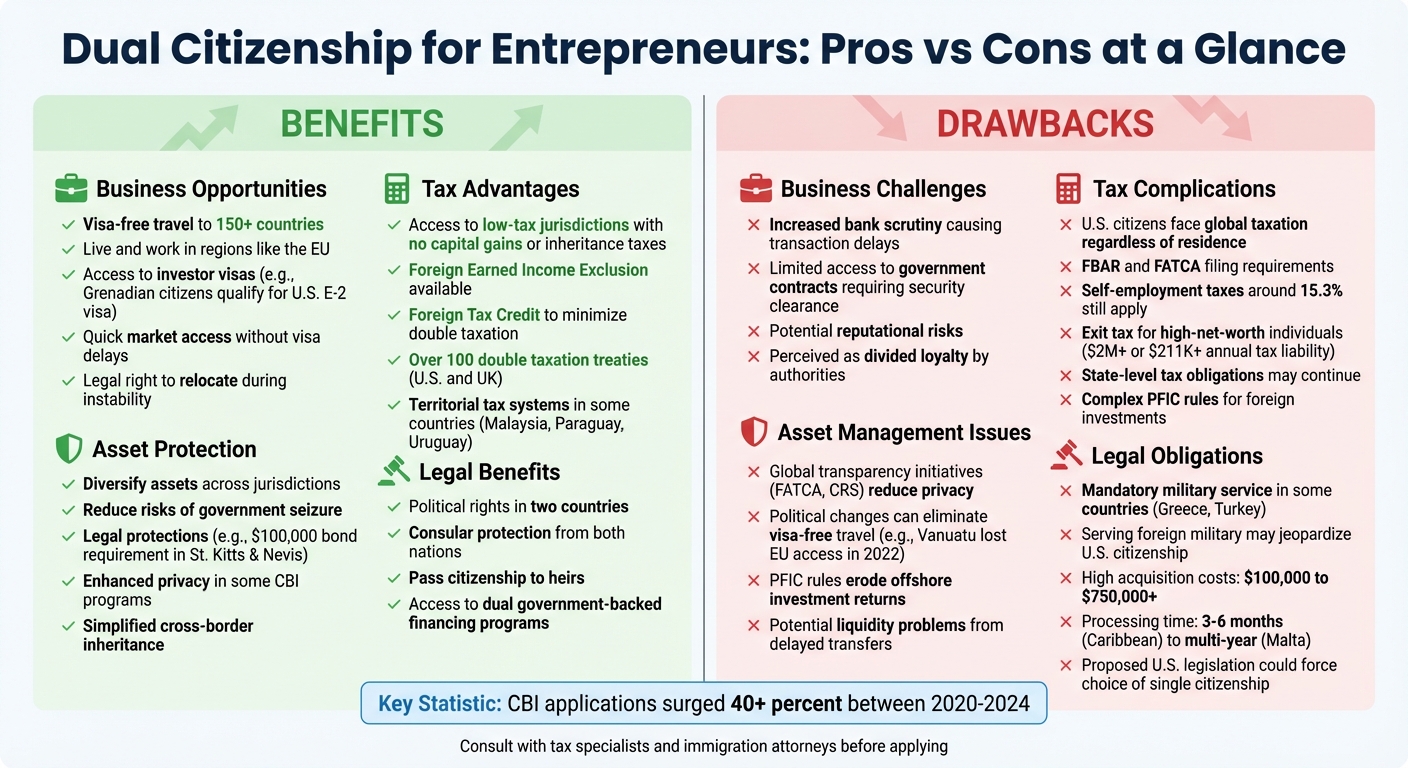
Deciding on dual citizenship means understanding how it could influence your business, finances, and legal status. Here’s a breakdown of the key advantages and challenges entrepreneurs face across four major areas:
| Category | Benefits | Drawbacks |
|---|---|---|
| Business Opportunities | Enjoy visa-free travel to 150+ countries, live and work in regions like the EU, and access investor visas (e.g., Grenadian citizens qualify for the U.S. E-2 visa). | Increased scrutiny from banks can slow down transactions; eligibility for government contracts or security clearances may be impacted; potential reputational risks. |
| Tax Obligations | Gain access to low-tax jurisdictions with no capital gains or inheritance taxes; leverage the Foreign Earned Income Exclusion and Foreign Tax Credit to minimize double taxation. | U.S. citizens face global taxation, must comply with FBAR and FATCA filings, and may have ongoing state-level tax obligations. |
| Asset Protection | Diversify assets across jurisdictions to reduce risks of government seizure; benefit from legal structures like the $100,000 bond in St. Kitts & Nevis; some Citizenship-by-Investment (CBI) programs offer greater privacy. | Global transparency measures (FATCA, CRS) make financial information more accessible; political changes can impact visa-free travel (e.g., Vanuatu lost EU access in 2022). |
| Legal Requirements | Gain political rights in two countries, consular protection from both, and pass citizenship to heirs through streamlined processes. | Some nations impose mandatory military service, which could conflict with U.S. citizenship; acquisition costs range from $100,000 to over $750,000, presenting a financial hurdle. |
Whether dual citizenship makes sense for you depends on factors like your business goals, market focus, and risk tolerance. For example, Caribbean options like Dominica typically start at $100,000 with a processing time of 3–6 months, while Malta’s EU citizenship requires investments of about $750,000 and multi-year residency commitments. Interestingly, applications for Citizenship-by-Investment programs surged by over 40% between 2020 and 2024, showing growing interest despite the complexities involved.
This comparison provides a foundation for assessing whether dual citizenship aligns with your entrepreneurial vision.
Conclusion
Dual citizenship offers a range of opportunities – like visa-free travel, diversified asset protection, and access to broader markets. But it’s not a one-size-fits-all solution. The advantages you gain depend on factors like your business goals, tax obligations, and whether both your home and chosen countries allow dual nationality. Some countries require renouncing your original citizenship, so verifying the rules of your target nation is crucial. For U.S. citizens, the situation is even more complex, as the IRS taxes worldwide income no matter where you live or which passport you hold.
"Before you jump into anything, consider consulting an immigration lawyer about how dual citizenship may affect your situation." – Investopedia
To navigate these complexities, consider working with professionals. A cross-border tax specialist (like a CPA or Enrolled Agent) and an immigration attorney can help you understand your reporting obligations, evaluate tax treaties, and address potential challenges like mandatory military service or state-level tax entanglements. While the upfront cost of professional advice – typically a few thousand dollars – may seem steep, it’s a worthwhile investment to avoid costly errors in the future.
FAQs
Will a second passport lower my U.S. taxes?
U.S. citizens are taxed on their worldwide income, no matter how many passports they hold. Having a second passport doesn’t change this. That said, there are ways to ease the tax burden. Tools like the Foreign Tax Credit and the Foreign Earned Income Exclusion can reduce the amount of taxes owed. To make the most of these options, it’s a good idea to work with a tax professional who understands the specifics.
Which second citizenship is best for my business?
The best second citizenship for you hinges on your business objectives. Are you looking for better market access, tax advantages, or asset protection? If streamlined investment paths and business-friendly environments are your focus, Saint Kitts and Nevis or Dominica might be ideal. On the other hand, Malta and Cyprus provide access to the European Union, which is a huge plus for entrepreneurs aiming to tap into EU markets. Keep in mind, though, that these options may come with more intricate tax and legal frameworks. Ultimately, your decision should align with your specific business priorities.
What new risks do I take on as a dual citizen?
Dual citizenship comes with its own set of challenges. For instance, you might encounter security concerns or even restrictions regarding the use of foreign passports. These issues can sometimes lead to questions about loyalty, which may complicate your eligibility for U.S. security clearances. It’s important to carefully consider these factors when weighing the implications of holding dual citizenship.
