
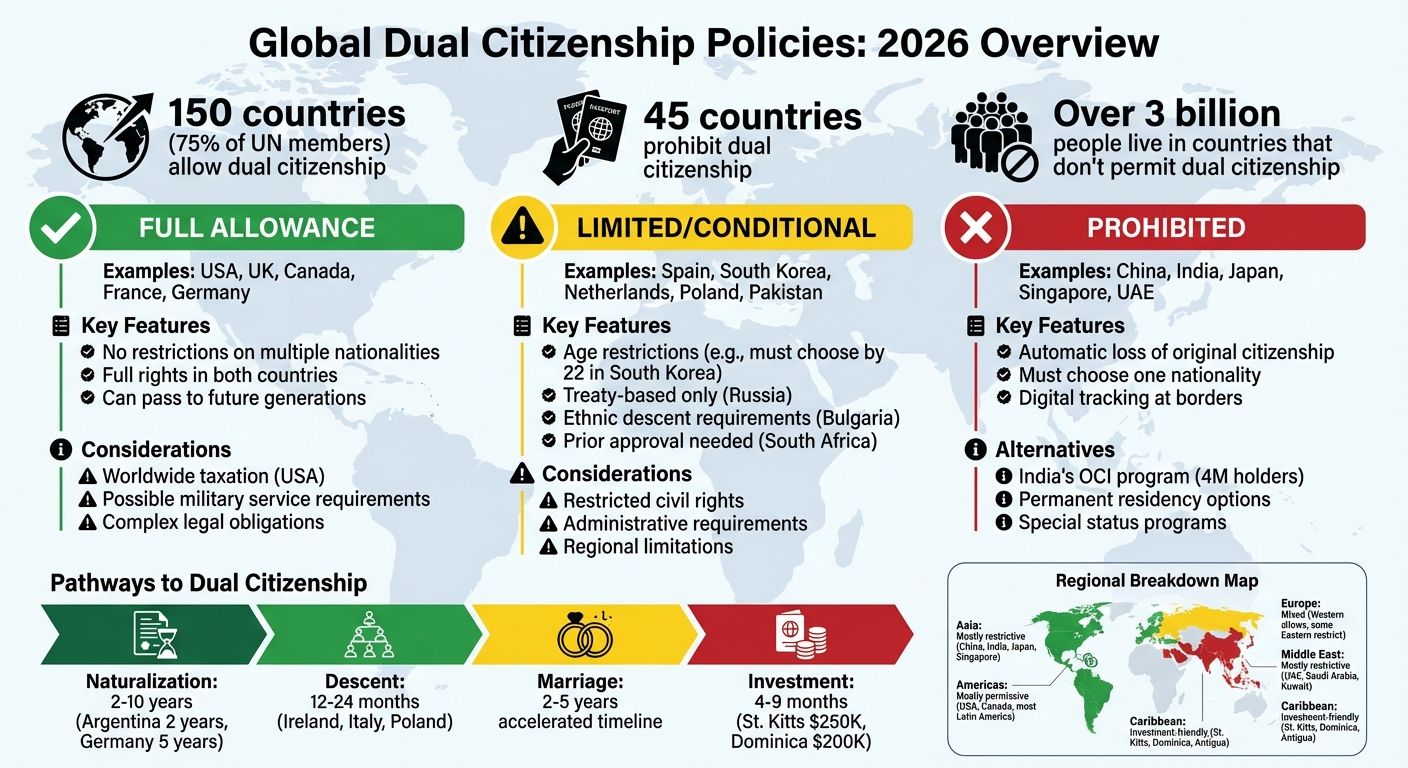
Dual citizenship laws vary widely. As of 2026, around 150 countries – 75% of UN members – permit some form of dual citizenship, but the specifics differ. Here’s a quick breakdown:
- Countries that allow dual citizenship without restrictions: Examples include the U.S., U.K., Canada, and France.
- Countries with limited or conditional dual citizenship: Spain, South Korea, and Poland impose specific rules, such as treaties, historical ties, or mandatory military service.
- Countries that prohibit dual citizenship: China, India, Japan, and Singapore strictly ban it, often revoking original citizenship upon acquiring another.
Germany recently reformed its laws in 2024, now allowing naturalized citizens to retain their original nationality. However, over 3 billion people live in nations where dual citizenship is not permitted.
Key pathways to dual citizenship include naturalization, descent, marriage, or investment. For example, St. Kitts and Nevis offers citizenship in 4–6 months with a $250,000 investment, while Argentina grants it after two years of residency. Each route comes with its own benefits and responsibilities, such as tax obligations or military service.
Understanding the legal frameworks is essential. In restrictive countries, alternatives like residency programs or special statuses (e.g., India’s OCI program) may provide similar benefits without full citizenship. Dual citizenship offers advantages like global mobility, economic opportunities, and security, but it also requires careful planning to manage obligations.
1. Countries That Allow Dual Citizenship
Legal Policies
As of 2026, about 150 countries – representing 75% of UN members – permit dual citizenship. However, the specifics of these policies vary widely. Some countries fully accept multiple nationalities without restrictions, while others impose conditions that dual citizens must carefully navigate.
A notable example is Germany, which reformed its laws in June 2024. The change now allows naturalized citizens to retain their original nationality, marking a progressive shift in one of Europe’s largest economies.
Countries generally fall into three categories regarding dual citizenship:
- Unrestricted Acceptance: Countries like the United States, United Kingdom, France, and Canada have no limitations on holding multiple nationalities.
- Limited Recognition: Nations like Poland allow dual citizenship but don’t officially acknowledge the second nationality. Within their borders, individuals are treated solely as Polish citizens.
- Conditional Acceptance: Countries such as Spain limit dual citizenship primarily to nationals of specific regions, including Latin America, Portugal, the Philippines, and Andorra, due to historical ties.
Certain nations also enforce procedural requirements. For instance, South Africa requires citizens to obtain "prior retention approval" before acquiring another nationality to avoid losing their original citizenship. Similarly, Egypt mandates notifying authorities within a year of obtaining a second nationality. Passport usage rules also vary: Mexico requires dual citizens to use a Mexican passport for travel, while Canada strongly advises using a Canadian passport for air travel.
"The US does not maintain an official US dual citizenship countries list. Whether a country is one of the practical US dual citizenship countries depends entirely on that country’s nationality law." – Andrew Coleman, CPA, Taxes for Expats
In some cases, dual citizenship comes with restrictions on civil rights. For example, Pakistan prohibits dual nationals from voting, serving in the military, or holding public office. Similarly, Egypt exempts dual citizens from military service but bars them from roles in Parliament or military academies.
Understanding these legal frameworks is essential, as eligibility for dual citizenship depends heavily on the pathways available in each country.
Requirements for Eligibility
The pathways to dual citizenship differ based on circumstances and country-specific rules. Here are the primary routes:
- Naturalization through residency: This is the most common path, though residency timelines vary. Argentina offers one of the shortest requirements at just two years. Canada requires 1,095 days (about three years) of physical presence within a five-year period. In the United Kingdom, residency typically takes five years, though spouses of British citizens can apply after three years. Following its 2024 reform, Germany now requires five years of legal residence.
- Citizenship by descent: Countries like Ireland, Italy, Poland, and Hungary provide streamlined programs for those who can prove ancestral ties. Processing can take 12–24 months and doesn’t require residency, but thorough documentation is essential.
- Marriage-based citizenship: This route often accelerates naturalization. For example, Mexico allows spouses of citizens to apply after two years of residency, while the UK offers a three-year timeline for spouses.
- Citizenship by Investment (CBI): This is the fastest legal route to dual citizenship. Caribbean nations lead in this category. St. Kitts and Nevis grants citizenship in 4–6 months with a minimum investment of $250,000. Dominica offers a more affordable option starting at $200,000, with processing taking 6–9 months. Antigua and Barbuda requires a minimum contribution of $230,000 to its National Development Fund.
| Country | Primary Path | Timeline | Minimum Investment (if applicable) |
|---|---|---|---|
| Argentina | Residence | 2 years | N/A |
| Canada | Residence | 3 years (1,095 days) | N/A |
| Germany | Residence | 5 years | N/A |
| United Kingdom | Residence/Marriage | 3–5 years | N/A |
| St. Kitts and Nevis | Investment | 4–6 months | $250,000 |
| Dominica | Investment | 6–9 months | $200,000 |
| Italy | Descent/Residence | 12–24 months (descent) | N/A |
These pathways not only provide legal access to dual citizenship but also open doors to various practical benefits.
Benefits for Global Citizens
Dual citizenship offers a range of benefits that go beyond just travel convenience. Global mobility is a major advantage, as a second passport often grants visa-free or visa-on-arrival access to more countries. This simplifies both business and leisure travel, especially for digital nomads and expats who might otherwise face bureaucratic challenges.
From an economic perspective, dual citizenship can broaden opportunities. It provides the right to work and invest in multiple jurisdictions, enabling asset diversification and access to new markets. However, US citizens should note they remain subject to worldwide income taxation regardless of additional citizenships.
Another critical benefit is the "Plan B" security function. In times of political or economic instability, dual citizenship offers a guaranteed safe haven for families. Unlike residency permits, which can be revoked, citizenship provides an unshakable status that doesn’t expire or require renewal.
Dual citizenship also enhances quality of life. It often grants access to better healthcare systems, education, and living standards. Moreover, many countries allow citizenship to be passed down to future generations, creating lasting benefits for children and grandchildren.
Finally, dual citizenship secures legal and social rights, such as voting and holding passports from both countries. However, these rights come with responsibilities. For instance, dual citizens may be subject to mandatory military service in countries like Israel, Switzerland, South Korea, Greece, and Turkey. Tax obligations can also become more complex, requiring careful planning with international tax professionals.
"A second citizenship acts as a ‘Plan B,’ providing a safe haven for you and your family during times of political or economic instability in your home country." – Quantome Passport
Before pursuing dual citizenship, it’s crucial to understand the retention rules of your home country. For example, South African citizens must apply for a "Letter of Retention" before naturalizing elsewhere, or they risk losing their original nationality. Additionally, always use the passport of the country you’re entering or exiting to avoid immigration issues.
sbb-itb-39d39a6
2. Countries with Limited Dual Citizenship
Legal Policies
Some countries allow dual citizenship, but only under strict conditions. These restrictions often depend on specific criteria rather than being broadly permitted.
For example, age-based limitations are common. In Indonesia, children can hold dual citizenship but must choose one nationality by the time they turn 18. Similarly, South Korea requires dual nationals by birth to declare their citizenship choice by age 22. Failing to do so can result in losing one of the nationalities automatically.
Other nations base their policies on treaties or reciprocal agreements. Russia, for instance, allows dual citizenship only if there’s a formal bilateral treaty in place. Spain limits dual nationality to citizens of certain countries with historical ties, such as Latin American nations, Portugal, Andorra, the Philippines, and Equatorial Guinea.
Ethnic descent can also play a role. Countries like Bulgaria, Croatia, and Slovenia permit dual citizenship for those who can prove ethnic heritage or birthright, while naturalized citizens are often required to renounce their original citizenship.
Some nations impose administrative conditions. The Netherlands generally restricts dual citizenship but makes exceptions for individuals married to Dutch citizens, those born in Dutch territories, or those whose original nationality is not officially recognized.
Austria has one of the strictest approaches, generally prohibiting dual citizenship. Exceptions are rare and typically granted for cases of "special merit", such as prominent professionals or situations where renouncing original citizenship would cause significant hardship.
"The answer determines whether acquiring a CBI passport is straightforward or whether it triggers renunciation obligations, criminal penalties, or loss of existing nationality."
– HPT Group
| Country | Nature of Restriction | Key Exception or Requirement |
|---|---|---|
| Indonesia | Age-based | Allowed for children; must renounce other citizenship at age 18 |
| South Korea | Age/Status-based | Must declare by age 22; exceptions for "special merit" or elderly returnees |
| Spain | Reciprocity-based | Limited to specific countries (e.g., Latin America, Philippines) |
| Netherlands | Status-based | Exceptions for spouses of Dutch citizens or those born in Dutch territories |
| South Africa | Administrative | Requires "prior retention" approval before naturalizing elsewhere |
| Bulgaria | Ethnic-based | Allowed for ethnic nationals; naturalized citizens must renounce original citizenship |
| Russia | Treaty-based | Allowed only with countries that have bilateral treaties |
These rules create distinct pathways for eligibility, which vary depending on the individual and the specific country.
Requirements for Eligibility
Eligibility for dual citizenship in these countries depends heavily on national policies and individual circumstances. For instance, in Russia and Spain, dual nationality is only possible if a formal bilateral treaty exists. Verifying such agreements is essential before proceeding.
A notable change occurred in January 2026 when Ukraine introduced Resolution No. 1412. This policy simplified the process for acquiring Ukrainian citizenship for citizens of the U.S., Canada, Germany, Poland, and the Czech Republic. These individuals can now obtain Ukrainian citizenship without renouncing their original nationality, making the process much easier as of January 27, 2026.
Austria, although restrictive, allows exceptions for "special merit" or hardship. These rare cases might include prominent figures or situations where giving up one’s original citizenship would create undue difficulties.
Benefits for Global Citizens
Despite the restrictions, limited dual citizenship offers practical advantages. For example, Ukraine’s recent policy allows U.S., Canadian, German, Polish, and Czech citizens to obtain Ukrainian citizenship while keeping their original passports. This opens up new opportunities for these individuals.
Dual citizenship can also provide access to economic and social benefits. In some nations, foreign ownership restrictions are waived for citizens, enabling real estate investments and business ventures. It can also grant access to healthcare, education at citizen rates, and social security benefits – valuable for families and retirees.
However, these perks come with responsibilities. Dual citizens might face mandatory military service or complex tax obligations. For instance, U.S. citizens are taxed on their worldwide income regardless of where they live. Additionally, consular protection may be limited when a dual citizen is in one of their countries of nationality, as that country might treat them solely as its own.
"Dual citizenship USA status offers great benefits. But you must understand both countries’ laws. Also, tax obligations can be complex."
– Hector Herrera, Houston Immigration Attorney, Herrera Law Firm
3. Countries That Do Not Allow Dual Citizenship
Legal Policies
As of 2026, 45 countries either ban or impose strict limits on dual citizenship, collectively affecting over 3 billion people. This list includes major global players like China, India, Japan, Singapore, and the UAE.
The enforcement of these rules varies. In many cases, obtaining foreign citizenship automatically results in losing your original nationality. For instance, China’s Nationality Law explicitly states that acquiring another citizenship leads to the automatic forfeiture of Chinese nationality. Similarly, India and Singapore enforce laws that revoke citizenship under similar circumstances.
"China fully bans dual citizenship, citing the importance of loyalty and safeguarding national unity."
– Henley & Partners
Some countries tie these restrictions to specific obligations. In Singapore, for example, males who obtain foreign citizenship not only lose their Singaporean nationality but may still be required to fulfill military service. Meanwhile, Japan enforces a policy requiring individuals to choose their nationality by age 22, a rule that has become stricter with the introduction of advanced digital tracking systems at border checkpoints.
The rise of digital monitoring has made it harder to maintain dual status without disclosure. China, for instance, uses digital border control systems to cross-check passport records, flagging individuals who attempt to bypass nationality laws. This shift from passive oversight to active enforcement has raised the stakes for those navigating these restrictions.
| Region | Countries Prohibiting Dual Citizenship |
|---|---|
| Asia | China, India, Japan, Singapore, Malaysia, Indonesia (for adults), Myanmar, Nepal, North Korea, Laos, Uzbekistan, Kazakhstan, Azerbaijan |
| Middle East | UAE, Saudi Arabia, Kuwait, Oman, Qatar, Bahrain, Iran |
| Europe | Andorra, Estonia, Lithuania, Montenegro, Monaco, San Marino |
| Africa | Botswana, Cameroon, DRC, Ethiopia, Eritrea, Guinea, Libya, Mauritania |
| Americas | Cuba, Suriname |
Requirements for Eligibility
For individuals navigating these restrictions, understanding the specific rules is essential. In some countries, acquiring a foreign passport automatically triggers penalties or revocation of citizenship. For example, under India’s Citizenship Act of 1955, Indian citizenship is automatically terminated when a person acquires a foreign passport. However, India offers an alternative through its Overseas Citizenship of India (OCI) program. While OCI status does not grant full citizenship, it provides visa-free travel, residency rights, and access to many benefits – excluding the right to vote, hold public office, or join the military.
"Singapore upholds a firm one-citizenship rule, stressing national allegiance and requiring proof of renunciation of other citizenships before granting naturalization."
– Henley & Partners
For nationals of restrictive countries, permanent residency in a foreign country often serves as a safer option than acquiring full citizenship. This approach allows individuals to retain their home country passport while benefiting from long-term residency rights abroad. Such strategies help avoid the legal and financial pitfalls associated with losing one’s original nationality.
Benefits for Global Citizens
For those navigating these complex legal landscapes, understanding the limitations of dual citizenship is vital for planning residency and protecting assets. In countries like China, India, or the UAE, residency-by-investment programs often provide a practical alternative. These programs allow individuals to access benefits such as quality healthcare, education, business opportunities, and travel flexibility – without risking the loss of their original nationality or facing legal penalties.
Some countries offer middle-ground solutions. For example, India’s OCI program, which serves around 4 million people globally, allows individuals to maintain strong ties to their home country without granting them full citizenship.
As enforcement becomes more sophisticated, maintaining undeclared dual citizenship is increasingly risky. Countries like China and Japan are leveraging advanced digital tools to identify and penalize unauthorized dual nationals. For global citizens, transparency and compliance with home country laws remain the safest path forward. These challenges underline the importance of understanding restrictive policies, paving the way for a deeper exploration of dual citizenship laws and asset protection strategies in the next sections.
Comparing Dual Citizenship Policies: Advantages and Disadvantages
When considering dual citizenship, understanding how different countries approach it can help you make a more informed decision about a second passport.
Countries that fully allow dual citizenship, such as the United States, United Kingdom, and Canada, provide extensive benefits. These include the freedom to live, work, and invest in multiple nations, as well as the ability to pass citizenship to future generations. However, these perks come with responsibilities. For instance, U.S. citizens are subject to worldwide taxation, meaning they must pay taxes to the IRS even if they live abroad and never return to the U.S. Additionally, some nations require mandatory military service for all citizens, including those holding dual citizenship and residing elsewhere.
In contrast, limited or conditional policies – seen in nations like Spain, South Korea, and the Netherlands – offer dual citizenship only under specific circumstances, such as through birth, descent, or special agreements. For example, Spain permits dual citizenship for individuals from Latin American countries but generally requires others to renounce their original nationality. South Korea allows dual citizenship at birth but mandates that males fulfill military service and decide on a single nationality by age 22. These policies offer regional access but often come with restrictions, including the potential loss of voting rights or eligibility for public office.
Countries that prohibit dual citizenship entirely, such as China, India, Japan, and Singapore, require individuals to choose one nationality. While this simplifies tax obligations and legal responsibilities, it also means giving up your original passport upon naturalization. India, for instance, provides a compromise through its Overseas Citizenship of India (OCI) program. While OCI grants visa-free travel and residency rights, it does not include voting privileges or full citizenship status. These prohibitive policies can significantly limit global mobility and asset protection options.
| Policy Type | Representative Countries | Key Advantages | Key Disadvantages |
|---|---|---|---|
| Full Allowance | USA, UK, Canada, Germany | Broad mobility; access to multiple social systems; generational transfer | Worldwide taxation; potential military service; legal complexities |
| Limited/Conditional | Spain, South Korea, Netherlands, Pakistan | Regional benefits (e.g., EU or Mercosur access); cultural connections | Restricted eligibility; renunciation often required; limited rights like voting |
| Prohibited | China, India, Japan, Singapore | Simplified legal and tax responsibilities | Loss of original nationality; reduced flexibility with passports; limited consular support |
Each policy type has its own set of trade-offs, influencing your ability to navigate global opportunities and manage responsibilities effectively.
Using Dual Citizenship for Asset Protection
Dual citizenship offers a practical way to safeguard wealth and spread financial risk. Mikkel Thorup, Founder and CEO of Expat Money, describes it as:
"A second passport is what I often call ‘political insurance’".
For many high-net-worth individuals, holding multiple citizenships serves as a shield against domestic turmoil, government interference, or sudden policy shifts. This ties into the broader strategy of using citizenship as a tool for securing assets.
Tax benefits are a major draw. While U.S. citizens are taxed on their worldwide income no matter where they live, other jurisdictions offer more favorable tax regimes. For example:
- Italy has a flat tax system where qualifying individuals pay a fixed €200,000 annually on worldwide income.
- Greece provides a similar setup with a €100,000 annual flat tax on foreign-sourced income.
- Caribbean nations like St. Kitts and Nevis and St. Lucia impose no taxes on inheritance, capital gains, or worldwide income for certain residents.
These tax strategies align well with the mobility advantages dual citizenship provides.
A second passport also enhances global mobility, making it easier to manage international investments and business operations. It can open up visa-free access to regions not covered by your primary citizenship. For instance:
- Caribbean Citizenship by Investment programs can issue passports in three to six months. St. Kitts and Nevis, in particular, does not report citizenship status to other countries.
- EU citizenship in countries like Malta, Portugal, or Germany grants the right to live, work, and invest across all 27 EU member states.
Beyond taxes and travel, dual citizenship can bypass restrictions on property ownership and business activities that are often limited to citizens. Citizenship also offers more secure property rights compared to permanent residency, which can expire after long absences. With projections showing that about 150 countries will allow dual citizenship by 2026, strategically choosing a second nationality can be a key step in protecting and growing wealth internationally.
Before pursuing dual citizenship, consult an international tax advisor to understand how bilateral treaties might affect your income and assets. Also, be aware of any obligations tied to your new citizenship, as these could impact your financial and relocation plans. Lastly, remember that when you’re in one of your countries of citizenship, that government may have limited ability to provide consular assistance for your other nationality.
Conclusion
This analysis highlights why understanding the nuances of dual citizenship is critical for effective international asset protection. Policies around dual nationality vary significantly across the globe. While about 150 countries permit some form of dual citizenship, approximately 45 countries completely prohibit it. Grasping these distinctions is essential for anyone considering a second passport as part of their global strategy.
The routes to obtaining dual citizenship – whether through descent, naturalization, marriage, or investment – aren’t one-size-fits-all. For instance, Citizenship by Investment typically takes 3–6 months, whereas naturalization can stretch over 5–10 years. Changes like Germany’s reform scheduled for June 2024 reflect an ever-shifting landscape.
These pathways often come with financial and civic responsibilities. U.S. citizens, for example, are subject to worldwide taxation, adding layers of complexity to dual citizenship planning. Similarly, countries like Israel, Switzerland, and South Korea may impose military service obligations, which can take applicants by surprise. As Professor Peter Spiro from Temple University points out:
"There’s an understanding that even if you’re eligible today, you may not be tomorrow. Eligibility is fluid; secure your options while you can."
Navigating these complexities requires professional guidance. Global Wealth Protection offers expertise to help individuals manage evolving regulations and design a personalized strategy for mobility, asset protection, and tax planning. Taking the right steps today can ensure long-term security and flexibility.
FAQs
Will I lose my original citizenship if I naturalize abroad?
Whether or not you lose your original citizenship when naturalizing in another country depends entirely on the laws of your home country. Some nations allow dual citizenship, meaning you can keep your original citizenship while acquiring a new one. Others, however, require you to renounce your original citizenship as part of the naturalization process. It’s crucial to review your home country’s specific rules before making any decisions.
Do dual citizens pay taxes in both countries?
Dual citizens might have to pay taxes in both countries, depending on each nation’s tax regulations and whether agreements like double taxation treaties are in place. Such treaties are designed to prevent individuals from being taxed twice on the same income.
Can dual citizenship trigger mandatory military service?
Dual citizenship doesn’t inherently mean you’re obligated to serve in the military. However, certain countries may impose military service requirements on dual citizens, depending on their laws and policies. To avoid surprises, it’s crucial to check the specific regulations in each country where you hold citizenship.
Related Blog Posts
- Dual Citizenship Pros and Cons: What Every Entrepreneur Needs to Know Before Applying
- Why a Second Passport Is the Ultimate Asset Protection Tool
- Passport Portfolio Strategy: How Many Citizenships Do You Actually Need?
- Worst Passports in the World: Why Citizenship Diversification Matters More Than Ever
