
Turkey’s Citizenship by Investment program lets you secure a second passport quickly by investing in the country. Here’s what you need to know:
- Investment Options: Real estate ($400,000), bank deposits, government bonds, or business investments ($500,000 each). All require a 3-year holding period.
- Eligibility: Must be 18+, have no criminal record, and provide legally sourced funds. Biometric data collection and police clearance are mandatory.
- Costs: Beyond the investment, expect fees for processing ($574 per person), passports ($165 each), and other expenses like taxes and valuations.
- Benefits: Visa-free access to 110+ countries, dual citizenship, and U.S. E-2 Visa eligibility (after 3 years of residency in Turkey).
- Risks: Currency fluctuations, stricter compliance checks, and potential for citizenship revocation if fraud is detected.
This program is a fast-track option for global mobility but comes with financial and legal complexities. Professional legal guidance is highly recommended to avoid pitfalls.
Eligibility Requirements
Building on the program’s background, here are the detailed eligibility criteria for applicants.
Basic Requirements for Applicants
To apply, the main applicant must be at least 18 years old and have a clean legal record in Turkey. Starting in 2025, both the main applicant and their spouse will need to provide police clearance certificates from their country of origin. Maintaining a clean criminal record is essential, and applicants must also meet strict health standards – those diagnosed with certain serious communicable diseases, such as HIV, are not eligible. Additionally, anyone considered a threat to Turkish national security or public order will be disqualified.
Financial transparency is another key requirement. Applicants must prove that their investment funds are legally sourced and meet the minimum thresholds. While Turkey doesn’t mandate residency or language proficiency, physical presence is required for biometric data collection. Both the main applicant and their spouse must travel to Turkey for fingerprinting and biometric photo capture.
Required Documents
Once you meet the eligibility criteria, you’ll need to gather the necessary paperwork to support your application.
- Passports: Valid passports for all family members.
- Civil Documents: This includes birth certificates, marriage certificates (or divorce or death certificates if applicable), and biometric passport photos for all applicants.
- Police Clearance: Certificates from your country of origin for both you and your spouse.
- Health Insurance: Proof of valid health insurance in Turkey.
- Residence Proof: A recent utility bill or similar document showing your current address.
- Turkish Tax Identification Number: Required for opening a bank account or completing property purchases.
For investment-specific documentation:
- Real Estate Buyers: Provide the title deed (Tapu).
- Bank Deposit Applicants: Submit bank statements and a Certificate of Conformity from the relevant ministry.
All foreign documents must be officially translated into Turkish and either apostilled or legalized. If you’re working with a lawyer, a Power of Attorney will also be necessary.
Application Exclusions and Limitations
Not all applicants are eligible. Citizens of Armenia, Cuba, Nigeria, North Korea, and Syria are currently excluded from the program. Additionally, Turkish law prohibits polygamy. If you have multiple legal spouses in your home country, citizenship can only be granted to one spouse.
"If an investor with multiple spouses applies for Turkish citizenship, the law mandates that citizenship is granted to only one spouse. The other spouses may face rejection based on public order concerns." – Lexin Legal Law
Submitting false information or entering into sham marriages leads to immediate rejection or revocation of citizenship. The program enforces strict compliance regarding investments. Payments made in cash outside the official banking system, purchasing property with liens or mortgages, or failing to obtain a government-authorized appraisal report will result in disqualification.
Children under 18 can be included in the main application, but those over 18 must apply separately. Incomplete or improperly prepared documents – such as those not translated or apostilled – can lead to significant delays or outright rejection.
Understanding these eligibility rules is crucial before diving into the specific investment options and associated costs.
sbb-itb-39d39a6
Investment Options and Costs
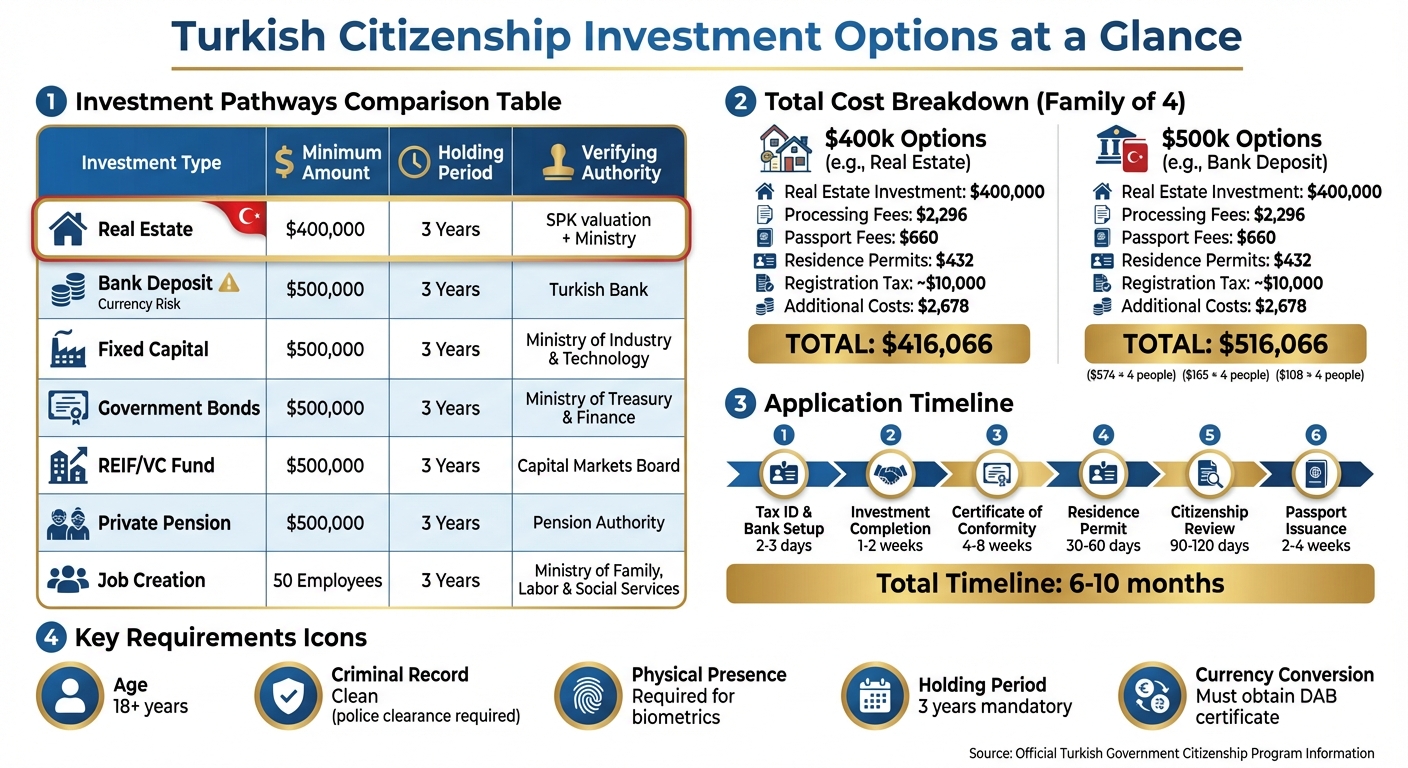
Once eligibility is confirmed, investors can explore several well-defined pathways to secure Turkish citizenship. These options are structured to comply with Turkey’s regulations while supporting the country’s broader economic goals.
Turkey offers seven investment pathways, each requiring specific financial commitments. For real estate, the minimum investment is $400,000, while other options require $500,000. This threshold was raised from $250,000 in May 2022. Despite the increase, the program generates around $250 million monthly from foreign investors, amounting to approximately $3 billion annually.
"The minimum investment requirement for Turkish citizenship is $400,000 in real estate, making it one of the most accessible citizenship by investment programs available." – Mark Damsgaard, Founder of Global Residence Index
All investments come with a mandatory three-year holding period. If you sell property, withdraw deposits, or liquidate investments before this period ends, citizenship will be revoked. Additionally, investors must secure a Foreign Exchange Purchase Certificate (DAB) by converting foreign currency into Turkish lira through the Central Bank of Turkey, using a local bank. This certificate is crucial for meeting compliance requirements.
Other costs include processing fees ($574 per family member), passport fees ($165 per person), and residence permits ($108 per family member). Real estate investors should also account for registration taxes (around $10,000) and mandatory valuation reports. For a family of four, the total cost is approximately $416,066 for real estate or $516,066 for the $500,000 investment options.
Real Estate Investment
The real estate route involves purchasing property worth at least $400,000. You can combine multiple properties to meet this amount, but only if they are bought with title deeds. For off-plan properties, a single notarized pre-sale contract must cover the full $400,000 requirement.
Eligibility is determined by an independent SPK (Capital Markets Board) valuation report, not the sale price. For example, even if you pay $450,000 for a property, it won’t qualify if the valuation is only $380,000. Additionally, your lawyer must place a "no-sale" annotation on the title deed and secure a Certificate of Conformity from the relevant ministry. Property values in Turkey generally rise by 15% to 25% annually, with Istanbul properties often doubling in value every five to ten years. After obtaining citizenship, property owners will pay an annual tax of 0.2% for apartments in metropolitan areas like Istanbul.
Bank Deposit Option
This option requires depositing $500,000 in a Turkish bank for three years. The funds must remain untouched, and compliance will be monitored throughout the holding period. However, this route carries risks tied to currency fluctuations. After the planned 2025 termination of the Foreign Exchange Protection Scheme (KKM), deposits will no longer be shielded from Turkish lira depreciation.
"The KKM scheme previously shielded depositors… new applicants will no longer enjoy this safeguard. That means new investors seeking to access this option will now fully bear the Turkish lira’s exchange rate risk." – Nomad Capitalist
Without this protection, investors face the risk of losing value if the lira depreciates significantly during the holding period, even though citizenship is still granted.
Government Bonds and Investment Funds
For those preferring less tangible assets, investing $500,000 in government bonds or approved funds offers an alternative. Eligible options include Real Estate Investment Funds (REIFs), venture capital funds, and private pension systems. Each option requires verification by different government agencies: the Ministry of Treasury and Finance for bonds, the Capital Markets Board for REIFs and venture capital, and the relevant pension authority for private pensions.
Business Investment and Job Creation
Business-focused pathways include a $500,000 fixed capital investment or creating jobs for 50 Turkish nationals. Fixed capital investments must align with Turkey’s economic priorities and are verified by the Ministry of Industry and Technology. Job creation, on the other hand, doesn’t require direct cash investment but involves maintaining the 50 jobs for three years, with compliance monitored by the Ministry of Family, Labor and Social Services.
Fixed capital investments typically focus on sectors like manufacturing, technology, or infrastructure. The ministry evaluates whether the investment supports national economic goals before issuing a Certificate of Conformity.
Investment Options Comparison
The table below provides a quick overview of the seven investment pathways:
| Investment Option | Minimum Amount | Holding Period | Key Condition |
|---|---|---|---|
| Real Estate | $400,000 | 3 Years | Must have "no-sale" annotation on title deed. |
| Bank Deposit | $500,000 | 3 Years | Held in a Turkish bank; subject to TRY exchange risk. |
| Fixed Capital | $500,000 | 3 Years | Verified by Ministry of Industry and Technology. |
| Govt Bonds | $500,000 | 3 Years | Verified by Ministry of Treasury and Finance. |
| REIF / VC Fund | $500,000 | 3 Years | Verified by Capital Markets Board. |
| Private Pension | $500,000 | 3 Years | Contribution to approved pension system. |
| Job Creation | 50 Employees | 3 Years | Verified by Ministry of Family, Labor and Social Services. |
Application Process
The process for obtaining Turkish citizenship through investment follows a series of clearly defined steps, designed to guide applicants smoothly to their new status. Generally, the process takes around 6–10 months to complete. Although some sources suggest a shorter timeline of 3–4 months, this only applies to cases with no complications. Importantly, applicants must first secure a Certificate of Conformity and a residence permit before submitting their citizenship application.
Most of the process can be handled remotely by granting Power of Attorney to a licensed Turkish lawyer. Applicants are typically required to be physically present only for biometric data collection, which occurs during the residence permit or passport application stages.
"Citizenship is a sovereign legal status, not merely a commercial transaction. Every stage must be supervised by an experienced immigration lawyer in Türkiye."
– Bayraktar Attorneys
Here’s a detailed breakdown of each step involved.
Step-by-Step Application Guide
- Preparation:
Start by obtaining a Turkish Tax Identification Number at the local tax office and opening a Turkish bank account. This step usually takes 2 to 3 business days. - Investment Completion:
Finalize your chosen investment. For real estate, ensure funds are transferred directly to the seller’s account, as using intermediaries could result in rejection. A government-authorized SPK valuation report (completed in 3–5 business days) is necessary, and your lawyer should secure a "no-sale" annotation on the title deed. - Certificate of Conformity:
Apply for the Certificate of Conformity, which confirms your investment meets program requirements. This step, managed by the relevant ministry, takes 4–8 weeks. - Residence Permit:
Secure a short-term investor residence permit under Article 315. This step requires no minimum stay and typically takes 30–60 days. You’ll need health insurance and proof of your investment for this application. - Citizenship Application Submission:
After obtaining the residence permit, submit your citizenship application to the Provincial Directorate of Census and Citizenship. This must include your spouse and any children under 18. The application undergoes a thorough review, including background checks by the Ministry of Interior, before final approval by Presidential decision. This review phase generally lasts 90–120 days.
"The citizenship application process is document-intensive. Every document, from birth certificates to marriage licenses, must be correctly prepared."
– Ahmet Üner, Attorney, Uner Law - Biometrics and Passport Issuance:
Once approved, submit your biometrics (fingerprints and photos) to receive Turkish ID cards and passports. Issuance of passports takes 2–4 weeks.
Expected Processing Timeline
The table below provides an overview of the estimated timeframes for each stage:
| Phase | Action | Estimated Duration |
|---|---|---|
| Phase 1 | Tax ID & Bank Account Setup | 2–3 business days |
| Phase 2 | Investment Completion | 1–2 weeks |
| Phase 3 | Certificate of Conformity | 4–8 weeks |
| Phase 4 | Short-term Residence Permit | 30–60 days |
| Phase 5 | Citizenship Application Review | 90–120 days |
| Phase 6 | Biometrics & Passport Issuance | 2–4 weeks |
Delays often result from incomplete or improperly formatted documents, such as missing apostilles, incorrect translations, or expired background checks. Engaging professionals for preliminary due diligence can lower the risk of application denial to about 1%.
For real estate investments, confirm that the property does not require military clearance (askeri izin) before purchase, as this can delay the title transfer. Additionally, ensure the property has not been used previously for a citizenship application, as each property can only be used once for this purpose.
"The Turkish citizenship by investment program allows applicants to obtain citizenship within 8+ months, making it one of the fastest options available globally."
– Vladlena Baranova, Head of Legal & AML Compliance Department, Immigrant Invest
Careful attention to detail throughout the process is crucial to avoiding risks, which will be explored in later sections.
Hidden Risks and Challenges
While the investment pathways may appear straightforward, there are several underlying risks that could derail your plans. Recognizing these challenges early can help you make smarter decisions and sidestep expensive errors.
Currency and Financial Risks
Currency fluctuations remain a major concern. In December 2025, Turkey’s Central Bank ended the Foreign Exchange Currency Protection Scheme (KKM), which had previously safeguarded investors against the depreciation of the Turkish Lira. Saad Ahsan Residency and Citizenship commented:
"With the [FX protection] policy now removed, foreign investors are fully exposed to the rise and fall of the Turkish lira".
Experts anticipate that this shift could lead to a 10–20% decline in application numbers.
Another financial hurdle is the valuation gap. Since January 2026, the GEDAŞ (Real Estate Valuation Center) system has replaced informal valuation methods with strictly enforced official valuations. This has created stricter compliance requirements, as one property advisory noted:
"If you purchase a property for $400,000, but the government-appointed expert values it at even $399,000, your citizenship application will be rejected" – istaproperty.com.
Other financial challenges include the immobilization of your capital for three years and steep capital gains taxes (15–40%) if the property is sold within five years. Additionally, hidden costs like title deed tax, notary fees, translation expenses, and VAT can add 7–12% to your investment, amounting to roughly $30,000–$50,000. Including family members in the application increases costs further, with state fees of $574 per person and residence permit fees of $5,000 per parent.
Beyond financial risks, legal and compliance issues also pose significant threats to application success.
Legal and Compliance Risks
Even minor errors in documentation can result in rejection. For instance, the title deed must include specific legal language ("satış yoluyla vatandaşlık") and enforce a mandatory three-year no-sale restriction. An Istanbul-based law firm emphasized:
"One error in fund flow can void the entire application".
To comply with regulations, foreign currency must be converted through an authorized Turkish bank, generating a "Döviz Alım Belgesi" (FX Purchase Certificate). Both the sending and receiving accounts must bear the applicant’s name. Using intermediaries or third-party transfers can trigger anti–money laundering concerns.
Turkish banks have also tightened their scrutiny of fund sources. Applicants must now provide detailed documentation, such as salary records, business income statements, or proof of inheritance, to verify the legitimacy of their funds. Additionally, properties located near military zones require special clearance (askeri izin), and failing to secure this clearance can lead to legal complications.
Revocation of citizenship is another pressing risk. In September 2025, Turkey’s Interior Ministry dismantled a criminal network in Istanbul that had orchestrated fraudulent property deals. This operation led to the arrest of 106 suspects, the revocation of citizenship for 451 foreign investors and their families, and the seizure of over 1,000 apartments. Under Articles 31 and 40 of Law No. 5901, citizenship obtained through fraud, false pretenses, or withholding significant details can be revoked.
These legal risks are further complicated by Turkey’s evolving geopolitical environment.
Geopolitical and Program Stability Risks
Frequent policy changes add to the uncertainty. For example, the termination of the KKM in December 2025 is just one instance of the government’s unpredictable adjustments. Similarly, the minimum real estate investment threshold was raised from $250,000 to $400,000 in June 2022 without prior warning.
External treaty changes can also affect the benefits of Turkish citizenship. While Turkish citizens can access the U.S. E-2 Treaty Investor Visa, CBI (Citizenship by Investment) applicants must now demonstrate three years of residency in Turkey to qualify.
Background checks have grown more rigorous. In 2026, rejection rates for applicants from high-risk or geopolitically sensitive regions ranged between 10% and 15%. These checks now involve thorough reviews of international databases and comprehensive audits of business activities. As farruk_bashir noted:
"Turkey’s CIP is still a valuable option, but it is no longer the easy choice as it used to be".
Turkey’s strategic location at the crossroads of Europe, Asia, and the Middle East introduces additional uncertainties, as diplomatic shifts can impact long-term planning.
Conclusion
Turkey’s Citizenship by Investment program offers a second passport in a relatively short timeframe of 4–12 months. To qualify, you can invest a minimum of $400,000 in real estate or opt for alternatives like bank deposits or government bonds with a $500,000 threshold. Beyond citizenship, this program opens doors to visa-free travel in over 110 countries and eligibility for the U.S. E-2 Investor Visa, provided you’ve lived in Turkey for at least three years.
However, there are risks to consider. Financial and geopolitical uncertainties, currency fluctuations, and additional costs – usually between 5% and 8% of the investment – can affect your overall returns. The required three-year capital lock-in period further adds to the financial commitment. Mistakes in documentation or fund transfers can derail your application, and citizenship may even be revoked if fraudulent details are uncovered.
The regulatory environment is also evolving, with stricter background checks and political opposition adding layers of complexity. As Bayraktar Attorneys aptly put it:
"Citizenship is a sovereign legal status, not merely a commercial transaction".
This highlights the importance of professional legal assistance throughout the process. Expert guidance can help ensure compliance with regulations and mitigate potential pitfalls.
Before committing to an investment, it’s crucial to verify property valuations, check the integrity of title deeds, and confirm SPK compliance. Partnering with experienced immigration attorneys will help you navigate the technical requirements and liaise with Turkish authorities effectively. As this guide has outlined, Turkish citizenship remains a solid option for strategic investors, but success depends on thorough research, realistic expectations, and skilled legal support.
FAQs
How can I reduce the risk of my property valuation coming in under $400,000?
To ensure your property valuation stays above $400,000, double-check that the tapu (title deed) and the valuation report are both accurate and consistent. Any mismatches or undervaluation could lead to the rejection of your citizenship application.
What fund-transfer mistakes can trigger rejection or AML red flags?
Errors in handling fund transfers can create unnecessary complications or even trigger Anti-Money Laundering (AML) alerts. One common issue is failing to clearly explain structured financial transactions, like loans, inheritances, or offshore transfers. Without proper details, these transactions might appear suspicious.
Another major mistake is submitting incorrect or falsified documentation during money transfers. Not only can this lead to rejection, but it may also raise serious concerns with financial institutions.
To avoid these problems, always prioritize accuracy and transparency in your financial records and transaction details.
Can my Turkish citizenship be revoked after approval, and why?
Yes, Turkish citizenship can be revoked even after it has been granted. This usually occurs if someone provides false information during their application, is found guilty of a crime, or fails to meet the legal requirements outlined in Turkish law. To retain citizenship, it’s crucial to comply with all applicable legal regulations.
