
In 2026, Citizenship by Investment (CBI) programs are more than a luxury – they’re a tool for global mobility, asset protection, and tax planning. These programs allow individuals to obtain citizenship in exchange for investments ranging from $90,000 to over $1 million. With visa restrictions tightening and geopolitical risks rising, demand for second passports has surged, particularly in the U.S. and UK.
Key Points:
- What It Is: CBI grants citizenship through investments like donations, real estate, or government bonds.
- Why It Matters: Benefits include visa-free travel, tax advantages, and family inclusion.
- Popular Programs: Leading options in 2026 include St. Kitts and Nevis, Grenada, Antigua and Barbuda, St. Lucia, and Turkey.
- Costs: Investments start at $200,000, with additional fees for due diligence, dependents, and processing.
- Risks: Programs face scrutiny from global regulators, and citizenship can be revoked for fraud or non-compliance.
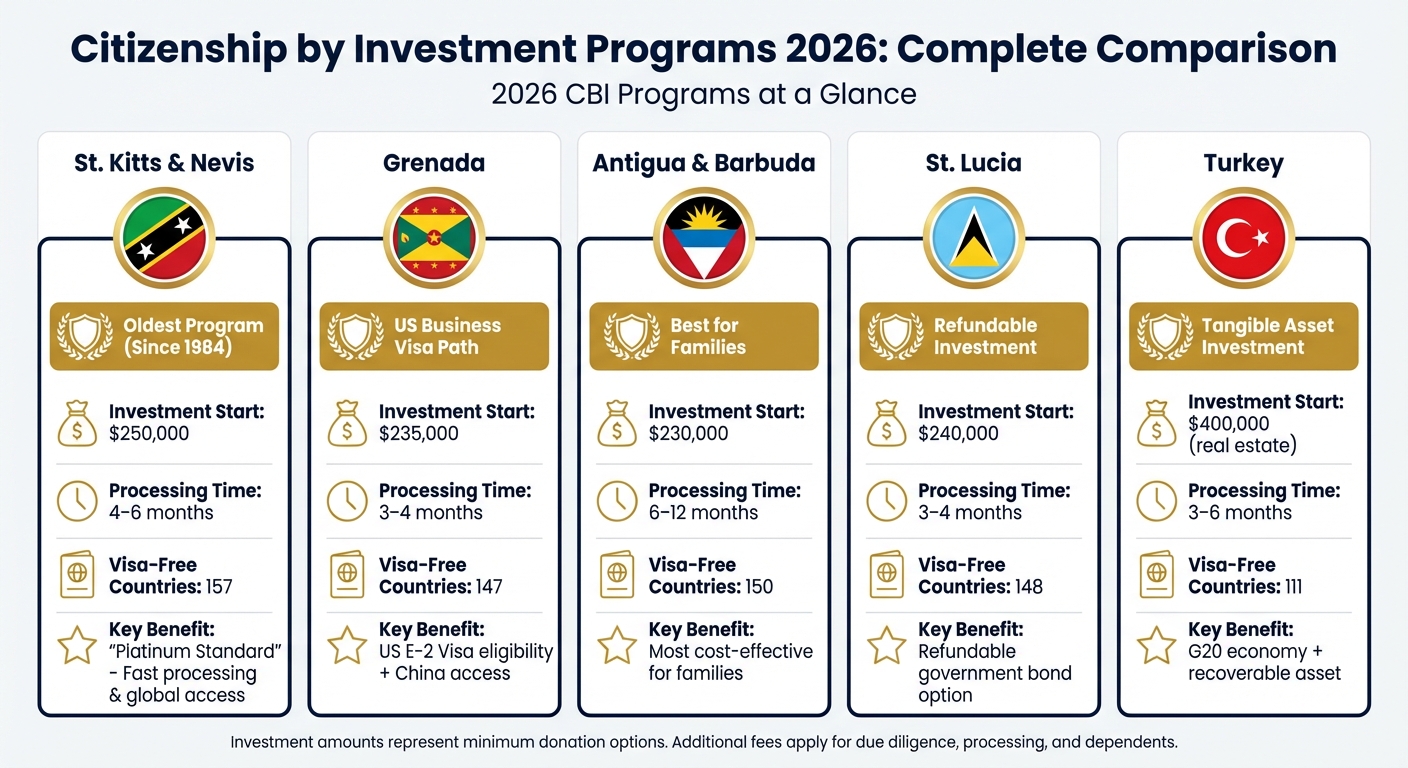
Quick Overview of Top Programs:
| Country | Investment Start | Processing Time | Visa-Free Countries | Notable Benefit |
|---|---|---|---|---|
| St. Kitts & Nevis | $250,000 | 4–6 months | 157 | Fast processing, global access |
| Grenada | $235,000 | 3–4 months | 147 | US E-2 Visa eligibility |
| Antigua & Barbuda | $230,000 | 6–12 months | 150 | Cost-effective for families |
| St. Lucia | $240,000 | 3–4 months | 148 | Refundable bond option |
| Turkey | $400,000 | 3–6 months | 111 | Investment in real estate |
CBI programs are evolving with tighter regulations, higher investment thresholds, and added requirements like interviews. To avoid legal or financial risks, work with licensed advisors and conduct thorough research. For personalized guidance, you can schedule a private consultation to discuss your specific needs. Whether for travel, business, or security, a second passport can open doors – but it requires careful planning.
What is Citizenship by Investment?
Citizenship by Investment (CBI) is a legal pathway offered by certain nations, granting full citizenship and a passport in exchange for a qualifying economic contribution. This isn’t a simple transaction but a formal naturalization process, with governments retaining the authority to approve or reject applications.
With CBI, you can secure a second passport in as little as 3–8 months – no need for residency, language tests, or years of waiting.
The process begins with confirming your eligibility and submitting documents such as identification, proof of funds, and a clean criminal record. Applicants then undergo rigorous due diligence to meet global anti-money laundering and counter-terrorism standards. Once cleared, you make the required investment and are granted citizenship.
CBI programs generally offer four main investment routes:
- Non-refundable donations: These are contributions to a government fund, often the quickest and most cost-effective option.
- Real estate investments: Purchase government-approved property, which must typically be held for 3–7 years before resale.
- Government bonds: Invest in state-backed bonds, which are often refundable after a set period but may not earn interest.
- Business investments: Create local jobs by investing in approved businesses.
In recent years, programs have expanded their options. For example, Turkey now accepts bank deposits, El Salvador allows Bitcoin/USDT contributions of $1 million, and Vanuatu includes agricultural investments. The global CBI industry generates around $20 billion annually, with nations like Dominica and St. Kitts and Nevis earning up to 40% of their GDP from these programs.
This streamlined approach has fueled rapid growth and transformation in the industry.
How Citizenship by Investment Programs Developed Over Time
Over the years, CBI programs have evolved significantly, adapting to both opportunities and challenges. The modern concept began in 1984 with St. Kitts and Nevis, which launched the first formal program to attract foreign capital for infrastructure, healthcare, and education. Other Caribbean nations quickly followed suit.
For decades, these programs operated with minimal scrutiny. However, as global concerns over money laundering and security increased, international regulators began to step in. In 2025, the European Court of Justice ruled against "golden passports", leading Malta to shut down its direct CBI program in April of that year. The EU and OECD have since pushed Caribbean nations to tighten their screening processes and increase minimum investment thresholds.
In response, five Caribbean nations – Antigua and Barbuda, Dominica, Grenada, St. Kitts and Nevis, and St. Lucia – agreed in 2024 to set a unified minimum investment threshold of $200,000 or more. By 2026, mandatory interviews for applicants and dependents became standard, reflecting a shift toward greater transparency and accountability.
New players have also entered the market. Argentina launched its program in July 2025 under President Javier Milei, creating the Agencia de Programas de Ciudadanía por Inversión (APCI). Similarly, Saint Vincent and the Grenadines introduced its program in late 2025 to address significant public debt. Countries in Africa, such as São Tomé and Príncipe and Sierra Leone, along with Pacific nations like Nauru, have also joined the CBI space.
"The investment citizenship market is undergoing a transformation from competition based on price to competition based on speed and the conditions for obtaining passports for the entire family."
- Elena Garnitsarik, Head of Legal Department, Passportivity
Who Can Apply for Citizenship by Investment?
CBI programs have refined their eligibility criteria over time. Applicants must be at least 18 years old, have no criminal record, and demonstrate that their funds are legally obtained.
Most programs allow family members to be included for additional fees. Typically, this includes spouses, dependent children (up to ages 25–30), and dependent parents or grandparents (usually over 55). Some newer programs, like Nauru’s 2026 initiative, even extend eligibility to siblings and grandchildren of any age.
Applications may be denied for reasons such as international sanctions, nationality restrictions, or failing background checks. Citizenship can also be revoked if fraudulent documents are discovered or if the individual engages in serious criminal activity after obtaining it.
Direct applications are generally not allowed. Instead, applicants must work with licensed intermediaries – authorized agents who manage the process and ensure compliance with government standards. While this adds to the overall cost, it ensures quality control and adherence to regulations.
Next, we’ll explore the top CBI programs available in 2026.
sbb-itb-39d39a6
Why Get a Second Passport?
A second passport offers more than just convenience – it’s a smart way to protect wealth, access new business opportunities, and ensure freedom of movement. By 2026, citizenship by investment has become a strategic tool for investors, not just a luxury.
The advantages of a second passport generally fall into three categories: financial security, global mobility, and tax planning. Each addresses the challenges faced by high-net-worth individuals in today’s unpredictable world.
For example, applications from UK nationals for citizenship by investment programs surged by 183% in early 2025 after changes to the non-domiciled tax regime. This trend highlights how investors are using second passports to shield themselves from shifting domestic policies and economic uncertainty.
"Citizenship by investment has evolved from a status symbol into a practical tool. Investors use a second passport to reduce geopolitical and tax risks." – Elena Garnitsarik, Head of Legal Department
Here’s a closer look at why demand for second passports is growing.
Protecting Your Assets and Financial Privacy
A second passport allows you to diversify your connections across different jurisdictions, reducing the risks tied to political or economic instability in one country. It doesn’t hide your assets but instead ensures access to global banking systems when your primary nationality might create barriers.
For instance, international banks often block accounts or impose extra scrutiny on citizens from high-risk or sanctioned countries. With a second passport from a stable nation, you can open international accounts and access credit facilities that might otherwise be out of reach.
Additionally, having multiple citizenships lets you spread your assets across various legal systems. This can protect your wealth from risks like capital controls, currency devaluation, or even asset seizure. Recent global events – such as border closures and emergency measures – have shown the value of having an unconditional right to live in a stable country. Unlike residency permits, which often come with conditions, citizenship provides permanent access without restrictions.
But it’s not just about safeguarding assets – a second passport also simplifies international travel.
Travel Without Visa Restrictions
For both business and personal reasons, global mobility is crucial. A second passport can grant visa-free or visa-on-arrival access to key regions like the Schengen Area, the UK, Singapore, and Hong Kong. This eliminates the hassle of waiting for visa approvals or dealing with embassy appointments, allowing you to travel more efficiently and focus on your priorities.
Some passports offer unique perks. For instance, citizenship in Grenada, Turkey, Egypt, or Jordan makes you eligible for the US E-2 Treaty Investor Visa, which allows you to live and run a business in the United States. Similarly, St. Kitts and St. Lucia passports make it easier to secure 10-year B1/B2 US visitor visas.
However, visa-free access isn’t always guaranteed. In 2022, the EU suspended Schengen access for Vanuatu due to due diligence concerns. Similarly, the UK revoked visa-free entry for Dominica and Vanuatu in 2023, citing national security issues. To mitigate these risks, many investors now acquire multiple citizenships to ensure uninterrupted travel privileges.
"A single Caribbean passport no longer guarantees freedom of movement; investors are forced to obtain two or three statuses in different countries." – Elena Garnitsarik, Head of Legal Department
While enhanced travel opportunities are a major draw, the tax advantages of certain jurisdictions add another layer of appeal.
Legal Tax Planning Options
Many citizenship by investment programs are based in countries with tax-friendly policies. Places like St. Kitts and Nevis, Antigua and Barbuda, and Vanuatu have no personal income tax, capital gains tax, or inheritance and wealth taxes. This allows individuals to create tailored tax residency strategies. By legally establishing residence in such jurisdictions, you can reduce your global tax liabilities while staying fully compliant with the law.
It’s important to note that simply obtaining a second passport doesn’t automatically change your tax obligations. Most countries tax based on residency, not citizenship. However, having a second citizenship gives you the legal right to move to a tax-friendly jurisdiction if needed.
For US citizens, tax planning is more complex due to citizenship-based taxation. That said, a second passport can still provide benefits like the Foreign Earned Income Exclusion and access to foreign tax credits.
On a broader scale, second citizenship can support business growth. It simplifies company registration, improves access to international financing, and allows operations in more stable markets. The global citizenship by investment market is valued at around $20 billion annually, with projections suggesting it could grow to $100 billion. Programs like those in Dominica and St. Kitts and Nevis contribute between 14% and 40% of their GDP, highlighting their economic importance and sustainability.
Best Citizenship by Investment Programs in 2026
Citizenship by investment programs cater to different priorities: some focus on speed, others on global mobility or benefits like eligibility for the US E-2 Treaty Investor Visa. In 2026, five programs stand out for their reliability, benefits, and track record: St. Kitts and Nevis, Grenada, Antigua and Barbuda, St. Lucia, and Turkey.
Recently, Caribbean nations harmonized their pricing, setting minimum donation amounts at $200,000 or higher to address international scrutiny. While this change has added consistency, each program still offers unique advantages depending on your goals.
Here’s a closer look at the standout programs in 2026 and what they bring to the table.
St. Kitts and Nevis
St. Kitts and Nevis introduced the first formal citizenship by investment program back in 1984. Often referred to as the "Platinum Standard", it combines quick processing with extensive global travel benefits. Applicants can choose between two main options: a $250,000 contribution to the Sustainable Island State Contribution (SISC) fund or a $325,000 real estate investment.
The passport allows visa-free travel to 167 destinations. Standard processing takes 4–6 months, but the Accelerated Application Process (AAP) can reduce it to just 60 days. Starting April 1, 2026, biometric data collection will be mandatory for all new applicants. Additionally, the US Financial Crimes Enforcement Network (FinCEN) lifted its advisory on the program earlier this year, signaling renewed trust.
This program is ideal for those who value speed, prestige, and the ability to travel widely. There are no residency requirements, and the application can include a spouse, children under 25, and parents over 55.
Grenada
Grenada’s program is unique as the only Caribbean option offering a pathway to the US E-2 Treaty Investor Visa. This makes it particularly attractive for entrepreneurs looking to live and run a business in the US.
"Grenada is the only Caribbean CBI jurisdiction with a qualifying bilateral investment treaty with the United States, enabling Grenadian passport holders to apply for an E-2 visa." – NTL International Advisory Team
Applicants can choose between a $235,000 donation to the National Transformation Fund (NTF) or a $270,000 joint real estate investment. Processing typically takes 3–4 months. Grenada’s passport provides visa-free access to over 144 countries, including China and Russia. To qualify for the E-2 visa, applicants must reside in Grenada for at least three years. This program is a great fit for business-minded investors looking for flexibility in the US and access to markets in Asia and Eastern Europe. Eligible family members include spouses, children under 30, siblings, and parents.
Antigua and Barbuda
Antigua and Barbuda is known for being a cost-effective option, especially for larger families. Investors can contribute $230,000 to the National Development Fund (NDF) or invest $300,000 in real estate. Another appealing option is the UWI Fund, which includes a one-year tuition scholarship, adding value for families.
The program offers visa-free travel to 164 countries, though processing times range from 6–12 months. There’s a minor residency requirement: new citizens must spend at least 5 days in Antigua and Barbuda within the first five years. This program is a solid choice for families looking for an affordable second passport option. Applications can include spouses, children, parents, and siblings under certain conditions.
St. Lucia

St. Lucia stands out for its diverse investment options. Applicants can choose a $240,000 contribution, a $300,000 real estate investment, or a $300,000 government bond option. The bond route is particularly appealing, as the full principal is refundable after five years. St. Lucia is the only Caribbean program offering this feature.
The passport provides visa-free access to 155 countries. Processing takes about 6–7 months, and there are no residency requirements. Eligible family members include spouses, children under 25, and parents. This program is a great option for those who want to minimize risk while securing a second passport.
Turkey
Turkey offers a different set of benefits compared to Caribbean programs. As a G20 nation located between Europe and Asia, it provides strategic advantages. The program requires a $400,000 investment in government-approved real estate, which must be held for three years before selling to recover the capital.
Turkey’s passport allows access to various regions, including parts of Europe, the Middle East, and Asia. Additionally, Turkey qualifies for the US E-2 Treaty Investor Visa. Processing times range from 3–6 months, and there are no residency requirements. The program is well-suited for those seeking a recoverable asset in a major economy. Applications can include spouses and children under 18.
The next section will break down program costs, timelines, and benefits to help you choose the best option for your goals.
Program Comparison: Costs, Timelines, and Benefits
When evaluating citizenship by investment programs, three main factors stand out: investment amount, processing time, and visa-free access. These elements play a crucial role in determining which program aligns best with your goals for asset protection and global mobility.
| Country | Investment Requirement | Processing Time | Visa-Free Countries | Special Benefit |
|---|---|---|---|---|
| St. Kitts & Nevis | $250,000 | 4–6 months | 157 | "Platinum Standard" stability |
| Grenada | $235,000 | 3–4 months | 147 | US E‑2 Visa eligibility and access to China |
| Antigua & Barbuda | $230,000 | 6–12 months | 150 | Competitive pricing for large families |
| St. Lucia | $240,000 | 3–4 months | 148 | Refundable government bond option |
| Turkey | $400,000 (real estate) | 3–6 months | 111 | Investment in a G20 economy, recoverable after a holding period of 3–7 years |
Caribbean countries adjusted their pricing between 2024 and 2025, setting minimum investments between $200,000 and $250,000 to meet stricter global standards. While donation-based routes typically cost between $230,000 and $250,000, Turkey stands apart with its $400,000 real estate requirement, offering a tangible asset in return.
Processing times are another important factor. Grenada and St. Lucia process applications quickly – within 3 to 4 months – while Antigua & Barbuda may take up to 12 months. Non-Caribbean programs, like those in Vanuatu or São Tomé & Príncipe, offer even shorter timelines (1–3 months), though they provide fewer visa-free travel options.
Visa-free travel access varies widely. Turkey provides access to 111 countries, while St. Kitts & Nevis leads the pack with 157 destinations.
Beyond the headline costs, it’s essential to account for additional expenses. Due diligence fees can exceed $7,500 per applicant, and government processing fees further increase the overall investment. Donation-based routes, however, avoid ongoing costs tied to real estate, such as property taxes, insurance, and maintenance.
To make an informed decision, consider both upfront and hidden costs for a full understanding of your investment.
Understanding the Full Cost of Citizenship by Investment
When considering citizenship by investment, it’s important to look beyond the advertised minimum investment. This figure is just the starting point. The full cost includes various additional expenses such as government processing fees, due diligence fees, administrative charges, legal fees, and extra costs for dependents.
For instance, due diligence fees can reach around $7,500 for the main applicant, with dependents incurring fees between $4,000 and $8,000 each. Government processing fees vary widely, ranging from $1,000 to $30,000 depending on the size of the family. Beyond these, applicants should also budget for expenses like passport issuance, medical exams, notarization, document translation, apostilles, and courier services. Currency exchange rates can further affect costs, especially when payments are required in U.S. dollars or euros.
If you’re opting for real estate investments, additional costs like stamp duty, property taxes, insurance, and maintenance fees come into play. Jean-François Harvey, Founder and Managing Partner of Harvey Law Group, highlights this point:
"Applicants pay at least $50,000 more than the donation option once property purchase price, government fees, legal fees, taxes, and maintenance costs have been paid."
These ongoing expenses can continue throughout the mandatory holding period – usually three to seven years – before you’re allowed to sell the property. This is why the actual cost often far exceeds the initial investment amount.
Donation vs. Real Estate: Which Investment Type is Right for You?
The choice between donation and real estate investments depends on your priorities. Donation programs are straightforward and faster, typically taking three to four months to process. They avoid the complexities of property assessments and ongoing maintenance costs.
Real estate investments, on the other hand, require a larger upfront commitment but offer the potential to recover your capital after the holding period. This option might appeal to those who plan to use the property or generate rental income. However, it comes with risks, such as market fluctuations and the challenge of reselling in an illiquid market. Additionally, real estate applications often take longer – six to nine months – due to more extensive due diligence.
If simplicity, lower costs, and speed are your main concerns, donation programs are likely the better choice. If you value owning an asset and are willing to navigate a longer, more involved process, real estate might be the way to go.
Other Fees You Should Know About
Several other costs can significantly impact your total financial commitment. Licensed agent fees vary based on the complexity of your case and the jurisdiction. It’s advisable to work with an advisor authorized across multiple programs to avoid being pushed toward a less suitable or pricier option.
Changes in your family situation – like marriage or the birth of a child – after submitting your application can also lead to additional documentation requirements and extra costs. Some programs are now introducing mandatory interviews for investors and adult dependents, which could add travel and administrative expenses to the mix.
Post-citizenship, there are ongoing expenses to consider. These include passport renewal fees, compliance reporting, and updating your documentation. For real estate investors, your capital remains tied up during the holding period, and selling property in a slow market can be challenging. To fully understand your financial commitment, calculate the total cost based on your family structure rather than focusing solely on the headline investment figure.
Legal Risks and What to Watch Out For
Citizenship by investment (CBI) is a lawful process, but it operates within a framework of changing international rules. Being aware of potential risks upfront can help you avoid costly errors and legal complications. Recent changes highlight the importance of understanding these risks when pursuing citizenship through investment.
In the summer of 2025, the European Court ruled that granting citizenship through investment violated EU law. This forced Malta to shut down its direct CBI program, replacing it with a "Citizenship by Merit" initiative that now requires 12–36 months of residency. International bodies like the EU, OECD, and the US frequently scrutinize CBI programs, urging countries to tighten their standards or risk losing visa-free travel privileges. For smaller nations like Vanuatu, St. Kitts and Nevis, and Dominica, which derive 14% to 40% of their GDP from CBI schemes, this scrutiny creates a delicate balance between economic reliance and external pressures.
The value of a passport can shift overnight due to geopolitical factors. Citizenship obtained through investment can be revoked for reasons such as fraud, misrepresentation, or failure to meet ongoing obligations like mandatory holding periods or physical presence requirements. New regulations are being introduced, including mandatory interviews and limited physical presence rules, as part of enhanced due diligence efforts. Steve Corbin, Managing Solicitor at Harvey Law Group, explains:
"For Saint Lucia CBI, draft regulations have been approved to implement a 30-day minimum residency requirement… expected to be implemented later this year (likely around Sept/Oct 2026)."
Meeting International Legal Requirements
To comply with international legal standards, you must first prove the legal origin of your investment funds. Governments enforce strict, multi-layered due diligence processes conducted by independent specialists. These checks cover criminal records, financial history, political exposure, and compliance with sanctions. Documentation like audited financial statements, tax returns, and sales agreements is required to meet source of funds (SoF) and source of wealth (SoW) criteria. These measures not only ensure compliance but also protect the integrity of your investment and mobility.
Full transparency is critical. You must disclose all criminal history – even if it has been expunged – as well as any prior visa denials. Failure to do so constitutes misrepresentation, leading to rejection or even revocation of citizenship. Anne Morris, Founder and Managing Director of DavidsonMorris, underscores the legal foundation of these programs:
"Citizenship by investment is a form of discretionary naturalisation grounded in national law. It involves a qualifying economic contribution but remains a sovereign legal act, not a commercial purchase."
Before proceeding, confirm that the program operates under a clear legal framework. Authentic programs are established by national legislation, such as the Grenada Citizenship-by-Investment Act, and are managed by dedicated government Citizenship by Investment Units (CIUs). If a program provider cannot reference the specific legislative act underpinning the program, it should raise a red flag.
Geopolitical stability is another factor to monitor. Countries facing ongoing tensions with the EU or OECD are at higher risk of losing visa-free travel privileges. To safeguard global mobility, consider combining a CBI passport with a residency permit (such as a Golden Visa) in a different region.
The next section will discuss how to navigate scams in the CBI industry.
How to Avoid Scams in the CBI Industry
Scammers prey on urgency and unrealistic promises. Beware of any provider guaranteeing "instant passports" or "guaranteed approval" in a matter of weeks. Legitimate due diligence processes take months, not weeks. Additionally, offers for citizenship from the US, UK, or EU member states are fraudulent, as these countries do not have direct CBI programs.
Always verify an agent’s credentials through the official government CIU website of the host country. Most programs require applicants to work with government-licensed agents or authorized representatives who undergo their own due diligence and pay annual licensing fees. However, some agents are only licensed to promote a single program, which can create conflicts of interest. Jean-François Harvey, Founder and Managing Director of Harvey Law Group, cautions:
"The most expensive mistake applicants make is… choosing a CBI lawyer or advisor whose business model is subject to a conflict of interest."
It’s better to work with law firms authorized across multiple jurisdictions rather than marketing agencies. Law firms can offer attorney-client privilege and formal legal representation – services that marketing agencies cannot provide. A credible advisor will never suggest bypassing source of funds checks, as legitimate programs always require thorough documentation.
Andrew Wilder from Savory & Partners emphasizes this point:
"Approval is not guaranteed simply because an investor can pay. Due diligence is central, and working with authorised channels minimizes avoidable risk."
In response to international scrutiny, Caribbean nations have introduced ECCIRA (Eastern Caribbean Citizenship by Investment Regional Authority). Established between 2024 and 2025, this body enforces unified rules, including passport issuance quotas and standardized application reviews. While this adds credibility, it’s only effective if you work with legitimate channels.
| Feature | Legitimate CBI Program | Fraudulent Scheme |
|---|---|---|
| Legal Basis | Established by formal legislation | Vague "special agreements" or unclear terms |
| Approval | Based on multi-layered due diligence | "Guaranteed" or promises of 100% success |
| Timeline | Typically 3–12 months or more | "Instant" or within 2–4 weeks |
| Agent Status | Listed on official CIU website | Unlisted or claims "exclusive" access |
| Documentation | Requires police clearances and proof of funds | Claims documentation is "not necessary" |
If a provider cannot clearly outline the legal framework of a program, it’s best to walk away. Choosing the wrong advisor can lead to wasted investments, rejected applications, and long-term legal trouble.
How Global Wealth Protection Can Help
Citizenship by investment involves much more than filling out forms – it’s a complex process requiring legal know-how, strategic foresight, and strict adherence to regulations. That’s where Global Wealth Protection steps in, simplifying the journey and guiding you from the initial evaluation to final approval.
The process starts with an initial consultation and goal assessment. During this stage, experts analyze your personal, business, and family objectives to recommend the most suitable investment path – whether that’s through donations, real estate, bonds, or business ventures. Unlike agents tied to specific programs, Global Wealth Protection operates across multiple jurisdictions, ensuring an impartial review of your options. This broader perspective helps avoid conflicts of interest and ensures the chosen program aligns with your wealth management and mobility goals.
A key part of the service is legal analysis and representation. This includes evaluating your eligibility under national citizenship laws, identifying any legal or reputational risks, and offering attorney-client privilege. Comprehensive due diligence is conducted, covering areas like criminal records, financial history, political connections, and compliance with international sanctions. Experts also confirm the legitimacy of your funds to prevent future compliance issues.
Beyond the legal groundwork, Global Wealth Protection enhances your tax strategy and safeguards your assets. They help identify jurisdictions with tax benefits, such as no personal income tax, no capital gains tax, or no inheritance tax. Their expertise ensures compliance with strict KYC/AML standards, reducing the risk of automatic account freezes at international banks. Additionally, they perform due diligence on government-approved real estate investments, ensuring your funds are allocated wisely.
Conclusion
The 2026 Citizenship by Investment (CBI) landscape presents a mix of opportunities and challenges for investors, reflecting a shift in how public perception of multiple passports and their utility has shifted. Once considered a luxury, CBI has evolved into a strategic tool for families and entrepreneurs seeking global mobility, asset protection, and tax planning.
Key trends define this transitional period: Caribbean nations have standardized minimum investment thresholds between $200,000 and $250,000, European programs have largely shut down due to regulatory pressures, and emerging options in Africa and the Pacific offer quicker processing and lower entry barriers. These changes highlight a dynamic global market with evolving priorities.
The advantages remain clear – visa-free travel to over 140 countries, tax planning benefits, and the ability to include multiple generations in a single application. However, these benefits come with responsibilities. Applicants must comply with rigorous due diligence requirements to avoid citizenship revocation. Additionally, government and legal fees can significantly increase the overall cost beyond the initial investment.
Industry leaders, like Anne Morris, Founder and Managing Director of DavidsonMorris, emphasize the importance of a strategic approach:
"Citizenship by investment should therefore be approached as a long-term legal status with strategic implications, rather than as a short-term mobility tool or financial product."
Ultimately, the best program depends on your specific needs – whether you prioritize fast processing, budget, family security, or access to unique opportunities like Grenada’s pathway to the U.S. E-2 visa. Success in this endeavor hinges on thorough research, careful planning, and professional guidance. Experienced advisors can simplify complex legal requirements and ensure your investment supports your long-term financial and personal goals.
Global Wealth Protection offers tailored expertise, ensuring a smooth and secure journey toward obtaining a strategic second passport.
FAQs
Which 2026 CBI program fits my goals best?
The ideal CBI program for 2026 depends entirely on your priorities. If you’re looking for affordability, São Tomé and Príncipe stands out with options starting at just $90,000.
For those who value speed, Caribbean programs like Saint Kitts and Nevis can grant citizenship in a matter of months. Meanwhile, if global mobility is your main goal, countries like Malta and Portugal offer extensive visa-free travel opportunities.
Turkey and Vanuatu strike a balance between cost-effectiveness and quick processing times, making them appealing for individuals seeking a middle ground. Ultimately, your decision should align with both your budget and personal objectives.
How much does CBI really cost after all fees?
The overall cost of citizenship by investment (CBI) generally falls between $100,000 and $400,000 or more. This includes various expenses such as government fees, due diligence charges, and administrative costs. The exact price varies based on factors like the chosen country, the type of investment, and the number of family members applying.
Can my CBI passport be revoked later?
Citizenship by investment (CBI) passports can indeed be revoked under certain circumstances. This typically happens if the applicant is found to have provided false information, committed fraud, or violated legal requirements. Since these programs are governed by the laws of the issuing country, maintaining compliance with all program rules is crucial to retaining citizenship status.
