
A second passport isn’t just about travel – it can protect your wealth, reduce taxes, and provide legal security. Here’s a quick breakdown of the top three Citizenship by Investment (CBI) programs:
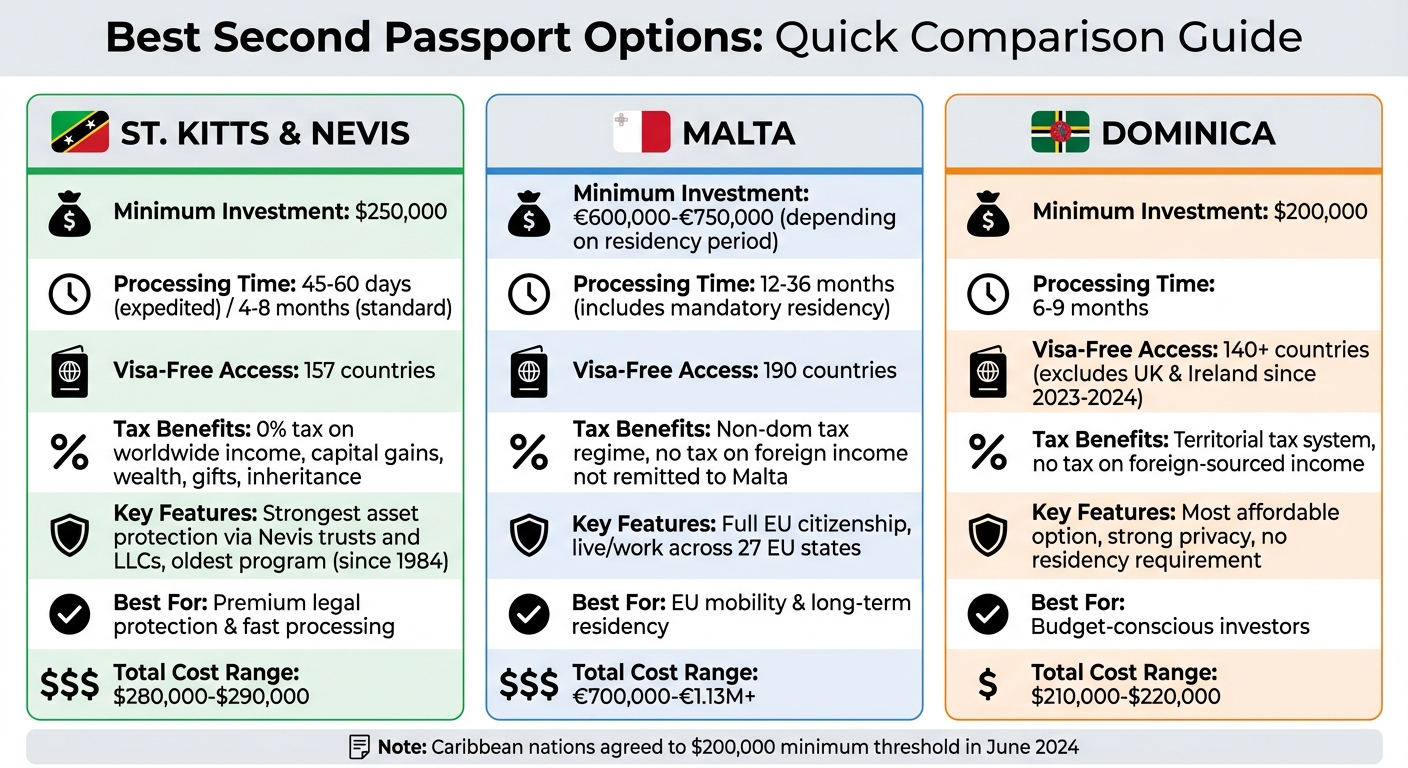
- St. Kitts and Nevis: Offers strong asset protection through Nevis trusts and LLCs, no taxes on global income, and visa-free access to 157 countries. Costs start at $250,000, with expedited processing available in 45–60 days.
- Malta: Grants full EU citizenship, allowing residence and work across Europe. Costs begin at €700,000, with a 12- or 36-month residency requirement. Provides tax advantages for foreign income not brought into Malta.
- Dominica: The most affordable option at $200,000, offering privacy and a territorial tax system. Visa-free access covers 140+ countries, though recent restrictions exclude the UK and Ireland.
Each program varies in cost, processing time, and benefits. Choose based on your goals – whether it’s legal safeguards, affordability, or EU mobility.
Quick Comparison:
| Program | Minimum Investment | Processing Time | Visa-Free Access | Tax Benefits | Key Features |
|---|---|---|---|---|---|
| St. Kitts & Nevis | $250,000 | 45–60 days | 157 countries | No global income or capital gains tax | Strong asset protection via Nevis trusts |
| Malta | €700,000 | 12–36 months | 190 countries | Non-dom tax regime | Full EU citizenship |
| Dominica | $200,000 | 6–9 months | 140+ countries | No foreign income tax | Affordable with privacy features |
Pick the program that aligns with your financial and mobility priorities. For personalized guidance, you can schedule private consultations to evaluate your specific situation.
1. St. Kitts and Nevis Citizenship by Investment
St. Kitts and Nevis offers one of the most established citizenship-by-investment programs in the world. First introduced in 1984, it holds the distinction of being the longest-running program of its kind. It combines multiple investment options with strong measures for protecting assets.
Investment Requirements
Investors can choose from several pathways to citizenship:
- Non-refundable donation: Starting at $250,000.
- Real estate investments: A minimum of $325,000 for condominiums or $600,000 for private homes, with a required seven-year holding period.
- Public Benefit option: Another route available under the program.
Each option comes with additional costs, including due diligence, application fees, and mandatory interview expenses. U.S. investors often lean toward direct property ownership to avoid potential complications tied to securities regulations.
Tax Advantages
St. Kitts and Nevis offers a highly attractive tax environment. Since eliminating personal income tax in 1980, the country has maintained a zero-tax policy on worldwide income, capital gains, wealth, gifts, and inheritance.
To take full advantage of the 0% tax rate on global income, investors need to spend at least 183 days annually in the country and obtain a Tax Identification Number. Nevis, in particular, is known for its strong legal protections through structures like Nevis LLCs and Asset Protection Trusts, which safeguard assets from lawsuits and creditor claims. For capital gains, assets sold within 12 months of purchase are taxed at 20%, but after that period, the rate drops to 0%.
Visa-Free Access
A passport from St. Kitts and Nevis unlocks visa-free or visa-on-arrival access to 157 destinations, including the United Kingdom, the Schengen Zone, Singapore, and Hong Kong. This makes it one of the most desirable travel documents among Caribbean programs. Additionally, the country recognizes dual citizenship, so applicants are not required to renounce their original nationality.
Processing Time
The standard application process takes about four to eight months from submission to passport issuance. For those in need of faster results, the Accelerated Application Process can reduce this timeline to 45–60 days for an extra fee.
As part of the application, all main applicants aged 16 and older must undergo a mandatory interview, which can be conducted virtually or in person. This is part of the program’s enhanced due diligence measures. Beyond speed, the program emphasizes confidentiality and asset protection for its investors.
Asset Protection Features
"Information on investors who acquire citizenship is kept completely confidential." – St. Kitts & Nevis Citizenship by Investment Unit
The government enforces strict non-disclosure policies, ensuring that the identities and assets of program participants remain private. There is no public registry for individuals who gain citizenship through investment. Combined with a stable legal system rooted in English Common Law, this framework offers a secure foundation for protecting wealth. Investors can also use trust structures and offshore entities to enhance privacy and manage intergenerational wealth transfer.
In 2015, the program’s fees accounted for 13% of the nation’s GDP, highlighting its economic importance and stability over time.
sbb-itb-39d39a6
2. Malta Citizenship by Investment
Malta’s program stands out by offering a combination of asset security, favorable tax policies, and full European Union (EU) citizenship. This citizenship allows individuals to live, work, and study across all 27 EU member states. As of July 2025, Malta’s program operates under the "Citizenship by Merit" framework, which evaluates applicants based on both their investments and exceptional contributions.
Investment Requirements
To qualify, applicants must fulfill a residency requirement and choose between two main investment paths:
- €750,000 contribution after 12 months of residency.
- €600,000 contribution after 36 months of residency.
In addition to these contributions, applicants must also meet the following conditions:
- Real estate: Either purchase property worth at least €700,000 (held for five years) or lease property for a minimum of €16,000 per year for five years.
- Philanthropy: Make a €10,000 donation to a registered Maltese NGO.
- Dependent fees: Pay €50,000 for each additional family member.
- Due diligence fees: €15,000 for the primary applicant and €10,000 for dependents over 18.
Applications must be submitted through government-approved agents, and the program has strict limits, accepting only 400 applicants annually or 1,500 in total.
Tax Advantages
Malta’s tax system complements its investment program by offering significant financial benefits. The country operates a non-domicile tax regime, meaning new citizens are only taxed on income sourced in Malta or foreign income brought into the country.
"Income earned abroad that is not remitted to Malta falls beyond the purview of the local tax authorities, while capital and capital gains remittances are untaxed." – MaltaInvest.mt
Additionally, Malta does not impose taxes on wealth, inheritance, death, or real estate. A network of double taxation treaties further protects cross-border assets.
Visa-Free Access
Malta’s passport is ranked 6th globally in 2026, granting visa-free or visa-on-arrival access to 190 destinations, including major countries like the United States, United Kingdom, and Canada. Since February 2000, Malta has allowed dual citizenship, enabling applicants to retain their original nationality while benefiting from EU citizenship.
Processing Time
The program’s residency requirement extends the timeline compared to Caribbean options. Applicants must reside in Malta for either 12 or 36 months before applying for citizenship. To demonstrate a "genuine link" with Malta, applicants are encouraged to engage locally – such as maintaining a physical presence, joining professional associations, or enrolling children in Maltese schools.
Asset Protection Features
Malta provides a secure environment for investors through its EU membership, which ensures strong legal and constitutional protections. The program incorporates a rigorous four-tier due diligence process, including checks by Interpol and Europol, to verify the source of wealth and assess the applicant’s reputation. This thorough vetting process reinforces the program’s commitment to asset security.
"The current approach centres on naturalisation based on merit and exceptional contribution, recognising individuals who have provided, or are capable of providing, outstanding services to Malta or to humanity more broadly." – CSB Group
The application process is handled with discretion, ensuring privacy for investors throughout their citizenship journey.
3. Dominica Citizenship by Investment
Dominica has been offering a citizenship-by-investment program since 1993, making it one of the Caribbean’s most established options. Known for its affordability and straightforward process, the program provides strong asset protection with no residency requirements and a fully remote application process.
Investment Requirements
To qualify, applicants have two main options:
- A non-refundable contribution to the Economic Diversification Fund:
- US$200,000 for a single applicant.
- US$250,000 for a family of up to four.
- A real estate investment of at least US$200,000 in government-approved properties, which must be held for three years (or five if sold to another CBI applicant).
Additional fees include:
- Due diligence fees: US$7,500 for the main applicant and US$4,000 for dependents aged 16 or older.
- Interview fees: US$1,000 per person aged 16 or older.
- Processing and certificate fees.
- For real estate applicants: Government fees of US$75,000 (single applicants) or US$100,000 (families of up to four).
Tax Advantages
Dominica’s territorial tax system means non-residents do not pay taxes on foreign-sourced income, such as dividends, interest, or royalties. Local income is taxed progressively (0% to 35%) after a US$30,000 allowance. There are no taxes on wealth, gifts, inheritances, or capital gains. International Business Companies enjoy a 20-year exemption on foreign-sourced income, making this jurisdiction particularly appealing for global investors.
Visa-Free Access
A Dominica passport allows visa-free or visa-on-arrival travel to over 140 destinations, including the EU Schengen Area, Hong Kong, Singapore, China, and Thailand. However, visa-free access to the UK was removed in July 2023, and Ireland followed in March 2024. Despite these changes, the passport is still ranked between 70th and 76th globally for travel freedom.
Processing Time
The application process usually takes 6 to 9 months, with "Approval in Principle" granted within 60 to 90 days. Applicants aged 16 and older must complete virtual interviews as part of the enhanced due diligence process. In 2023, Dominica revoked the citizenship of 260 individuals who provided false information, demonstrating its commitment to maintaining the program’s integrity.
Asset Protection Features
Dominica’s legal framework, rooted in English Common Law, offers strong asset protection. Tools like International Exempt Trusts, Private Limited Liability Companies (LLCs), and International Business Companies can be registered within 24 hours without requiring a local secretary. These structures provide privacy and safeguard wealth internationally. Additionally, the Eastern Caribbean Dollar (XCD) is pegged to the US Dollar, ensuring currency stability.
"Our Programme has efficient processing times and offers one of the most affordable routes to citizenship in the Caribbean." – Dominica Citizenship by Investment Unit
In June 2024, Caribbean nations offering citizenship-by-investment programs agreed on a minimum investment threshold of US$200,000, eliminating competitive pricing reductions. For single applicants, total costs for Dominica are estimated at US$210,000–US$220,000, which is lower than the US$280,000–US$290,000 required for St. Kitts and Nevis.
Advantages and Disadvantages
Each citizenship program comes with its own trade-offs in terms of cost, processing speed, and long-term benefits. It’s essential to weigh these factors against your specific asset protection goals.
St. Kitts and Nevis stands out as a premium Caribbean option, requiring a minimum contribution of $250,000, with total costs for single applicants falling between $280,000 and $290,000. A key feature is its accelerated processing route, which can deliver approval in just 45–60 days for an additional fee. This quick turnaround makes it a solid choice for those seeking geopolitical insurance, offering a swift "Plan B" during times of political or economic instability. The jurisdiction also excels in asset protection, thanks to its Nevis trusts and LLCs. Here, foreign judgments are not recognized, and creditors must post a $100,000 bond before filing a case. With visa-free travel to over 150 countries and no personal income, capital gains, or inheritance taxes, it offers robust benefits. However, its higher upfront costs may deter some applicants. For a more budget-friendly alternative, Dominica provides similar advantages with slightly longer processing times.
Dominica is the most affordable option, requiring a minimum investment of $200,000 and total costs ranging from $210,000 to $220,000. Processing times are typically 90–120 days, and the territorial tax system ensures no taxes on foreign-sourced income. However, the program has faced setbacks in terms of global mobility. It lost visa-free access to the UK in July 2023 and Ireland in March 2024 due to concerns over due diligence, reducing its travel access to 144 countries. While this is a drawback for those prioritizing extensive travel, Dominica still offers strong financial privacy and reliable asset protection structures.
For those seeking European Union citizenship, Malta provides a unique option. Costs range from €700,000 to over €1.13 million for families, involving a mix of government contributions, property investments (either purchase or lease), and philanthropic donations. Applicants must fulfill a mandatory residency requirement of 12 or 36 months before citizenship is granted, with total processing taking 12–18 months or longer. In return, citizens gain full EU mobility, including visa-free access to 180+ countries and the right to live and work across the European Union. Additionally, Malta’s non-dom tax regime ensures foreign-sourced income and capital gains remain untaxed unless brought into Malta. However, the program’s high costs and extended timeline are significant drawbacks.
In June 2024, Caribbean nations agreed to a Memorandum of Agreement that established a minimum investment threshold of $200,000, ending pricing competition among programs. This shift means that reputation and unique features now play a larger role in differentiating these programs, rather than cost alone.
Ultimately, each program tailors its offerings to meet specific asset protection and mobility needs, allowing individuals to choose based on their priorities and circumstances.
Conclusion
When deciding on a second passport, it’s essential to align your choice with your specific asset protection goals and personal priorities.
St. Kitts and Nevis stands out for those prioritizing strong legal safeguards and offshore asset protection. Its Nevis trusts and LLCs offer a high level of security by not recognizing foreign court judgments, meaning cross-border creditor claims must go through local legal systems. This program also provides excellent financial privacy and a tax-free environment, making it ideal for preserving wealth.
For a more budget-friendly option, Dominica is a strong contender. It delivers essential asset protection features, solid financial privacy, and a favorable tax structure – all at a lower cost. It’s a practical choice for those seeking a secure backup without significant financial outlay.
If you’re looking for EU citizenship with added geopolitical stability, Malta offers a premium solution. While the financial commitment is substantial – ranging from €700,000 and above – and processing times can extend from 12 to 36 months, Malta provides full EU mobility, access to over 180 countries, and the security of European legal systems.
Your decision should take into account factors like budget, tax planning, and family needs, with investment requirements starting at $200,000 for Dominica and exceeding €700,000 for Malta. As you compare these programs, consider St. Kitts and Nevis for top-tier legal protection, Dominica for affordability with reliable asset protection, and Malta for long-term EU residency and mobility.
With standardized minimum investments across many programs, reputation and processing speed have become critical deciding factors. Ultimately, the best choice will depend on your immediate priorities – whether that’s fast processing, robust legal safeguards, or the long-term benefits of EU citizenship.
FAQs
Will a second passport reduce my U.S. taxes?
Obtaining a second passport might help lower your U.S. taxes if it’s tied to a country with tax-friendly laws. However, it could also result in dual citizenship taxes or even higher financial obligations, depending on the tax agreements between the nations involved. It’s essential to consult a tax professional to determine how this could affect your specific circumstances.
Which option is best for protecting assets from lawsuits?
Certain locations are well-regarded for their ability to safeguard assets from legal claims, thanks to robust legal protections and creditor safeguards.
Nevis is a standout option, offering strict legal protections and notably short statutes of limitations, making it a popular choice for those seeking asset security. Similarly, the Cook Islands are recognized for their exceptional creditor protections and tax-neutral environment, which add to their appeal.
For those prioritizing stability and privacy, Switzerland and Luxembourg are excellent options. Both are known for their strong legal frameworks and a long-standing reputation for financial security, making them reliable choices for asset protection.
Can my family apply with me, and what will it cost?
Yes, your family can join you in applying for a second passport. The costs depend on the specific program, with Caribbean options generally starting at about $100,000. Many of these programs allow you to include family members in the application, which makes them an attractive option for those looking to secure financial privacy and protect their assets.
