
If you have European ancestry, you might already qualify for EU citizenship as an American without realizing it. Many EU countries allow descendants of citizens to claim citizenship through their family tree, offering benefits like the ability to live, work, and study across Europe. Here’s what you need to know:
- Key Requirement: Prove an unbroken chain of descent from your EU ancestor using birth, marriage, and naturalization records.
- Popular Countries: Ireland, Italy, Poland, Slovakia, and Hungary have programs with varying rules (e.g., generational limits, language tests).
- Costs: Application fees range from $100 to $550, with total costs often between $1,000 and $10,000+.
- Processing Times: Timelines differ by country, from 9 months (Ireland) to several years (Italy).
Quick Tip: Missing records or name discrepancies can complicate applications, so thorough research and preparation are essential. If needed, professional help from genealogists or attorneys can smooth the process.
An EU passport offers more than travel perks – it’s a pathway to education, healthcare, and a legacy for future generations. Start by tracing your ancestry and gathering records to see if you’re eligible.
How to Determine Your Eligibility
Before diving into paperwork or chasing down records, it’s crucial to confirm that you’re eligible. While the general process might seem simple, every EU country has its own set of rules for granting citizenship through ancestry.
Common Eligibility Requirements
The cornerstone of any ancestry-based citizenship claim is proving an unbroken chain of citizenship from your ancestor to you. This means your ancestor must not have renounced their citizenship – such as by naturalizing in another country – before the next person in your lineage was born. For instance, if your Italian great-grandfather became a U.S. citizen in 1935 and your grandfather was born in 1940, the chain would be broken.
To establish this chain, most countries require certified birth, marriage, and death certificates for each generation connecting you to your ancestor. It’s essential that these documents match exactly – discrepancies like "Maria" versus "Mary" need to be corrected. Additionally, documents issued outside the EU usually need apostilles (official certifications) and certified translations.
Naturalization dates are another critical detail. Before you invest time and money into genealogy research, verify the exact date your ancestor became a citizen of their new country. In the U.S., naturalization records can be accessed through the National Archives. This one piece of information could save you months of effort.
Once you’ve confirmed the unbroken chain, explore the specific programs offered by EU countries for ancestry-based citizenship.
EU Countries with Descent-Based Citizenship Programs
Not all EU countries offer the same opportunities. Some are more accessible than others, depending on your lineage.
- Ireland: If you have a parent or grandparent born on the island of Ireland, you’re in luck. Ireland’s process is straightforward, and under the Good Friday Agreement, this includes Northern Ireland. The application fee is €278, and success rates for well-documented applications are over 90%.
- Poland: Poland offers one of the most flexible programs, with no generational limit as long as the citizenship chain remains unbroken. It’s estimated that 10 to 20 million people worldwide could qualify for Polish citizenship by descent. However, navigating partition-era records can be tricky. Government fees are relatively low, around $55.
- Italy: Italy used to allow unlimited generational claims, but the rules changed in March 2025 with the Tajani Decree. Now, eligibility is limited to those with at least one grandparent born in Italy. According to WhereNext:
"Previously, Italy had no generational limit at all – applicants routinely traced lineage back 4, 5, or even 6 generations. That era is now over".
Additionally, if your Italian lineage passes through a female ancestor who had a child before January 1, 1948, you’ll need to file through the Italian courts instead of a consulate.
- Slovakia: In 2022, Slovakia expanded its program to include great-grandchildren, making it one of the few countries allowing claims three generations back. This change has opened doors for many Americans, as over 800,000 Slovak descendants live in the U.S..
- Hungary: Hungary allows unlimited generational claims but requires applicants to pass a conversational interview in Hungarian.
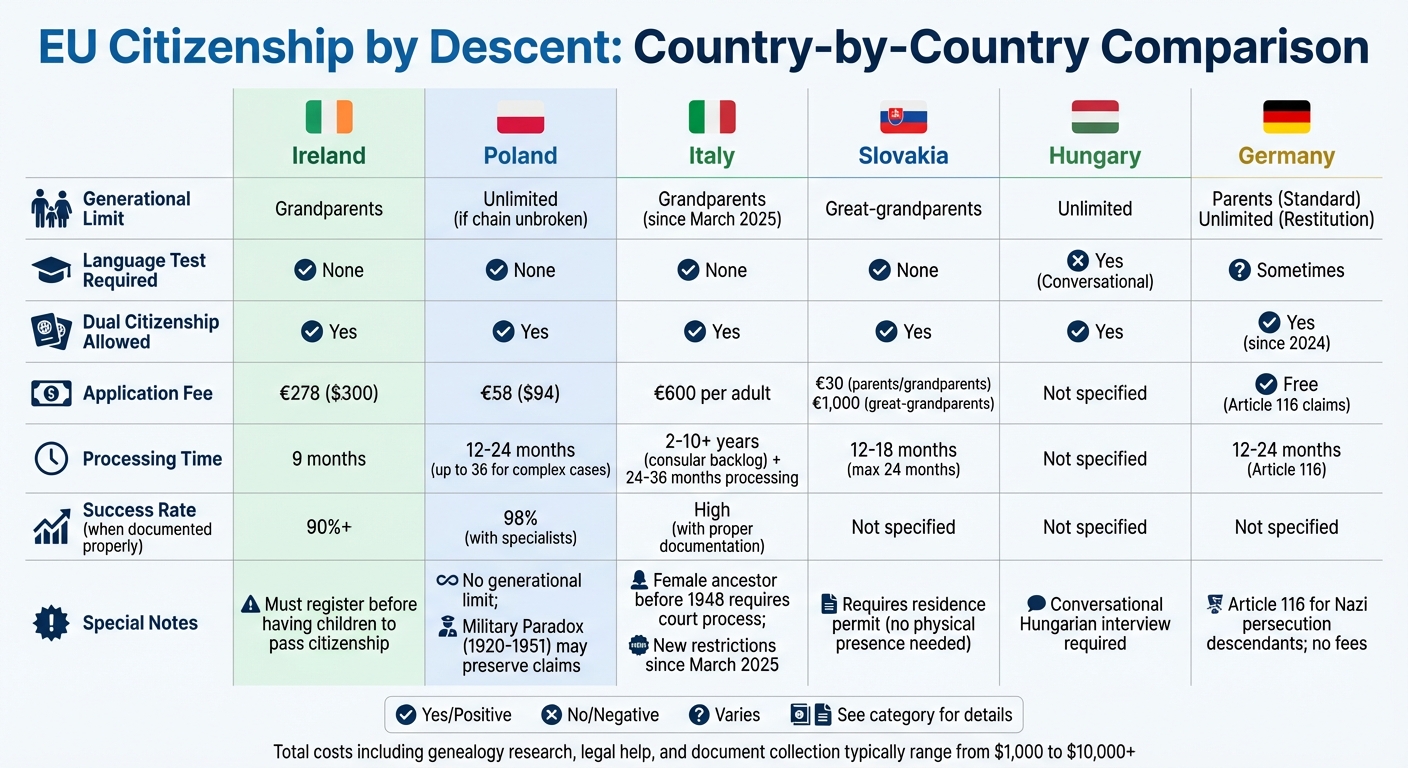
Here’s a quick comparison of some of the most popular programs:
| Country | Generational Limit | Language Test | Dual Citizenship Allowed |
|---|---|---|---|
| Ireland | Grandparents | None | Yes |
| Poland | Unlimited (if chain unbroken) | None | Yes |
| Italy | Grandparents (since March 2025) | None | Yes |
| Slovakia | Great-grandparents | None | Yes |
| Hungary | Unlimited | Yes (Conversational) | Yes |
| Germany | Parents (Standard) / Unlimited (Restitution) | Sometimes | Yes (since 2024) |
Potential Obstacles and Restrictions
Even if you meet the generational requirements, there are common hurdles that could complicate your application. Missing or incomplete records are a frequent issue. Fires, wars, and shifting borders have destroyed many vital records, especially in regions like Poland or Slovakia that have changed hands multiple times.
Name discrepancies are another common problem. For example, immigration officials often anglicized names at entry points, turning "Giuseppe" into "Joseph" or "Stanisław" into "Stanley." If this happened in your family, you’ll need to prove these variations refer to the same individual using legal documents.
Some countries also set strict deadlines for specific programs. For instance, Luxembourg’s Article 89 pathway for descendants has a hard deadline of December 31, 2025. Germany, which liberalized its dual citizenship laws in 2024, has no generational limits for descendants of Nazi-era persecution victims applying under Article 116, and these applicants pay no application fees.
One unique challenge for those claiming Polish citizenship is the "Military Paradox." Between 1920 and 1951, many Polish citizens who naturalized abroad retained their Polish citizenship unless they received a formal military release from the Polish government. This technicality has saved many claims that initially seemed invalid.
Once you’ve confirmed your eligibility and identified potential obstacles, you can move forward with gathering the required documents to support your claim.
sbb-itb-39d39a6
Collecting Required Documents and Proof of Ancestry
Once you’ve confirmed your eligibility, the next step is to gather the necessary paperwork. A successful application hinges on having the right documents in order.
Required Documents for Your Application
At the heart of any citizenship by descent application is a complete set of vital records that links you to your European ancestor. For example, if you’re claiming citizenship through a great-grandparent, you’ll need your long-form birth certificate, along with your parent’s and grandparent’s birth and marriage certificates (and death certificates, if applicable). You’ll also need your great-grandparent’s birth certificate.
In addition to these records, you’ll need proof of your ancestor’s nationality. This could be an old passport, identity papers, military service records, or entries in municipal registries like Italy’s comune records or Greece’s dimotologio. Naturalization records are another critical piece – you’ll need to show that your ancestor did not naturalize in another country before the next generation was born, as this could disrupt the citizenship chain.
It’s important to note that all foreign documents must have an Apostille or consular legalization and be translated by a certified translator. Some Italian consulates even require vital records to be issued within the last 6–12 months.
Make sure you request long-form certificates, as these include the detailed parental information needed to prove your lineage. Short-form certificates often lack the necessary details for citizenship applications.
With these documents in hand, you can move on to researching your family history to address any gaps.
How to Research Your Family History
Start by reviewing any family documents you already have, such as passports, birth certificates, marriage licenses, or immigration papers. These can provide key details like names, dates, and locations to guide your search for official records.
For applicants in the U.S., the National Archives (NARA) and U.S. Citizenship and Immigration Services (USCIS) are invaluable resources. If you need to prove your ancestor never naturalized, you can request a "Certificate of Non-Existence" from USCIS. This document confirms that no naturalization record exists, helping preserve the unbroken citizenship chain.
Once you’ve gathered basic information, contact the civil registry or town hall in the European municipality where your ancestor was born to request long-form birth certificates. If you’re dealing with records from Eastern Europe – where wartime destruction often impacted archives – specialized databases like JRI-Poland, Yad Vashem, or the International Tracing Service (ITS) can be incredibly helpful.
In cases where civil records are unavailable, parish archives can often serve as substitutes. Church baptismal records, census data, and school records might be accepted as secondary evidence when official documents are missing.
If you still encounter gaps, the next section outlines how to handle missing or incomplete records.
Handling Missing or Incomplete Records
Missing records are a common hurdle in ancestry-based citizenship applications. Wars, fires, and shifting borders have destroyed many vital records, particularly in regions like Poland and Slovakia that experienced significant upheaval during the 20th century.
When civil records are unavailable, church records, census data, and military documents can serve as crucial secondary evidence. For Polish records from the partition era, keep in mind that documents might be written in Russian, German, or Yiddish, which could require specialized expertise for research and translation.
For gaps related to the Holocaust, databases like JRI-Poland, Yad Vashem, and the International Tracing Service can help. If you’re pursuing Polish citizenship specifically, military records or population registers (księgi ludności) may be used in place of missing civil records.
In some cases, hiring a professional genealogist may be necessary to reconstruct your family history and locate archival documents. While this can increase costs – expenses for document procurement, apostilles, translations, and legal assistance typically range from $2,000 to $10,000, with complex Italian cases potentially exceeding $10,000 – it can be the difference between a successful and unsuccessful application.
How to Apply for EU Citizenship by Descent
This step wraps up your journey from confirming your eligibility to officially applying for EU citizenship through your ancestral ties. With your documents in order and your family history verified, you’re ready to proceed. While the exact process differs from country to country, the main steps are straightforward: gather and submit your paperwork, then wait for the official response.
Preparing and Submitting Your Application
Start by organizing your documents in chronological order, beginning with your ancestor and working down to yourself. Double-check that all documents meet the required standards and that names are consistent across all records.
In most cases, applications are submitted through the consulate or embassy of the respective country in your area. Some countries offer alternative options. For instance, Italy allows applications at a local town hall (comune) if you establish legal residency there, potentially shortening processing times to 3–9 months. Ireland, on the other hand, has moved its Foreign Births Register applications online, making the process more efficient.
Once your application is submitted, you’ll receive a confirmation and a case number for tracking. Authorities might request additional documents or clarifications later, so keep copies of everything you provide. Each country has specific submission guidelines, so it’s essential to tailor your application accordingly.
Application Procedures by Country
Each EU country has its own rules and requirements for citizenship by descent:
- Ireland: If you have an Irish-born grandparent, you must register in the Foreign Births Register (FBR). The registration fee is €278 for adults and €153 for minors. Citizenship is effective from the date of registration, not from birth. Importantly, you must register before having children if you want them to inherit Irish citizenship.
- Italy: Under the "Tajani Decree" (Law 74/2025), new claims are limited to two generations (parents or grandparents), and the ancestor must have lived in Italy for two consecutive years after becoming a citizen but before your birth. The consular application fee is €600 per adult. If your claim is through a female ancestor who had children before January 1, 1948, you’ll need to apply through the Italian courts instead of a consulate.
- Poland: Poland uses a "confirmation of citizenship" process rather than granting or restoring citizenship. There’s no strict generational limit as long as the citizenship chain remains intact. The government fee is approximately €58 (about $94). A key detail: Polish men who naturalized abroad between 1920 and 1951 often retained their citizenship unless they were formally released from military service, benefiting many male-line applicants.
- Slovakia: In 2022, Slovakia expanded eligibility to include great-grandchildren. However, applicants must obtain a Slovak residence permit as part of the process, though physical presence isn’t required before approval. Fees are €30 for claims based on parents or grandparents, but increase to €1,000 for great-grandparent claims.
- Czech Republic: The Czech Republic offers a simplified "declaration" process for descendants of former citizens (children and grandchildren). Decisions are required within 180 days by law, with a fee of about CZK 1,000 (around $45).
Understanding these specific procedures helps ensure your application is completed correctly.
Processing Times and What to Expect
Knowing how long the process might take can help you plan better. Processing times vary significantly depending on the country and the application method:
- Ireland: The Foreign Births Register currently takes about 9 months to process applications.
- Poland: Standard cases typically take 12–24 months, though more complex cases requiring archival research can stretch to 36 months.
- Italy: Italy often has the longest processing times. Consular applications in major U.S. cities like New York or Los Angeles face appointment backlogs of 2–10+ years, with an additional 24–36 months for processing after submission. Many applicants choose faster alternatives, like the judicial route (12–24 months) or establishing residency in Italy for a quicker local application process.
- Czech Republic: The Ministry of Interior is required to decide within 180 days, though actual processing often takes 6–12 months.
- Slovakia: While the statutory maximum is 24 months, most applications are processed within 12–18 months.
- Germany: Article 116 claims, specifically for descendants affected by Nazi-era persecution, generally take 12–24 months to process and are free of charge.
Applicants with well-prepared documentation have high success rates. For example, Irish applications submitted correctly boast a success rate of over 90%, while Polish cases handled by specialists report a success rate of around 98%.
Tips for a Successful Application
Submitting a well-prepared, error-free application is crucial when pursuing EU citizenship by descent. Knowing where common pitfalls occur – and recognizing when expert help is needed – can be the difference between a smooth approval process and a frustrating rejection.
Common Mistakes to Avoid
One major hurdle involves verifying naturalization dates. If your Italian ancestor became a U.S. citizen before your parent or grandparent was born, the citizenship chain is broken, and your claim will be denied. Before investing time and resources, secure a "Certificate of Non-Existence" from USCIS or NARA to confirm your ancestor either never renounced their original citizenship or did so after the next generation was born.
Another frequent issue is resolving name discrepancies. For example, if "Giuseppe Rossi" appears as "Joseph Ross" on documents, legal proof is required to show that these names refer to the same person. Address inconsistencies through legal amendments before submitting your application.
Incomplete documentation is another common stumbling block. You’ll need a full set of vital records – birth, marriage, death, and naturalization certificates – for every relative in your lineage. Carefully check dates and proactively correct minor name variations. Additionally, any documents not in the target country’s official language must be professionally translated and apostilled to be legally valid.
For Irish citizenship claims, specific rules apply. If applying through a great-grandparent, your parent must have registered in the Foreign Births Register before your birth. Missing this step can invalidate your claim, no matter how strong your ancestral connection.
By addressing these issues upfront, you’ll be better positioned to decide whether professional assistance is necessary.
When to Hire Professional Help
Certain situations call for expert guidance. Genealogists, attorneys, and other specialists can help navigate the complexities of citizenship applications.
- Genealogists are invaluable when official records are missing. They can reconstruct family histories using secondary sources like church baptismal records or military documents.
- Immigration attorneys are essential for navigating complex nationality laws. For instance, Italy’s "1948 cases" require legal action in Italian courts because lineage through a woman before January 1, 1948, cannot be handled by consulates. Legal fees for these cases typically range from $3,000 to $5,000. Attorneys are also helpful for resolving significant name changes or proving citizenship continuity across generations.
- Specialists for language barriers are necessary when retrieving records in languages like Russian, German, or Yiddish, especially for partition-era documents.
Costs for applications involving genealogical research and legal assistance generally range from $1,000 to $5,000. Italian applications, depending on their complexity, can cost between $2,000 and $10,000 or more.
While professional help can streamline the process, staying organized is equally important.
Staying Organized Throughout the Process
Keeping meticulous records is key to a successful application. Create both digital and physical master folders with subfolders for each ancestor in your lineage. Clearly label all documents with their dates and types, and keep copies of every submission. Authorities may request additional clarification or replacement documents months into the process.
Pay close attention to deadlines. Some programs have strict cutoff dates, like Luxembourg’s December 31, 2025, deadline for Article 89 applicants. Missing these deadlines can derail an otherwise strong application.
Stay informed about policy changes that could impact your eligibility. For example, Italy limited claims to grandparents in March 2025, invalidating many previously viable applications. Monitoring legislative updates ensures you’re focusing on pathways that remain open.
Lastly, maintain a detailed communication log for interactions with consulates, embassies, or government offices. Record dates, names of officials, and key discussion points. With some consulates facing wait times of over a decade, a clear record of your application’s progress and any commitments made can be a lifesaver.
Conclusion
Summary of Key Points
Obtaining EU citizenship through descent is a practical way to enjoy the perks of European mobility and lifestyle. The process involves confirming your ancestry and gathering detailed documentation. Costs and timelines vary depending on the country. Government fees typically range from $100 to $500, while overall expenses – including genealogical research, legal help, and document collection – can span $1,000 to $5,000 or more. In some cases, like complex Italian court proceedings, costs may exceed $10,000.
Countries such as Ireland and Italy (starting March 2025) limit eligibility to grandparents, while Poland allows claims without a strict generational cutoff if continuity is proven. Processing times also differ: Irish Foreign Births Register applications usually take 12 to 18 months, while Italian consulates in the U.S. may have backlogs lasting from 2 to over 10 years. Knowing these details upfront can help you plan efficiently and avoid unnecessary delays or expenses.
Getting Started with Your Application
To begin, identify the country of your ancestry, research its citizenship laws, and trace your family tree to locate the ancestor who held citizenship. Confirm that they did not renounce their citizenship or naturalize in another country before the birth of the next generation. For example, Italian claims often require proof that the ancestor did not naturalize elsewhere.
Start gathering key documents as soon as possible, as obtaining foreign records can take time. Stay updated on recent policy changes – like Italy’s upcoming March 2025 restriction limiting claims to grandparents – which could impact eligibility if earlier rules applied to you. If your case involves missing records, a complicated lineage (such as a female ancestor before 1948), or discrepancies in names, consider consulting a genealogist or immigration attorney early on.
Act quickly to file your application. Some programs have strict deadlines, and consulate backlogs are growing. Once you secure your EU passport, you’ll gain the freedom to live, work, study, or retire in any of the 27 EU countries, as well as Iceland, Liechtenstein, Norway, and Switzerland – without needing extra visas or meeting income requirements. This process not only reconnects you with your heritage but also opens doors to exciting opportunities within Europe.
FAQs
How do I check if my citizenship-by-descent line is unbroken?
To ensure your citizenship-by-descent claim remains valid, you’ll need to confirm that your ancestral line of citizenship is intact. This means verifying that none of your ancestors naturalized in another country or took actions that might have caused them to lose their citizenship. Start by digging into your family history and collecting essential records, such as birth certificates, marriage licenses, and naturalization documents. Pay close attention to whether any ancestor renounced or forfeited their citizenship, as this could impact your eligibility.
What’s the fastest EU country to apply through if I qualify by ancestry?
Ireland tends to have one of the quickest processing times for citizenship by descent, typically completing applications within 6 to 12 months. Italy and Poland follow with relatively short timelines as well, generally taking around 1 to 2 years. However, the exact duration can depend on factors like how complete your documentation is and the specific procedures required in each country.
What do I do if my family documents have missing records or name mismatches?
If your family documents are incomplete or show discrepancies, it’s important to collect as much supporting evidence as you can. This could include birth certificates, marriage records, or other official documents that confirm your family ties. If gaps still exist, you might turn to genealogical resources like census records or church documents to fill in the blanks. For particularly tricky cases, seeking legal guidance or consulting an expert can help you address these challenges and bolster your application.
