
You don’t need to be wealthy to secure a second citizenship. Many countries offer affordable pathways to citizenship through ancestry, marriage, or short residency periods. Here’s what you need to know:
- Ancestry: Countries like Ireland and Italy allow you to claim citizenship through family lineage for as little as $300–$600 in fees.
- Marriage: Portugal and Spain offer citizenship to spouses of citizens, with timelines as short as 1–3 years.
- Short Residency: Argentina (2 years) and Paraguay (3 years) provide quick naturalization options for those willing to establish ties.
These pathways not only save money but also grant access to visa-free travel, better financial opportunities, and a backup plan for uncertain times. Ready to explore your options? Let’s break it down.
Citizenship by Ancestry
If your family tree connects to specific countries, you might already qualify for a second passport without needing to invest hefty sums in formal programs. Citizenship by ancestry, also known as citizenship by descent, allows individuals to claim nationality through their parents, grandparents, or even earlier generations. The process is surprisingly affordable, with government fees typically ranging from $300 to $600.
To qualify, you’ll need to provide proof of your lineage through documents like birth, marriage, and sometimes naturalization records. The biggest challenge often arises when an ancestor became a citizen of another country before their child’s birth, which can sever the chain of eligibility. But if your documentation is intact, the financial commitment is minimal compared to investment-based citizenship programs – a small cost for the benefits of a second passport.
Consider this: 70-80 million people of Irish descent live outside Ireland, far outnumbering the country’s current population. Similarly, over 25 million Italians emigrated between 1861 and the 1970s, creating a global diaspora of 60-80 million people. These figures suggest that millions of Americans may already qualify for European citizenship without even knowing it.
Ireland: Citizenship Through Ancestry
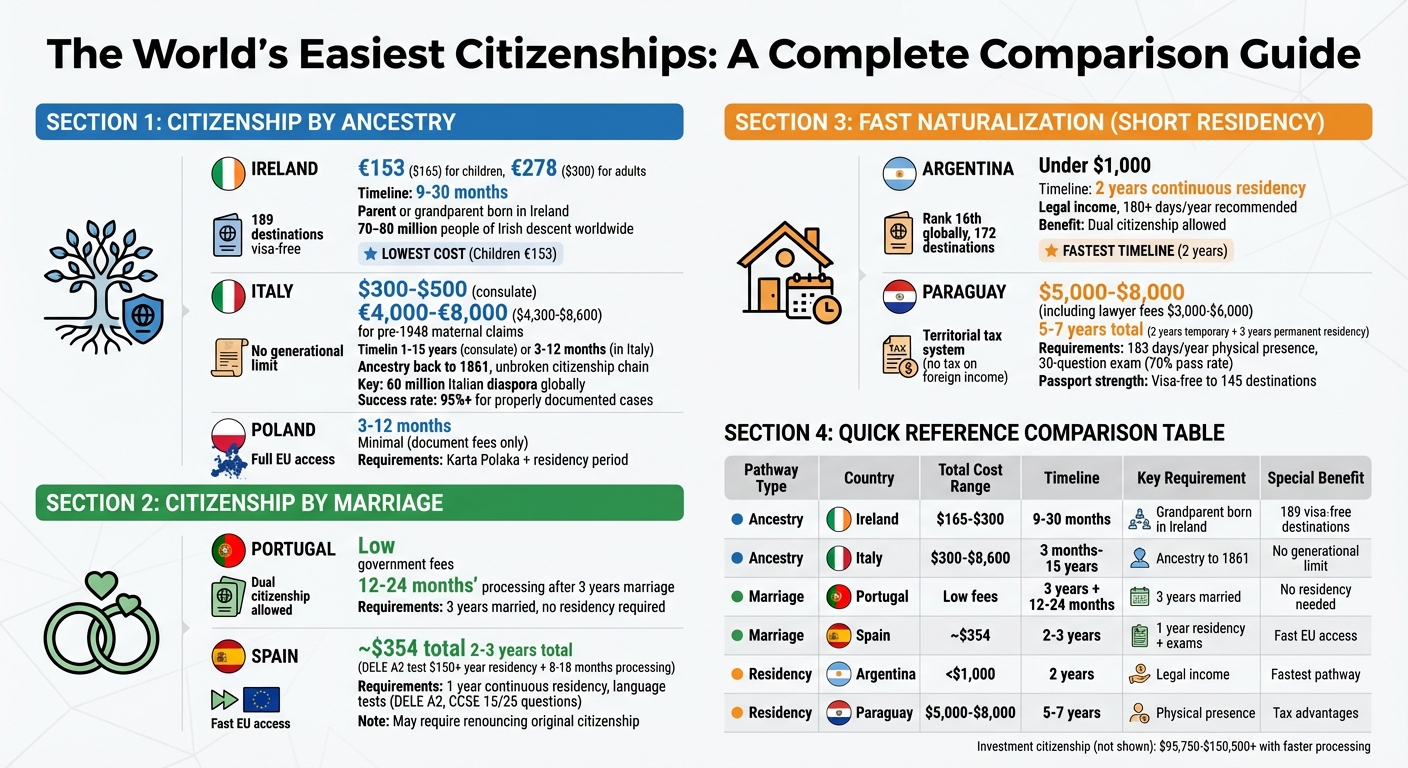
Irish citizenship is automatically granted to anyone with at least one parent born on the island of Ireland (including Northern Ireland). If your connection is through a grandparent, you’ll need to register via the Foreign Births Register (FBR). The registration fee is €278 (around $300) for adults and €153 (approximately $165) for children.
An Irish passport is among the top-ranking passports globally, offering visa-free travel to 189 destinations. However, the registration process through the FBR can take anywhere from 9 to 30 months, depending on the volume of applications and the complexity of the documentation.
If your claim goes back to a great-grandparent, it only works if your grandparent registered in the FBR before your parent’s birth, ensuring the citizenship chain remains unbroken.
What you’ll need:
- Long-form birth certificates showing parents’ names
- Marriage certificates for proof of legal unions or name changes
- Death certificates for ancestors in the direct line
Documents issued outside Ireland require an Apostille, which typically costs $5 to $30 in the U.S.. Any non-English or non-Irish documents must be translated by a certified professional. Additionally, your application must be witnessed and signed by a designated professional, such as a lawyer, doctor, or notary.
The best approach is to work backward, starting with your own birth certificate and tracing one generation at a time to avoid missing links. For Irish records predating 1864, church baptismal records may be necessary. Fortunately, many parish registers have been digitized by the National Library of Ireland.
Italy: Jure Sanguinis (Right of Blood)
Italy’s citizenship by descent program, known as jure sanguinis or “right of blood,” has no generational limit. You can trace your ancestry as far back as 1861, the year Italy became a unified nation. This makes it one of the most inclusive ancestry programs – provided you can document each step of the lineage.
The main requirement is proving an unbroken chain of Italian citizenship. If an ancestor naturalized in another country before their child was born, the chain is considered broken. In the U.S., naturalization dates can be verified through USCIS records, "Declarations of Intention", or "Petitions for Naturalization".
For claims through the maternal line before January 1, 1948, a judicial process in Italy is required. These cases are highly successful – over 95% win when properly documented – though legal fees for this route typically range from €4,000 to €8,000 (around $4,300 to $8,600).
Administrative fees for consulate applications fall between $300 and $500. Processing times vary widely: 1 to 15 years through consulates, but only 3 to 12 months if you apply while living in Italy.
Key steps:
- Request birth certificates directly from the municipality (comune) where your ancestor was born.
- Obtain Apostilles and certified translations for any non-Italian documents.
- Only original state-issued certificates or certified copies are accepted – photocopies won’t suffice.
Poland: Karta Polaka to Citizenship
Poland offers a unique pathway through the Karta Polaka (Polish Card), which confirms Polish ancestry or cultural ties. While it doesn’t grant citizenship outright, the Karta Polaka simplifies the process of obtaining Polish residency and eventual citizenship, all at a low cost.
To qualify, you’ll need to prove Polish heritage with documents like birth or marriage certificates and demonstrate a basic knowledge of Polish language and culture. The application process involves an interview to assess your cultural knowledge and language proficiency.
Once you obtain the Karta Polaka, you can apply for a permanent residence permit in Poland. This residency can then lead to full citizenship after meeting the required residency period. Costs are minimal, mainly covering document authentication, translations, and small government fees.
A Polish passport grants full access to the European Union, allowing you to live, work, and study in any of its 27 member states. For Americans with Polish ancestry, this is an affordable route to European citizenship without the high costs of investment programs.
These ancestry-based pathways open doors to citizenship in a way that’s both cost-effective and deeply personal. Next, we’ll explore alternative routes like citizenship by marriage.
sbb-itb-39d39a6
Citizenship by Marriage
Marriage can be a quicker and more structured pathway to citizenship compared to ancestry or standard naturalization. While ancestry-based citizenship often involves extensive paperwork and naturalization typically requires several years of residency, marriage offers a middle-ground option. For those willing to meet specific criteria, this route comes with shorter timelines and lower costs. In Europe, Portugal and Spain are particularly notable for their accessible marriage-based citizenship processes.
Each country has its own set of requirements regarding marriage duration, residency, and societal integration. Below, we break down how these pathways work in Portugal and Spain, highlighting their differences and similarities.
Portugal: Citizenship Through Marriage
In Portugal, you must be legally married to a Portuguese citizen for at least three years before applying for citizenship. Interestingly, Portugal doesn’t require you to reside in the country during this time. Instead, you can apply from abroad as long as you prove a meaningful connection to the Portuguese community. This could include evidence like basic Portuguese language skills, employment, or regular visits to Portugal.
The process is relatively straightforward, with government fees being much lower than those associated with investment-based citizenship programs. Processing times typically range from 12 to 24 months, and Portugal allows dual citizenship. This means you can keep your U.S. passport while obtaining Portuguese citizenship, adding to the appeal of this route.
Spain: Family Unity Citizenship
Spain’s marriage-based citizenship pathway is faster but comes with stricter residency requirements. To qualify, you must live in Spain continuously for one year while legally married to a Spanish citizen. This effectively reduces the standard naturalization timeline from 10 years to just one. However, your residency clock only starts once you receive your residency card, known as the Tarjeta de Familiar de Comunitario. During this year, you must maintain uninterrupted residency, and both spouses must be registered at the same address on the municipal census (Empadronamiento).
Applicants must also pass two exams: the DELE A2 language test (approximately $150) and the CCSE cultural exam (about $92). The CCSE test includes 25 questions on Spanish history, government, and society, and you need to answer at least 15 correctly to pass. The total processing fee for the application is around $112. From marriage to citizenship, the entire process usually takes 2 to 3 years, with application reviews lasting 8 to 18 months.
One key difference with Spain is that it often requires applicants to renounce their original citizenship when taking the oath of allegiance, though exceptions exist for citizens of certain countries. If your marriage took place outside Spain, you’ll also need to register it with the Spanish Civil Registry, which can add another 6 to 12 months to the process.
"The process is a forensic audit of your first year of marriage. The government wants to ensure the union is real, the residency is continuous, and the integration is genuine." – Markus Weber, Senior Editor, Global Immigration Desk
Fast Naturalization with Short Residency Requirements
If ancestry or marriage doesn’t apply, some countries provide quick naturalization through shorter residency requirements. While most European nations demand extended periods of continuous residency, certain South American countries have structured their immigration systems to welcome newcomers. Argentina and Paraguay stand out for their relatively short timelines and low financial hurdles for those ready to build genuine connections.
These pathways emphasize actual residency, not just paperwork. Applicants must show true ties through employment, property ownership, or active involvement in the community. Here’s a closer look at these efficient options for fast-tracking citizenship.
Argentina: 2-Year Residency to Citizenship
Argentina offers one of the fastest paths to citizenship, requiring just two years of continuous legal residency. To qualify, you need to be at least 18 years old, have a lawful source of income, and no prison sentences exceeding three years in the last five years. While there’s no formal language or cultural test, basic Spanish is necessary for interviews. Argentina also allows dual citizenship, so you can retain your U.S. passport.
The Argentine passport ranks 16th globally as of 2026, granting visa-free access to 172 destinations. Total fees for the process are under $1,000. Most applicants start with a Rentista visa (requiring proof of monthly passive income) or a Pensionado visa for retirees.
Although there’s no strict rule on how many days you must spend in Argentina, staying at least 180 days per year is strongly recommended to establish genuine ties. Recent policy updates have tightened the definition of "continuous residence", with minimal international travel expected during the two-year period. Exceptions may apply if you have family connections in Argentina.
Paraguay: 3-Year Residency Pathway
Paraguay provides another option, requiring three years of permanent residency through a judicial process. The total timeline is usually 5 to 7 years, as most applicants first secure temporary residency for about two years before entering a 12- to 24-month court process. While the process is more complex due to its judicial nature, it remains a viable option for those committed to the requirements.
Applicants must pass a 30-question exam (with a 70% pass rate) and demonstrate basic proficiency in Spanish or Guarani. Paraguay’s Supreme Court enforces the "arraigo" (genuine ties) requirement, ensuring applicants are physically present for about 183 days each year.
"In 2026, the Supreme Court rigorously enforces the ‘arraigo’ (genuine ties) requirement. Holding a residency card without actually living in Paraguay is insufficient for naturalization." – ExpatSettles Naturalization Guide
Costs for the process typically range from $5,000 to $8,000, which includes lawyer fees ($3,000–$6,000), government fees ($100–$210), and a refundable solvency deposit of about $5,500 for initial residency. Because naturalization involves a judicial lawsuit rather than a standard administrative application, hiring a lawyer experienced in "Naturalización Judicial" is crucial.
Although Paraguay’s Constitution technically requires naturalized citizens to renounce their original nationality (with exceptions for Spanish and Italian citizens), this rule is not strictly enforced for U.S., U.K., or Canadian citizens under an informal "Don’t Ask, Don’t Tell" policy. The Paraguayan passport allows visa-free access to 145 countries and qualifies holders for E-2 Treaty investor visas to the United States. Additionally, Paraguay’s territorial tax system means foreign-sourced income isn’t taxed.
Both Argentina and Paraguay demonstrate that citizenship can be achieved without substantial investments, offering affordable and accessible options for those looking to establish new roots.
Comparing Low-Cost Citizenship Options
When considering low-cost citizenship pathways, it’s helpful to break down the options side by side. Ancestry-based citizenship through countries like Ireland and Italy is one of the most affordable routes, with administrative fees ranging from $400 to $800. Ireland’s process is relatively quick, while Italy’s takes about 2–4 years, especially after the 2025 law adjustment.
Residency-based naturalization offers another budget-friendly option. For instance, Argentina requires just 2 years of residency and involves minimal extra costs. Other countries have slightly longer timelines – Serbia requires 3 years, while Uruguay offers a 3-year pathway for married applicants (or 5 years for singles). Interestingly, citizens of Argentina and Peru can apply for Spanish citizenship after only 2 additional years of residence in Spain, creating a combined 4-year route to an EU passport.
Marriage-based citizenship in Portugal stands out for its simplicity. A foreign spouse can apply after 3 years of marriage without needing to live in the country. These pathways provide a variety of low-cost options, each catering to different circumstances and priorities.
On the other hand, investment-based citizenship options, while faster, come with higher price tags. For example:
- São Tomé and Príncipe: $95,750 with a 6–8 week processing time.
- Vanuatu: Approximately $138,000 with processing in just 30 days.
- Nauru: Currently $125,500 under a promotional rate (valid until June 30, 2026), increasing to $150,500 afterward.
- Sierra Leone’s Heritage pathway: Around $100,000.
São Tomé and Príncipe also offers strategic benefits, granting access to Portuguese-speaking nations through its CPLP membership.
Each route serves different needs and priorities. Ancestry and marriage-based pathways are cost-effective but require either thorough documentation or personal ties. Residency-based options demand a time commitment and physical presence but keep financial costs low. Meanwhile, investment programs provide speed and convenience, though they step outside the "low-cost" framework central to this discussion. Ultimately, the right choice depends on your budget, timeline, and willingness to relocate.
Pairing Citizenship with Asset Protection
A second passport does more than just expand your travel options – it can also act as a shield for your wealth. When combined with offshore tools like trusts and companies, it creates extra layers of legal separation, helping to protect your assets from potential risks.
One of the most valuable benefits of a second passport is improved access to international banking. Many financial institutions limit services for non-residents, making it harder to open accounts, invest, or secure credit. Citizenship removes these barriers, opening doors to more financial opportunities. For instance, in places like Vanuatu, where there are no personal income, capital gains, inheritance, or wealth taxes, you can hold assets through an offshore company and potentially enjoy tax-free growth for as long as 20 years.
This combination of citizenship and offshore structures also serves as a safety net during times of political or economic instability. If your home country imposes currency controls, freezes assets, or closes borders, having an alternate citizenship allows you to move yourself – and your wealth – to a more secure jurisdiction. Paraguay, for example, offers a three-year residency pathway and doesn’t tax foreign income. This makes it an excellent backup option where you can establish banking relationships and business operations before an emergency arises.
Global Wealth Protection highlights how aligning your citizenship with offshore company formation can strengthen asset protection. Choosing the right jurisdiction based on your personal situation is essential. For example, if you qualify for Italian citizenship by ancestry, you could also set up an offshore trust for asset protection in a jurisdiction with strong legal safeguards, creating a robust wealth protection strategy.
This approach not only helps shield your assets but also provides the added benefits of dual citizenship. With nearly half of all countries worldwide (around 49%) allowing dual citizenship, you can often retain your original nationality while enjoying the perks of a second one. This flexibility lets you maintain your existing business and personal ties while protecting your wealth across multiple jurisdictions.
Application Processes and Next Steps
Navigating the application process for citizenship can feel overwhelming, but breaking it down into clear steps makes it manageable. If you’re pursuing ancestry-based citizenship, your first task is to compile detailed documentation that connects you to your qualifying ancestor. This includes certified birth, marriage, and death certificates for every individual in your lineage. Each document must be apostilled and translated by certified professionals into the language of the country you’re applying to. One of the most important steps is verifying your ancestor’s naturalization date. If they became a citizen of another country before the next generation was born, the citizenship link is broken. To confirm this, you’ll need to obtain either their naturalization certificate or a Certificate of Non-Existence from USCIS or NARA. Be prepared to address name discrepancies, such as "Giuseppe" versus "Joseph", which may require legal amendments or court orders. These efforts are crucial to ensure an unbroken citizenship chain.
For marriage-based citizenship, the documentation process is just as thorough. You’ll need a registered marriage certificate and proof of cohabitation for the required period – typically one year in Spain and three years in Portugal. Immigration officials may conduct interviews or even visit your home to confirm the authenticity of your relationship. If you’re pursuing naturalization, you’ll need to provide proof of legal residency, a clean criminal record, and evidence of a stable income. Additionally, some countries, like Portugal and Germany, require language proficiency tests at the A2 and B1 levels, respectively.
Processing times can vary widely depending on the country and method. For example, Ireland’s Foreign Births Register typically takes 12 to 18 months. Italian consulates in major U.S. cities, such as New York, often face backlogs exceeding 10 years, but applying directly through an Italian town hall can shorten the process to 3–6 months. Poland’s processing time ranges from 3 to 12 months. If these timelines or the documentation process seem daunting, you might consider seeking professional assistance.
For those juggling multiple pathways or facing complex requirements, professional guidance can save time and prevent mistakes. Services like Global Wealth Protection offer consultations to help you determine the best citizenship route for your situation. They also assist in preparing and certifying your documents to meet all necessary criteria, reducing the risk of delays or errors.
Conclusion
Getting a second citizenship doesn’t have to break the bank or take years to achieve. The path you choose largely depends on factors like your ancestry, residency, or even marital status. Whether you’re tapping into heritage-based options in countries like Ireland, Italy, or Poland, opting for fast-track naturalization in places like Argentina or Paraguay (where just two years of residency is required), or using marriage to expedite the process, there are affordable options for many circumstances. These pathways offer various perks – like easier travel, visa-free access to more countries, tax advantages, or entry into economic zones like the European Union or Mercosur.
If you can prove European ancestry, pursuing citizenship through heritage often provides one of the most budget-friendly ways to secure an EU passport. For those without ancestral ties, Latin America’s naturalization options can be a smart alternative. For example, short-term residency in Spain, thanks to Ibero-American agreements, can lead to EU citizenship in just four years. Similarly, marriage-based routes in countries like Spain or Portugal can significantly cut down naturalization timelines.
It’s also important to weigh the legal and tax considerations of dual citizenship. Start by checking your home country’s stance on dual nationality – currently, about 49% of nations allow it, but some still require you to give up your original passport. Tax responsibilities are another factor, especially for U.S. citizens, who must report income worldwide, no matter where they live.
Given the complexity of legal requirements and shifting regulations, professional advice can make all the difference. Global Wealth Protection provides consultations to help tailor a citizenship strategy that fits your needs, ensuring your application process is smooth and compliant. Beyond travel and financial perks, a second passport can act as a safety net, offering flexibility and added security for your financial future. With the right guidance, a second passport can open doors to greater mobility, financial opportunities, and peace of mind.
FAQs
How do I confirm whether my ancestry claim is “unbroken” if my ancestor naturalized in the U.S.?
To ensure your ancestry claim remains "unbroken", you need to verify that your ancestor did not obtain another citizenship, like U.S. citizenship, which could potentially disrupt the lineage. Collect key documents, such as naturalization certificates and birth records, to confirm their citizenship status at the time of your birth. It’s also crucial to review the specific laws of the country in question and seek advice from legal experts or consular officials to validate your claim.
Will getting a second citizenship affect my U.S. taxes or reporting requirements?
Obtaining a second citizenship can have implications for your U.S. tax and reporting responsibilities. As a U.S. citizen, you are required to report worldwide income to the IRS, no matter where your second citizenship is based. Additionally, you might need to file extra tax forms depending on your circumstances. To stay compliant with IRS regulations, it’s a good idea to consult a qualified tax professional.
What counts as “continuous residency” for fast naturalization in Argentina or Paraguay?
In Argentina, achieving fast naturalization involves maintaining legal and uninterrupted residency in the country for two years before applying. Interestingly, there’s no requirement for a specific number of days to be spent annually during this period.
Paraguay, on the other hand, generally requires three years of permanent residency for naturalization. Within those three years, you need to have spent at least six months in total in the country, but there’s no strict rule about how many days must be spent there each year. In both countries, ensuring your residency status remains legal is the most important factor.
