
If you’re thinking about getting a second passport, there are two main options among the simplest citizenship programs: Citizenship by Investment (CBI) and Citizenship by Descent (CBD). Here’s a quick breakdown:
- CBI: You invest money (starting at $100,000) and can get citizenship in as little as 2-6 months. It’s ideal for those who need fast access to global mobility, asset protection, or visa-free travel. However, it’s expensive and requires ongoing compliance with investment rules.
- CBD: This is based on ancestry, meaning you can qualify if you have family ties (e.g., parents or grandparents) to certain countries. It’s far less costly (around $500–$5,000), but the process can take 6 months to 3+ years and requires detailed genealogical proof.
Both paths have pros and cons. CBI offers speed and convenience, while CBD is cheaper and grants permanent citizenship that can often be passed to future generations. Your choice depends on your goals, budget, and eligibility.
Quick Comparison
| Factor | Citizenship by Investment (CBI) | Citizenship by Descent (CBD) |
|---|---|---|
| Cost | $100,000–$1M+ | $500–$5,000 |
| Time to Process | 2–6 months | 6 months–3+ years |
| Eligibility | Financial investment | Proof of ancestry |
| Residency Needed? | Minimal or none | None |
| Visa-Free Travel | ~140–157 countries | ~180–190+ countries (EU focus) |
| Long-Term Security | Can be revoked | Permanent |
Choosing between these options requires balancing speed, cost, and your personal circumstances. Read on for a deeper dive into both pathways.
Citizenship by Investment: How It Works
Citizenship by Investment (CBI) allows individuals to gain full citizenship and a passport by making a significant financial contribution. Unlike the traditional path to citizenship, which often requires years of residency, CBI programs offer a quicker route without requiring applicants to live in the country. The first formal CBI program was introduced by St. Kitts and Nevis in 1984, and since then, several countries have adopted similar initiatives to support their national development efforts.
Who Qualifies and What You’ll Pay
To qualify for CBI, applicants must meet a few basic requirements: they need to be at least 18 years old, have a clean criminal record, and prove their funds are legitimate. Once eligible, applicants can choose from three main investment options:
- Non-refundable donations
- Real estate investments (with a holding period of three to seven years)
- Business investments
In the Caribbean, the minimum donation threshold is $200,000 across five participating nations. Here’s a breakdown of the costs:
- Antigua and Barbuda: $230,000 donation for a family of four.
- St. Kitts and Nevis: $250,000 for a single applicant.
- Dominica: $200,000 minimum.
- St. Lucia: $240,000 minimum.
- Grenada: $235,000 minimum, with the added benefit of U.S. E-2 visa treaty access.
Outside the Caribbean, investment requirements are typically higher. For example, Turkey mandates a $400,000 real estate purchase, while Malta requires an investment totaling approximately $1 million to $1.2 million. Vanuatu, on the other hand, offers one of the most affordable programs at $130,000.
In addition to the investment, applicants should budget for extra costs like due diligence fees (usually $5,000 to $10,000 per adult), government processing fees, and legal expenses. Once eligibility and investment choices are confirmed, most programs offer a streamlined process for fast approval.
Program Costs and Processing Times
One of the biggest draws of CBI programs is their speed. Processing times vary by country, ranging from 30 to 60 days in Vanuatu to two to six months for most Caribbean programs. During this time, governments conduct thorough background checks, including:
- Screening for international sanctions
- Verifying criminal records
- Reviewing financial histories
Some countries, like Grenada and St. Kitts, may also require in-person interviews for applicants and adult dependents. Since due diligence fees are non-refundable, any issues during this stage could result in financial losses. Careful pre-screening of your documents can help avoid such setbacks.
What You Gain from CBI
CBI programs offer more than just a passport – they come with practical benefits that can enhance your personal and financial freedom. One key advantage is increased global mobility. For example:
- St. Kitts and Nevis passport holders can travel visa-free to over 157 destinations, including the Schengen Area and the United Kingdom.
- Antigua and Barbuda offers access to more than 150 countries.
- Dominica and St. Lucia provide visa-free entry to around 145 and 146 destinations, respectively.
Most programs do not require residency, allowing you to live wherever you choose. However, Antigua and Barbuda does have a minor residency condition: a five-day stay within the first five years. Many CBI countries also offer tax-friendly policies, such as no taxes on foreign income or capital gains. Keep in mind, though, that U.S. citizens remain subject to worldwide taxation unless they formally renounce their U.S. citizenship.
CBI applications often cover not just the primary applicant but also their family members, including:
- Spouses
- Dependent children (typically up to age 25–30 if enrolled in school)
- Dependent parents (usually aged 55 or older)
- Siblings in some cases
"A second passport is not a consumer purchase. It is a multi-decade asset – one that provides travel freedom, political insurance, banking access, tax planning optionality, and a legacy that can be passed to children and grandchildren." – HPT Group
For those who choose the real estate route, there’s an added perk: after holding the property for the required period (usually three to seven years), you can sell it and recover your investment. This makes real estate a potentially more flexible option compared to non-refundable donations.
sbb-itb-39d39a6
Citizenship by Descent: How It Works
Citizenship by Descent (CBD) is based on a straightforward idea: your family tree might hold the key to a second passport. Instead of requiring a financial investment, this process relies on your ancestry – a principle known as jure sanguinis, or "right of blood." If your parents, grandparents, or even great-grandparents were citizens of certain countries, you might already qualify for citizenship. The key is proving an unbroken chain of citizenship through your lineage, ensuring none of your ancestors renounced their citizenship before passing it on. For example, if your Italian great-grandfather became a U.S. citizen in 1920, before your grandfather’s birth in 1925, the chain would be broken. However, if he naturalized in 1930, after your grandfather was born, your claim remains intact. Let’s break down eligibility, required documents, timelines, and the benefits of CBD.
Who Qualifies and What Documents You Need
Eligibility depends on your ancestry and the rules of the country you’re applying to. Over 30 countries offer CBD programs, each with specific requirements. For instance, Italy updated its rules in March 2025, now limiting claims to those with at least one grandparent born in Italy. Previously, claims could span unlimited generations. Ireland allows claims if you have at least one grandparent born there, unless your parent was registered in the Foreign Births Register before your birth. Meanwhile, Poland and Hungary continue to allow claims across unlimited generations, provided citizenship was never formally renounced.
Some countries apply unique historical criteria. Germany, under Article 116, allows descendants of individuals stripped of citizenship during the Nazi regime (1933–1945) to reclaim it without generational limits, and the application process is fee-free. Lithuania, on the other hand, requires proof that an ancestor maintained citizenship and left before June 15, 1940, the start of the Soviet occupation.
To apply, you’ll need a complete set of documents tracing your ancestry. This includes birth, marriage, and death certificates for every individual in your lineage. These documents must be certified, apostilled, and translated into the official language of the country. You’ll also need to prove your ancestor didn’t naturalize elsewhere before passing on their citizenship. This often involves obtaining a naturalization certificate or a "Certificate of Non-Existence" from the relevant government authority. Even small inconsistencies – like an ancestor named "Giuseppe" on an Italian birth record but "Joseph" on U.S. documents – may require legal corrections. If primary records are missing, alternative documents such as baptismal certificates, school records, or census data might suffice. Once eligibility is confirmed, the focus shifts to costs and timelines.
Program Costs and Processing Times
The costs of CBD vary but generally range from $500 to $5,000. These expenses cover government fees, document retrieval, apostilles, and translation services. For example, Ireland’s Foreign Births Register charges about $298, while Poland’s government fees are approximately $55. In total, including legal assistance, expenses usually fall between $1,500 and $5,000. Italy’s consular fees are now around $643, but when you add document-related costs, the total can climb to $2,000–$10,000 or more.
However, what CBD saves in upfront costs, it often makes up for in time. While investment-based citizenship programs can take as little as 30 to 180 days, CBD applications typically take six months to three years. Processing times vary widely depending on where you apply. For example, filing for Italian citizenship through U.S. consulates can take two to ten years (or longer in some cases), whereas applying directly in Italy may only take three to six months. Ireland’s Foreign Births Register often experiences backlogs of 12 to 18 months, while Poland generally processes applications within three to 12 months.
Certain cases can take even longer. For example, those claiming Italian citizenship through a female ancestor born before January 1, 1948, must go through court proceedings, which can add 12–24 months to the process. Similarly, Hungarian applicants must pass a conversational language interview, which may require six to 18 months of language preparation. These additional steps reflect the thorough verification process but also highlight the importance of planning ahead.
What You Gain from CBD
CBD offers the chance to secure permanent citizenship rights without financial investment. With it comes a passport that provides the same travel privileges as any other citizen, and the ability to pass this citizenship to future generations. For many U.S. citizens, this could be a game-changer – especially considering that 33 million Americans claim Irish ancestry, 17 million claim Italian, and 9 million claim Polish.
Most countries offering CBD, like Italy, Ireland, Poland, and Germany, allow dual citizenship, so you can keep your U.S. passport. However, some, like Lithuania, have stricter rules that may require legal advice. A few countries, such as Greece, may require military service for male citizens, though diaspora populations often qualify for exemptions.
The benefits go beyond travel. CBD gives you the right to live, work, and study in your ancestral country, as well as across the European Union. Unlike investment-based options, CBD doesn’t tie you to residency requirements or property ownership once citizenship is granted.
"A second passport is not about abandoning your home country. It is about expanding your options." – WhereNext
Side-by-Side Comparison: CBI vs. CBD
When deciding between Citizenship by Investment (CBI) and Citizenship by Descent (CBD), five factors usually come into play: eligibility, cost, speed, mobility, and long-term security. Let’s break them down.
Eligibility sets the two options apart right from the start. For CBI, you’ll need a clean background and proof of sufficient funds. Some programs even require health screenings to ensure you don’t carry communicable diseases. CBD, on the other hand, is all about ancestry. You’ll need to show documented evidence of a biological connection to a citizen – whether that’s a parent, grandparent, or sometimes even a more distant relative. Without this lineage, CBD isn’t an option, no matter your financial standing.
Cost and speed are often deciding factors. CBI is known for being pricey but quick. For example, Caribbean programs typically require a minimum donation of about $200,000, with total costs for a single applicant ranging from $230,000 to $300,000. European programs like Malta can exceed $1 million. However, you could secure your passport in as little as two to six months. CBD is far less expensive, with costs generally ranging from $500 to $5,000 for government and document fees. The trade-off? It’s slower, taking anywhere from six months to three and a half years. For instance, Portugal’s grandparent-based claims can take up to 42 months.
When it comes to global mobility, CBD often takes the lead. EU passports obtained through descent – like those from Italy, Ireland, or Poland – usually grant visa-free access to 187–190+ destinations, including the ability to enter the U.S. through the Visa Waiver Program. In contrast, Caribbean CBI passports typically offer visa-free travel to 140–157 countries, but you’ll likely need a visa for the U.S.. That said, some CBI programs, such as Grenada and Turkey, do offer eligibility for the U.S. E-2 Investor Visa. However, new regulations may require up to three years of residency in the treaty country first.
Finally, long-term security is another key difference. CBI citizenship can be revoked if there’s fraud or if investment requirements aren’t maintained. CBD citizenship, however, is permanent and can often be passed down to future generations.
Comparison Table
Here’s a quick overview of the main differences:
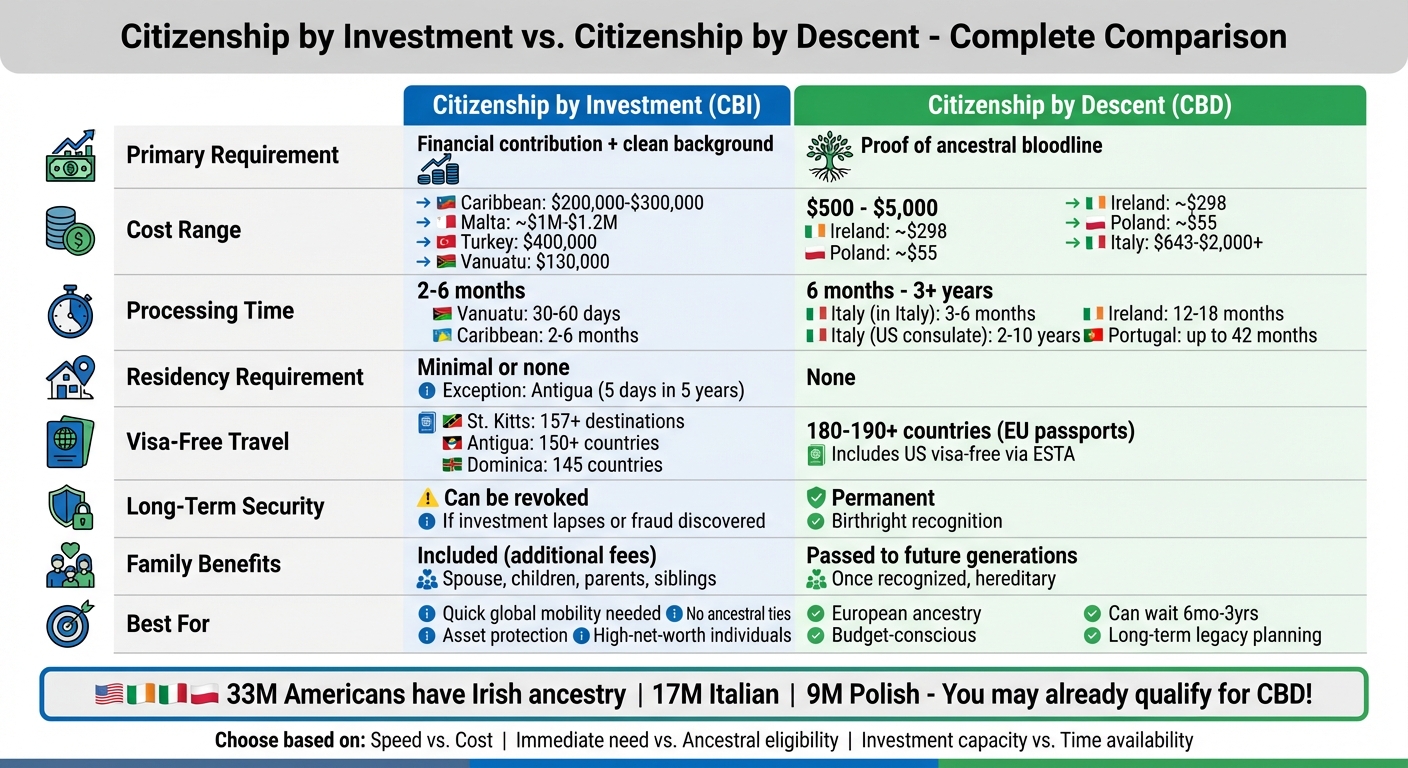
| Factor | Citizenship by Investment (CBI) | Citizenship by Descent (CBD) |
|---|---|---|
| Primary Requirement | Financial contribution and clean background | Proof of ancestral bloodline |
| Minimum Cost | $200,000–$1M+ | $500–$5,000 |
| Processing Time | 2–6 months | 6 months–3.5 years |
| Residency Requirement | Usually none or minimal | None |
| Language Requirement | Rarely required | Sometimes (e.g., Portugal A2, Hungary) |
| Visa-Free Destinations | 140–157 (Caribbean average) | 180–190+ (EU average) |
| U.S. Visa-Free Access | Usually no (requires B-1/B-2) | Usually yes (via ESTA/VWP) |
| Reversibility | Can be revoked if investment lapses or fraud is discovered | Generally permanent (birthright recognition) |
| Family Inclusion | Spouse, children, parents, siblings (additional fees) | Passed to future generations once recognized |
This breakdown provides a clear picture to help you weigh your options based on your priorities and circumstances.
Which Option Fits Your Situation?
When deciding between Citizenship by Investment (CBI) and Citizenship by Descent (CBD), it’s essential to consider both your immediate needs and your long-term legacy. CBI is ideal for those seeking quick global mobility and asset protection, while CBD is a more cost-effective option for individuals with European ancestry who can afford to wait.
CBI for Fast Access and Asset Protection
CBI is tailored for high-net-worth individuals who need a second passport quickly. Whether you’re navigating geopolitical uncertainty, looking to diversify your assets offshore, or require visa-free travel for business, CBI can deliver results in as little as six months. For instance, St. Kitts and Nevis offers an accelerated approval process that takes just 45–60 days.
Caribbean programs are particularly attractive for their tax benefits, which include no capital gains, inheritance, or wealth taxes. If you’re aiming to secure eligibility for an E-2 Investor Visa in the U.S., countries like Grenada or Turkey stand out as strategic options. However, U.S. citizens should remain mindful of worldwide taxation rules and FATCA reporting obligations, making professional tax planning a necessity.
The cost of investment varies by country. For entrepreneurs, investors, or families seeking a reliable "Plan B" during political instability, CBI offers both speed and certainty.
CBD for Ancestral Ties and Lower Costs
While CBI provides quick results, CBD is a more economical pathway for those with ancestral ties to European countries. If you have Irish, Italian, Polish, or Hungarian roots, CBD could be the better financial choice. Unlike investment-based programs, CBD involves minimal fees and grants access to an EU passport. This passport allows visa-free travel to over 190 destinations and the right to live, work, and study across 27 EU member states. That level of access is hard to match with CBI programs.
Millions of Americans with Irish, Italian, or Polish heritage may already qualify. Before committing significant funds to a CBI program, it’s worth examining your family history. If you have a grandparent or great-grandparent from an EU country, you might already be eligible for one of the world’s most powerful passports.
"The value per dollar of ancestry routes is unmatched." – WhereNext
The trade-off with CBD is time. Processing can take anywhere from six months to 42 months, depending on the country. Gathering the necessary documents – such as birth and marriage certificates spanning several generations – can also be a meticulous process. However, once granted, CBD citizenship is permanent and can be passed down to future generations, making it a lasting legacy.
Ultimately, your decision between CBI and CBD should align with your financial situation, mobility needs, and long-term family goals. Each pathway offers distinct benefits tailored to different priorities.
Conclusion
Deciding between CBI (Citizenship by Investment) and CBD (Citizenship by Descent) comes down to your specific priorities, such as how quickly you need a passport, your budget, and whether you meet eligibility criteria. CBI provides a quicker route but requires a significant financial commitment, while CBD offers a more affordable option for those with verified ancestral ties, although it takes longer to complete.
Before committing to a CBI program, take a closer look at your family history. With approximately 33 million Americans tracing Irish ancestry, 17 million with Italian roots, and 9 million with Polish heritage, you could already qualify for a European passport. Such a passport grants visa-free travel to over 190 countries and the ability to live and work in any of the 27 EU member states. For those without ancestral ties – or for anyone needing a passport urgently for business, security, or asset protection – CBI is often the more practical choice.
"A second passport is not about abandoning your home country. It is about expanding your options." – WhereNext
Both paths come with their own complexities. CBI requires strict financial due diligence and clear documentation of funds, while CBD involves detailed genealogical research, certified translations, and apostilled certificates. To avoid setbacks like rejected documents or delays, it’s wise to work with experienced professionals who can guide you through the process.
Ultimately, the best choice depends on your personal circumstances, goals, and financial resources. Carefully assess your situation and documentation to determine which route will secure the second passport – and the opportunities – that best fit your needs.
FAQs
Which route is best if I need a second passport fast?
If you’re looking for speed, Citizenship by Investment (CBI) is hard to beat. This route can grant citizenship in as little as 1–4 months. For instance, Vanuatu provides a passport in just 1–2 months for approximately $130,000. Caribbean programs, such as those offered by Dominica or St. Kitts and Nevis, usually take a bit longer – around 4–9 months. In contrast, pathways like citizenship by descent or naturalization often take several years, making them a slower choice if time is of the essence.
How can I tell if I qualify for citizenship by descent?
To see if you qualify for citizenship by descent, start by confirming if you have a family connection to a country that allows this pathway. Typically, this involves proving that one of your parents, grandparents, or even great-grandparents held citizenship in that country.
Each country has its own rules, so you’ll need to review their specific requirements. This often includes submitting documents like birth certificates or family records to establish your ancestral link. Citizenship by descent operates on the principle of jus sanguinis, which means citizenship is passed down through your bloodline.
What risks could cause citizenship by investment to be revoked?
Citizenship by investment programs come with strict guidelines, and failing to adhere to them can result in revocation. Misuse of the program – like participating in illegal activities, not meeting the legal obligations, or manipulating the investment process – can trigger this consequence. Authorities are also vigilant about preventing exploitation by criminal elements, and any such misuse identified may lead to the loss of citizenship.
