
When setting up an offshore company, costs can vary widely based on several factors. Here’s what you need to know:
- Jurisdiction: The choice of location significantly impacts costs. For instance, Seychelles is affordable for setup and maintenance, while Switzerland is much more expensive.
- Company Type: Different legal structures, like IBCs or LLCs, have varying setup and recurring costs. Specialized structures like offshore trusts or SPCs are pricier.
- Service Scope: Basic formation packages cover essentials, but premium options (e.g., nominee services, bank introductions) and offshore bank accounts add significant costs.
- Compliance Requirements: Jurisdictions with stricter rules (e.g., mandatory audits) increase both setup and annual expenses.
- Maintenance Fees: Annual costs, including registered agent fees and compliance filings, vary greatly by jurisdiction.
Key Takeaway: Balancing upfront costs with long-term expenses is crucial for selecting the right offshore setup. Low initial fees may lead to higher maintenance costs or operational challenges later.
1. Location and Jurisdiction
Where you choose to incorporate can dramatically affect your total costs. Two companies with identical setups can face very different financial realities simply because one is registered in Seychelles and the other in Switzerland.
Impact on Upfront Costs
Government registration fees vary widely depending on the jurisdiction. For instance, filing in the UK costs around $15, while the Cayman Islands charges over $853 just to get started. Other options fall in between, such as Seychelles (around $100), the British Virgin Islands (BVI) ($550), and Singapore ($225). However, these fees are just the beginning – most jurisdictions also require a local registered agent and office address from the start, which can add anywhere from $300 to $2,500 to your initial expenses.
In the BVI, upfront costs can also depend on your authorized share capital. Companies authorizing more than 50,000 shares face government fees of $1,350, compared to $550 for those with fewer shares. Opting for a lower threshold can save you up to $800 right away.
While initial fees are important, the jurisdiction you choose has a lasting impact on your long-term costs.
Effect on Ongoing Costs
Your choice of jurisdiction locks in recurring costs for the years ahead. For example, Seychelles International Business Companies (IBCs) are among the cheapest to maintain annually, with costs ranging from $850 to $1,300. This is largely because Seychelles doesn’t require mandatory annual return filings. On the other hand, BVI companies now require annual financial returns (a new rule introduced in 2023), which has pushed their typical maintenance costs to $2,700 to $4,900 per year. At the higher end of the spectrum, maintaining a company in Switzerland can cost anywhere from $11,500 to $30,000 annually, factoring in accounting, audits, and compliance.
Some jurisdictions, like Hong Kong and Mauritius, also require statutory audits. These audits add a layer of recurring professional fees that can catch many business owners off guard.
Complexity of Compliance and Setup
Costs aside, regulatory complexity plays a big role in how easy – or difficult – it is to set up and maintain a company. Generally, simpler jurisdictions like Seychelles allow incorporation within 24 hours to 3 days with minimal filings. Meanwhile, more regulated hubs like Singapore or the UAE require additional documentation and can take 2–3 weeks to complete the process.
This complexity also affects practical matters, such as banking. For example, BVI companies are widely accepted by major banks in the UK, Switzerland, and Singapore. In contrast, Seychelles IBCs are often limited to digital banks and select institutions in Asia. As Marensa Advisory explains:
"Banking is the real constraint. Many jurisdictions can incorporate quickly. Far fewer can consistently support bank onboarding."
Before deciding on a jurisdiction based solely on its low setup fees, it’s crucial to confirm whether your preferred bank or payment processor will work with that entity. Skipping this step could lead to costly restructuring down the line.
sbb-itb-39d39a6
2. Company Type and Legal Structure
After exploring how jurisdiction impacts costs, the next major factor to consider is the legal structure of your offshore entity. This choice directly influences both the initial setup costs and the ongoing expenses. Picking the right structure isn’t just about saving money upfront – it’s a key part of managing offshore assets effectively.
Impact on Upfront Costs
The registration fees for offshore entities can vary widely depending on the type of structure you choose. For example:
- In the Cayman Islands, registering a standard Exempted Company costs $1,850, while setting up an LLC is $2,250 – an extra $400 for its added flexibility.
- More specialized structures come with higher price tags:
- Segregated Portfolio Company (SPC): Starts at $5,000+
- Foundation Company: Ranges from $7,000 to $15,000
- Private Trust Company (PTC): Between $10,000 and $25,000.
On the more affordable side, a Seychelles IBC costs around $950 to set up, making it one of the least expensive options. Meanwhile, a BVI Business Company starts at roughly $1,750. The price differences often reflect the complexity of the legal documentation and the need for local representation.
Effect on Ongoing Costs
Your choice of legal structure also determines the level of compliance required in the future. Simpler structures like IBCs usually have fewer ongoing obligations. For example, in Seychelles, IBCs don’t require mandatory audits or annual return filings, keeping annual costs between $850 and $1,300.
On the other hand, more complex structures, such as LLCs, can lead to higher recurring expenses. For instance:
- US-based LLCs face strict compliance requirements. Missing Form 5472 can result in penalties of up to $25,000.
- Economic Substance Requirements can add $3,000 to $10,000 annually to your compliance costs.
Complexity of Compliance and Setup
Some structures demand more effort and resources during both setup and ongoing operations. For example:
- A Singapore Private Limited (Pte Ltd) requires a local resident director, which can add $2,000–$5,000 to both initial and yearly expenses.
- Specialized structures like SPCs or Trust Companies often require custom legal documentation, which may cost an additional $3,000–$12,000 on top of the base registration fees.
As Privacy Solutions points out:
"For pure asset protection, the LLC wins every time. For operational business structures involving outside capital, the Nevis IBC or Nevis corporation may be more practical".
Choosing the wrong structure might save you money at the start but could lead to significant challenges and higher costs down the line. The legal structure you select not only shapes your initial fees but also has a long-term impact on compliance and operational expenses. Up next, we’ll examine how the scope of services and package options can further influence formation costs.
3. Formation Package and Service Scope
The formation package you select plays a major role in shaping both your initial and future expenses. Two companies set up in the same jurisdiction can face vastly different costs, depending on whether one owner picks a basic package while the other chooses a more comprehensive, full-service option.
Impact on Upfront Costs
Formation packages typically include essentials like government registration fees, a registered office, and key corporate documents (e.g., Certificate of Incorporation, Memorandum & Articles of Association). However, optional add-ons – such as bank introductions, apostille services, or nominee directors – can significantly increase costs.
The price difference between package tiers is worth noting. For instance, in the Seychelles, a basic package starts at $990, while a top-tier package with nominee services can reach $3,760. Similarly, in the British Virgin Islands (BVI), costs range from $2,090 for a basic package to $4,960 for a premium option. In the Cayman Islands, adding bank account setup assistance to a basic Exempted Company formation adds $1,500 to the total. Meanwhile, services like individual apostille certifications in Belize or Panama may cost between $450 and $600 per document if purchased separately. These costs directly affect your budgeting and long-term financial planning.
| Package Tier | Typical Services Included | Upfront Cost Range |
|---|---|---|
| Basic | Registration, Memorandum & Articles, Registered Office (1 yr), Share Certificates | $990–$2,000 |
| Executive | Basic + Certified Documents, Bank Account Opening Assistance | +$1,000–$1,500 |
| Ultimate | Executive + Nominee Director/Shareholder, Online KYC Certification | +$2,500–$3,500 |
Effect on Ongoing Costs
The package you choose also determines your recurring compliance costs. Basic packages often leave out mandatory filings – like annual returns or economic substance reports – forcing you to handle these separately, which can be costly. For example, in the BVI, failing to file an Economic Substance report can result in penalties starting at $20,000 for a first offense and climbing up to $400,000 for repeated violations in high-risk cases.
"The jump from Basic to Standard is almost always worth it. The annual financial return and economic substance declaration are mandatory filings… Leaving them unbundled typically costs more in the long run." – Air Corporate
Opting for a full-service package can help you avoid these pitfalls. Bundled compliance services – such as registered agent support, UBO register maintenance, and compliance calendars – streamline the process and reduce the risk of non-compliance.
Complexity of Compliance and Setup
Offshore company formation involves more than just filing paperwork. Setting up a corporate bank account, for example, is often one of the trickiest steps. Without professional introductions or existing banking relationships, around 30–40% of new offshore bank account applications are rejected. A comprehensive package can simplify this process by providing a "banking-ready" file, which includes professional CVs, business plans, and source-of-wealth documentation, ensuring your company is ready to operate from day one.
"The fastest offshore setups are the ones built to pass banking, due diligence, and ongoing compliance from day one." – First Elite Global
If maintaining privacy is a concern, consider including nominee services from the outset. Adding a nominee director or shareholder after formation often requires amending your register, which can incur additional legal fees beyond the standard annual nominee cost of around $1,000. By choosing these services upfront, you save on future expenses. Providers like Global Wealth Protection offer full-service packages that cover filings, certifications, and banking introductions, helping you navigate the complexities of offshore formation with ease. These considerations play a crucial role in shaping your overall strategy and service selection.
4. Compliance and Document Requirements
It’s easy to overlook the paperwork involved in offshore company formation – until you’re knee-deep in notarizations and apostille requirements. Each jurisdiction has its own set of compliance rules, and stricter regulations often mean higher initial costs and longer setup times.
Compliance documentation is just as important as choosing the right jurisdiction and legal structure. It directly impacts both the upfront and ongoing costs of maintaining an offshore entity.
Impact on Upfront Costs
Most jurisdictions require a range of certified documents, including:
- Copies of passports
- Recent proof of residence
- Professional reference letters
- Source-of-wealth declarations
If your company has corporate shareholders, you’ll also need incorporation documents and registers of directors or members. These documents often need to be authenticated, which can add to the initial costs. For example:
- Notarizations and apostilles: Typically cost between $50 and $300 per document.
- Certified translations: Required for non-English documents, especially for companies involved in international banking or contracts, further increasing setup costs.
These initial documentation expenses lay the groundwork for the ongoing compliance obligations discussed below.
Effect on Ongoing Costs
Recurring compliance requirements differ by jurisdiction. For instance, Seychelles has no annual return filing, but the British Virgin Islands (BVI) requires one, and the Cayman Islands mandates both annual returns and audits for regulated entities like funds.
| Jurisdiction | Annual Return | Audit Required | Est. Annual Compliance Cost |
|---|---|---|---|
| Seychelles | Not required | No | $850–$1,300 |
| BVI | Required | No | $2,700–$4,900 |
| Cayman Islands | Required | Yes (regulated entities) | $7,850+ |
| Hong Kong | Required | Yes (mandatory) | $3,200–$9,100 |
Jurisdictions with mandatory audits, such as Hong Kong (approximately $1,000–$3,000) and Mauritius (around $2,000–$5,000), tend to have higher recurring costs tied to documentation. Even in jurisdictions with lighter requirements, annual Anti-Money Laundering (AML) compliance reviews can add about $200 per year.
Complexity of Compliance and Setup
Most offshore hubs now require beneficial ownership details to be maintained by a registered agent or in a private register. For example:
- In the BVI, this is handled through the BOSS (Beneficial Ownership Secure Search) system.
- In Seychelles, the registered agent keeps the register, which is only accessible to regulators.
"The Seychelles Register of Beneficial Owners is maintained by the registered agent and accessible only to regulators and the Financial Intelligence Unit, never to the public." – Elias Marchetti, Senior Compliance Counsel, Sovera Global
Economic substance rules add another layer of complexity. If your business involves activities like fund management, intellectual property holdings, or shipping, you may need to establish a physical presence in the jurisdiction. This could mean hiring local employees, setting up a physical office, or ensuring onsite management. Meeting these substance requirements can cost over $6,000 annually.
Before committing to a specific structure, it’s essential to determine if your business activities trigger these rules. Services like Global Wealth Protection can help evaluate your substance obligations upfront, potentially saving you from expensive adjustments later.
5. Ongoing Maintenance and Renewal Costs
Setting up an offshore company is just the beginning. Staying compliant involves consistent financial outlays, as annual renewal fees are required to maintain good standing for the life of the company.
Impact on Upfront Costs
When forming a company, the initial cost often includes the first year’s maintenance fees. This means the upfront expense is higher than the base formation fee might suggest. Expenses like registered agent fees, government license fees, and registered office costs are typically prepaid during incorporation. Some service providers offer discounts for multi-year prepayments on these fees, which can help reduce long-term costs.
Effect on Ongoing Costs
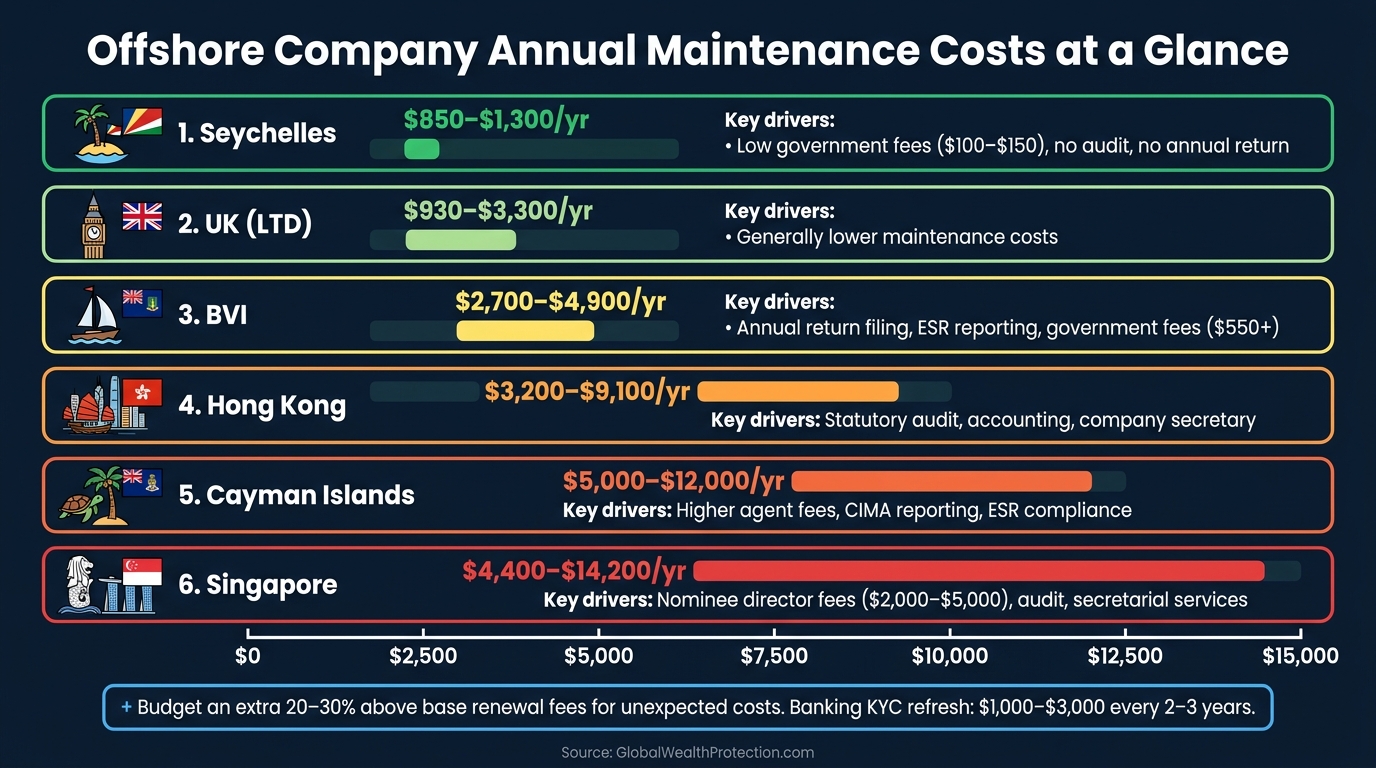
Annual maintenance costs can vary significantly depending on the jurisdiction. For example, Seychelles has relatively low yearly fees, ranging between $850–$1,300, while jurisdictions like Singapore or the Cayman Islands can exceed $12,000 annually, driven by requirements like audits, nominee directors, and higher government fees.
| Jurisdiction | Typical Annual Maintenance (USD) | Key Cost Drivers |
|---|---|---|
| Seychelles | $850 – $1,300 | Low government fees ($100–$150), no audit, no annual return |
| BVI | $2,700 – $4,900 | Annual return filing, ESR reporting, government fees ($550+) |
| Hong Kong | $3,200 – $9,100 | Statutory audit, accounting, company secretary |
| Cayman Islands | $5,000 – $12,000 | Higher agent fees, CIMA reporting, ESR compliance |
| Singapore | $4,400 – $14,200 | Nominee director fees ($2,000–$5,000), audit, secretarial services |
| UK (LTD) | $930 – $3,300 | Generally lower maintenance costs |
These wide-ranging fees highlight the importance of considering long-term commitments when choosing a jurisdiction. Additionally, banking maintenance adds another layer of recurring costs. Corporate accounts often charge monthly fees of $20–$100, and Know Your Customer (KYC) refresh fees can range from $1,000–$3,000 every 2–3 years. To account for unexpected costs, it’s wise to budget an extra 20–30% above the base renewal fees.
Complexity of Compliance and Setup
Failing to meet renewal deadlines can lead to costly consequences. Late filings incur fines, and persistent non-compliance could result in administrative strike-off. If this happens, the company’s bank accounts are frozen, and it loses the ability to operate legally. Reinstating a struck-off company involves substantial costs, often exceeding the original renewal fees, due to administrative penalties and legal restoration expenses.
"The cost of offshore company formation extends beyond the initial incorporation stage; maintaining legal good standing requires compliance with annual statutory renewal obligations." – OVZA Legal Affairs
Staying compliant is critical, as missed filings can lead to severe financial and operational setbacks. Partnering with a service provider like Global Wealth Protection can help by offering tools like compliance calendars and automated renewal reminders, ensuring deadlines aren’t missed and penalties are avoided.
Comparison Table
Each factor – ranging from location to maintenance – carries its own weight in determining the overall expenses of offshore company formation. These factors influence upfront fees, recurring costs, and the complexity of compliance in unique ways. Here’s a breakdown of their impact:
| Factor | Initial Fee Impact | Ongoing Cost Impact | Compliance Complexity |
|---|---|---|---|
| 1. Location & Jurisdiction | Low to very high (ranging from roughly $850 to over $15,000+) | High – driven by government fees and economic substance requirements | High – varies depending on the jurisdiction’s reputation and regulations |
| 2. Company Type & Legal Structure | Moderate – International Business Companies (IBCs) are among the more affordable options, while regulated entities cost more | High – trusts, funds, and licensed entities demand significant administration | Moderate to high – regulated structures require extensive documentation |
| 3. Formation Package & Service Scope | High – full-service packages may add $1,000–$3,000+ compared to a DIY setup | Moderate – ongoing compliance support can ease internal workload | Low for the client – full-service providers typically handle the complexity |
| 4. Document & Compliance Complexity | Moderate – costs for KYC, notarization, and apostilles typically range from $50–$300 per document | Moderate – periodic filings, such as UBO updates and KYC renewals, are necessary | High – enhanced due diligence is required for high-risk industries |
| 5. Ongoing Maintenance & Renewals | Low – initial formation packages often include these fees | High – audits, renewals, registered agent fees, and banking maintenance can accumulate | Moderate – mandatory in jurisdictions like Hong Kong and Mauritius |
This table highlights how each factor contributes to the overall cost structure, offering a clear perspective for better planning. It’s important to note that a lower upfront fee doesn’t always mean lower long-term costs. For example, a Seychelles IBC might start at $850–$1,300, but additional onboarding costs can arise. On the other hand, jurisdictions such as Singapore or Hong Kong may have higher initial fees, but they often offer smoother banking integration, which can justify the investment over time. Each jurisdiction balances formation and operational costs differently, so both short-term and long-term expenses need to be considered to understand the true cost of maintaining an offshore entity.
"In 2026, offshore and international company formation is no longer a ‘cheap vs expensive’ decision. The best jurisdiction is the one you can operate, defend, and maintain over time." – Marensa Advisory
When planning, think beyond the immediate costs and consider the total expense over several years to find the most sustainable strategy for your needs.
Conclusion
Setting up an offshore company involves much more than just paying a registration fee. Factors like jurisdiction, company type, scope of services, compliance requirements, and ongoing maintenance all contribute to the overall cost and complexity. Overlooking any of these can lead to unexpected issues such as hidden expenses, banking difficulties, or regulatory penalties later on.
Focusing solely on low upfront fees can be a costly mistake. Structures that seem affordable at the start may become unmanageable over time due to unforeseen banking and compliance costs. A successful offshore setup requires careful planning, addressing ongoing obligations like substance requirements, renewal deadlines, and banking due diligence – not just the initial setup price.
"Going offshore isn’t about secrecy. It’s about control. You control where your company is based, where your money lives, and how much you pay in tax." – Global Wealth Protection
To navigate these complexities, professional advice is invaluable. Global Wealth Protection provides tailored solutions, helping clients select the right jurisdiction based on their nationality, business model, and risk tolerance. Their services include offshore formation, banking introductions, compliance support, and private consultations to create sustainable and compliant structures. For example, in 2026, Global Wealth Protection successfully structured a project that enabled seamless invoicing across North America and Europe, showcasing the benefits of thorough planning.
FAQs
How do I choose a jurisdiction that won’t cause banking problems later?
To steer clear of banking challenges, it’s important to start by clearly defining your business needs. Consider factors like your use case, specific banking requirements, and compliance obligations such as tax residency and any industry-related risks.
A helpful approach is to use a scorecard system to evaluate potential jurisdictions. Key criteria to assess include:
- Banking acceptance: How open is the jurisdiction to your type of business?
- Regulatory clarity: Are the rules and expectations straightforward?
- Professional support: Is there access to experienced advisors or services?
When selecting a jurisdiction, ensure it aligns with your entity type and ownership structure. Once you’ve chosen the right location, focus on preparing a clear, banking-ready file. This should include all necessary Know Your Customer (KYC) documents and detailed source-of-funds information to meet compliance requirements. Proper preparation can make all the difference in avoiding unnecessary complications.
Which company type is cheapest long-term for my business?
For those prioritizing long-term savings, setting up an International Business Company (IBC) in places like Seychelles or Belize can be a smart financial move. These companies enjoy 0% corporate tax on foreign income, require minimal reporting, and don’t mandate audits or annual filings. Seychelles IBCs, in particular, often come with lower fees compared to jurisdictions like the British Virgin Islands. While banking access may be somewhat limited, they’re a great option for entrepreneurs looking for simplicity and low ongoing costs.
What hidden compliance costs should I budget for each year?
When planning your offshore maintenance budget, it’s essential to account for recurring costs. These include registered agent and office fees, which can range from $800 to $5,000 annually, and government renewal fees.
Other potential expenses to keep in mind:
- UBO register filings: These typically cost between $200 and $1,000.
- Nominee director services: This service may set you back anywhere from $1,200 to $8,000.
- Accounting or audit requirements: Costs will depend on specific compliance needs.
Additionally, maintaining banking access often comes with transaction and maintenance fees, which usually fall between $500 and $2,000 per year. Properly estimating these costs will help you stay prepared and avoid unexpected financial surprises.
