
Setting up an offshore company can seem appealing with promises of tax savings, asset protection, and global banking access. But the true costs go beyond the initial setup fee. Here’s a quick breakdown:
- Initial Setup Costs: Range from $1,500 (Caribbean) to over $15,000 (Switzerland) depending on the jurisdiction.
- Annual Maintenance Costs: Start as low as $850 (Seychelles) and can exceed $14,000 (Singapore or Hong Kong) when factoring in compliance, audits, and registered agent fees.
- Hidden Expenses: Bank account setup ($500–$5,000), nominee services ($1,500–$8,000 annually), and document legalization ($50–$300 per document).
- Compliance Penalties: Non-compliance fines can reach $20,000 or higher, depending on the jurisdiction.
The key takeaway: Offshore companies make financial sense only if the tax savings outweigh the combined setup and recurring costs. For most businesses, this means earning $100,000+ annually.
Choose your jurisdiction wisely, bundle services where possible, and avoid cutting corners on compliance to ensure long-term success.
Initial Setup Costs
Setting up an offshore company involves three primary expense categories: government fees, agent or office costs, and legal documentation. These costs vary widely depending on the jurisdiction. For instance, while establishing a UK LTD can cost as little as $930 in the first year, forming a Swiss GmbH can exceed $15,000. Let’s break down these expenses further.
Incorporation Fees and Government Charges
Government incorporation fees are a crucial part of the setup process, as they are mandatory payments to the jurisdiction’s company registry. These fees vary significantly by location:
- In the UK, incorporation fees start at just $15, offering one of the most affordable options.
- Seychelles charges between $100 and $150 for an International Business Company (IBC).
- In the British Virgin Islands (BVI), fees increased on January 1, 2023. Companies authorized to issue up to 50,000 shares now pay $550, up from $450. For companies issuing more than 50,000 shares, the fee jumps to $1,350 – an $800 difference, applicable both at the time of incorporation and annually.
"The BVI government fees are fixed and predictable. The service fees charged by registered agents and corporate service providers vary significantly." – Collin, Accounting Manager, Air Corporate
Mid-tier jurisdictions like Panama charge a government fee of around $300, bringing total setup costs to approximately $1,495. Similarly, Hong Kong’s government fee stands at $220, with first-year costs reaching $2,875. On the higher end, the Cayman Islands charge $853 in government fees, resulting in total setup costs of $3,745 or more. Switzerland is the most expensive jurisdiction, with notary and formation fees ranging between $3,000 and $8,000. This brings total setup costs to anywhere from $11,500 to $30,000.
Legal and Administrative Documentation Costs
Every offshore company requires essential documents such as a Certificate of Incorporation, Memorandum and Articles of Association, and initial registers of directors and shareholders. While many service providers include these in their packages, additional documentation costs can quickly add up:
- A Certificate of Incumbency (used as proof of current officers for banks) costs around $320.
- A Certificate of Good Standing typically costs $350.
Additional expenses include apostille or legalization services, which range from $150 to $300 per document. However, these are often unnecessary for digital banking, though they may still be required for real estate transactions or legal proceedings. KYC (Know Your Customer) due diligence for directors and beneficial owners adds another $200 to $500 per individual. Other costs, like corporate seals and international courier fees, fall between $50 and $150 each.
These documentation-related expenses can substantially impact the overall initial setup costs, especially in jurisdictions requiring more extensive legal formalities.
sbb-itb-39d39a6
Annual Compliance and Maintenance Expenses
Once your company is up and running, you’ll need to budget for ongoing costs, which typically range from $3,000 to $15,000 per year. These expenses ensure your business remains legally compliant and operational. Below, we’ll break down the main categories of annual compliance costs, including registered agent services, government renewals, and accounting requirements.
Registered Agent and Office Address Services
Many offshore jurisdictions require businesses to have a local registered agent and a local office address. The registered agent acts as a go-between for your company and the local government, handling essential documents like legal notices, tax forms, and service of process. This setup also safeguards your privacy by keeping your personal address off public records.
"A registered agent is a legal requirement for many businesses, ensuring they can receive important documents reliably." – BBCIncorp
The cost of registered agent services varies widely depending on the jurisdiction. For example:
- United Kingdom: $100–$300 per year
- Seychelles: $350–$500
- Panama: $500–$1,000
- British Virgin Islands (BVI): $700–$1,500
- Singapore: $300–$800
- Hong Kong: $500–$1,200
- Cayman Islands: $1,200–$2,500
Skipping this requirement can lead to serious issues. In the BVI, for instance, failing to maintain a registered agent triggers strike-off proceedings after just 90 days. To streamline costs, some providers bundle registered agent services with corporate secretary and mail-handling services. Beyond this, staying compliant also involves paying annual government fees on time.
Annual Government Fees and License Renewals
Governments charge annual fees to keep companies in good standing. Here’s a snapshot of typical costs:
- Seychelles: $100
- Panama: $300
- BVI: $450 for companies with up to 50,000 shares, increasing to $1,200 for higher share capital
- Cayman Islands: $854
- Mauritius Global Business Companies: $2,850
Timeliness is key here. For example, in the BVI, late payment of government fees incurs an immediate 50% penalty. To avoid penalties or the risk of being struck off, it’s a good idea to set reminders at least 60 days before deadlines. If your company is struck off, reinstatement can cost anywhere from $5,000 to $15,000 in legal fees in jurisdictions like the Cayman Islands.
Accounting and Tax Reporting Costs
Even in jurisdictions with no tax filing requirements, companies are usually required to keep detailed financial records. Here’s a breakdown of typical accounting and reporting costs:
- Seychelles: $300–$600 annually with no tax filings required
- BVI: Basic accounting starts at $500, with Economic Substance filings adding $500–$1,000
- Hong Kong and Mauritius: Annual audits are mandatory, costing between $1,000 and $3,000
- Singapore and United Kingdom: Audit exemptions exist for small companies based on revenue and asset thresholds (e.g., below SGD 10 million in Singapore)
- UAE Free Zones: Accounting and audit compliance typically cost $1,000–$3,000
For companies involved in activities like holding assets, banking, or shipping in jurisdictions like the BVI, Economic Substance filings are a must. Non-compliance can result in penalties of $5,000 for the first offense and $10,000 for repeat violations.
In Hong Kong, total accounting and audit expenses usually range from $1,800 to $6,000 annually. Meanwhile, jurisdictions like the BVI, Cayman Islands, and UAE now require annual Economic Substance declarations, adding another layer of obligations and costs.
Cost Comparison by Jurisdiction
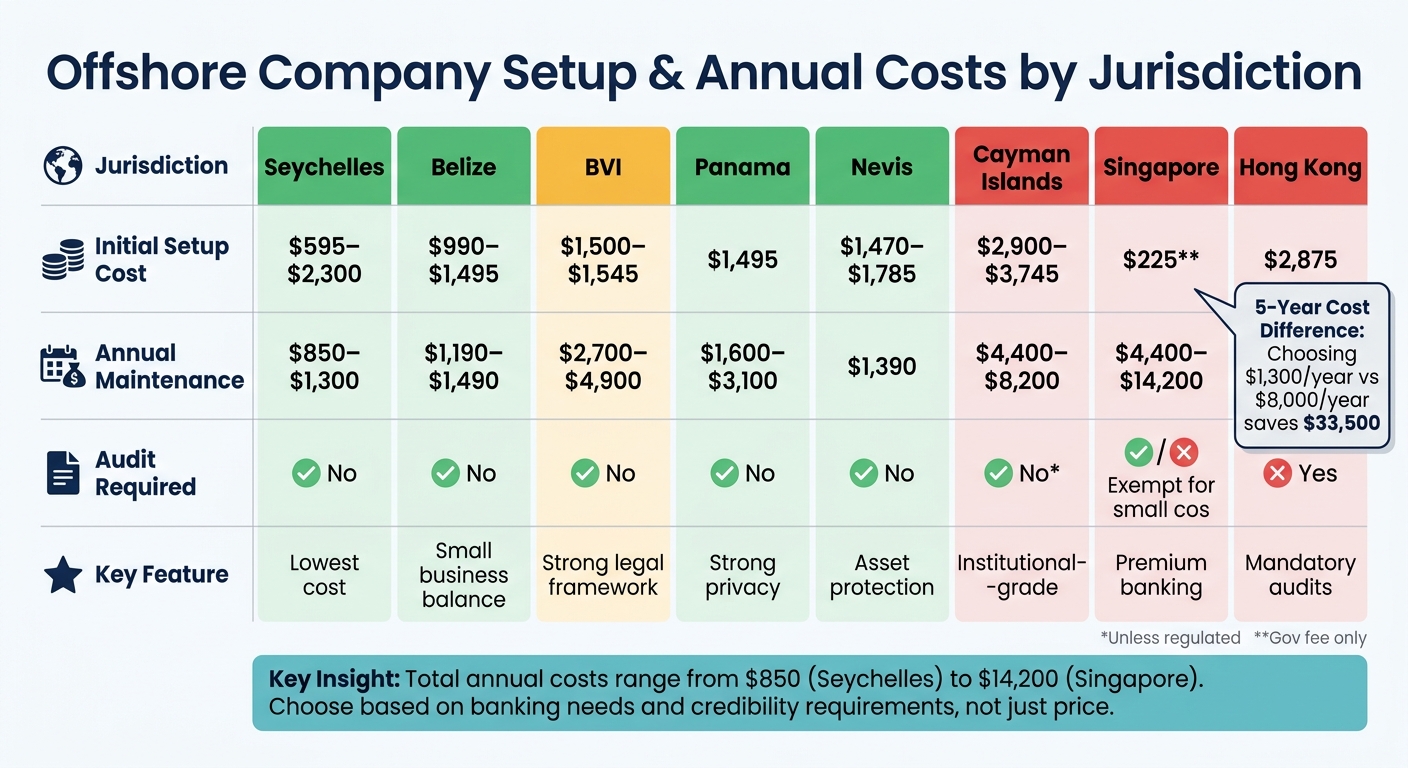
Choosing the right offshore jurisdiction involves weighing costs against factors like credibility and compliance. The yearly expense of maintaining an offshore company can range from under $1,000 in budget-friendly locations to over $14,000 in high-end financial hubs. Knowing these differences can help you avoid unnecessary expenses while ensuring your chosen jurisdiction aligns with your business goals.
The British Virgin Islands (BVI) is often seen as a cost-effective choice for holding companies and trading entities, thanks to its lower fees and quick processing times. On the other hand, the Cayman Islands is known for its appeal to institutional structures like hedge funds and private equity, though it comes with much higher setup and maintenance costs. At the more affordable end, Seychelles offers some of the lowest annual maintenance costs, ranging from $850 to $1,300. These contrasts highlight the importance of carefully evaluating jurisdictional costs.
It’s important to note that headline formation fees don’t tell the full story. They often exclude ongoing expenses such as government renewals, registered agent fees, and compliance filings. For example, while Singapore’s government fee is relatively low, total annual costs can climb to $14,200 when factoring in mandatory nominee director fees ($2,000 to $5,000) and accounting requirements.
Cost Table for Popular Offshore Jurisdictions
Here’s a breakdown of costs across some of the most popular offshore jurisdictions:
| Jurisdiction | Initial Setup Cost | Total Annual Maintenance | Mandatory Audit? | Key Consideration |
|---|---|---|---|---|
| Seychelles | $595 – $2,300 | $850 – $1,300 | No | Lowest cost, but banking can be challenging |
| Belize | $990 – $1,495 | $1,190 – $1,490 | No | Good balance for small businesses |
| BVI | $1,500 – $1,545 | $2,700 – $4,900 | No | Popular globally; strong legal framework |
| Panama | $1,495 | $1,600 – $3,100 | No | Territorial tax system; strong privacy |
| Nevis | $1,470 – $1,785 | $1,390 | No | Asset protection for U.S. investors |
| Cayman Islands | $2,900 – $3,745 | $4,400 – $8,200 | No (unless regulated) | Institutional-grade credibility |
| Singapore | $225 (Gov fee only) | $4,400 – $14,200 | Exempt for small cos | Requires local director; premium banking |
| Hong Kong | $2,875 | $3,200 – $9,100 | Yes | Mandatory audits increase costs |
When planning your budget, consider more than just the formation fee. Hidden expenses – like document apostille and offshore bank accounts introduction fees – can add up. While Seychelles offers the lowest costs, jurisdictions like Singapore and Hong Kong provide better banking access and reputational advantages, which may justify their higher price tags.
First-Year and Long-Term Budget Planning
Total First-Year Costs
The first year of setting up an offshore structure is often the most expensive. It combines the initial setup fees with full maintenance costs. For instance, in Seychelles, the base incorporation package costs $950, but the renewal fee for the second year rises to $1,650. The initial low fee typically covers setup, while the higher renewal costs account for ongoing compliance requirements.
"The first year is the most expensive because it includes the incorporation fee on top of the annual services. From year 2 onward, you pay renewal only." – Vivian Au, Founder, Air Corporate
In more affordable jurisdictions, first-year costs generally stay below $2,000, while premium locations can exceed $7,200. Additionally, setting up a bank account can cost anywhere from $500 to over $5,000 and may take up to three months. To avoid delays, many businesses opt for an EMI (Electronic Money Institution) to kickstart their operations.
Offshore setups make financial sense only when the tax savings outweigh the annual maintenance costs by at least three times. This is typically the case for businesses earning $100,000 to $150,000 or more. After the initial setup year, the focus shifts entirely to managing recurring expenses.
Long-Term Maintenance Costs
Once the first year is complete, recurring costs become the primary concern. These include government fees, registered agent services, compliance filings, and accounting. While these costs are usually stable, they can increase if additional services like nominee directors are required, which can range from $1,500 to $8,000 annually.
Some jurisdictions, like Seychelles and Belize, offer lower annual costs, ranging between $850 and $1,650, and do not require tax filings. On the other hand, locations like Hong Kong and Singapore require statutory audits and tax filings, pushing annual costs to $3,200 to $14,200. In places like the British Virgin Islands (BVI) and Cayman Islands, economic substance filings add another $500 to $1,000 yearly.
Over time, these differences can add up significantly. For example, choosing a jurisdiction with $1,300 in annual costs instead of one with $8,000 could save you $33,500 over five years. These savings highlight the importance of carefully selecting a jurisdiction that aligns with your long-term financial strategy.
Hidden Costs and Common Mistakes
Bank Account Setup and Nominee Services
Setting up a bank account is often the first major hurdle in offshore company formation. While forming a company might take just 48 hours, opening a corporate bank account can stretch to three months – or longer. During this time, you’re still on the hook for annual maintenance fees, even though your company can’t operate yet. Adding to the challenge, many banks now require in-person identity verification, forcing executives to travel internationally just to complete the process.
"The truth most formation companies won’t tell you: you can form a company in 48 hours, but getting a bank account can take 3 months – if you’re approved at all." – EasyInc
Banking introduction fees typically fall between $1,000 and $3,000. However, certain industries – like crypto, supplements, and coaching – are often labeled "high-risk" by banks. This means even legitimate businesses in these sectors may face repeated rejections, as banks avoid the higher compliance costs tied to these industries.
Nominee services are another expense to consider. These services can cost between $1,500 and $8,000 annually, depending on the jurisdiction. For example, in Singapore, nominee director fees range from $2,000 to $5,000 per year. The British Virgin Islands (BVI) charges $500 to $2,000 per role, while costs in the UAE and Singapore can climb as high as $8,000. Beyond these retainers, you may also need to cover liability insurance and ongoing salary obligations for local resident directors. These banking and nominee-related challenges often lead to additional hidden costs, which extend into areas like currency conversion and legal advisory fees.
Currency Conversion and Legal Advisory Fees
Financial surprises don’t stop at banking issues. Currency conversions and legal documentation fees can also catch founders off guard. For instance, document legalization, such as obtaining an apostille, costs between $50 and $300 per document. Other mandatory documents, like a Certificate of Incumbency (about $320) and a Certificate of Good Standing (around $350), add to the bill.
"The gap between what is listed and what eventually gets invoiced is where most founders get surprised." – Collin, Accounting Manager, Air Corporate
Additional fees include KYC and due diligence costs ($200 to $500), beneficial ownership filings ($200 to $1,000), and courier charges (ranging from $50 to $150 per shipment). If your business operates across multiple jurisdictions, recurring currency conversion fees can quickly add up whenever you pay government fees or service providers in different currencies.
A frequent mistake is failing to request an itemized quote upfront. Many low-cost agents omit fees for document certification, apostilles, courier services, and compliance reviews, which leads to unexpected invoices later. Another common error is over-authorizing shares. In the BVI, keeping authorized share capital at or below 50,000 shares can save $800 in government fees, both during incorporation and annually. To avoid these costly pitfalls, careful planning and detailed itemized budgeting are essential.
How to Reduce Costs While Staying Compliant
Selecting the Right Jurisdiction for Your Needs
Reducing costs without compromising compliance starts with choosing the right jurisdiction. But remember, the cheapest option isn’t always the most suitable. For example, Seychelles offers a low annual cost of about $850 and quick incorporation within 1 to 3 business days. This makes it a good fit for lightweight holding companies or consultancy work that doesn’t need extensive banking. However, if your business relies on credible international banking, the UK emerges as a strong option. With formation fees as low as $15 and annual costs ranging from $930 to $3,300, the UK balances affordability with global credibility.
Some jurisdictions also offer significant savings through reduced filing requirements. Belize and St. Vincent and the Grenadines, for instance, waive accounting and tax return filings for certain structures, cutting down ongoing professional fees. Nevis is another cost-effective option, offering excellent asset protection for LLCs at lower setup costs than premium jurisdictions like the Cook Islands. If you’re targeting markets in Africa or Asia, Mauritius could be ideal. It provides a wide treaty network to minimize dual taxation, with corporate tax rates as low as 3% through partial exemption regimes.
The key is aligning the jurisdiction with your business needs. Seychelles works well for digital platforms with minimal banking demands, while Hong Kong or Singapore are better for businesses needing access to top-tier international banks. A general rule of thumb: offshore structures are worth it only if they save at least three times the annual maintenance cost in taxes, which usually means generating $100,000 to $150,000 in annual revenue.
Once the right jurisdiction is selected, bundling services and automating compliance can help further reduce costs.
Bundling Services and Automating Compliance
Smart bundling and automation are effective ways to trim costs after picking the right jurisdiction. Bundled service packages often cost less than purchasing individual services. For example, in the British Virgin Islands, a standard package covering incorporation, government fees, registered agent services, KYC reviews, annual financial returns, and economic substance reporting typically costs $2,500 to $3,500 for the first year. Opting for separate services can drive the total to $4,000 or more.
"The jump from Basic to Standard is almost always worth it. The annual financial return and economic substance declaration are mandatory filings… Leaving them unbundled typically costs more in the long run." – Air Corporate
To avoid surprise costs, ask for fully itemized quotes upfront. Also, coordinate bank account opening alongside incorporation to prevent paying extra fees for a dormant company.
Why Cutting Corners Can Cost You More
While bundling saves money, skipping critical compliance steps can lead to expensive consequences. Cutting corners on compliance can cost thousands. Tax authorities now expect evidence of genuine economic activity – like physical offices, local staff, and on-site management. Without this, your home country may classify your company as a "controlled foreign corporation" and tax it as though the offshore structure doesn’t exist.
"A company with no substance is a target for your home country’s tax authority to declare it a ‘controlled foreign corporation’ and tax you as if the offshore structure doesn’t exist." – EasyInc
Banks also demand proof of physical substance, such as utility bills, office photos, or even site visits, to confirm the alignment between your declared jurisdiction and actual operations. Using nominee directors to hide true decision-makers can trigger compliance issues, potentially freezing funds or cutting off access to the global financial system. Since 2008, banks have become increasingly cautious about offshore entities due to heavy fines.
The days of anonymous offshore accounts are over, thanks to global tax information-sharing initiatives like the OECD, CRS, and FATCA. A 0% tax rate is meaningless if your structure can’t open a bank account or meet substance requirements. Instead, consider starting with electronic money platforms like Wise or Revolut to establish a 3- to 6-month transaction history before transitioning to traditional international banks. To stay compliant, maintain a clear paper trail with a physical address, valid contracts, and active bank operations to prove legitimate business activity to tax authorities.
Conclusion
Setting up an offshore company involves more than just an incorporation fee. You’ll also face ongoing costs like registered agent fees, government renewals, compliance filings, accounting, and banking setup. These recurring expenses can add up to several thousand dollars annually. Knowing these costs upfront can help you avoid surprises and decide if an offshore structure aligns with your financial goals.
"The total cost must be weighed against the tax savings – a structure that costs USD 15,000 per year but saves USD 100,000+ in tax is highly efficient." – HPT Group
As a general rule, tax savings should be at least three times your annual maintenance costs. For most businesses, this means generating $100,000 to $150,000 in annual revenue before the benefits outweigh the expenses. Below this range, the compliance requirements and fees may cancel out any tax advantages. This highlights the importance of careful planning.
Choosing the right jurisdiction is critical. A zero percent tax rate won’t help if you run into issues with banking or tax classification. Make sure the jurisdiction you select supports your operational needs, complies with economic substance requirements, and works with your banking setup. Also, account for hidden costs like nominee fees, document apostilles, and currency conversion charges.
To keep costs manageable and remain compliant, focus on aligning your jurisdiction with your business needs, bundling services where possible, and steering clear of shortcuts that could lead to penalties or banking issues. When all these factors are carefully considered and aligned with your goals, an offshore company can be a powerful tool for international business and asset protection , such as structuring offshore trusts – provided the financials make sense.
FAQs
What costs are usually left out of an offshore company quote?
Hidden costs that are often left out of offshore company quotes can catch you off guard. These may include fees for expert consultation, unexpected legal or compliance-related expenses, and potential risks from accidental errors. Misunderstanding the actual expenses involved can also lead to additional operational costs you didn’t anticipate. To steer clear of these surprises, it’s crucial to plan carefully and fully understand the specific requirements of the jurisdiction you’re dealing with.
How do I pick the best offshore jurisdiction for my business and banking needs?
When deciding on the right offshore jurisdiction, it’s important to weigh several key factors, including regulatory stability, tax policies, reputation, confidentiality, and administrative expenses. Each of these elements can significantly impact your business operations and financial management.
Start by comparing jurisdictions based on their legal frameworks, asset protection options, and compliance requirements. For example, some locations may offer stronger privacy protections, while others might stand out for their cost efficiency.
Popular jurisdictions like Nevis and Seychelles are often favored for their emphasis on privacy and relatively low costs. However, the best choice will depend on how well a jurisdiction aligns with your specific business goals and banking needs. Always ensure the jurisdiction you choose upholds international credibility and meets legal compliance standards.
What happens if I miss an annual filing or renewal deadline?
Missing an annual filing or renewal deadline for an offshore company can lead to fines, penalties, or even suspension of business rights. If non-compliance continues, the consequences can escalate, potentially resulting in administrative dissolution, being struck off the register, or losing legal standing in the jurisdiction. To steer clear of these risks, it’s essential to stay vigilant about filing deadlines and meet all compliance requirements on time.
