
Want to protect your wealth, reduce taxes, or gain more freedom? In 2026, relocating to a country that aligns with your financial and personal goals is more than a trend – it’s a strategy. With over 142,000 millionaires expected to move this year and investment migration generating €20 billion in revenue, this guide breaks down how to make it work for you.
Key Takeaways:
- Who benefits most? Entrepreneurs, high-net-worth individuals, and investors seeking tax savings, asset protection, or tax and residency solutions for a better lifestyle.
- What’s the process? Define your goals, evaluate countries based on taxes and stability, create a relocation plan, and implement it step by step.
- Why diversify? Relying on one country for everything creates risks. A multi-residency strategy spreads risk and ensures flexibility.
- Top jurisdictions in 2026: UAE (0% tax), Switzerland (lump-sum tax), Panama (territorial tax), and Malta (remittance-based tax).
Quick Example:
A German entrepreneur saved $600,000 annually by restructuring their business and relocating to the UAE, avoiding exit taxes and gaining a tax-free income.
The bottom line: This isn’t just about taxes – it’s about creating a global safety net for your wealth, lifestyle, and future. Follow the four-step framework to make informed decisions and secure your financial freedom.
Step 1: Define Your Personal and Financial Goals
Before diving into research, take a moment to clearly outline your goals and evaluate your current situation. Skipping this step could lead to costly mistakes down the road.
"Expatriation is a 7-stage project, not an event. Motivation → diagnose → model → choose → exit → land → operate. Skip a stage and you reopen old tax exposure later."
Identify Your Goals and Constraints
Start by pinpointing your primary motivation for relocating. Are you looking to lower your tax burden? Secure political flexibility as a backup plan? Ensure better education and safety for your family? Expand your business? Or perhaps gain a pathway to a second citizenship? Your main objective will guide every decision you make.
Once you’ve identified your primary goal, separate it from secondary preferences. For example, you might need to live in a jurisdiction with zero personal income tax but only prefer a warm climate. Mixing these priorities can lead to decisions that fail to meet your core objectives. Establish “kill criteria” – non-negotiable conditions that disqualify a jurisdiction, such as an exit tax exceeding a specific amount or residency requirements that clash with your work schedule.
| Primary Motivation | Best-Fit Jurisdictions | Key Constraint |
|---|---|---|
| 0% Personal Income Tax | UAE, Monaco, Bahamas | High cost of living; entry friction |
| Passive/Investment Income | Cyprus (Non-Dom), Malta | Requires specific income structures |
| Professional Salary | Spain (Beckham Law), Greece | Time-limited benefit (6 to 7 years) |
| Asset Protection | Switzerland, Singapore | High minimum wealth thresholds |
Once your motivations are clear, take the next step: understanding your tax and legal profile.
Know Your Tax and Legal Profile
Your current tax situation plays a major role in determining your options. For U.S. citizens, it’s crucial to understand how citizenship-based taxation (CBT) affects you. For instance, the 2026 FEIE (Foreign Earned Income Exclusion) applies only to earned income, not passive or investment income.
It’s also important to evaluate your exit tax exposure. If you have significant unrealized capital gains in assets like stocks, real estate, or a business, countries such as Canada and Australia may impose a "deemed disposition" tax when you leave. This means you could owe taxes on gains even if you haven’t sold the assets. Additionally, check with your financial institutions to ensure they won’t restrict your accounts when you update your address – some U.S.-based banks and brokerages are known to do this.
For U.S. citizens, one more critical factor is the Covered Expatriate tests. If your worldwide net worth surpasses $2 million, or if you have five years of incomplete FBAR or FATCA filings, you could face punitive exit tax treatment.
"Expatriation is a legal event. Exit is a strategy. Confusing the two is where many costly mistakes begin." – Max Dilendorf, Esq.
Gauge Your Risk Tolerance and Time Horizon
After assessing your financial profile, think about your comfort with risk and set a realistic timeline for your relocation. A 12- to 18-month timeline is typical, as it allows enough time to untangle local commitments, open new accounts, secure residency permits, and gather the necessary documentation.
Your risk tolerance will also influence your choice of jurisdiction. High-cost, zero-tax destinations like Dubai or Singapore provide maximum tax efficiency but come with significant living expenses and entry requirements. Mid-tier options such as Lisbon or Panama strike a balance between lifestyle and tax savings. On the other hand, lower-cost options like Chiang Mai or Buenos Aires offer significant cost savings but may carry greater political or currency risks. There’s no one-size-fits-all solution – it all depends on your financial goals, family needs, and how much uncertainty you’re prepared to handle over the next five years.
sbb-itb-39d39a6
Step 2: Evaluate Jurisdictions for Tax and Asset Protection
Once you’ve defined your goals and assessed your risk profile in Step 1, the next step is to evaluate jurisdictions based on tax systems, legal frameworks, and political stability. To simplify this process, focus on three main filters: tax structure, asset protection laws, and political and banking stability.
Key Tax Concepts to Understand in 2026
Not all low-tax jurisdictions are created equal. There are four main tax models, and picking the wrong one could lead to unexpected tax liabilities.
- Worldwide taxation: Countries like the United States, Germany, and Australia tax you on your global income, no matter where you earn it.
- Territorial taxation: Jurisdictions such as Panama, Paraguay, and Georgia only tax income earned within their borders, leaving foreign income untouched.
- Remittance-based systems: In Malta, for example, foreign income is taxed only when brought into the country. Malta imposes a €15,000 minimum annual tax, with a 15% flat rate on remitted income.
- Lump-sum systems: Switzerland uses this approach, taxing individuals based on their lifestyle and spending rather than actual income. In 2026, the minimum federal and cantonal tax starts at CHF 435,000.
Economic substance requirements are critical in some jurisdictions, like Panama and Singapore. To qualify for tax exemptions on foreign passive income, you may need to establish a physical office, hire local employees, and ensure key decisions are made locally.
Additionally, Controlled Foreign Corporation (CFC) rules can tax retained earnings, reducing the benefits of operating in a 0% tax jurisdiction. For U.S. citizens, a Section 962 election can help manage this, but it requires careful planning.
"An ultra-low bill that can be overturned by the next election is no longer a compelling proposition." – Christina Miller, Ph.D., Global Leadership Forum
Understanding these tax models is essential before diving into legal protections.
How to Assess Asset Protection Laws
Tax planning is only part of the equation – strong asset protection laws are just as important. Without a solid legal framework, even the best tax structures can fall apart. Focus on these three areas when evaluating a jurisdiction’s legal system:
- Rule of law: Look for independent courts, enforceable contracts, and predictable outcomes.
- Property rights: Ensure ownership laws are clear and well-enforced.
- Creditor protections: Investigate how the jurisdiction shields assets from potential claims.
As Patricia Casaburi, CEO of Global Citizen Solutions, points out:
"In a more fragmented and unstable global landscape, disciplined evaluation of structural conditions becomes a competitive advantage."
It’s also important to check whether the jurisdiction adheres to international standards set by organizations like the FATF (Financial Action Task Force) and the OECD. Being on an EU or OECD blacklist can lead to banking complications and stricter CFC rules.
For those with significant wealth, jurisdictions like the Cayman Islands or The Bahamas often provide robust asset protection options by structuring offshore trusts and foundations. These tools can help spread risk by separating asset management from your country of residence.
Finally, don’t overlook the broader financial and political environment when assessing a jurisdiction.
Banking, Currency, and Political Risk
A stable banking system and consistent policies are crucial when selecting a jurisdiction. Political risk is often underestimated but can have a huge impact on your financial strategy.
Look for countries with dollarized economies or USD-pegged currencies, such as Panama (fully dollarized) or the UAE (USD-pegged Dirham). These arrangements can help protect against currency devaluation. Similarly, Switzerland’s Swiss Franc and Singapore’s dollar are historically stable currencies, though they may come with higher entry costs.
Policy durability is another vital factor. For example, the UK’s abrupt elimination of its non-dom regime in 2025 led to an estimated 16,500 millionaires leaving the country. This serves as a reminder that favorable policies can disappear overnight.
"Demand has scaled because wealthy families have learned, sometimes painfully, that the assumption of jurisdictional stability is itself a source of risk." – Patricia Casaburi, CEO, Global Citizen Solutions
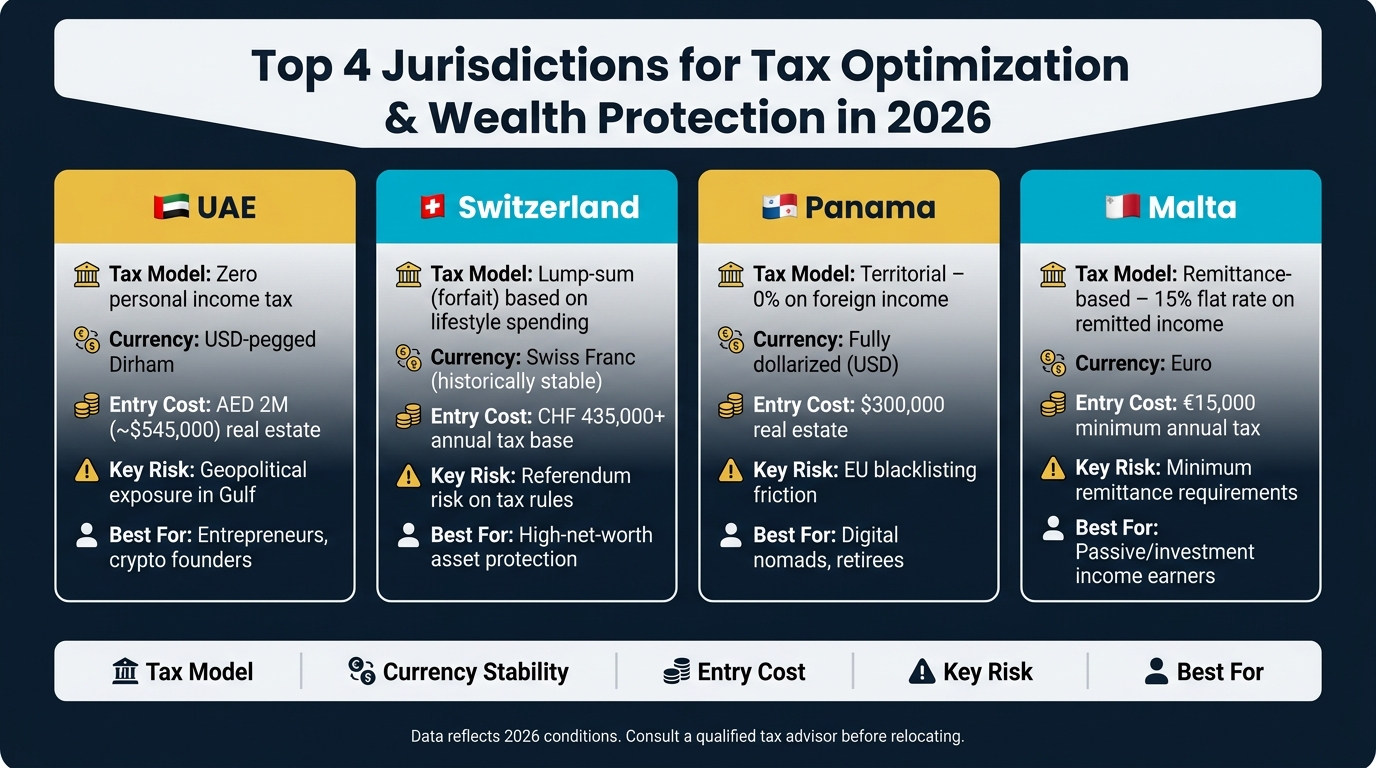
Here’s how four popular jurisdictions stack up across key factors:
| Factor | UAE | Switzerland | Panama | Malta |
|---|---|---|---|---|
| Tax Model | Zero personal income tax | Lump-sum (forfait) | Territorial (0% on foreign income) | Remittance-based (15% flat) |
| Currency | USD-pegged Dirham | Swiss Franc | Fully dollarized (USD) | Euro |
| Entry Cost | AED 2M (~$545,000) real estate | CHF 435,000+ annual tax base | $300,000 real estate | €15,000 minimum annual tax |
| Key Risk | Geopolitical exposure in Gulf | Referendum risk on tax rules | EU blacklisting friction | Minimum remittance requirements |
No jurisdiction is flawless. The key is to find one with trade-offs that align with your financial goals and risk tolerance. This careful evaluation of jurisdictions sets the stage for creating your internationalization strategy in Step 3.
Step 3: Build Your Internationalization Plan
Now that you’ve assessed your jurisdictions, it’s time to turn that research into a concrete internationalization strategy. This step involves deciding where to live, how to structure your business and assets, and where to manage your finances.
Choose Your Residency Approach
In 2026, the layered portfolio model is the go-to strategy for residency planning. Instead of betting on just one country, you create a mix of complementary residencies and citizenships, each serving a specific purpose.
Here’s how to layer your portfolio:
- Fiscal residence: Establish your tax base in countries like the UAE, Panama, or Paraguay.
- Supplementary residencies: These improve your lifestyle or mobility, such as through EU Golden Visa programs.
- Backup citizenship: An irrevocable safety net, often obtained via Caribbean Citizenship by Investment programs.
"A single passport is a single point of failure." – WorldPath AI
The right primary residency depends on your situation. Entrepreneurs and crypto founders often lean toward the UAE or Cyprus, which is updating its non-dom rules in 2026 with an 8% corporate tax rate. Digital nomads may prefer Paraguay, where residency only requires one visit every three years and local income is the sole taxable source. Retirees frequently look to Panama or Portugal due to their lower living costs. For example, an American retired couple’s average monthly expenses of $4,300 to $5,800 stretch much further in Central America or Southern Europe.
Once you’ve chosen your fiscal residence, secure a Tax Residency Certificate as soon as possible. This document is crucial for proving to your home country that you’ve officially moved.
This multi-layered residency strategy sets the groundwork for a resilient financial and personal structure.
Structure Your Business and Assets
Your residency plan should work hand-in-hand with a robust business structure. This is where flag theory comes into play. The idea is to diversify key aspects of your life – passport, tax residency, business operations, asset holdings, and physical presence – across different jurisdictions.
For instance, a German SaaS founder shifted to a Dutch holding company 18 months before moving to the UAE. By investing $200,000 in UAE real estate to obtain a Golden Visa and securing a tax residency certificate within seven months, he avoided Germany’s exit tax (Wegzugsbesteuerung) on unrealized capital gains. This restructuring saved him about $600,000 annually starting in his second year.
For asset protection, jurisdictions like the Cayman Islands and The Bahamas are ideal for setting up trusts or foundations. This separation ensures that no single legal system has control over your entire financial portfolio.
"Wealth expatriation is not a flight. It is a project – with a budget, a timeline, dependencies, regulators, and accountants." – TaxFreeResidency.com
Spread Your Banking and Investments Across Borders
With your residency and business framework in place, make sure your banking and investments are equally diversified. A multi-jurisdictional lifestyle requires a strategic approach to banking. Consider a three-layer banking system:
| Banking Layer | Purpose | Examples |
|---|---|---|
| FinTech Layer | Daily operations, currency exchange, mid-market rates | Wise, Revolut, Mercury (for US LLCs) |
| Wealth Storage | Capital protection and private banking | Singapore (OCBC, DBS), Switzerland |
| Local Layer | Managing property expenses and local needs | Banks in your residency country (e.g., Panama) |
For U.S. citizens, banking abroad comes with extra challenges. FATCA regulations often make foreign banks hesitant to accept American clients. If you do hold foreign accounts, you’ll need to file an FBAR annually and report them under FATCA, regardless of where you live.
The Foreign Earned Income Exclusion (FEIE) for 2026 allows U.S. citizens living overseas to exclude up to $132,900 of earned income from federal taxes, provided they meet the physical presence test.
It’s essential that your declared fiscal residence aligns with your actual travel patterns. The Common Reporting Standard (CRS) automatically shares financial account details between participating countries, so discrepancies between where you claim to live and where you spend your time could raise red flags. To avoid issues, use a digital day-count tracker instead of relying on manual spreadsheets.
Managing a multi-jurisdictional portfolio professionally can cost between $15,000 and $50,000 annually. However, for many, this expense is a small price to pay compared to the savings and protection that come from proper structuring.
Step 4: Execute, Monitor, and Adjust Your Plan
Now that your internationalization plan is set, it’s time to put it into action, keep a close eye on its progress, and make adjustments as needed.
Build a Step-by-Step Action Plan
Internationalization isn’t a one-and-done decision – it’s a process with clear deadlines. Relocating from a high-tax jurisdiction can take anywhere from 6 to 18 months, depending on the complexity of your assets.
To navigate this, follow four key stages: Diagnose, Model, Exit, and Land. Skipping any of these steps could lead to avoidable complications.
"Tax planning comes BEFORE country selection." – taxfreeresidency.com
Keep detailed records to protect yourself against retroactive residency claims from your original country. This includes dated documents like deregistration certificates, lease cancellations, utility shut-offs, and even flight boarding passes.
Before making a permanent move, consider a three-month trial stay in your target country. Renting a furnished apartment during this period can help you uncover any challenges with local bureaucracy, banking, or cultural differences – giving you a clearer picture of what to expect.
Stay Compliant and Work With the Right Experts
One of the biggest risks to compliance comes from miscommunication between your team of advisors. Tax advisors, immigration lawyers, and wealth managers often work in silos, assuming others are handling critical details. To avoid costly mistakes, make sure these experts communicate directly and regularly.
If you’re a U.S. citizen, remember to file an FBAR for any foreign accounts exceeding $10,000. You can also exclude up to $132,900 of earned income under the Foreign Earned Income Exclusion (FEIE), provided you meet the physical presence test.
Under the Common Reporting Standard (CRS), financial institutions automatically share account data with the tax authority of your declared residency. To stay on top of this, use a digital app to track your travel and ensure your movements align with your stated residency claims.
Once your compliance framework is in place, make it a habit to review your plan regularly and adjust as needed.
Review and Adjust as Things Change
Laws around taxes and residency shift frequently. To stay ahead, monitor regulatory updates every quarter and conduct a full strategic review every five years – or sooner if you experience major life events like a business sale, marriage, divorce, or significant asset acquisition.
"The clients we see succeed treat their move the way a CFO would treat a corporate redomicile: in distinct stages, with kill-criteria at each stage and a paper trail thick enough to survive an audit five years later." – taxfreeresidency.com
Managing a multi-residency portfolio professionally can cost between $15,000 and $50,000 annually. For those with substantial assets, this is a small price to pay compared to the risks of non-compliance. If you’re unsure where to begin, consider a private consultation or a Global Escape Hatch action plan to craft a tailored approach for your situation. Regular reviews and timely adjustments will ensure your global strategy remains effective and secure.
Conclusion: Putting Together a Long-Term Global Strategy
"Going where you’re treated best" isn’t a one-and-done choice – it’s a continuous process that adapts as your life, finances, and the world evolve. This guide lays out a roadmap, from setting clear goals and assessing different jurisdictions to crafting and fine-tuning your plan. But more than just a plan, this approach requires a mindset shift.
Think of your residencies and citizenships as parts of a diversified portfolio. Having a primary residence, a secondary option for tax or lifestyle benefits, and a backup citizenship can protect you from relying too heavily on one place. As Dominic Volek, Group Head of Private Clients at Henley & Partners, aptly states:
"Every decision to acquire an additional residence or citizenship reflects a recognition that reliance on a single jurisdiction is no longer sufficient – and is naive."
By layering these options, you reduce vulnerabilities and gain flexibility to adapt when laws or circumstances change.
Timing is also crucial, often more than people realize. For instance, Caribbean citizenship-by-investment programs are set to start at $200,000+ in 2026, a noticeable increase from just a few years ago. Similarly, European Golden Visa programs in countries like Portugal and Spain have either been heavily restricted or phased out altogether. Waiting too long can mean fewer opportunities or higher costs. Acting sooner rather than later often leads to better outcomes.
Tax policies are shifting faster than many expected. The UK ended its non-dom regime in April 2025, Portugal closed its NHR program, and Cyprus overhauled its 60-day residency rule at the start of 2026. These changes aren’t isolated – they signal a broader global movement toward stricter regulations and higher barriers. To navigate these shifts, working with skilled professionals who understand immigration, tax, and wealth management is critical.
The goal isn’t about finding a flawless country; it’s about building a robust and adaptable framework tailored to your needs. This strategic diversification not only protects your assets but also ensures your personal and financial freedom in an ever-changing world.
FAQs
How do I avoid accidentally staying a tax resident of my home country after I move?
To stop being considered a tax resident, it’s not enough to simply leave the country – you need to take formal steps to cut ties. Pay attention to three key areas: physical presence, administrative ties, and center of vital interests.
- Physical presence: Ensure you spend fewer than the threshold number of days in the country (commonly 183 days, though this can vary).
- Administrative ties: Deregister from civil records, cancel any domestic memberships, and update official documents like your ID or driver’s license.
- Center of vital interests: This involves relocating key aspects of your life, such as moving your family, changing your primary banking relationships, and selling or vacating your main residence.
These steps are essential to demonstrate that your ties to the country have been severed. Always consult a tax professional to confirm your departure is handled correctly.
What documents do I need to prove my new tax residency to banks and tax authorities?
To establish your new tax residency, obtaining a Tax Residency Certificate (TRC) from your new country’s tax authority is essential. You’ll also need to provide supporting documents such as a valid passport, proof of address (like utility bills or a rental agreement), and your local tax ID number.
To further demonstrate your integration, keep detailed records, including local bank statements, employment contracts, and evidence of your physical presence, such as flight stubs. These documents can help confirm your residency status.
How do I choose the right mix of residency, banking, and asset jurisdictions?
To manage risks associated with political, fiscal, or legal instability, it’s wise to spread your life across multiple jurisdictions. This means separating where you live, bank, hold assets, and maintain citizenship.
- Residency: Opt for a location that aligns with your income situation and U.S. tax obligations while offering a favorable tax environment.
- Assets: Secure your wealth by placing it in stable jurisdictions and using legal structures designed to protect your holdings.
- Citizenship: A second citizenship can offer added mobility and security. Just make sure to comply with all U.S. reporting requirements.
This approach creates a safety net, giving you more flexibility and resilience in uncertain times.
