
Flag theory is a strategy where individuals spread key aspects of their lives – like citizenship, tax residency, business, and banking – across multiple countries. The goal? To reduce reliance on any single government and protect personal and financial freedom. By 2026, this approach has expanded to include eight "flags", addressing modern needs like digital assets and infrastructure.
Here’s why it matters now: Governments use AI and global systems like CRS, FATCA, and CARF to monitor financial activity. Political instability, rising taxes, and stricter controls push people to diversify their legal and financial setups. Americans are leading this shift, with 50% of new investment migration clients focusing on tax flexibility and asset protection – not just visa-free travel.
Modern flag theory emphasizes transparency and compliance, unlike its secrecy-driven past. It’s about building legitimate, multi-jurisdictional setups to safeguard your assets and future. Key steps include securing a second citizenship, establishing tax residency in favorable jurisdictions, diversifying banking, and protecting assets through trusts or digital tools. Whether you’re a U.S. citizen navigating global tax rules or a non-U.S. citizen seeking zero-tax options, flag theory offers a structured way to stay secure in an interconnected world.
The Core Flags in Modern Flag Theory
Modern Flag Theory is all about strategically placing key aspects of your life in jurisdictions that offer the most advantages. By doing this, you reduce the risk of any single government having full control over your affairs. Below, we break down how each flag – citizenship, residency, business, banking, and lifestyle – can help protect and grow your global interests.
Citizenship and Passport Flag
Your passport is more than just a travel tool – it’s a gateway to opportunities. Dominic Volek, Group Head of Private Clients at Henley & Partners, explains:
"Residence and citizenship rights are being integrated into the core architecture of wealth structuring, alongside trusts, holding companies, and asset allocation strategies."
In 2026, having a second citizenship can mean much more than visa-free travel. Take an EU passport, for example – it grants not only travel perks but also the legal right to live, work, and do business across 27 member states. That’s a level of security far beyond a simple visa waiver.
The three main ways to obtain second citizenship are:
- By descent: Often free if you qualify through ancestry.
- Naturalization: Requires living in a country for 5+ years.
- Citizenship by investment (CBI): Programs like Dominica’s start at $200,000 with processing times of 2 to 4 months. Malta’s program, on the other hand, costs over €1,000,000 and provides full EU rights within 12 to 36 months.
As WorldPath AI puts it, "A single passport is a single point of failure."
Residency and Tax Residency Flag
Residency plays a key role in Flag Theory, but it’s important to separate immigration residency (your legal right to live in a country) from tax residency (where you owe taxes). Many countries apply the 183-day rule to determine tax residency, though some use a "center of vital interests" test.
For those with foreign-source income, establishing tax residency in a territorial tax jurisdiction can help avoid taxation on global earnings. Countries like Paraguay, Panama, and Georgia are popular choices. For instance, Paraguay requires roughly 90 days of physical presence and a bank deposit, with setup costs starting around $5,000.
Banks now demand a formal Tax Residency Certificate as part of anti-money laundering compliance. Without it, accounts can be frozen. To make your residency claim audit-proof, you’ll need genuine economic ties, such as a local lease, utility bills, and a valid ID.
Business Base and Corporate Structures Flag
Where you base your business can greatly impact how much revenue you keep. Timing is everything – establishing tax residency first can help you avoid Controlled Foreign Corporation (CFC) rules that might otherwise tax offshore profits in your home country.
Non-US citizens often use single-member LLCs in states like Wyoming or Delaware. These structures, when paired with territorial tax residency, allow access to top-tier US banking without triggering federal tax. The IRS treats such LLCs as "disregarded entities", meaning that as long as the owner has no US-source income, no federal tax applies.
However, if you spend over half your working time in a country where you hold a digital nomad visa, you risk creating a Permanent Establishment (PE), which could make your company’s profits taxable there.
Asset Protection and Banking Flag
This flag is all about resilience. By spreading assets across multiple jurisdictions, you protect yourself from localized banking issues or government-imposed capital controls. If one country freezes your accounts, your financial stability remains intact.
A well-rounded banking setup might include:
- A primary account in your tax residency country.
- A wealth management account in stable hubs like Switzerland or Singapore.
- Local accounts tied to specific properties or businesses.
To further shield assets, legal tools like offshore trusts (in Nevis or the Cayman Islands) or Private Interest Foundations (in Panama) can separate personal liability from asset ownership.
| Asset Class | Recommended Jurisdictions | Primary Benefit |
|---|---|---|
| Private Banking | Switzerland, Singapore, Luxembourg | Stability and strong regulations |
| Corporate Entities | Wyoming (USA), UAE, BVI, Estonia | Tax efficiency and fintech opportunities |
| Digital Assets | UAE, El Salvador, Portugal | Legal clarity and favorable tax rules |
| Asset Protection | Nevis, Cook Islands, Cayman Islands | Strong trust and creditor protection laws |
| Real Estate | Dubai, Thailand, Dominican Republic | Residency links and portfolio diversification |
Managing a multi-jurisdictional portfolio can cost $15,000 to $50,000 annually, but the benefits of diversification often outweigh the expense.
Lifestyle and Playgrounds Flag
This flag focuses on where you want to live daily, leveraging geo-arbitrage – earning in a strong currency while enjoying a lower cost of living and high quality of life.
For example, a remote worker earning $300,000 annually could save about $141,000 in taxes by moving from Germany (47% income tax) to the UAE (0% income tax). Additionally, healthcare in countries like Thailand or Mexico can cost 70% to 85% less than in the US.
Top lifestyle hubs in 2026 include:
- Portugal: European stability with attractive tax rules.
- Thailand: Affordable living with great infrastructure.
- UAE: A business-friendly environment with zero income tax.
Ultimately, the lifestyle flag is deeply personal. Factors like safety, climate, language, schooling, and healthcare quality are all key when choosing the right place to call home.
sbb-itb-39d39a6
Modern Trends and Tools Shaping Flag Theory in 2026
Flag Theory has evolved significantly in response to stricter global regulations, the rise of remote work, and advancements in financial technology.
Global Transparency and Compliance
The days of financial secrecy are over. As Ipanema Partners puts it:
"The era of hiding wealth in numbered Swiss accounts or anonymous offshore trusts is over, permanently."
More than 100 jurisdictions now share financial account data automatically through the Common Reporting Standard (CRS). Meanwhile, frameworks like FATCA and CARF have introduced new layers of monitoring, requiring individuals to maintain legally compliant, multi-jurisdictional setups. This has made the residency flag a cornerstone of modern Flag Theory. Since CRS data flows to your declared tax residence, choosing a territorial tax jurisdiction – like Panama or Paraguay – can ensure foreign income is reported there without triggering taxes. However, without a valid Tax Residency Certificate, individuals risk frozen accounts, as tax authorities increasingly use AI to cross-check CRS data, geolocation, and transaction patterns.
Corporate structures are also under the microscope. Shell companies without real operations are being challenged under economic substance laws. A pivotal case, Otay Project LP v. Commissioner, saw the US Tax Court disallow a $714 million deduction in February 2026, reinforcing that technical compliance alone won’t suffice. This shift in regulation aligns with broader changes in work culture.
Digital Nomadism and Remote Work
Remote work has opened new doors for Flag Theory enthusiasts. The best digital nomad visas offer remote workers a legal pathway to establish residency in foreign jurisdictions, allowing them to secure Tax Residency Certificates and potentially benefit from territorial tax systems.
At the same time, developments in digital assets are reshaping how people approach global financial strategies.
Digital Assets and Blockchain
Cryptocurrency has introduced what many now call the "sixth flag" – a digital asset flag. These assets operate outside the control of any single government, creating a jurisdiction-free class of wealth.
Effectively managing this flag involves choices about where to store private keys, deploy smart contracts, and comply with regulatory frameworks. Self-custodied crypto can act as a safeguard against government interference. While authorities can track on-chain activity, they cannot freeze assets without access to private keys.
The regulatory environment for digital assets is evolving swiftly. CARF began collecting crypto transaction data in January 2026, with the first automatic exchanges planned for 2027 across 75 jurisdictions. Countries like the UAE, El Salvador, and Portugal currently offer clear legal frameworks and favorable tax policies for digital asset holders.
These changes highlight how Flag Theory continues to adapt to the modern financial landscape.
Banking and Fintech Innovations
Gone are the days when managing money across borders required vast wealth and exclusive banking relationships. Today, platforms like Wise Business allow users to hold multiple currencies, access EU IBANs, and make cross-border payments with ease.
Non-US citizens have also found solutions in Wyoming and Delaware single-member LLCs. These entities, treated as disregarded by the IRS, provide access to US banking and fintech tools without triggering federal tax obligations. Remote account opening is now standard in key financial hubs like Singapore, Switzerland, the UAE, and the US, making international banking more accessible than ever.
As Ahmad Abbas noted in IMI Daily:
"The compliance infrastructure that killed old flag theory legitimized the new version."
AI-powered compliance tools are now integral for individuals navigating multi-flag setups. These platforms can track global net worth and estimate expatriate tax responsibilities in real time, helping users stay ahead of evolving regulations.
How US and Non-US Citizens Can Apply Flag Theory
With modern compliance tools and digital systems, both US and non-US citizens now have more tailored ways to implement flag theory effectively.
Flag Theory for US Citizens
The United States is one of only two countries that taxes its citizens based on citizenship rather than residency. As Max Donovan explains:
"You can move to the moon, marry a foreign national, and never set foot on U.S. soil again, but as U.S. citizens, you remain subject to IRS claims on your global income."
Because of this, many US expats rely on two key tools to manage their tax obligations: the Foreign Earned Income Exclusion (FEIE) and the Foreign Tax Credit (FTC). For 2026, the FEIE allows you to exclude up to $132,900 of foreign-earned income from US taxes. The FTC, on the other hand, provides a dollar-for-dollar credit for taxes already paid to a foreign government. Which option works best depends on your host country’s tax rate.
- If you’re in a low-tax jurisdiction (0–15%), the FEIE tends to be the better choice.
- In high-tax countries like Germany or Denmark, the FTC usually saves more money.
| Strategy | Best For | Income Cap | Applies to all income? |
|---|---|---|---|
| FEIE | Low-tax countries (0–15%) | $132,900 | No (earned income only) |
| FTC | High-tax countries (above 22%) | No cap | Yes |
US expats should also consider their home state’s tax policies before moving abroad. States like California and New York are aggressive about maintaining tax residency, so establishing domicile in a no-income-tax state (like Florida or Texas) before leaving the US can avoid future complications. Timing your departure to meet the 330-day Physical Presence Test is another crucial step for FEIE eligibility.
For self-employed US citizens earning over $80,000, setting up an S-Corp can reduce the 15.3% self-employment tax. While compliance costs range between $3,000 and $5,000 annually, this strategy can pair with FEIE or FTC to minimize overall tax liability. However, those considering renouncing US citizenship should be aware of the Exit Tax under IRC Section 877A. This applies to "covered expatriates" with a net worth over $2 million or a 5-year average annual income tax above $201,000, with capital gains exceeding $886,000 taxed at the time of renunciation.
While these strategies address the unique challenges of US citizens, non-US citizens enjoy more flexibility, as detailed below.
Flag Theory for Non-US Citizens
Non-US citizens can often eliminate taxes on foreign-sourced income by moving to a territorial or zero-tax jurisdiction, such as Panama, Paraguay, or the UAE. For example, a remote software founder earning $300,000 annually could save around $141,000 per year by relocating from Germany (47% tax rate) to the UAE (0%).
Another common approach is using a US single-member LLC (registered in states like Wyoming or Delaware) to access US banking and fintech tools. This setup avoids US federal taxes as long as the owner has no physical presence in the US and maintains tax residency in a territorial jurisdiction.
The key to success lies in sequencing your flags properly. First, secure genuine tax residency in a favorable jurisdiction. Next, establish banking and then incorporate your business. With today’s AI-driven Common Reporting Standard (CRS) monitoring, proving real economic substance – such as having a local lease, utility bills, and a Tax Residency Certificate – is essential to ensure your structure holds up under scrutiny.
No matter your citizenship, having the right support network is critical to staying compliant and protecting your assets.
Building a Strong Support Network
The success of flag theory depends on expert guidance. Laws and regulations vary across jurisdictions and change frequently, so even a minor mistake can unravel an entire structure. For US citizens, working with a CPA who specializes in expat taxation is vital. General accountants often lack knowledge of complex areas like totalization agreements, Form 8854, or PFIC rules. Annual filing services typically cost between $500 and $2,000, which is a small price compared to the fines for errors.
Non-US citizens setting up multi-jurisdictional structures need a team that includes an international tax advisor, a corporate attorney familiar with economic substance requirements, and an asset protection specialist for trusts or foundations. As economist Enrique Guillén puts it:
"In today’s regulatory environment… protecting your wealth requires structure. Not secrecy. Not shortcuts. Structure."
The right advisors don’t just help set up your structure – they ensure it stays compliant as regulations evolve. In 2026, these changes are happening faster than ever before, making professional support more important than ever.
Key Takeaways and Next Steps
Balancing Freedom, Costs, and Complexity
Adding more flags to your strategy doesn’t always translate to greater freedom. In fact, a poorly planned five-flag setup can end up costing more than it saves. For high-net-worth individuals, establishing a comprehensive plan typically costs between $50,000 and $250,000, with ongoing compliance expenses averaging $40,000 annually. Digital entrepreneurs can often start with a simpler setup – residency and business registration – at a cost of $15,000 to $50,000.
The key is to address your most pressing issue first. As David Stancel aptly puts it:
"One jurisdiction change, executed correctly and personally understood, beats a six-flag structure you can’t explain to a tax inspector."
For most people, the first and most critical step is securing the right tax residency. This approach ensures a logical sequence for implementing additional strategies without unnecessary costs or complications.
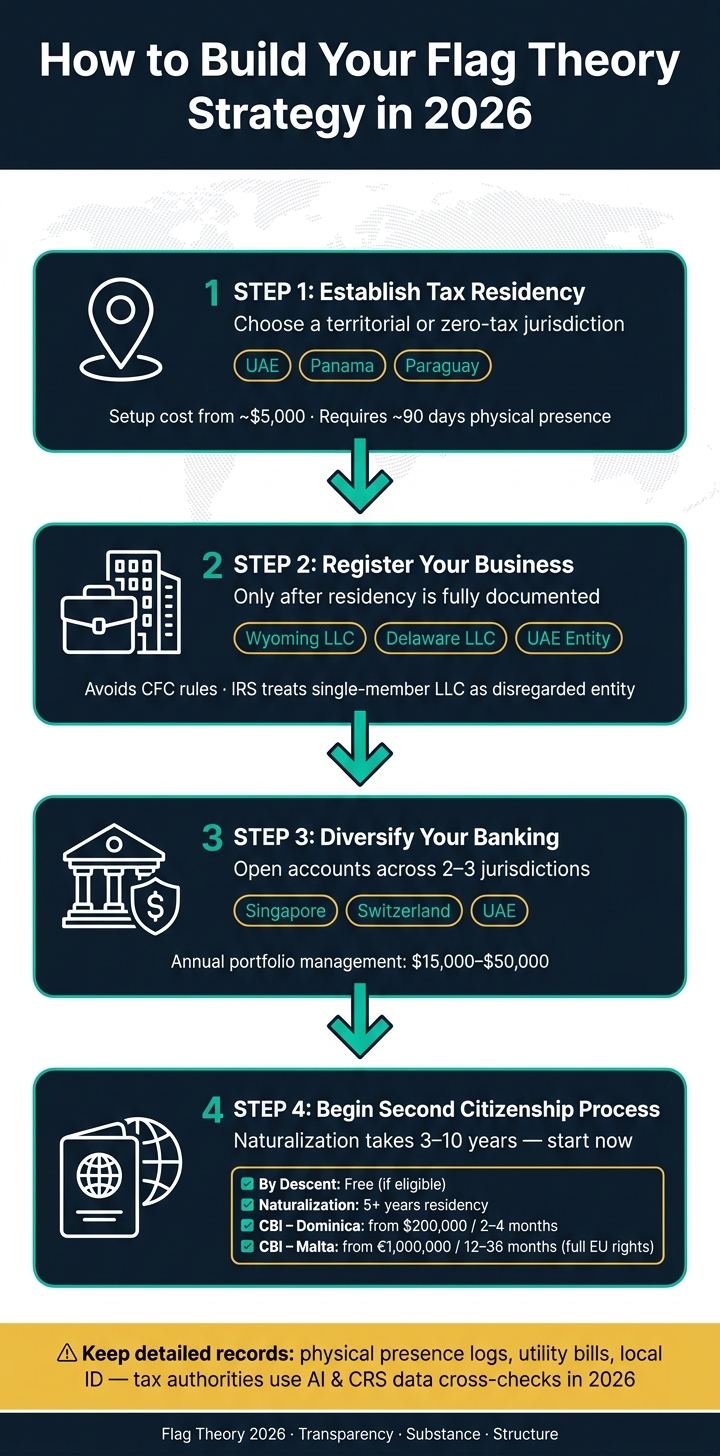
Steps to Start Your Flag Theory Plan
The order in which you implement your flag theory strategy is crucial. For example, establishing tax residency before setting up an offshore business helps you avoid complications with Controlled Foreign Corporation (CFC) rules, which can negate potential tax benefits if handled incorrectly.
Here’s a step-by-step approach to building your plan:
- Establish tax residency: Choose a jurisdiction with territorial or zero-tax policies, such as the UAE, Panama, or Paraguay – popular choices in 2026.
- Register your business: Do this only after your residency is fully established and documented.
- Diversify your banking: Open accounts in at least two or three jurisdictions, such as Singapore, Switzerland, and the UAE, to spread your financial footprint.
- Start the citizenship process early: Naturalization can take anywhere from 3 to 10 years, so it’s wise to begin sooner rather than later.
Throughout the process, keep detailed records of your physical presence, utility bills, and local identification documents. By 2026, tax authorities are leveraging machine learning to cross-check CRS data, geolocation, and transaction patterns, making a solid paper trail essential for protecting your position.
Where Flag Theory Is Headed
The trend in flag theory is shifting from a focus on individual countries to regional platforms. For example, a single EU residency or citizenship grants access to 27 member states, while GCC residency connects you to six Gulf nations. This "platform approach" simplifies the process while offering broader access.
Another major development is the Crypto-Asset Reporting Framework (CARF), which began mandatory data collection on January 1, 2026. The first automatic exchanges between governments are set for 2027, with over 75 jurisdictions already committed. If you hold digital assets, it’s critical to align with these emerging regulations well in advance.
Despite these changes, the core principle of flag theory remains the same. As Ahmad Abbas of IMI explains:
"The goal isn’t accumulating passports or minimizing tax bills but to ensure you’re never trapped."
The focus now is on transparency, substance, and careful planning, rather than secrecy or shortcuts.
FAQs
Is flag theory legal in 2026?
Yes, flag theory is legal when it’s set up correctly and adheres to both domestic and international laws. In 2026, the focus remains on lawful jurisdictional diversification and maintaining clear, transparent legal statuses across multiple countries. However, failing to comply with global reporting standards like CRS (Common Reporting Standard), FATCA (Foreign Account Tax Compliance Act), or CARF (Crypto-Asset Reporting Framework) can result in severe legal and financial penalties.
What’s the first flag I should set up?
For many founders and remote workers, the smartest move is to begin with your tax residency flag. Setting up tax residency in a jurisdiction with low or zero taxes can significantly impact how your global income is taxed. This step lays the groundwork for a more organized approach, allowing you to add other elements like business incorporation or asset management as you go.
How do I prove tax residency to banks?
To show tax residency to banks, you’ll need to provide documents that demonstrate a clear connection to a specific location. Start with essentials like your tax identification number, recent tax filings, a lease agreement or property deed, and utility bills in your name.
You can strengthen your case with additional proof, such as employment contracts, local insurance policies, or even records of membership in local clubs or organizations. These documents help establish your ties to the area and confirm your residency status.
