
Managing wealth across borders requires careful planning. Here’s the key takeaway: multi-currency accounts can help you protect your finances from currency risks, reduce transaction costs, and align your assets with your future spending needs.
Why Multi-Currency Strategies Matter
- Risk Reduction: Diversify currencies to safeguard against devaluation and economic instability.
- Cost Savings: Offshore accounts offer better foreign exchange rates (0.5%-2%) compared to domestic banks (3%-5%).
- Flexibility: Hold funds in multiple currencies to avoid forced conversions and unfavorable exchange rates.
Types of Multi-Currency Accounts
- Offshore Private Bank Accounts: Ideal for high-net-worth individuals; offers asset protection and tailored services but requires a $250,000+ deposit.
- Digital/Fintech Accounts: Affordable options for freelancers and small businesses but lack deposit insurance.
- Multi-Currency Business Accounts: Best for international businesses managing cross-border transactions.
Key Strategies
- Currency Diversification: Match your currency holdings to your spending needs (e.g., GBP for UK education, EUR for EU retirement).
- Jurisdictional Diversification: Spread accounts across stable regions like Switzerland or Singapore to reduce risks.
- Compliance: U.S. account holders must file FBAR (>FBAR (>$10,000) and FATCA forms0,000) and FATCA requirements to avoid penalties.
Quick Comparison Table
| Account Type | Best For | Minimum Deposit |
|---|---|---|
| Offshore Private Bank | HNWIs, family offices | $250,000–$1M+ |
| Digital/Fintech Accounts | Freelancers, small businesses | $0–$1,000 |
| Multi-Currency Business | International corporations | Varies by bank |
For long-term financial stability, combine these strategies with proper compliance and documentation practices. This approach ensures your wealth is protected and optimized for global use.
Types of Multi-Currency Accounts
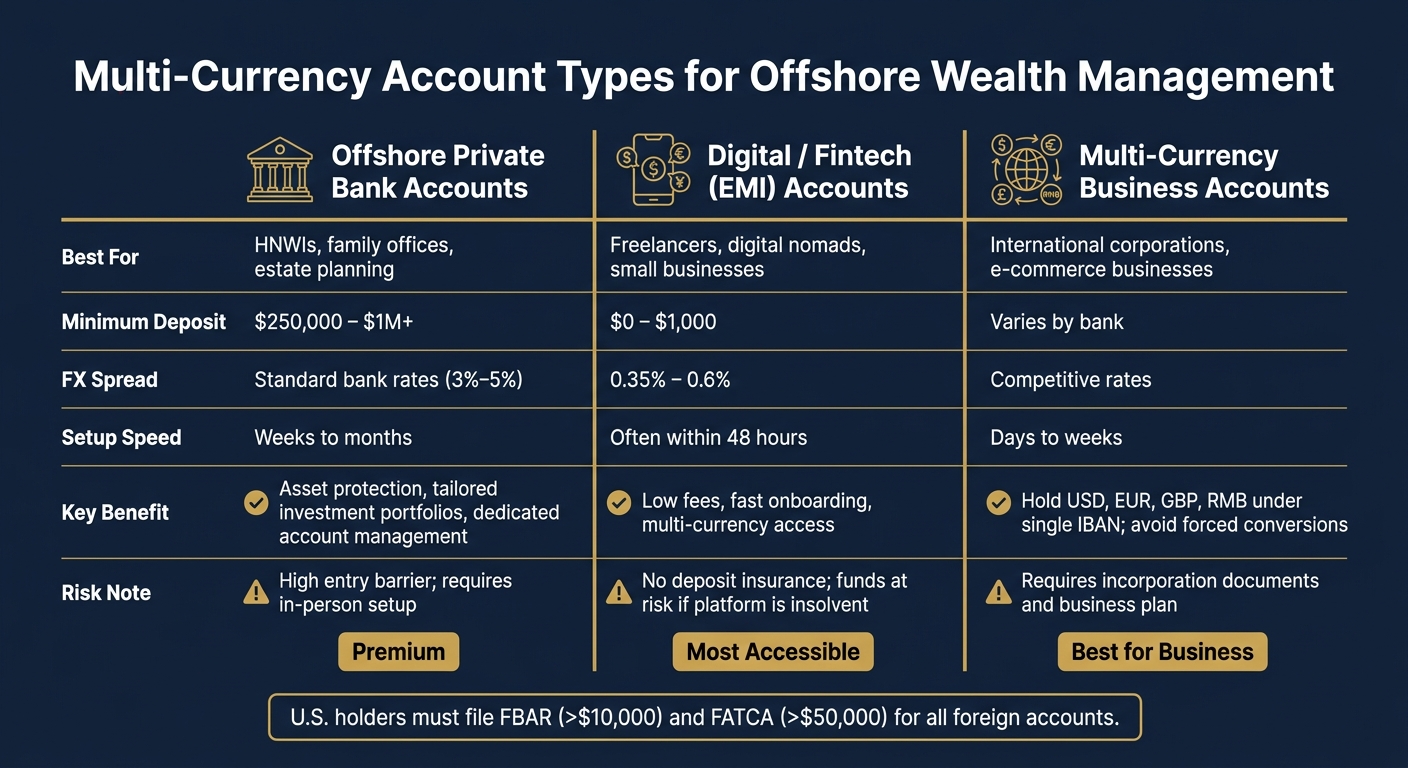
Selecting the right multi-currency account is a key step in structuring offshore wealth effectively. The choice depends on factors like your financial situation, available capital, and specific goals – whether you’re safeguarding wealth, managing cross-border expenses, or handling international business transactions.
Offshore Private Bank Accounts
Offshore private banking offers more than just a secure place to store money. These accounts come with exclusive perks, such as dedicated account management, custom investment portfolios, lending options, and personalized financial advice. Institutions like Julius Baer in Switzerland or respected private banks in Singapore are popular choices for these services.
Opening offshore bank accounts online typically requires a substantial deposit, ranging from $250,000 for entry-level services to $10 million for ultra-high-net-worth clients. Additional fees may apply for premium features like numbered accounts.
These accounts provide access to international investment opportunities that are often unavailable domestically. They also offer strong asset protection, particularly in financially stable jurisdictions like Switzerland, Singapore, and the Cayman Islands. This combination of tailored services and legal security makes them a cornerstone for building a diversified offshore wealth strategy.
International Digital and Fintech Accounts
Digital and fintech platforms cater to freelancers, digital nomads, and small businesses, offering an affordable way to access multi-currency banking. These accounts are managed by Electronic Money Institutions (EMIs), which provide many banking features without being traditional banks. The onboarding process is fully digital, using eKYC (electronic Know Your Customer), and fees are relatively low, with FX spreads typically ranging from 0.35% to 0.6%.
However, funds held in EMIs are not covered by national deposit insurance schemes. This means that in the event of insolvency, account holders become creditors. Because of this, fintech accounts are best suited for operational purposes, such as handling daily transactions, rather than storing significant reserves.
"The institutions that promise ‘no questions asked’ banking in 2026 are either lying, unlicensed, or about to be shut down." – Project Black Ledger
Before transferring substantial funds, ensure the platform is licensed by a recognized financial authority. For larger enterprises, though, a more specialized account structure may be required.
Multi-Currency Business Accounts
For international businesses, managing multiple currencies is a necessity. These companies often receive payments in one currency, pay suppliers in another, and handle payroll in several others. Multi-currency business accounts simplify this process by allowing businesses to hold, receive, and pay in various currencies – such as USD, EUR, GBP, and RMB – under a single IBAN. This eliminates the need for separate accounts in different currencies.
One major advantage is the ability to avoid forced currency conversions. Instead of automatically converting incoming funds to a base currency at the bank’s rate, businesses can hold balances in foreign currencies and convert them strategically when rates are favorable, significantly cutting down FX costs. To open such an account, companies usually need to provide documentation like certificates of incorporation, articles of association, and a detailed business plan outlining key cash flows and major clients.
| Account Type | Best For | Typical Minimum Deposit |
|---|---|---|
| Offshore Private Bank | HNWIs, family offices, estate planning | $250,000–$1M+ |
| Digital / Fintech (EMI) | Freelancers, nomads, small businesses | $0–$1,000 |
| Multi-Currency Business | International corporations, e-commerce | Varies by bank |
sbb-itb-39d39a6
Key Strategies for Using Multi-Currency Accounts Effectively
Currency Diversification and Allocation
When it comes to managing multi-currency accounts, aligning your currency holdings with your actual spending needs is key. This isn’t about chasing optimal exchange rates but ensuring your money is where you need it, when you need it.
A good way to approach this is by dividing your funds into three distinct timeframes:
- Short-term (0–5 years): Keep this in the currency you use for daily expenses.
- Medium-term (5–20 years): If you have specific plans, such as buying property in Europe, you might hold funds in EUR. For those prioritizing capital preservation, CHF could be a solid choice.
- Long-term (20+ years): Spread these assets across stable reserve currencies to minimize risks over time.
"Currency planning is about alignment, not optimisation." – Skybound Wealth USA
To test your diversification, imagine your largest currency holding suddenly loses 20% of its value. If that scenario would cause significant financial stress, your holdings are likely too concentrated. For example, some American family offices allocate 10% to 30% of their liquid assets into CHF-linked investments to reduce exposure to such risks.
This kind of planning also helps manage risks tied to specific jurisdictions and explains why offshore asset protection is a core component of wealth management.
Reducing Jurisdictional and Banking Risks
Relying on a single jurisdiction for offshore assets can leave you exposed to unexpected issues like bank freezes, compliance reviews, or account closures – often triggered by changes in residency. These challenges tend to arise when you least expect them.
The solution? Spread your accounts across two or three jurisdictions. For example:
- Singapore is a go-to hub for Asian currencies like RMB, JPY, and HKD.
- Switzerland is a classic choice for high-net-worth individuals, offering stability and access to safe-haven currencies like CHF.
"Having accounts in two or three jurisdictions provides a safety net." – David Brougham, Founder, FlashFi
Diversification doesn’t just stop at geography. Use a mix of financial institutions, such as a traditional offshore bank and a regulated fintech platform. Each offers unique advantages:
- Traditional banks: Provide deposit insurance and stronger regulatory protections.
- Fintech platforms: Offer quicker onboarding and lower foreign exchange costs, typically between 0.4% and 0.7%, compared to the 3%–5% charged by conventional banks.
Keep in mind, inactive accounts can attract compliance reviews, so maintain activity with small recurring transactions.
Structuring Accounts Around Financial Goals
How you organize your accounts can also make a big difference. A three-segment approach works well for those managing international finances:
- Income Hub: A primary account (often in USD, EUR, or GBP) to receive payments and consolidate inflows.
- Local Spending: An account in your country of residence for daily expenses and bills, helping you avoid foreign transaction fees.
- Reserves and Investments: Long-term holdings placed in stable jurisdictions like Singapore or Switzerland, or managed through offshore bonds in places such as the Isle of Man or Luxembourg.
Avoid automatic currency conversions when funds arrive. Instead, wait for favorable exchange rates or convert only when necessary – banks often apply default rates that can lead to unnecessary losses.
For predictable future expenses, consider using forward contracts to lock in favorable rates.
This structured approach not only simplifies account management but also aligns seamlessly with broader offshore wealth strategies.
Choosing the Right Banking Jurisdictions
Picking the right banking jurisdiction plays a major role in building effective multi-currency strategies for managing offshore wealth.
Key Factors to Consider
The jurisdiction you choose should align with your goals, whether you’re focusing on cross-border trade, safeguarding wealth for the long term, or tapping into specific regional markets.
Two critical considerations are political and economic stability and the jurisdiction’s regulatory reputation. Instability can lead to frozen or devalued assets, while jurisdictions adhering to FATF anti-money laundering standards and OECD tax transparency guidelines are less likely to cause payment delays or attract excessive scrutiny from counterparties. Additionally, ensure the jurisdiction provides access to relevant currencies and payment systems like ACH or SEPA, which can help minimize intermediary fees.
"The wrong jurisdiction doesn’t fail you obviously. It fails you in transfer delays, in FX margins you didn’t track, and in minimum balances sitting idle while your operations run somewhere else." – Bertrand Théaud, Founder, Statrys
Another often-overlooked factor is the ease of remote account opening. Many fintech platforms in Hong Kong and Singapore offer fully digital onboarding processes, while traditional private banks often require in-person interactions.
These considerations are essential when comparing offshore options to domestic banking solutions.
Offshore Accounts vs. Local Accounts
The biggest advantage of offshore accounts is separation. They protect your assets from domestic legal and economic risks. In contrast, local accounts are vulnerable to domestic freezes, currency restrictions, and reporting obligations, which can limit your financial flexibility when you need it most.
| Feature | Offshore Bank Accounts | Local Bank Accounts |
|---|---|---|
| Asset Protection | High; insulated from home-country risks | Tied to local jurisdiction |
| Currency Access & Privacy | Multi-currency options with easier FX management; high privacy (transparent to tax authorities) | Limited to local currency or high-fee FX options; standard local reporting |
| Accessibility | May involve intermediaries or initial travel | Convenient local branch access |
For U.S. account holders, it’s important to note that offshore accounts don’t exempt you from reporting requirements. If your combined foreign account balances exceed $10,000 at any point during the year, you must file an FBAR (FinCEN Form 114). The goal isn’t secrecy – it’s about diversification and resilience.
Beyond jurisdiction, the type of account you choose can further refine your offshore strategy.
Private Banking vs. Standard International Accounts
The choice between private banking and standard international accounts depends on your financial needs and profile. Private banking, often associated with Switzerland or the Channel Islands, provides tailored investment advice, succession planning, and premium services. However, these perks come with a high entry point – Swiss private banks typically require minimum deposits of $500,000 to several million dollars. In Singapore, traditional banks usually start at $200,000.
On the other hand, standard international accounts and fintech platforms prioritize transactional efficiency. They often have no minimum deposit requirements, lower fees, and faster setup times – sometimes within 48 hours. MAS-licensed platforms in Singapore and HKMA-regulated providers in Hong Kong are particularly known for their speed and ease of use.
| Feature | Private Banking | Standard International / Fintech |
|---|---|---|
| Setup Speed | Weeks to months | Often within 48 hours |
| Minimum Deposit | $200,000–$1M+ | $0–$5,000 |
| Service Range | Comprehensive (loans, investments, advisory) | Primarily payments and FX |
| Ideal For | High-net-worth individuals and family offices | Entrepreneurs, freelancers, and SMEs |
Choose the account type based on your actual financial activities. Private banking works best for long-term wealth management and succession planning, while corporate or fintech accounts are better suited for active international trade. Avoid using personal accounts for high-volume transactions, as this can lead to unnecessary compliance reviews.
Risk Management and Compliance for Multi-Currency Accounts
Once you’ve settled on the best jurisdiction and account type, the next hurdle is navigating the risks of managing funds across multiple currencies while ensuring compliance with U.S. reporting laws.
Managing Foreign Exchange Risks
Currency values fluctuate constantly, and those swings can eat into your returns. But there are practical strategies to help you minimize that risk.
One simple method is natural hedging – organizing your finances so that income and expenses in the same currency balance each other out. For instance, if you receive rental income in euros and also pay property expenses in euros, you’ve already reduced your need for currency conversions.
For more targeted protection, tools like forward contracts let you lock in exchange rates for future transactions, while currency options offer a safety net against declines, though they come at an upfront cost.
"Currency planning is about alignment, not prediction." – Kumar Patel, Private Wealth Adviser, Skybound Wealth USA
It’s also wise to test your financial resilience by simulating a 20% drop in the value of your largest currency holding. If this scenario would significantly impact your finances, it might signal an over-concentration of risk.
Taking these steps to manage foreign exchange risks also ties directly into staying compliant with U.S. financial reporting obligations.
FATCA and Reporting Requirements for U.S. Account Holders
Beyond managing currency exposure, strict adherence to U.S. regulations is non-negotiable. Holding multi-currency accounts abroad comes with specific reporting requirements that must be met.
Two key filings are required. First, the FBAR (FinCEN Form 114) must be submitted if the total value of all your foreign accounts exceeds $10,000 at any point in the calendar year – even if just for a day. Second, FATCA (Form 8938) requires reporting certain foreign financial assets directly on your IRS tax return, with thresholds starting at $50,000 for some taxpayers. These filings differ in terms of agencies, deadlines, and thresholds.
| Feature | FBAR (FinCEN Form 114) | FATCA (Form 8938) |
|---|---|---|
| Reporting Agency | FinCEN | IRS |
| Threshold | >$10,000 aggregate at any time | Varies (e.g., >$50,000) |
| Filing Method | Electronically via BSA E-Filing | Attached to Form 1040 |
| Due Date | April 15 (auto-extension to Oct 15) | Same as income tax return |
| Recordkeeping | 5 years required | Generally 3–6 years |
The consequences of failing to comply are severe.
"Fines for even innocent mistakes and noncompliance start at $10,000 and go up rapidly from there." – Ian Beardsley, CPA, M.S., Walkner Condon
In extreme cases, violations can lead to criminal charges, including imprisonment.
Keeping Proper Documentation
Strong recordkeeping is the backbone of a well-maintained offshore account. U.S. individuals are required to keep foreign account records for at least five years from the FBAR due date.
At a minimum, your records should include the account holder’s name, account number, the foreign bank’s name and address, account type, and the highest balance during the year. Additionally, document the source of funds and provide a clear economic rationale for maintaining each account. For personalized guidance on structuring these accounts, consider private consultations. Many financial institutions now require this information under enhanced due diligence rules. Proper documentation not only helps with compliance but also strengthens the legitimacy of your offshore strategy.
One often-missed detail is tracking the original cost basis of assets in their local currency. Even if an asset appears to hold steady in euros or Swiss francs, it may show a reportable gain – or loss – once converted to USD.
"A ‘flat’ result locally can produce a taxable gain in USD, or a local gain can disappear when translated." – Skybound Wealth USA
If your setup includes trusts or foundations, ensure all beneficial ownership disclosures and governing documents are up to date. Under FATF Recommendation 24, regulators expect quick access to accurate ownership information. Missing documentation is one of the most common reasons accounts get flagged or frozen.
Conclusion
Offshore wealth management through multi-currency accounts relies on a thoughtful and sturdy financial framework. As Joshua Shoshan, CFP, explains:
"Multi-currency investing and jurisdictional diversification… enable affluent families to safeguard their assets against both economic and political risks."
The principles outlined in this guide highlight the core elements of a well-rounded offshore wealth strategy. What once served as a niche tax tool has transformed into a vital system for managing assets across borders.
Key Takeaways
To recap, this guide emphasizes strategies that integrate currency diversification, jurisdictional redundancy, and structuring aligned with your financial goals.
These strategies are most effective when used together. Currency diversification provides a buffer against the depreciation of any one currency, while jurisdictional redundancy – opening accounts in stable, well-regulated regions – offers protection from localized instability. Aligning your assets with future liabilities in the same currency reduces uncertainty in long-term planning, whether it’s for retirement in another country or covering international education costs.
It’s crucial to stay compliant with all regulations, as incomplete documentation or unreported accounts can derail even the most carefully crafted plans. By adopting this comprehensive approach, you can confidently address global financial challenges.
For expert assistance in implementing these strategies, contact Global Wealth Protection. Their team specializes in navigating the legal and practical aspects of offshore wealth structuring.
FAQs
How many currencies should I hold?
When deciding how much currency to hold, there’s no one-size-fits-all answer. It all comes down to your spending habits, future plans, and comfort with risk. A practical strategy is to hold currencies that cover your primary expenses, future commitments like education costs, and any long-term goals you’re aiming for.
A smart way to approach this is through a bucketed strategy. This means aligning specific currencies with your short-, medium-, and long-term financial needs. Additionally, spreading your holdings across reliable, stable currencies can act as a safeguard against inflation or potential devaluation. This way, your portfolio stays flexible and in tune with market shifts.
Should I use an offshore bank or a fintech account?
Deciding between an offshore bank and a fintech account comes down to what you need financially. Offshore banks are tailored for high-net-worth individuals or businesses looking for premium services like investment advisory and asset protection. On the other hand, fintech accounts cater more to freelancers and small businesses that value cost efficiency and convenience.
That said, it’s important to note one key difference: funds in fintech accounts may not be covered by deposit protection, meaning you’re technically treated as a creditor. When making your choice, consider factors like tax strategies and privacy requirements to determine which option aligns with your priorities.
What’s the easiest way to stay FBAR/FATCA compliant?
The simplest way to stay on top of FBAR and FATCA requirements is to maintain thorough records and submit the necessary IRS forms on time. For FBAR, you’ll need to electronically file FinCEN Form 114 by April 15. If you miss that deadline, there’s an automatic extension until October 15, provided your foreign account balances exceed $10,000.
For FATCA compliance, file IRS Form 8938 if your foreign financial assets exceed $50,000 for single filers or $100,000 for those married and filing jointly. Staying organized and timely with these forms will help you avoid potential penalties.
